.svg)
Definition
RFO meaning: Understanding the request for offer
Understanding RFO meaning starts with recognizing its purpose in the procurement lifecycle. A request for offer (RFO) is a procurement document where buyers invite vendors to submit their best commercial terms, pricing structures, and general solution capabilities without requiring extensive technical specifications or detailed project plans. Think of it as a middle ground between an RFP's comprehensive requirements and an RFQ's narrow price focus.
Organizations typically issue RFOs during early-stage vendor evaluation when they want to understand market options and pricing ranges before committing to a full procurement process. The RFO helps buyers determine budget feasibility and narrow their vendor shortlist without investing in the lengthy RFP process upfront.
Unlike RFPs that might include 200+ questions spanning technical architecture, security protocols, and implementation timelines, RFOs usually contain 20-50 questions focused on:
- High-level solution capabilities and features
- Pricing models and cost structures
- General service level agreements
- Vendor qualifications and experience
- Basic implementation approach
RFO meaning in different contexts: Industry variations
The meaning of RFO can vary slightly depending on the industry context, though the core purpose remains consistent across sectors.
RFO meaning in technology procurement
In technology and software procurement, RFO meaning typically emphasizes platform capabilities, integration possibilities, and flexible pricing models. Buyers use RFOs to understand which vendors can technically meet their needs before diving into detailed security questionnaires and compliance documentation.
For example, when evaluating AI RFP software, a buyer might issue an RFO asking vendors to describe their auto-fill capabilities, integration options, and pricing tiers without requiring the extensive technical specifications that would appear in a full RFP.
RFO meaning in professional services
For consulting firms and agencies, RFO meaning leans toward understanding team capabilities, methodologies, and rate structures. Buyers want to see qualifications and approach without committing to detailed project specifications that would be required in an RFP.
RFO meaning in government procurement
In government contexts, RFO meaning often means market research and budget planning. Agencies use RFOs to gauge vendor interest, understand pricing ranges, and determine whether sufficient qualified vendors exist before initiating formal competitive bidding processes.
Understanding these contextual variations in RFO meaning helps vendors tailor responses appropriately to buyer expectations in different sectors.
RFO vs RFP vs RFQ: Understanding the differences
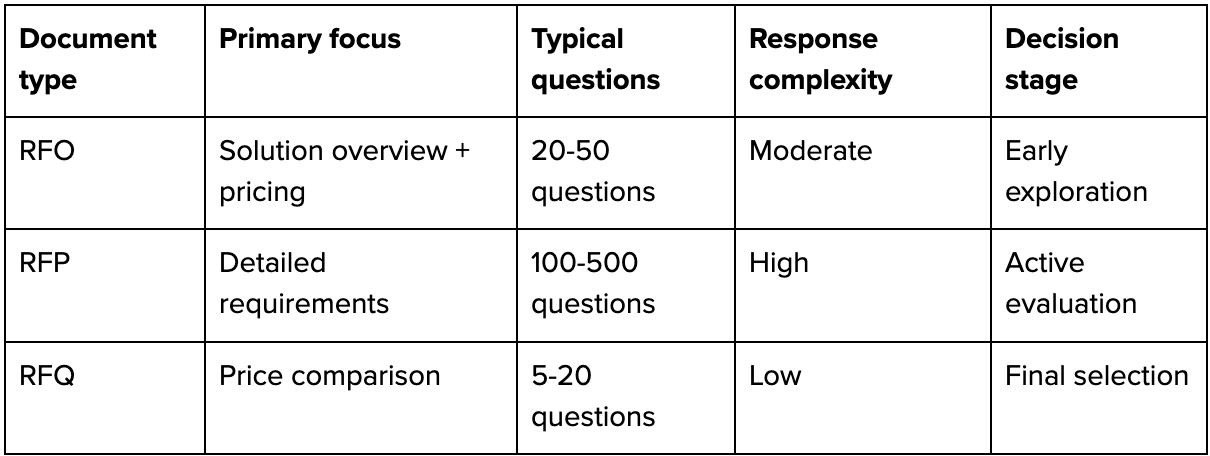
The confusion between these procurement documents is understandable since they all start with "request for" and involve vendor evaluation. Here's how they differ in practice:
- Request for offer (RFO): Buyers want to see your general solution and commercial terms. They're exploring options and may not have finalized requirements. Your response should highlight value propositions, flexible pricing options, and proof points without drowning them in technical detail. Response time typically ranges from 1-2 weeks, and your proposal cover should emphasize business outcomes over specifications.
- Request for proposal (RFP): Buyers have defined requirements and need detailed technical responses. They want to see exactly how your solution addresses their specific needs, often including security questionnaires, integration requirements, and implementation plans. RFPs can take 10-40 hours to complete properly, which is why many sales teams now use AI sales assistants to automate repetitive sections while maintaining accuracy.
- Request for quotation (RFQ): Buyers know exactly what they want and simply need pricing. These documents focus almost entirely on cost breakdowns, payment terms, and delivery schedules. Your response is primarily a pricing spreadsheet with minimal narrative explanation.
Here's a practical comparison:
Common RFO use cases and industries
RFOs are most frequently encountered in industries where buyers require flexibility during vendor selection or where procurement processes involve multiple stages. Understanding these patterns helps your team recognize RFOs quickly and respond appropriately.
- Technology and software: SaaS companies receive RFOs when enterprise buyers want to understand platform capabilities and pricing tiers before building a business case for budget approval. A typical scenario: a VP of sales enablement exploring AI sales assistants for their team issues an RFO to compare 5-7 vendors before narrowing to 2-3 finalists for the full RFP process.
- Professional services: Consulting firms and agencies often receive RFOs for projects where the scope isn't fully defined. Buyers want to see your approach, team qualifications, and hourly rates without committing to detailed project specifications. This allows them to gauge budget requirements before finalizing project scope.
- Government and public sector: Government agencies sometimes use RFOs as a preliminary step before formal competitive bidding. They're testing the market to understand available solutions and establish realistic budget expectations for upcoming fiscal years.
- Healthcare and pharmaceuticals: Healthcare organizations issue RFOs when evaluating new vendors for non-critical systems where they need to understand capabilities and costs before involving procurement and legal teams in a full RFP process.
The key commonality across these use cases: buyers aren't ready for the commitment and detail of a full RFP, but they need more substance than a simple price quote. Your response generation approach should match this middle ground.
How to respond to an RFO effectively?
Responding to RFOs requires a different strategy than RFPs or RFQs. You're selling value and possibilities, not just checking compliance boxes.
- Focus on outcomes over features: Since RFOs typically lack detailed technical requirements, use this opportunity to lead with business impact. Instead of listing every feature, highlight how your solution solves the buyer's core challenges. For example, rather than describing enterprise search capabilities in technical terms, explain how it eliminates the 10+ hours sales reps waste searching for collateral each week.
- Provide flexible pricing options: RFO buyers are often exploring budget scenarios. Present 2-3 pricing tiers or models that accommodate different use cases and team sizes. This helps buyers advocate internally for appropriate budget levels rather than forcing them into a single price point they might not be able to justify.
- Include proof points and social proof: With limited space for technical detail, lean heavily on customer success stories, industry-specific metrics, and concrete results. Statements like "our customers reduce RFP response time by 48 hours on average" carry more weight than feature descriptions in RFO responses.
- Keep your proposal cover compelling: Your proposal cover for an RFO should immediately communicate value and differentiation. This is often the only page decision-makers read before shortlisting vendors. Lead with the buyer's pain point, your unique approach, and quantified outcomes, not with your company history or generic mission statement.
- Demonstrate speed and responsiveness: How quickly and professionally you respond to the RFO signals how you'll perform as a vendor. Autonomous AI agents help presales and solutions teams respond faster without sacrificing quality, which becomes particularly important when competing against 5-10 other vendors.
Stop letting RFOs slow down your pipeline
Every RFO sitting in your queue represents both an opportunity and a resource allocation decision. Respond too slowly, and you're eliminated before the real evaluation begins. Respond without enough car,e and you waste the opportunity to differentiate early.
The revenue teams seeing the biggest impact are those who treat RFOs as pipeline acceleration opportunities rather than administrative burdens. With the right approach and tools, you can respond to 3x more RFOs while improving response quality and buyer engagement.