


Your best solutions engineer is delivering the same 45-minute product walkthrough for the seventh time this week. The questions are nearly identical. The objections are familiar. The demo script has not changed in two months. While this SE runs through standard functionality for a mid-market prospect who may never convert, three qualified enterprise deals are waiting for technical validation that only they can provide.
This is the presales capacity problem at its most concrete: SE time is finite, demand for it is not, and organizations that treat every opportunity as requiring identical SE involvement will always be bandwidth-constrained. Sales organizations spend 70% of their time on non-selling activities. For presales teams, a substantial portion of that goes to repetitive, low-differentiation demo delivery that adds minimal strategic value.
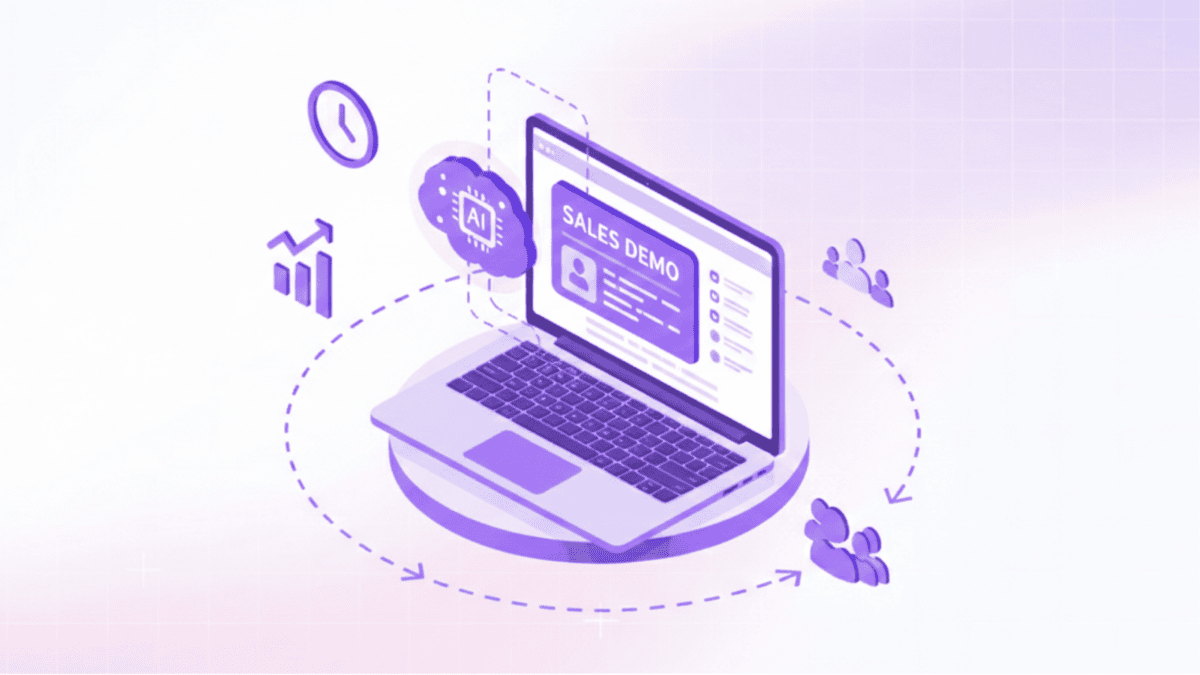
Automated sales demos address part of this problem. But understanding what automation actually solves, and what it cannot touch, is what separates teams that deploy these tools effectively from those that create new problems while solving old ones.
What automated sales demos actually mean
"Automated sales demos" covers several distinct approaches that warrant distinction, as they reduce workload in different ways and suit different parts of the sales process.
- Interactive product tours are self-guided, browser-based walkthroughs of your product that prospects can explore without a live SE present. They are pre-built, clickable simulations that show specific workflows or features, often triggered at the top of the funnel to give prospects a hands-on sense of the product before they book a live call.
- Recorded async demos are narrated video walkthroughs that prospects watch on demand. More passive than interactive tours, they work well for awareness-stage content and for sending to stakeholders who were not present on a live call.
- AI-personalized demo environments use prospect firmographic and behavioral signals to customize which features are highlighted, which industry use cases are surfaced, and what messaging is presented. Rather than one generic walkthrough, the demo adapts to the prospect's profile.
- Live demo assistance tools do not replace the SE on the call but reduce their cognitive load during it, surfacing competitive intelligence, flagging deal signals, suggesting answers to unexpected questions, and handling note-taking so the SE can focus entirely on the conversation.
These categories are not interchangeable. Interactive tours reduce early-funnel demo demand. Recorded demos handle async follow-up. Live assistance tools make human-delivered demos more effective. A complete presales automation strategy typically involves multiple approaches deployed at different stages.
Where automation genuinely reduces SE workload
The highest-leverage application of demo automation is eliminating the demos that should never have required a live SE in the first place.
1. Early-funnel qualification demos
Many organizations route every inbound request directly to a live SE demo, regardless of fit or stage. Prospects who found the product through a search ad and have no clear use case get the same full-SE treatment as a warm enterprise referral. This conflates awareness-stage curiosity with genuine evaluation intent.
Interactive product tours handle this filtering function efficiently. A prospect who can explore the product on their own and still wants a live conversation is demonstrably more engaged and better qualified than one who booked a demo without prior product exposure. Inserting a self-guided experience before live SE scheduling improves the quality of conversations that reach human presales, making each SE conversation more likely to advance a qualified opportunity.
2. Standard product walkthroughs for known personas
For products with distinct buyer personas that follow predictable evaluation paths, building persona-specific demo tracks eliminates the need for SEs to customize standard walkthroughs on the fly. A procurement leader at a manufacturing company evaluating your platform has predictable questions and a predictable journey; neither requires an SE's full attention to navigate.
Pre-built demo tracks for high-volume personas let SEs invest their time in genuinely complex conversations: custom solution architecture, edge case technical validation, and competitive differentiation where deep product knowledge actually creates advantage.
3. Self-service evaluation support
Serious prospects frequently want to explore the product independently after an initial call, testing specific workflows, validating technical requirements, or sharing access with colleagues who were not on the initial demo. Without a structured self-service option, this exploration either requires additional SE time or happens without support, increasing the risk of prospects misunderstanding capabilities or hitting friction that kills momentum.
Automated sandbox environments or structured trial experiences let prospects complete much of their independent evaluation without consuming SE bandwidth, reserving live support for moments where it genuinely advances the deal.
What automation cannot replace
The risk in deploying demo automation is conflating what it handles with what it solves. Automation reduces repetitive workload; it does not replace the strategic value that makes presales teams essential.
1. Complex technical architecture conversations
When a prospect needs to understand exactly how your platform integrates with a three-tier legacy infrastructure while maintaining HIPAA compliance and sub-second query performance, no automated tour answers that question. This requires an SE who deeply understands the architecture, understands the specific constraints, and can design a credible solution in real time.
These conversations are where SE expertise creates a genuine competitive advantage. The prospect is evaluating not just whether your product can do what they need, but whether your team can be trusted to implement it. A pre-built demo does not build that trust.
2. Competitive differentiation under pressure
When a prospect says "Yyour main competitor told us they can do all of this plus X," the response requires real-time competitive intelligence, honest acknowledgment of trade-offs, and confident positioning of your actual advantages. A recorded demo cannot respond to live competitive challenges; it can only present your narrative without friction.
Presales and solutions teams handling competitive evaluations need access to current battlecard intelligence and objection-handling frameworks during live calls, not just pre-scripted demo flows that assume unchallenged presentations.
3. Executive-level credibility
C-suite stakeholders evaluating enterprise purchases are not watching automated product tours to make million-dollar decisions. They want to talk to someone whose expertise they can probe, whose judgment they can test, and whose credibility they can validate. An SE in that conversation is not delivering a demo; they are building a relationship that underpins the commercial conversation.
Automation has no role here. The question is how to protect SE time for these conversations by reducing time spent on lower-value activities that automation handles more effectively.
Presales intelligence: Reducing workload beyond the demo itself
Demo delivery is only one portion of the SE workload. The activities surrounding demos, preparation, real-time support during calls, and post-demo follow-up consume comparable hours and are equally addressable through automation.
1. Pre-demo preparation
Effective demos require preparation: understanding the prospect's industry, their specific use case, relevant case studies, competitive positioning relevant to their evaluation, and any technical requirements they have shared in advance. For SEs managing multiple concurrent deals, this research can consume an hour or more per demo.
Tools that aggregate account context from CRM, surface relevant case studies from past deals, and flag competitive dynamics specific to the prospect's evaluation compress this preparation without sacrificing quality. When an SE walks into a demo already briefed on the prospect's stack, their known objections, and the competitive landscape they are navigating, they deliver better conversations in less preparation time.
2. Real-time support during live demos
Even experienced SEs encounter questions they cannot answer immediately. A prospect asks about the specifics of integration for a system your product supports, but the SE does not know them well. A technical question surfaces that requires referencing product documentation. A competitor is mentioned whom the SE is not fully briefed on.
SiftHub's Answer Agent surfaces verified answers from Confluence, SharePoint, Slack, and product documentation in the apps they’re already working in, without requiring the SE to leave the conversation. This eliminates the 'I'll get back to you' response that stalls deal momentum.
3. Post-demo deal qualification
After a demo, SEs and AEs often have optimistic impressions that do not reflect deal reality. The prospect seemed engaged, asked detailed questions, and expressed enthusiasm. But was it real buying intent or curiosity? Are their stated budget and timeline credible? Is the champion capable of driving internal consensus?
AI agents that analyze demo conversations against qualification frameworks like MEDDIC flag gaps between what was said and what constitutes a genuinely qualified opportunity. SiftHub’s AI Teammate analyzes demo conversations to surface deal signals, flagging whether the prospect's engagement reflects genuine buying intent or enthusiasm without commitment. Hence, SEs invest follow-up hours in opportunities that actually have momentum.
4. Post-demo follow-up and collateral
The hour after a demo typically involves: writing a follow-up email summarizing what was discussed; finding the case study that matches the prospect's use case; locating the technical architecture diagram relevant to their integration question; and pulling together a customized leave-behind.
Building the full presales efficiency stack
Solving the SE capacity problem requires thinking about two distinct layers that work together.
The demo automation layer handles what can be systematized: early-funnel product exposure, standard persona walkthroughs, and self-service evaluation support. These tools are purpose-built for demo delivery and perform well on metrics such as engagement time, feature exploration depth, and qualification signal.
The presales intelligence layer handles everything related to demos: preparation intelligence, real-time support during calls, post-demo qualification analysis, and follow-up content generation. These tools do not replace the SE on the call, they make the SE dramatically more effective by eliminating the research, search, and assembly work that consumes non-demo time.
The organizations that reduce presales workload most effectively deploy both layers. Demo automation eliminates demos that should not require live SEs. Presales intelligence makes the demos that do require live SEs better, faster, and less administratively burdensome.
The result is not fewer SEs, it is SEs who spend more of their time doing what only humans do well: building trust with technical buyers, designing custom solutions, and winning competitive evaluations. As Neil Parekh, Revenue Lead at SiftHub, puts it: "AI is not replacing sales engineers but augmenting their capabilities. Technology can help sales engineers focus on high-value tasks."
Sales teams that deploy this stack report handling significantly more pipeline coverage with the same SE headcount, not because SEs are working faster on the same tasks, but because the tasks that only humans can do are now the primary use of their time. As SiftHub's solution framework notes, "Sales teams no longer lose out just because the best SE couldn't join", because better tooling means every demo benefits from the collective knowledge of the team, not just the individual SE on the call.
Measuring the impact on SE workload
Reducing presales workload is a meaningful goal only if you can verify it is happening. The metrics that matter are not vanity measurements but operational indicators of how SE time is being deployed.
- Hours per demo closed: Track total SE time invested per qualified opportunity moved forward. If automation is working, this metric decreases as tools and SE time handle routine activities, allowing them to concentrate on high-value conversations.
- Demo-to-qualification rate: Early-funnel automation should improve the quality of prospects who reach live SE conversations. If interactive tours are filtering effectively, the percentage of live demos that result in qualified opportunities should increase.
- Follow-up turnaround time: Post-demo efficiency is measurable. If SEs are spending 45 minutes on post-demo follow-up before automation and 8 minutes after, that time saving is real and compounds across every demo in the quarter.
- SE-to-AE coverage ratio: One of the most persistent presales capacity problems is SE bandwidth, which constrains how many deals AEs can run simultaneously. If automation reduces per-deal SE hours, AEs can carry more active deals with the same SE support, directly increasing pipeline coverage.
Presales teams exist to build technical credibility with buyers who make complex, high-stakes purchasing decisions. Every hour an SE spends on a repetitive standard demo, hunting for a case study, or writing a post-call summary is an hour not spent building credibility with the buyers who actually need it.
Automated sales demos solve one layer of this problem by handling what can be systematized. Presales intelligence tools solve the rest by making every human-led interaction more efficient and more effective. Together, they transform SE capacity from the primary constraint on revenue growth to a strategic asset deployed exactly where it creates the most value.