



A proposal team is a cross-functional group responsible for creating, managing, and submitting competitive bids in response to RFPs, RFIs, and security questionnaires. Research shows competitive bids influence 30-40% of business sales revenue, making proposal team effectiveness directly tied to bottom-line results.
Key takeaways:
- Core roles: Proposal manager (coordinates entire response, first hire for 66% of companies), proposal writers (transform strategy into narrative), subject matter experts (provide technical depth), capture manager (owns win strategy), graphics designer (creates visuals), editor/quality reviewer (ensures compliance)
- Team sizing: Small businesses need 3 people; mid-market 5-8 dedicated members; enterprise 20-30 for major opportunities
- Essential tools: Proposal management software with compliance tracking; content management systems; collaboration platforms (Slack, Teams); document creation tools; graphics software; AI-powered automation achieving 90%+ questionnaire completion
- Key metrics: Win rate (30-50% typical benchmark), proposal volume, time to respond, content reuse rate (50-75% for high performers), resource utilization
- AI impact: Reduces response time 60-70%; auto-generates first drafts; pulls relevant content instantly.
A proposal team is a cross-functional group responsible for creating, managing, and submitting competitive bids in response to RFPs, RFIs, and security questionnaires. Research shows competitive bids influence 30-40% of business sales revenue, making proposal team effectiveness directly tied to bottom-line results.
Key takeaways:
- Core roles: Proposal manager (coordinates entire response, first hire for 66% of companies), proposal writers (transform strategy into narrative), subject matter experts (provide technical depth), capture manager (owns win strategy), graphics designer (creates visuals), editor/quality reviewer (ensures compliance)
- Team sizing: Small businesses need 3 people; mid-market 5-8 dedicated members; enterprise 20-30 for major opportunities
- Essential tools: Proposal management software with compliance tracking; content management systems; collaboration platforms (Slack, Teams); document creation tools; graphics software; AI-powered automation achieving 90%+ questionnaire completion
- Key metrics: Win rate (30-50% typical benchmark), proposal volume, time to respond, content reuse rate (50-75% for high performers), resource utilization
- AI impact: Reduces response time 60-70%; auto-generates first drafts; pulls relevant content instantly.
For companies responding to high volumes of RFPs, security questionnaires, and complex bid opportunities, having a well-structured proposal team can mean the difference between winning contracts and watching them go to competitors. Yet many organizations struggle with proposal chaos: missed deadlines, inconsistent messaging, overworked subject matter experts, and processes that feel more like herding cats than strategic execution.
Building a high-performing proposal team requires more than just assembling talented people. It demands clearly defined roles, streamlined processes, and the right technology to support collaboration. This comprehensive guide walks you through everything you need to create a proposal team that consistently delivers winning responses while maintaining efficiency and quality.
Understanding the proposal team
A proposal team is a cross-functional group responsible for creating, managing, and submitting competitive bids in response to opportunities. These teams handle everything from RFPs and RFIs to security questionnaires and complex multi-volume proposals. According to industry research, competitive bids influence roughly 30 to 40 percent of business sales revenue, making the effectiveness of your proposal team directly tied to your bottom line.
The size and structure of proposal teams vary dramatically based on organizational needs. Small businesses might have a lean three-person team where individuals wear multiple hats. Mid-market companies typically staff teams with five to eight dedicated members. Enterprise organizations responding to government contracts or highly technical RFPs often deploy teams of 20 to 30 people for major opportunities.
Regardless of size, successful proposal teams share common characteristics. They operate with clear role definitions, follow repeatable processes, leverage centralized knowledge repositories, and maintain strong communication channels. They also balance efficiency with quality, understanding that speed without accuracy leads to disqualified submissions or proposals that fail to resonate with evaluators.
Core proposal team roles and responsibilities
1. Proposal manager or coordinator
The proposal manager serves as the project leader and quarterback for the entire response. This person oversees the proposal from kickoff through submission, managing timelines, coordinating contributors, and ensuring compliance with all requirements.
Key responsibilities include
- Developing the proposal schedule with color review milestones
- Creating the compliance matrix to track all RFP requirements
- Building the proposal outline, allocating resources and assigning sections to writers, facilitating kickoff and strategy meetings, monitoring progress against deadlines, resolving conflicts and removing obstacles, and managing quality control through review cycles.
Research shows that the proposal manager is typically the first dedicated hire for organizations building proposal teams, with 66 percent of companies making this their initial investment. This role requires exceptional project management skills, the ability to work under pressure, strong communication abilities, and deep understanding of the proposal development process.
2. Proposal writers and content developers
Proposal writers transform strategy into a compelling narrative. They draft responses to RFP requirements, weave subject matter expert input into cohesive stories, tailor content to specific buyer needs and pain points, and ensure messaging aligns with win themes and value propositions.
Larger proposal teams often employ multiple writers, each responsible for specific sections or volumes. A volume lead or book boss may coordinate these writers, providing structural guidance and feedback to ensure consistency across sections.
Effective proposal writers possess more than just writing skills. They excel at synthesizing complex technical information into clear language, understand persuasive storytelling techniques, can write to various audiences from technical evaluators to executive decision-makers, and work efficiently under tight deadlines.
3.Subject matter experts
Subject matter experts provide the technical depth and specialized knowledge that make proposals credible and competitive. SMEs contribute expertise on technical approaches, product specifications, and solution architectures, review content for accuracy and feasibility, help develop pricing and resource estimates, and provide proof points like case studies and performance data.
One of the biggest challenges in proposal management is SME availability. These individuals typically have full-time responsibilities outside the proposal process, making them frequent bottlenecks. Effective proposal teams develop strategies to maximize SME efficiency, such as conducting focused interviews rather than expecting them to write content, providing clear questions and guidance rather than vague requests, respecting their time with well-organized review sessions, and capturing their knowledge in reusable content libraries.
4.Capture manager
The capture manager owns the business development opportunity itself. They receive the RFP, understand the customer's needs and decision criteria, and develop the overall win strategy. This role bridges sales and proposal execution.
Capture managers are responsible for documenting capture intelligence and creating capture plans, identifying and managing relationships with teaming partners or subcontractors, developing competitive positioning and differentiators, supporting proposal strategy development, and participating in solution innovation sessions and reviews.
5.Graphics designer and desktop publisher
Visual presentation matters enormously in proposals. Graphics designers and desktop publishers ensure proposals look professional and communicate information effectively through visuals.
Responsibilities include creating proposal templates aligned with RFP formatting requirements, developing compelling graphics that support key messages, designing cover pages, tabs, and section dividers, ensuring brand consistency throughout the document, and managing the graphics library with version control.
6.Editor and quality reviewer
Editors refine proposal content for clarity, readability, and impact. They check grammar and spelling, ensure consistent terminology and voice throughout, verify that responses directly address requirements, identify gaps or weaknesses in the narrative, and polish sentences for maximum impact.
Quality reviewers, sometimes called compliance officers, focus specifically on ensuring the proposal meets all mandatory requirements. They verify that every RFP question is answered, check page limits and format specifications, confirm required forms and certifications are included, and validate that submission instructions are followed precisely.
Building your proposal team: Practical steps
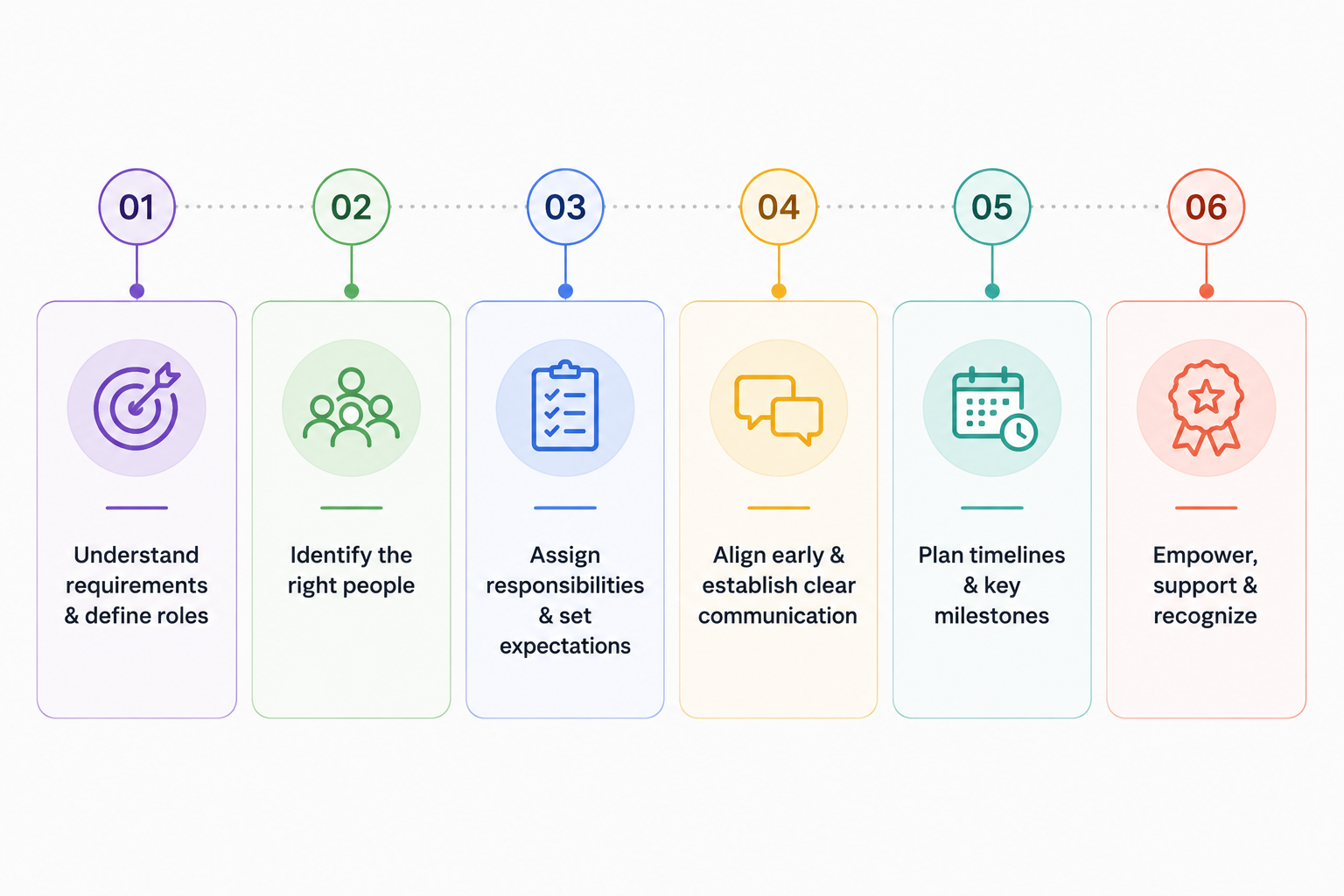
Step 1: Assess your current state
Before building or restructuring your proposal team, understand your current reality. Evaluate how many proposals you receive annually, your typical response time from RFP receipt to submission, current win rates, and where you're losing, resource bottlenecks and pain points, and where critical knowledge lives.
This assessment helps you right-size your team structure and identify the most critical roles to fill first.
Step 2: Start with core roles
For organizations just formalizing their proposal process, start with the essential triangle: proposal manager, proposal writer, and access to subject matter experts. This minimal viable team can handle moderate proposal volumes while you build capabilities.
According to research, the typical hiring progression is proposal manager first, then proposal writer, followed by content manager once you reach higher proposal volumes or around 1,000 employees.
Step 3: Define clear responsibilities
Use a responsibility assignment matrix to map who is responsible, accountable, consulted, and informed for each proposal task. This clarity prevents tasks from falling through cracks and reduces conflict over ownership.
Document these responsibilities in a proposal process guide that serves as onboarding material for new team members and a reference for existing staff.
Step 4: Develop cross-training
Build resilience into your team through cross-training. Ensure multiple people can perform critical functions so vacations or departures don't cripple your capability.
Cross-training also helps team members appreciate the challenges their colleagues face, improving collaboration and empathy.
Step 5: Create communication norms
Establish how your team will communicate during proposal efforts. Many teams get overwhelmed with meetings that fragment focus time for writing and strategic work.
Set guidelines about when to use email versus instant messaging versus meetings, establish core working hours for synchronous collaboration, create channels for different topics, and respect focused work time for writers and SMEs.
Step 6: Scale thoughtfully
As proposal volumes increase, resist the urge to simply add more writers. Sometimes the bottleneck is process inefficiency rather than capacity.
Evaluate whether better tools, reusable content libraries, or process improvements might address capacity issues before adding headcount.
When you do grow the team, consider where specialization adds value. For highly technical organizations, dedicated technical writers may make sense. For teams handling diverse RFP types, content managers who curate libraries become valuable.
Essential tools for proposal teams
1. Proposal management software
Dedicated proposal management platforms centralize content, streamline collaboration, and automate repetitive tasks. Core features to seek include central content libraries with version control, compliance matrix and requirement tracking, workflow and task management, templates and document assembly, review and approval workflows, and analytics on proposal performance.
For teams managing significant RFP, proposal, and security questionnaire volume, SiftHub's AI RFP software goes beyond document collaboration, connecting directly to the knowledge sources your team already maintains across Google Drive, Confluence, SharePoint, Slack, CRM, and past submissions, and auto-filling responses with full source attribution on every answer. Rather than building a separate content library, SiftHub surfaces the right answer from the right source at the moment it is needed.
2. Content management and knowledge repositories
Your proposal team needs a single source of truth for company information, past proposals, boilerplate content, case studies, technical specifications, and pricing information.
Whether you use a dedicated content library within proposal software or leverage existing knowledge management tools like Confluence or SharePoint, the key is making content easily searchable, tagging content by topic and use case, implementing version control to prevent outdated information, and establishing clear ownership for content accuracy.
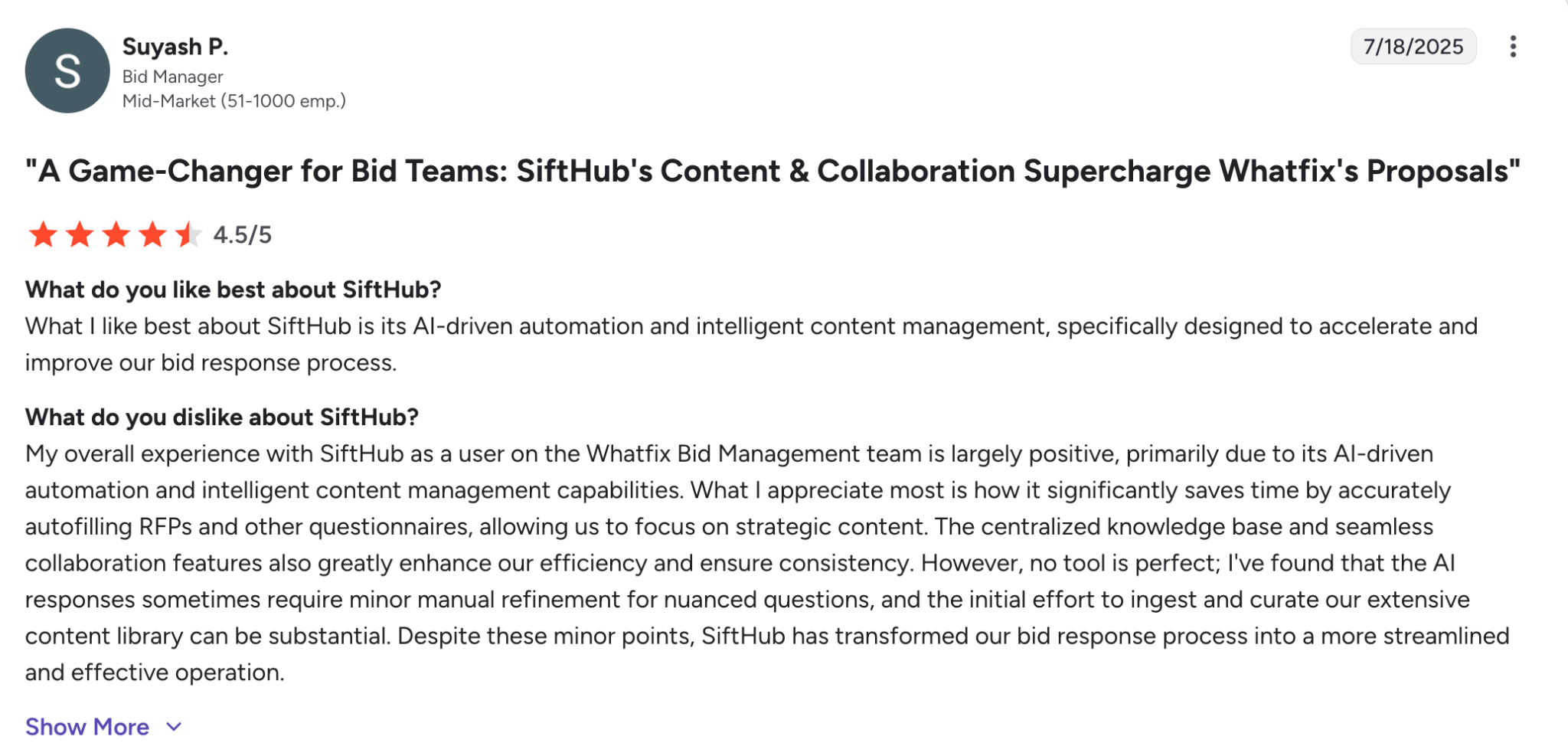
High-performing proposal teams depend on accessible knowledge and efficient collaboration to maintain consistency across submissions. As one bid manager noted:
3. Collaboration platforms
Proposal development requires real-time coordination among distributed contributors. Collaboration tools facilitate this through shared document editing, commenting and feedback, task assignment and tracking, and file sharing and version control.
Microsoft Teams, Slack, and Google Workspace provide foundational collaboration capabilities. For proposal-specific collaboration, look for features like section-based commenting, change tracking, and stakeholder notifications.
4. Document creation and formatting tools
While many organizations still use Microsoft Word for proposal development, specialized document assembly tools offer advantages for complex proposals. These tools enable content block assembly, automated formatting and numbering, template management, and variable insertion for personalization.
Look for tools that maintain formatting consistency automatically, reducing the desktop publishing burden and allowing more time for content quality.
5. Graphics and design software
Professional visuals differentiate winning proposals. Your team needs tools for creating diagrams, infographics, and process flows, editing images and photos, designing templates and page layouts, and ensuring brand consistency.
Adobe Creative Suite remains the standard for sophisticated graphics work, but more accessible tools like Canva or Microsoft Designer enable non-designers to create professional-looking visuals.
6. Project management platforms
Proposal managers need visibility into task status, dependencies, and timeline risks. Project management tools help by providing Gantt charts and timeline visualization, resource allocation and workload management, milestone tracking, and burndown charts.
Whether you use dedicated project management software like Asana or Microsoft Project, or leverage built-in features of your proposal management platform, the key is having real-time visibility into proposal progress.
7. AI-powered response automation
The latest innovation in proposal tooling is AI-powered automation that dramatically accelerates response creation. These platforms use artificial intelligence to auto-fill questionnaires and RFPs based on knowledge repositories, generate first drafts of proposal sections, suggest relevant content from past proposals, and identify compliance gaps.
Sifthub, for example, achieves up to 90% first-pass completion on security questionnaires and RFPs, pulling from connected sources — Google Drive, Confluence, SharePoint, Slack, CRM, past submissions, and approved Q&A libraries, with every answer attributed to its source document. For questions outside the automated knowledge base, SiftHub's project management feature routes them to the right SME based on content type rather than manual triage, with deadline visibility across every active submission.
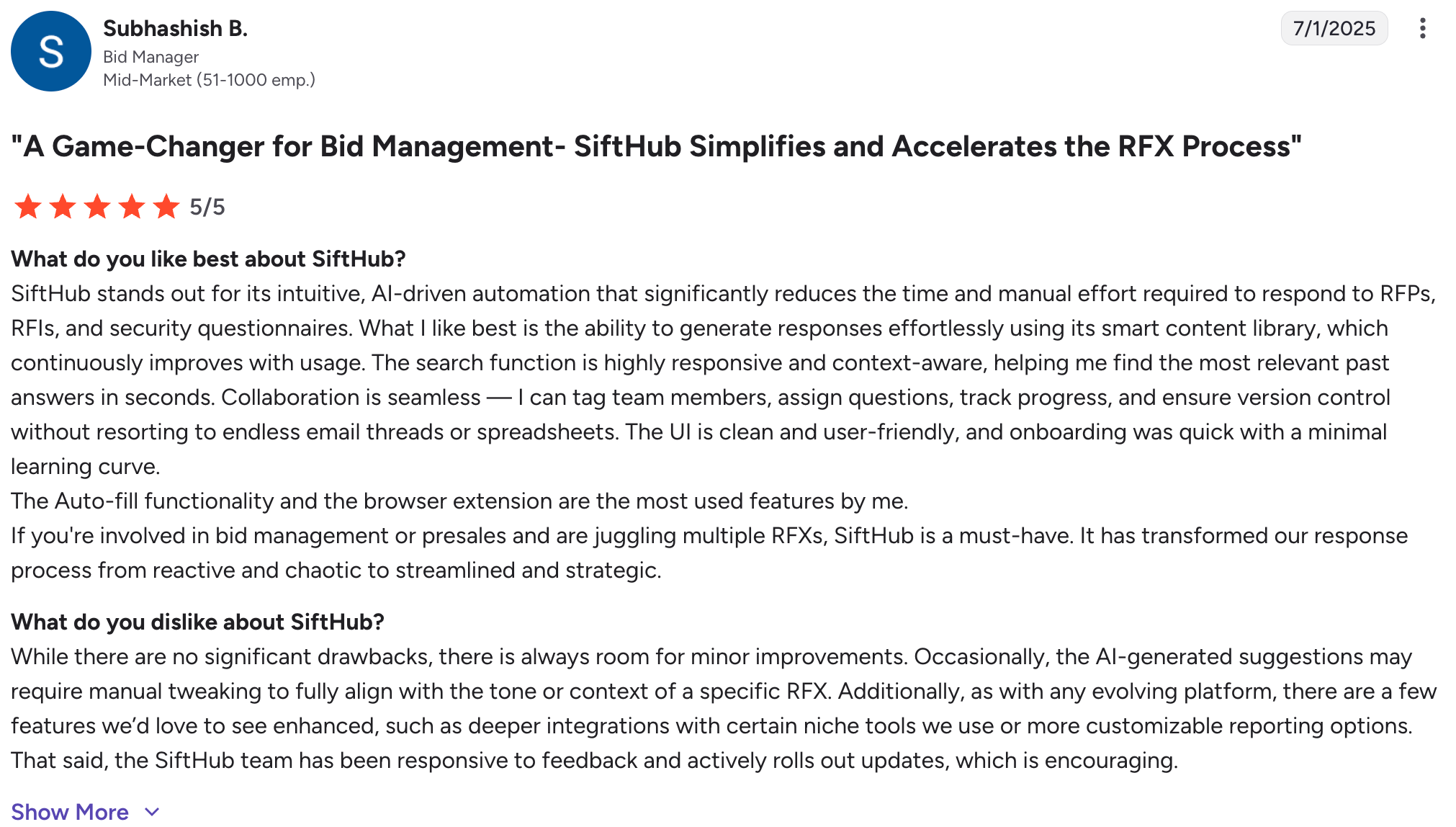
Modern proposal teams rely on centralized knowledge, structured collaboration, and automation to manage increasing proposal volumes efficiently. One bid management professional described the impact of these capabilities on their team's workflow:
Measuring proposal team performance
1. Key metrics to track
High-performing proposal teams measure what matters. Essential metrics include win rate as a percentage of submitted proposals that win, proposal volume in responses submitted per month or quarter, time to respond from RFP receipt to submission, resource utilization showing hours per proposal and cost per response, content reuse rate measuring how much existing content is leveraged, review cycle effectiveness tracking issues found and time to resolve, and customer feedback scores when available.
Track these metrics over time to identify trends and measure improvement from process or tool changes.
2. Qualitative indicators
Numbers don't tell the whole story. Pay attention to qualitative indicators like team morale and burnout signals, stakeholder satisfaction from executives and sales, proposal quality and competitiveness, process adherence and compliance, and collaboration effectiveness.
Regular retrospectives and feedback sessions help capture these softer signals before they become serious problems.
3. Benchmarking
Industry benchmarks provide context for your performance. According to research, typical win rates for competitive bids range from 30 to 50 percent, depending on industry and complexity. Average response times vary from less than two weeks for simple proposals to four-plus weeks for complex RFPs. High-performing teams typically achieve 50 to 75 percent content reuse rates.
Compare your metrics against these benchmarks and your own historical performance to gauge effectiveness.
The future of proposal teams: AI and automation
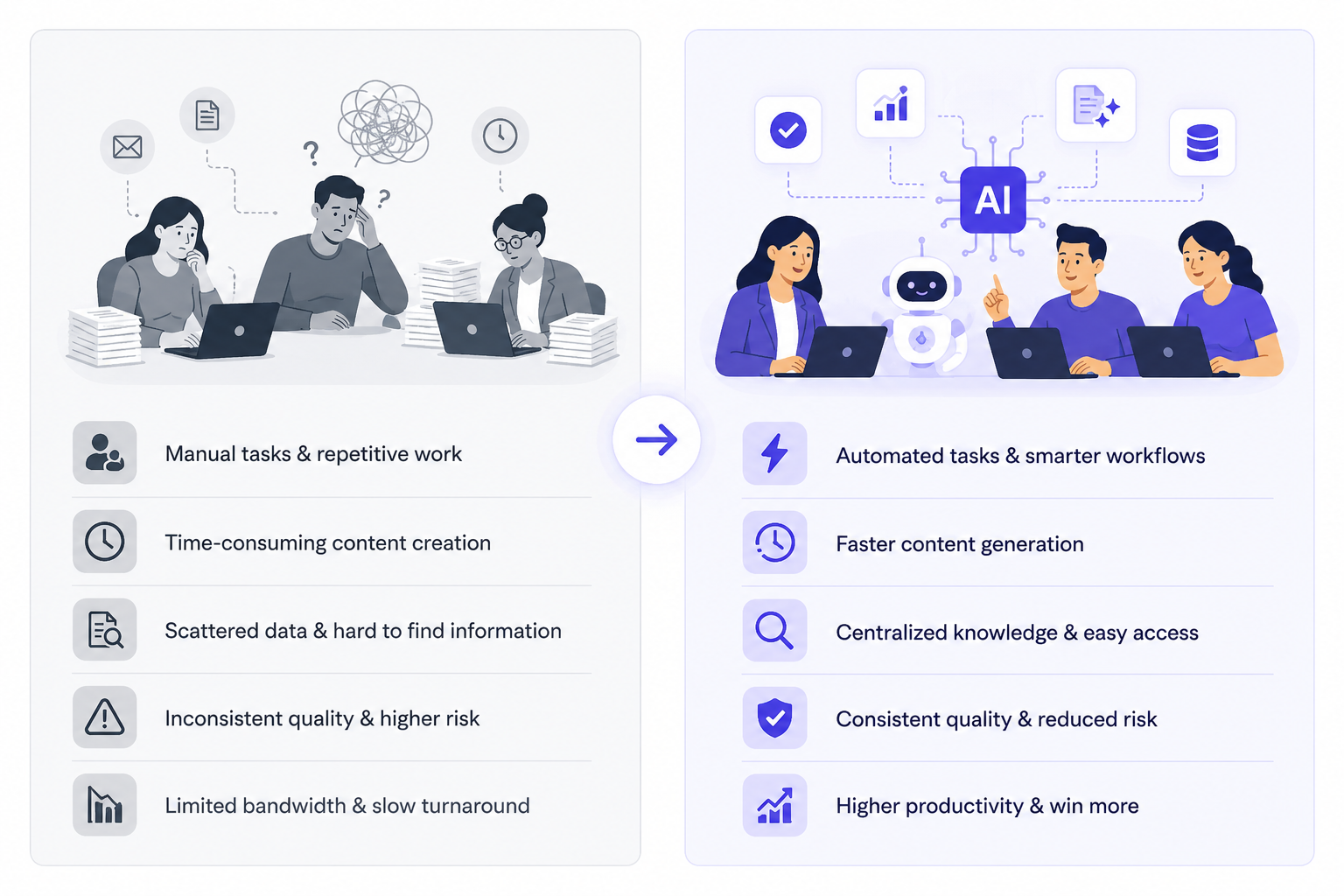
The proposal function is undergoing a dramatic transformation as artificial intelligence and automation mature. Forward-thinking organizations are already leveraging AI to auto-generate first drafts from requirements, pull relevant content from knowledge repositories, personalize responses to specific evaluators, identify win themes from competitor analysis, and predict win probability based on response quality.
The most successful proposal teams will be those that embrace AI as a force multiplier rather than viewing it as a threat. By automating repetitive tasks like content retrieval, questionnaire filling, and compliance checking, teams free up capacity for the creative, strategic work that drives wins.
Conclusion: Your roadmap to proposal team success
Building a high-performing proposal team doesn't happen overnight. It requires thoughtful attention to roles, processes, and tools, combined with leadership commitment and cultural support.
Start by assessing your current state honestly. Where are the pain points in your proposal process? What causes missed deadlines, quality issues, or losses? Use these insights to prioritize improvements.
As your foundation solidifies, layer on sophistication. Add specialized roles as volume justifies them. Implement more structured review processes. Adopt tools that automate repetitive work and enhance collaboration.
Measure everything. Track your win rates, response times, and resource utilization. Use data to identify what's working and what needs adjustment. Conduct regular retrospectives to capture lessons learned and implement continuous improvement.
With the right combination of skilled people, efficient processes, and SiftHub's connected knowledge layer, your proposal team can become a true competitive advantage, responding faster, winning more often, and driving sustainable revenue growth.