


.avif)

A proposal cover page serves as the professional introduction to your submission, providing essential information that helps evaluators quickly identify your proposal and route it to appropriate reviewers. In competitive procurement where buyers receive dozens of responses, the cover creates the critical first impression that determines whether reviewers approach your proposal with interest or indifference.
Key takeaways:
- 6 essential elements: Client information (organization name, department, address), your company details (logo, contact, certifications), specific proposal title/RFP number, submission date, version/revision number, confidentiality statement
- Design principles: Visual hierarchy for 5-second scannability; brand consistency (fonts, colors, logos); generous white space; avoid information overload; verify file format and submission requirements
- Common mistakes: Spelling errors in client names or RFP numbers; generic template-obvious designs; including executive summaries or capability statements; ignoring buyer-specified formatting
Best practice: Templates for efficiency, but customize with opportunity-specific details to signal genuine investment.
A proposal cover page serves as the professional introduction to your submission, providing essential information that helps evaluators quickly identify your proposal and route it to appropriate reviewers. In competitive procurement where buyers receive dozens of responses, the cover creates the critical first impression that determines whether reviewers approach your proposal with interest or indifference.
Key takeaways:
- 6 essential elements: Client information (organization name, department, address), your company details (logo, contact, certifications), specific proposal title/RFP number, submission date, version/revision number, confidentiality statement
- Design principles: Visual hierarchy for 5-second scannability; brand consistency (fonts, colors, logos); generous white space; avoid information overload; verify file format and submission requirements
- Common mistakes: Spelling errors in client names or RFP numbers; generic template-obvious designs; including executive summaries or capability statements; ignoring buyer-specified formatting
Best practice: Templates for efficiency, but customize with opportunity-specific details to signal genuine investment.
Your proposal cover page is the first thing evaluators see when reviewing your submission. In competitive procurement processes where buyers receive dozens of responses, that first impression determines whether reviewers approach your proposal with interest or indifference. A well-designed proposal cover instantly communicates professionalism, attention to detail, and your understanding of the opportunity.
This guide walks through the essential elements of effective proposal covers, common mistakes to avoid, and practical examples you can adapt for your next submission. Whether you're responding to a request for proposal (RFP), request for quotation (RFQ), or creating an unsolicited business proposal, these best practices ensure your cover page strengthens rather than weakens your position.
What is a proposal cover page?
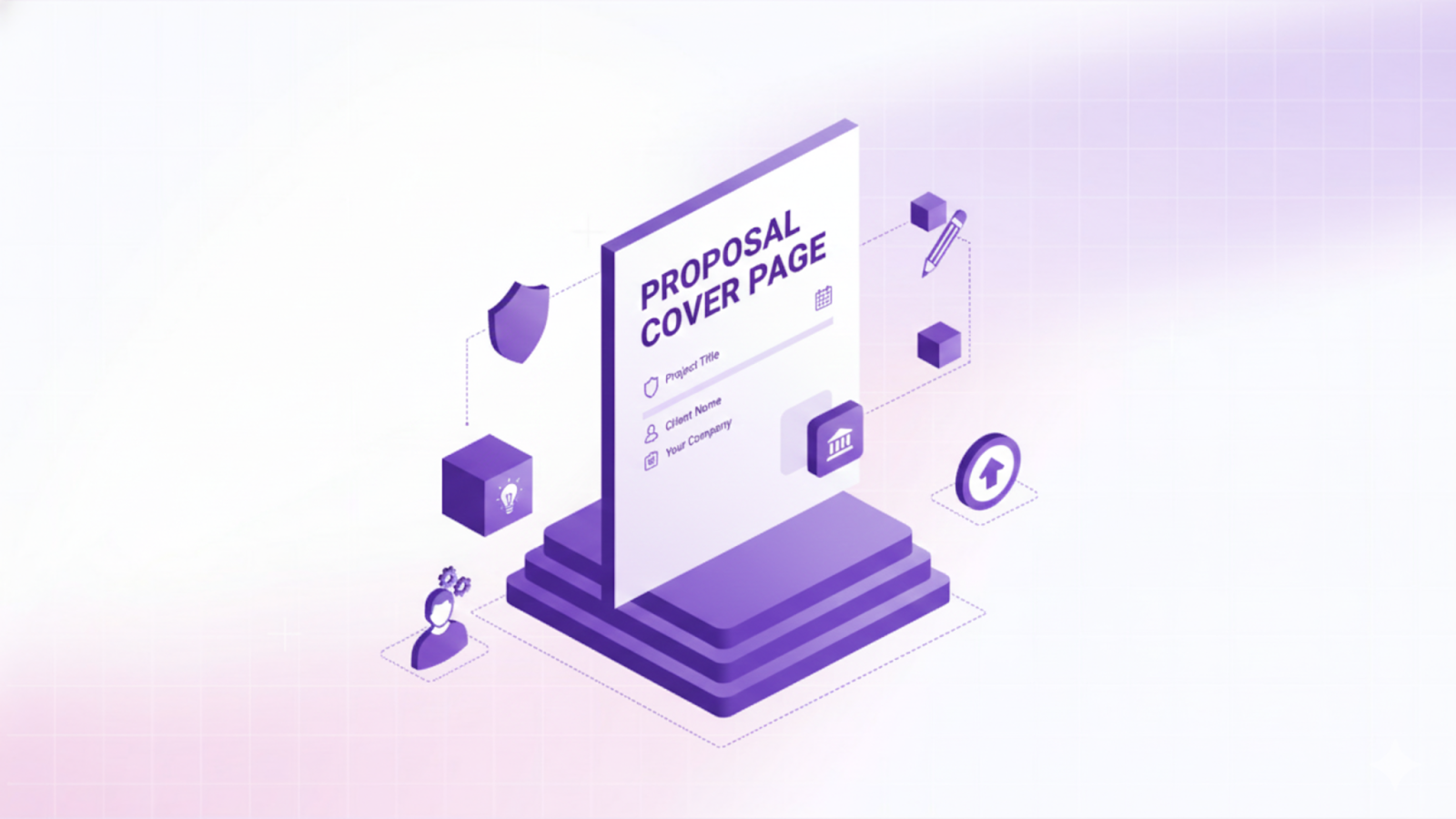
A proposal cover page serves as the professional introduction to your entire submission. It provides essential information that helps evaluators quickly identify your proposal, understand what you're offering, and route the document to appropriate reviewers. Think of it as the business equivalent of a book cover; it should be visually appealing while conveying critical information at a glance.
The proposal cover differs from a cover letter, which provides narrative context and personalized messaging. Your cover page is purely informational and visual, designed for immediate comprehension rather than persuasive storytelling. Most organizations create standardized cover page templates that can be quickly customized for each opportunity, ensuring consistency while allowing for client-specific personalization. The goal is instant clarity combined with a polished presentation that reflects your organization's brand standards.
Essential elements of a winning proposal cover
1. Client information
Start with the most important detail: who this proposal is for. Include the client's full legal organization name, relevant department or division if applicable, and the complete mailing address. For government contracts, include agency identifiers and contract numbers. For corporate clients, reference their procurement or purchasing department.
Many organizations overlook this detail and lead with their own company name. This client-first approach immediately signals that you've customized this submission rather than using a generic template. It also helps busy procurement teams quickly confirm they're reviewing the correct submission when managing multiple concurrent sourcing processes.
Position client information prominently, typically in the upper portion of the page. Use clear labeling like "Prepared for:" or "Submitted to:" to distinguish client details from your company information.
2. Your company information
Include your organization's full legal name, logo, address, and primary contact information. The contact details should direct to the proposal team lead or account executive managing this opportunity, not generic company switchboard numbers. Buyers appreciate knowing exactly who to contact with questions during evaluation.
Your logo placement matters more than most organizations realize. Position it where it reinforces brand recognition without competing with client information for attention. Many successful proposal covers place the logo in the header or upper corner, maintaining visibility without dominating the page.
Include relevant certifications, accreditations, or industry memberships if they strengthen your credibility for this specific opportunity. A minority-owned business certification might be relevant for diversity-focused procurement, while an ISO certification matters for manufacturing or IT services. Only include credentials that directly relate to the buyer's requirements.
3. Proposal title and project name
Create a clear, descriptive title that references the specific opportunity. Use the exact project name or RFP number from the buyer's documentation. Generic titles like "Business proposal" or "Service offering" suggest a lack of attention to detail. Specific titles like "Proposal for enterprise software implementation—RFP #2024-IT-089" immediately confirm you're addressing the right opportunity.
If the buyer hasn't provided a specific project name, create one that clearly describes what you're proposing. "Marketing services agreement for Q1-Q4 2025" works better than "Marketing proposal." Clarity beats creativity on proposal covers.
4. Submission date
Include the date you're submitting the proposal, not the date you created the document or the date it was printed. For formal procurements with strict deadlines, this date confirms your submission met timing requirements. Use the full date format (December 23, 2025) rather than numerical shortcuts that can create confusion across different date formatting conventions.
If your proposal responds to a formal RFP with a published due date, some organizations also reference that deadline: "Submitted December 23, 2025, in response to RFP due December 31, 2025." This demonstrates awareness of procurement timelines and assures reviewers that your submission arrived on time.
5. Version or revision number
For proposals that go through multiple review cycles or revisions based on buyer feedback, include a clear version number or revision date. This simple detail prevents confusion when multiple iterations exist and helps procurement teams ensure they're evaluating your most current submission.
Use straightforward versioning like "Version 2.0" or "Revised submission, December 23, 2025." Overly complex version schemes create unnecessary confusion. If you're submitting a best and final offer (BAFO) in response to negotiation requests, label it clearly: "Best and final offer, Revision 3."
6. Confidentiality statement
Many proposals include proprietary pricing, methodology details, or strategic information you don't want shared beyond the evaluation team. A brief confidentiality statement on your proposal cover establishes expectations about information handling.
Standard language might read: "This proposal contains confidential and proprietary information. It is submitted with the understanding that it will be held in strict confidence and not disclosed to third parties without prior written consent from [Your Company]."
For government contracts, recognize that freedom of information laws may require disclosure of certain proposal elements after award. Tailor your confidentiality language accordingly and avoid overreaching claims that conflict with public procurement regulations.
Design best practices for proposal covers
1. Visual hierarchy and readability
Your proposal cover should communicate essential information at a glance. Evaluators should immediately understand who the proposal is from, what opportunity it addresses, and when it was submitted.
Best practices to follow:
- Prioritize information visually: client name → project title → your company name
- Use font size and weight to guide attention, not overwhelm it
- Keep the cover scannable in under 5 seconds
- Use generous white space to avoid visual clutter
- Limit content to what’s strictly necessary for identification
A clean, well-structured cover signals professionalism and respect for the evaluator’s time.
2. Brand consistency
Your proposal cover should align with your brand while remaining formal and buyer-focused. Consistency across visual elements reinforces credibility and attention to detail.
Key elements to align:
- Brand fonts, colors, and logo usage
- Visual style consistent with the rest of the proposal
- Professional tone adapted for business development, not marketing
- Cohesive design across cover, section headers, and dividers
Sales collateral and proposal builder tools help teams apply brand standards consistently without requiring design expertise from every contributor.
3. File format and submission requirements
A strong cover design only works if it meets the buyer’s technical and formatting requirements. Always confirm submission rules before finalizing your design.
What to verify before submission:
- Accepted file format (PDF, Word, portal upload)
- Required fonts, sizes, or government-mandated templates
- Compatibility across devices and preview windows
- Image compression or formatting limitations in portals
- Final file rendering after export
Testing your final file prevents avoidable issues that can undermine even the best-designed cover.
Common proposal cover mistakes to avoid
1. Information overload
The proposal cover is not a sales pitch; it’s an identifier. Overloading it with extra content dilutes clarity and professionalism.
Avoid including:
- Executive summaries or capability statements
- Long mission or vision statements
- Service lists or feature callouts
- Multiple contacts or team photos
- Excessive graphics or decorative elements
If it doesn’t help identify the proposal, it doesn’t belong on the cover.
2. Spelling and accuracy errors
Minor mistakes on the cover page create major credibility problems. Evaluators often see these errors as indicators of poor quality control.
Double-check every detail:
- Client organization name
- RFP or RFQ reference number
- Project title and submission date
- Company name and contact details
- Version accuracy across submissions
Checklists and systematic reviews are essential for teams handling multiple proposals simultaneously.
3. Generic, template-obvious designs
Buyers can immediately spot a generic template. While templates improve efficiency, the final cover should feel tailored to the specific opportunity.
Simple ways to personalize effectively:
- Include the client’s logo (when permitted)
- Adapt color accents to complement the client’s brand
- Reference the specific project or initiative clearly
- Use relevant, industry-appropriate imagery
Small adjustments go a long way in signaling genuine investment in the opportunity.
4. Ignoring buyer specifications
Failing to follow explicit buyer instructions is one of the fastest ways to lose a bid, regardless of proposal quality.
Common compliance pitfalls:
- Skipping required cover elements
- Reordering mandated information
- Modifying provided templates
- Ignoring formatting or layout rules
Government and regulated procurements are especially strict; compliance is non-negotiable.
Proposal cover example and template
Here's a practical example of an effective proposal cover layout:
[Your Company Logo - Upper Left]
Prepared for:
Metropolitan Hospital System
Attention: Sarah Chen, Director of Procurement
4500 Medical Center Drive
Chicago, Illinois 60611
Proposal for:
Electronic health record (EHR) system implementation
RFP #MHS-2024-IT-045
Submitted by:
[Your Company Name]
2100 Technology Boulevard
San Francisco, California 94105
Contact: James Rodriguez, Account Executive
Phone: (415) 555-0123
Email: james.rodriguez@yourcompany.com
Submission date: December 23, 2025
Proposal valid through: March 23, 2026
Confidentiality notice: This proposal contains proprietary information submitted in confidence. It may not be disclosed to third parties without written authorization from [Your Company Name].
Certifications: ISO 27001, HITRUST, SOC 2 Type II
This example demonstrates a clear information hierarchy, comprehensive contact details, and relevant credibility indicators without visual clutter. Organizations can adapt this structure to their brand standards while maintaining the essential elements that buyers need.
How does technology accelerate proposal cover creation?
SiftHub, an AI-enablement platform, generates content if provided with a template, by pulling from your connected knowledge base and internal documentation. When responding to new opportunities, teams provide their existing proposal templates or cover letter formats, and SiftHub populates them with opportunity-specific content, product descriptions, customer proof points, technical specifications, and tailored messaging. While you maintain complete control over visual design and branding.
The platform focuses exclusively on content generation, not design, ensuring your carefully crafted templates receive accurate, contextually relevant information without manual searching across multiple systems.
The personalization capabilities of modern sales enablement platforms ensure that proposal covers feel custom-crafted for each buyer, incorporating relevant industry imagery, appropriate tone, and client-specific details that strengthen first impressions. This technology-enabled approach combines the efficiency of templates with the impact of customization.
For organizations managing high volumes of proposals, enterprise search functionality helps teams quickly locate past covers for similar opportunities, enabling rapid reuse of proven designs while ensuring current brand standards and contact information. This approach captures institutional knowledge that might otherwise remain locked in individual team members' files.
Integrating your proposal cover with the full submission
Your proposal cover should act as a visual and structural blueprint for the entire document. What evaluators see on the cover should feel consistent as they move through the rest of the proposal.
1. Establish visual continuity
The design choices on your cover page should extend seamlessly throughout the submission to create a cohesive, professional experience.
Ensure consistency across:
- Fonts and typography styles
- Color palette and brand accents
- Section headers and page layouts
- Icons, graphics, and table formatting
A unified visual language signals organization, attention to detail, and professionalism.
2. Use standardized proposal templates
Many high-performing teams rely on comprehensive proposal templates rather than designing each submission from scratch.
Well-built templates typically include:
- Proposal cover layouts
- Section dividers and chapter openers
- Page headers, footers, and numbering styles
- Design guidelines for charts, tables, and diagrams
This approach ensures consistency regardless of who contributes content.
3. Align cross-functional contributors
Complex proposals often involve multiple stakeholders, each working on different sections. Without shared standards, visual inconsistency quickly creeps in.
Centralized design systems help align:
- Presales teams building solution narratives
- Solutions engineers creating architecture diagrams
- Security teams drafting compliance responses
- Pricing teams assembling financial models
When everyone works within the same framework, the final proposal feels unified—not stitched together.
4. Support consistency with modern tools
Modern response generation and proposal tools make it easier to maintain design standards at scale.
These tools help teams:
- Access approved templates and layouts
- Reuse on-brand content blocks
- Assemble proposals faster without redesigning elements
- Ensure every submission meets brand and formatting requirements
Instead of starting from a blank page, teams can focus on content quality and strategy while maintaining a polished, consistent presentation.
Transform your proposal process with the right tools
Creating compelling proposal covers consistently requires balancing efficiency with customization, a challenge that grows more complex as your opportunity volume increases.
SiftHub's AI teammate capabilities help teams generate customized proposal cover content for their pre-designed templates. Instead of manually searching through shared drives for client-specific information, past project details, relevant case studies, or technical specifications, teams can query their knowledge base and receive verified, current content in seconds. The platform pulls from your connected systems, CRM data, previous proposals, product documentation, and customer success stories to populate your existing cover letter templates with accurate, opportunity-specific information while you retain complete control over design and branding.
For bid and proposal professionals managing multiple concurrent submissions with tight deadlines, this efficiency advantage means the difference between thoughtful, customized covers and generic templates that undermine your competitive position. The technology enables you to bring the same level of care and personalization to every submission, regardless of volume or timeline constraints.
Ready to transform how your team creates winning proposals? Book a demo to see how SiftHub helps sales and presales teams respond faster with consistently professional materials that strengthen every submission.