


.avif)

RFP versus RFQ comes down to one question: do you need vendor expertise to help define the solution, or have you already defined it and just need a price? This guide covers both procurement documents in depth, as well as how they relate to a third document, the RFI, which often precedes both.
- RFPs solve complex problems requiring customized solutions; RFQs get pricing for requirements that are already fully defined.
- Sending the wrong document wastes weeks: an RFP where an RFQ would do over-burdens vendors, while an RFQ sent too early locks in a price before you've explored the right approach.
- Evaluation criteria differ sharply — RFPs weigh technical fit, approach, and experience alongside price (typically 20–30% of the score), while RFQs evaluate almost entirely on price.
- Staged approaches (RFI → RFP → RFQ) are common for major strategic procurements, moving from market exploration to solution evaluation to final pricing.
- SiftHub's AI RFP software helps vendors respond faster and more consistently to both RFPs and RFQs, centralizing knowledge so response teams aren't rebuilding answers from scratch each time.
RFP versus RFQ comes down to one question: do you need vendor expertise to help define the solution, or have you already defined it and just need a price? This guide covers both procurement documents in depth, as well as how they relate to a third document, the RFI, which often precedes both.
- RFPs solve complex problems requiring customized solutions; RFQs get pricing for requirements that are already fully defined.
- Sending the wrong document wastes weeks: an RFP where an RFQ would do over-burdens vendors, while an RFQ sent too early locks in a price before you've explored the right approach.
- Evaluation criteria differ sharply — RFPs weigh technical fit, approach, and experience alongside price (typically 20–30% of the score), while RFQs evaluate almost entirely on price.
- Staged approaches (RFI → RFP → RFQ) are common for major strategic procurements, moving from market exploration to solution evaluation to final pricing.
- SiftHub's AI RFP software helps vendors respond faster and more consistently to both RFPs and RFQs, centralizing knowledge so response teams aren't rebuilding answers from scratch each time.
You're about to kick off a procurement process for a new software system. Your finance team wants detailed pricing. Your IT team needs technical specifications. Your executives want to see different approaches to solving the problem. Should you send an RFP or an RFQ?
Using the wrong procurement document wastes weeks of your team's time and frustrates vendors who invest resources responding to requests that don't match their offerings. More critically, it prevents you from getting the information you actually need to make confident decisions. An RFP sent when you needed an RFQ results in overly complex proposals when you just wanted straightforward pricing. An RFQ sent when you needed an RFP gives you prices without the strategic context to evaluate whether those solutions actually fit your needs.
Understanding when to use each document type isn't just a procurement best practice; it directly impacts the quality of responses you receive, the time required to evaluate them, and ultimately whether you select the right vendor for your needs. This guide breaks down RFP versus RFQ in full, what separates them, when to use each, and where a third document, the RFI, fits into the sequence.
What is an RFP?
A Request for Proposal (RFP) is a formal document used when you have a complex problem requiring customized solutions. You know what you need to accomplish: reduce customer churn, streamline operations, and improve security, but you're open to different approaches for solving it.
RFPs ask vendors to propose comprehensive solutions, including their understanding of your problem, proposed approach and methodology, implementation timeline and resources, pricing and contract terms, and relevant experience. The emphasis is on "how" vendors will solve your problem, not just "what" they'll deliver.
When to use an RFP: You're facing a complex challenge without a clear solution path. You need customization or integration work. Multiple factors matter beyond price, such as vendor experience, implementation approach, ongoing support, and cultural fit. You want to evaluate competing methodologies where different vendors may take fundamentally different approaches to solving the same problem.
What is an RFQ?
A Request for Quotation (RFQ) is a straightforward pricing request used when you know exactly what you need and want to compare costs from qualified vendors. You've already decided on specifications, quantities, and requirements; you're just determining who can deliver at the best price.
RFQs include detailed product or service specifications, exact quantities and delivery requirements, quality standards and acceptance criteria, delivery locations and timelines, and payment terms. The focus is entirely on "how much" vendors will charge for delivering against your precise specifications.
When to use an RFQ: Your requirements are completely defined with exact specifications, quantities, and quality standards. You're comparing prices for commodity or standardized items. You have existing vendor relationships. Price is the primary decision factor. Timing is critical; RFQs typically receive faster responses than RFPs because vendors simply price against specifications rather than develop comprehensive proposals.
Key differences between RFP and RFQ
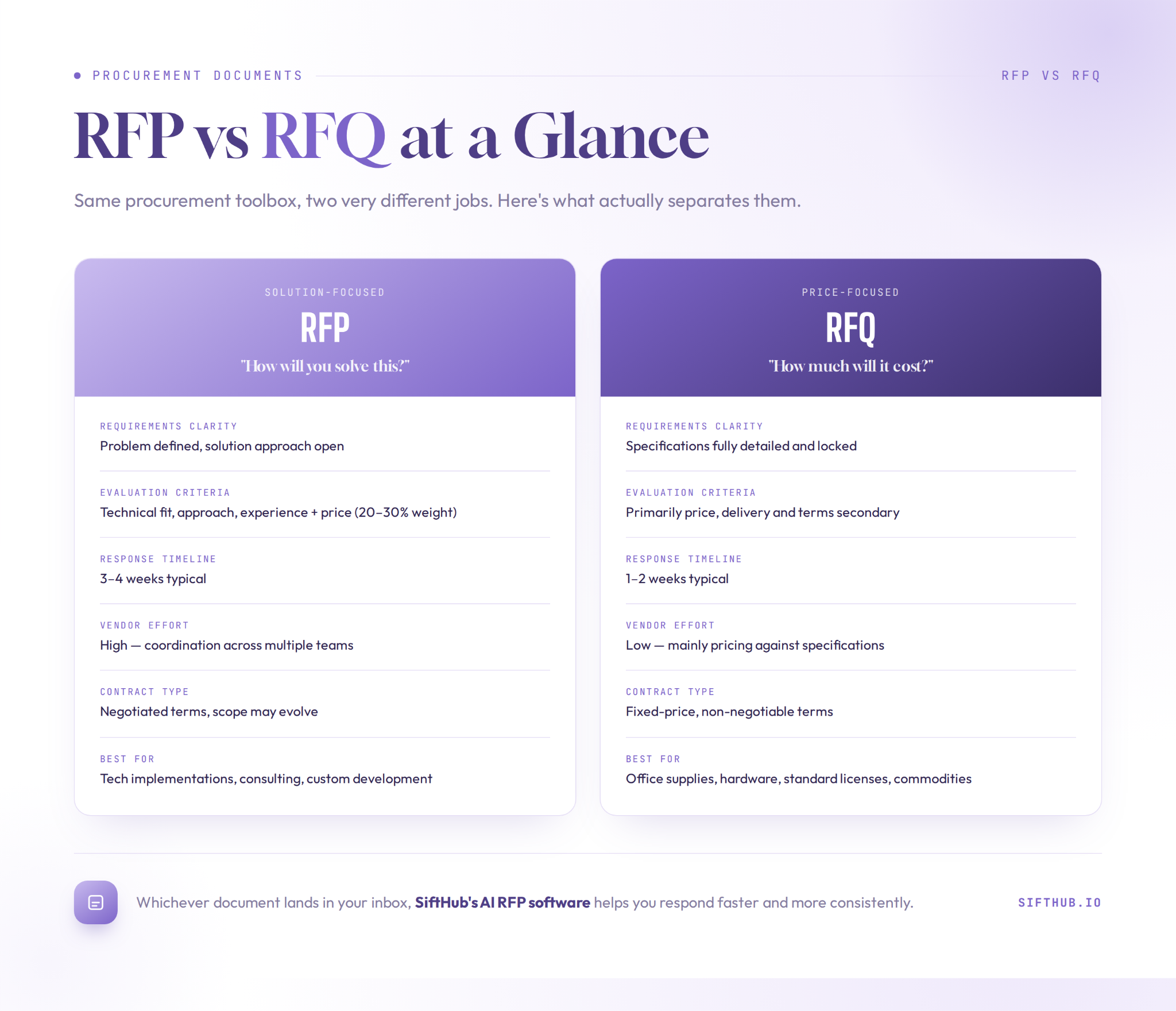
Understanding the fundamental differences helps you choose the right document for each procurement situation.
RFP vs RFQ: Quick comparison table
Purpose and complexity
RFPs address complex problems requiring comprehensive solutions. They're exploratory, allowing vendors to propose different approaches. RFQs address straightforward purchases where you know exactly what you want and simply need pricing. They're transactional, focused on cost comparison.
Information requested
RFPs request detailed information about vendor approach and methodology, technical architecture and implementation, team qualifications and experience, project timeline and milestones, pricing and contract terms, and customer references and case studies. The goal is to understand how vendors will deliver value.
RFQs request unit pricing for specified items, total cost including shipping and fees, delivery timelines, payment terms, warranty or guarantee information, and volume discounts if applicable. The goal is to understand the total cost of exactly what you specified.
Evaluation criteria
RFPs use weighted scoring across multiple criteria, such as technical fit, implementation approach, vendor experience, total cost of ownership, and innovation. Price typically represents 20-30% of the total score, with other factors carrying significant weight.
RFQs primarily evaluate on price, with delivery time and payment terms as secondary considerations. You're looking for the lowest qualified bid from vendors who can meet your specifications.
Response time and effort
RFPs typically require 3-4 weeks for vendor responses. Vendors invest significant time understanding your requirements, developing customized proposals, coordinating input from technical teams and executives, and creating presentations or demonstrations. Organizations responding to complex RFPs often use AI RFP software to accelerate the response process while maintaining quality.
RFQs usually require 1-2 weeks for vendor responses. Vendors simply price against your specifications, require minimal coordination since requirements are clear, and submit straightforward pricing documents. The reduced complexity means faster turnaround for both sides.
Contract implications
RFPs often lead to negotiated contracts in which final terms evolve through discussion, scope may be refined during contracting, and pricing may adjust based on the final scope. The proposal serves as a starting point for negotiation.
RFQs typically lead to fixed-price contracts in which terms are non-negotiable, scope is locked in during the RFQ, and pricing is binding as quoted. What you specified is what you'll receive at the quoted price.
Common mistakes in choosing between RFP and RFQ
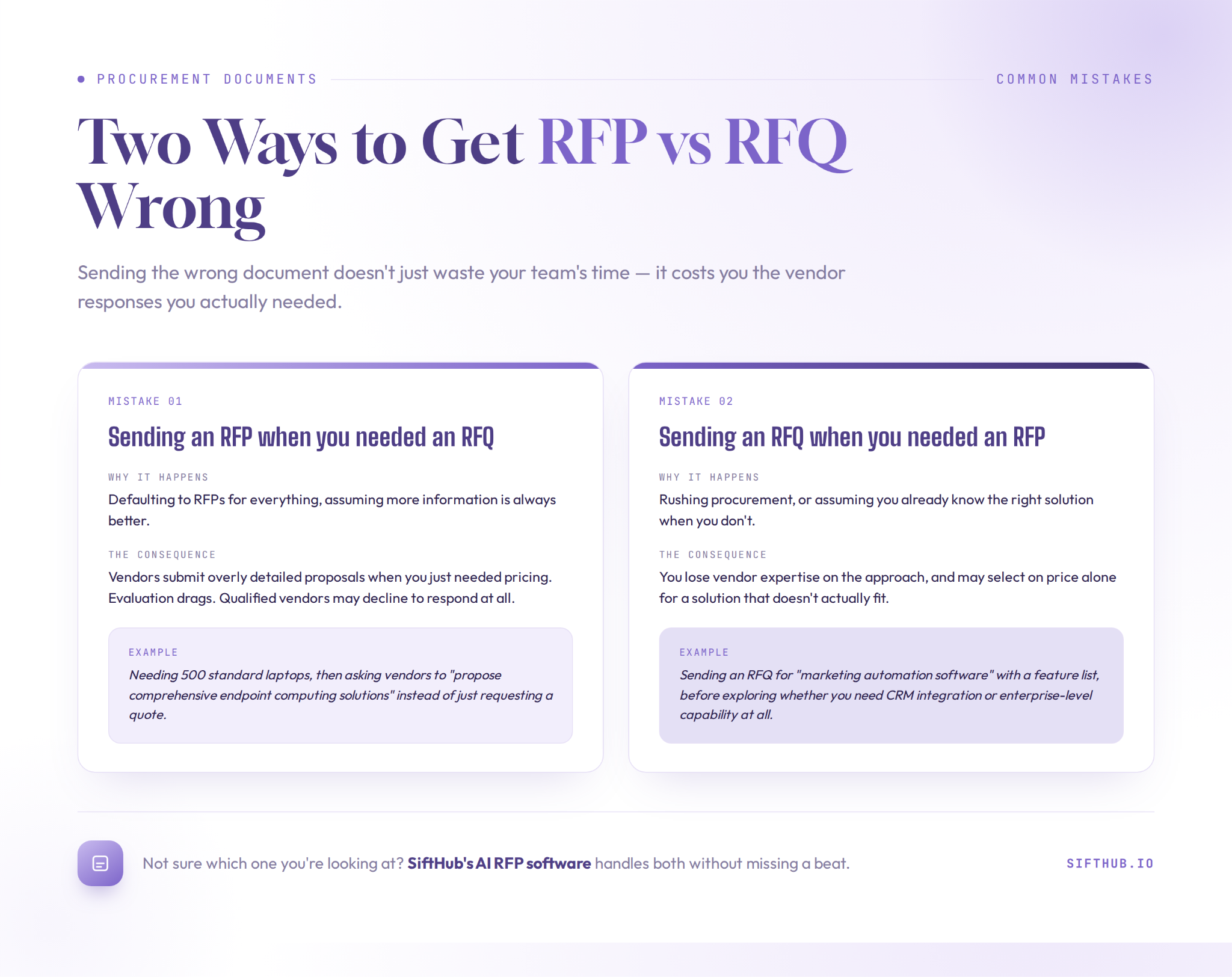
1. Sending an RFP when you need an RFQ
This happens when teams default to RFPs for everything, assuming more information is always better. But when you already know exactly what you want, comprehensive RFPs burden vendors with unnecessary work and your team with excessive information to review.
The consequence: Vendors submit overly detailed proposals when you just need pricing, evaluation takes longer, and some qualified vendors may decline to respond.
Example: You need 500 standard laptops with specific hardware configurations. Sending an RFP asking vendors to "propose comprehensive endpoint computing solutions" wastes time. An RFQ with precise specs gets you the pricing you need faster.
2. Sending an RFQ when you need an RFP
This happens when teams rush procurement or underestimate complexity. They think they know exactly what they want, but they're making assumptions that haven't been validated against vendor capabilities.
The consequence: You miss opportunities to learn from vendor expertise about better approaches and may select a solution based solely on price that doesn't fully address your needs.
Example: Your marketing team wants "marketing automation software," and you send an RFQ specifying features. But you haven't explored whether you need enterprise-level automation, CRM integration requirements, or whether your team can use advanced features. An RFP would surface these considerations.
3. Confusing RFI, RFP, and RFQ
Organizations sometimes use these terms interchangeably or don't understand where each fits in the procurement lifecycle. This creates confusion for vendors about what information to provide and what level of detail is expected.
Request for Information (RFI): Used at the very beginning when you're exploring what solutions exist and gathering market intelligence. You're not ready to buy; you're educating yourself about options, capabilities, and approaches. RFIs are purely informational with no pricing expected.
Request for Proposal (RFP): Used when you understand your problem and are ready to evaluate comprehensive solutions. You want vendors to propose how they'll solve your challenge.
Request for Quotation (RFQ): Used when you know exactly what you want and are ready to compare pricing from qualified vendors.
The typical progression is RFI → RFP → RFQ, though many procurements skip one or more steps depending on your existing knowledge and the clarity of your requirements. If you're weighing RFI versus RFP specifically, rather than RFP versus RFQ, our dedicated guide to RFI vs RFP covers that comparison in full.
How to determine which document to use
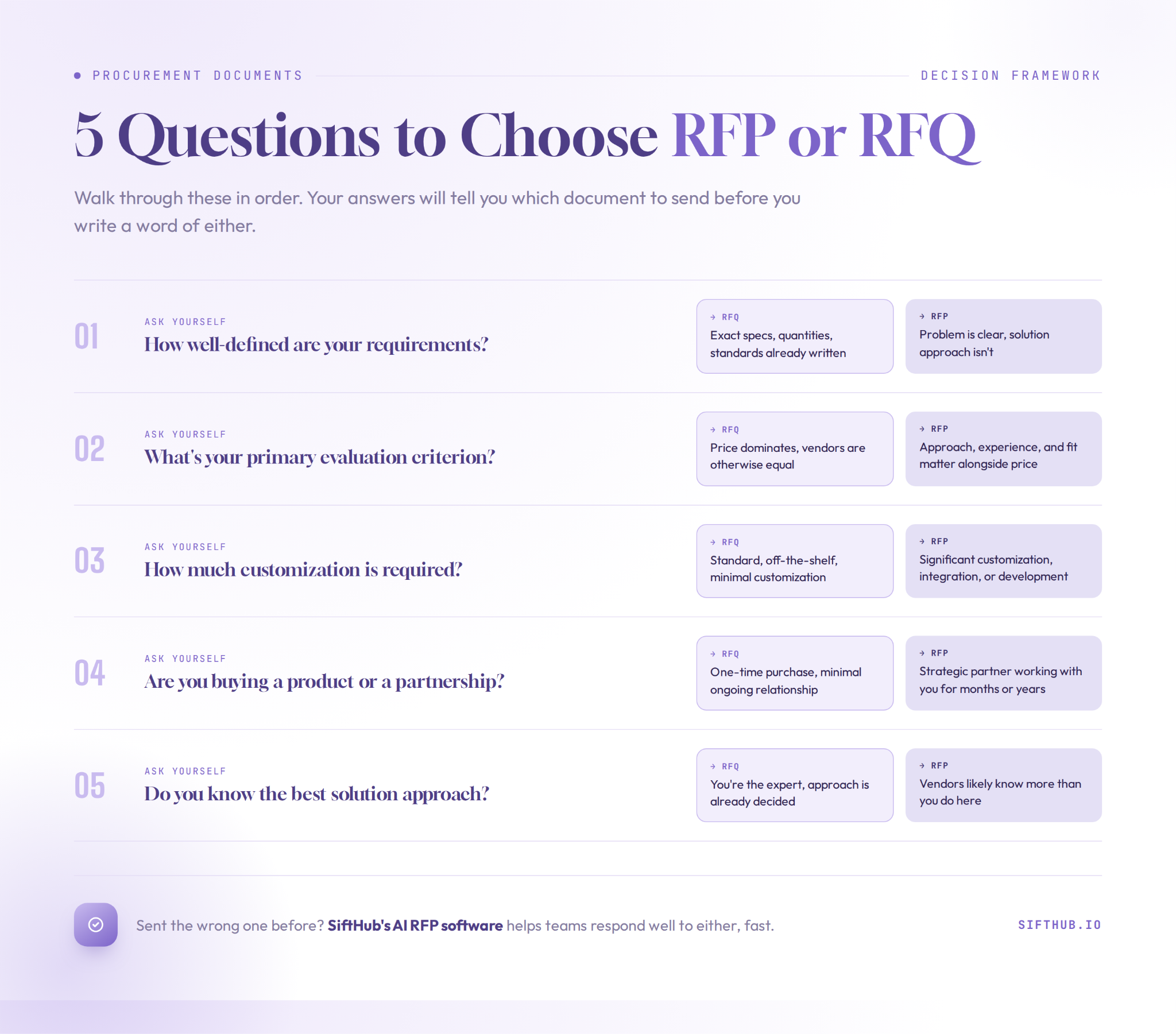
Walk through these questions to choose the right procurement document.
- How well-defined are your requirements? If you can write detailed specifications with exact quantities, features, and standards, use an RFQ. If you can articulate the problem but not the specific solution, use an RFP.
- What's your primary evaluation criterion? If price is the dominant factor and all qualified vendors deliver essentially the same outcome, use an RFQ. If you're evaluating approach, experience, methodology, or cultural fit alongside price, use an RFP.
- How much customization is required? Standard solutions with minimal customization work well with RFQs. Solutions that require significant customization, integration, or development require RFPs so vendors can propose their approach.
- Are you buying a product or a partnership? One-time purchases with minimal ongoing relationships work well with RFQs. Strategic partners who'll work closely with your team over months or years need RFPs to evaluate the relationship dimension.
- Do you know the best solution approach? If you're an expert in this area and know the optimal approach, use an RFQ. If vendors likely have expertise you lack, or if multiple valid approaches exist, use an RFP to leverage vendor knowledge.
Best practices for RFPs and RFQs
Regardless of which document type you choose, these practices improve response quality and streamline evaluation.
1. For RFPs: Balance detail with flexibility
Provide enough context about your business, challenges, and objectives so vendors understand what you're trying to accomplish. But avoid over-specifying the solution, as this limits vendor creativity and reduces the exploratory benefits of RFPs.
Include clear evaluation criteria with weights so vendors know what matters most if the implementation approach accounts for 30% of your decision, and the price for 20%, state that upfront. This transparency helps vendors focus their proposals appropriately.
Set realistic response timelines. Three to four weeks is standard for complex RFPs. Rushed timelines result in lower-quality proposals as vendors can't properly coordinate technical, sales, and executive input.
2. For RFQs: Eliminate all ambiguity
Write specifications with precision. "High-performance laptops" is ambiguous. "Dell Latitude 5540 with Intel Core i7-1355U, 16GB RAM, 512GB SSD, Windows 11 Pro" is specific. The more precise your specifications, the more accurate and comparable your quotes will be.
Include all relevant terms and conditions in the RFQ itself. Payment terms, delivery requirements, warranty expectations, and volume discounts should be part of the initial document, not negotiated later. This ensures all vendors quote against the same parameters.
Specify the exact quote format you want. Provide a template showing how you want pricing broken down, including unit prices, quantities, shipping, taxes, and the total cost.
3. For both: Support efficient vendor responses
Whether you're sending an RFP or RFQ, vendors invest time and resources responding. Supporting efficient response processes benefits both sides; vendors can respond faster and more accurately, and you receive higher-quality, more complete responses.
Organizations sending RFPs and RFQs increasingly recognize that vendors using AI RFP software to manage their response processes deliver better proposals faster. Bid and proposal teams equipped with AI RFP tools can quickly locate relevant information, ensure responses use current product knowledge, and maintain consistency across proposals, all while significantly reducing response time.
This benefits buyers because faster vendor responses mean faster procurement cycles, more complete and accurate information since vendors aren't rushing, and better comparison because all vendors can feasibly respond to your timeline.
The vendor perspective: What RFPs and RFQs mean for response teams
Understanding how vendors experience RFPs versus RFQs helps you create documents that get better responses.
RFP responses require coordination across sales, presales, solutions, product, finance, legal, and executives. This coordination is time-intensive. Organizations responding to dozens of RFPs annually face the challenge of assembling information quickly while ensuring accuracy. SiftHub's AI RFP software helps by centralizing knowledge from across teams, enabling rapid assembly without constant interruptions of busy subject matter experts.
RFQ responses depend on information accessibility. The challenge isn't complexity; it's retrieval speed. How quickly can teams confirm current pricing, verify product specifications, determine delivery timelines, and assemble complete quotes? Vendors with well-organized knowledge systems and response generation capabilities can turn RFQ responses around in hours rather than days.
Hybrid approaches: When you might use both
Some complex procurements benefit from staged approaches.
RFP followed by RFQ: Issue an RFP to evaluate approaches and shortlist vendors, then issue an RFQ to your shortlisted vendors requesting final, binding pricing. This ensures you choose the right solution before optimizing for price.
RFI → RFP → RFQ: For major strategic procurements, start with an RFI to understand market options, issue an RFP to shortlisted vendors for comprehensive proposals, then use an RFQ for binding quotes from top choices. This progression moves from exploration to evaluation to price optimization. For a closer look at the transition between the first two stages specifically, see our guide on RFI vs RFP, or our full breakdown of RFI vs RFP vs RFQ for all three stages together.
Making your choice: RFP or RFQ decision framework
Use this framework to choose the right procurement document confidently:
Choose an RFP when:
- Your requirements focus on outcomes rather than specific solutions.
- You want vendors to propose different approaches.
- Multiple factors beyond price influence your decision.
- You're selecting a long-term partner, not just making a purchase.
- Customization, integration, or implementation complexity is significant.
- You can give vendors 3-4 weeks to respond thoughtfully.
Choose an RFQ when:
- Your requirements are completely specified and documented
- You're comparing prices for defined deliverables
- Price is the primary or dominant decision factor
- You're purchasing standardized products or services
- You have existing qualified vendor relationships
- You need a fast turnaround (1-2 weeks or less)
Choose both (staged approach) when:
- The procurement is complex and high-value
- You want to evaluate approaches before optimizing the price
- You're shortlisting from many options to a few finalists
- Stakeholder buy-in requires demonstrating a thorough evaluation.
Conclusion
The difference between RFPs and RFQs isn't just semantic; it shapes the information you receive, the time required for procurement, and the quality of your ultimate vendor selection. RFPs work when you need comprehensive solutions to complex problems and value vendor expertise in proposing approaches. RFQs work when you know exactly what you want and need an efficient price comparison.
Getting this choice right means better vendor responses, faster procurement cycles, more confident decisions, and ultimately better outcomes from your vendor relationships. The key is honestly assessing whether you need vendors to help you solve a problem (RFP) or price a solution you've already defined (RFQ).
For vendors receiving these documents, response quality and speed often determine whether they advance in procurement processes. Organizations that equip their teams with AI RFP software to manage response processes, centralize knowledge, automate content assembly, and ensure accuracy consistently deliver more competitive proposals across both RFPs and RFQs.
The procurement landscape continues evolving as both buyers and vendors adopt technologies that make processes more efficient and effective. Understanding when to use RFPs versus RFQs remains foundational to procurement success, regardless of the tools used.