


.avif)

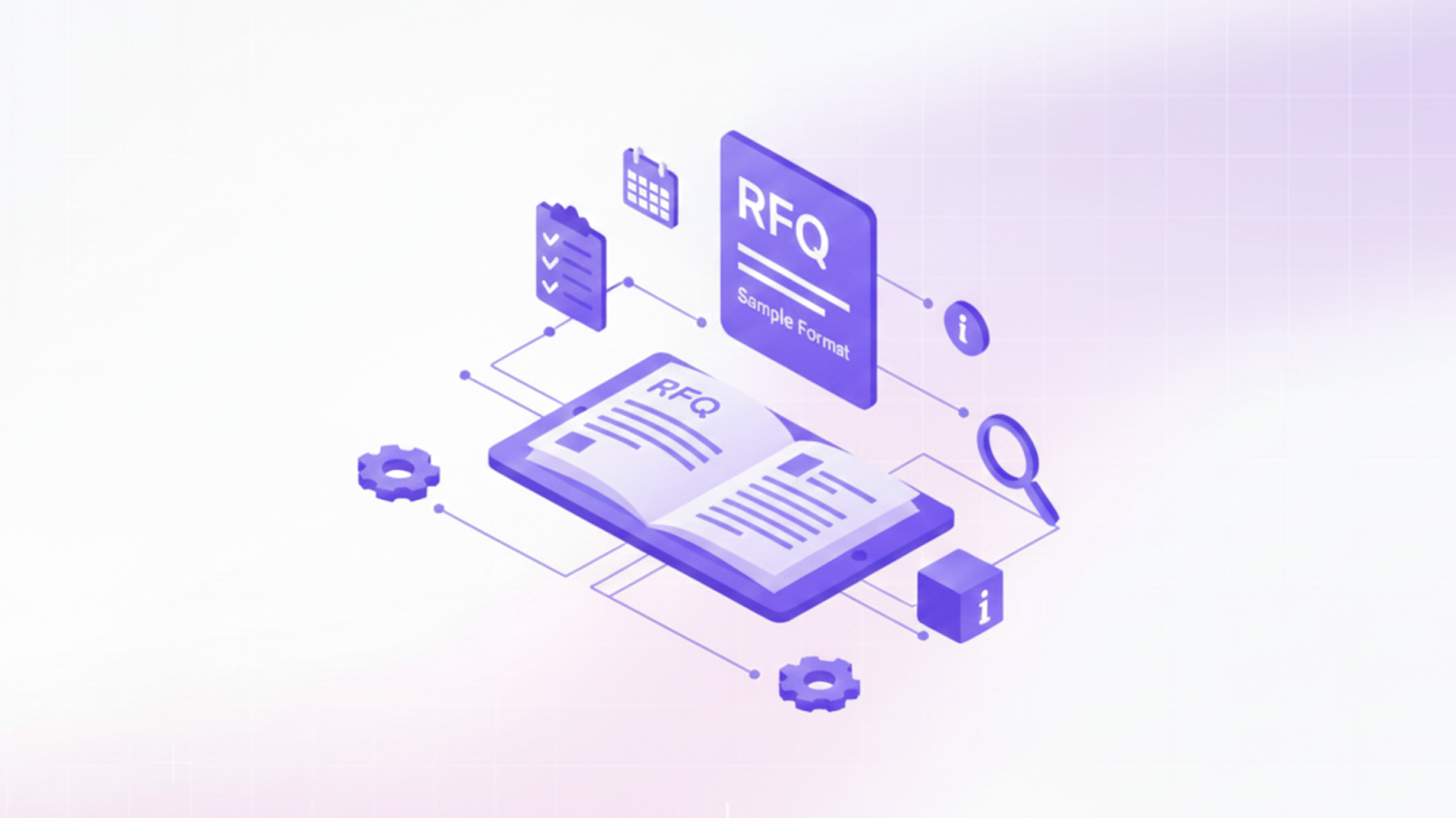
An RFQ (Request for Quotation) is a formal procurement document that solicits price quotes from suppliers for products or services with clearly defined specifications. Unlike RFPs that evaluate comprehensive solutions, RFQ documents focus primarily on pricing when you already know exactly what you need.
- Essential components: header with tracking number and deadlines, detailed specifications, quantity and delivery requirements, itemized pricing structure, evaluation criteria, submission instructions, terms and conditions
- When to use: manufacturing components with fixed specs, replacement parts, standardized services, commodity purchases
- RFQ vs RFP vs RFI: RFQs focus on price, RFPs evaluate approach and capability, RFIs gather market intelligence before either
- Common mistakes: vague specifications, unrealistic timelines, missing evaluation criteria, and no single point of contact
- Vendor-side: responding accurately and quickly to RFQs requires instant access to verified pricing, compliance documentation, and past submission content.
An RFQ (Request for Quotation) is a formal procurement document that solicits price quotes from suppliers for products or services with clearly defined specifications. Unlike RFPs that evaluate comprehensive solutions, RFQ documents focus primarily on pricing when you already know exactly what you need.
- Essential components: header with tracking number and deadlines, detailed specifications, quantity and delivery requirements, itemized pricing structure, evaluation criteria, submission instructions, terms and conditions
- When to use: manufacturing components with fixed specs, replacement parts, standardized services, commodity purchases
- RFQ vs RFP vs RFI: RFQs focus on price, RFPs evaluate approach and capability, RFIs gather market intelligence before either
- Common mistakes: vague specifications, unrealistic timelines, missing evaluation criteria, and no single point of contact
- Vendor-side: responding accurately and quickly to RFQs requires instant access to verified pricing, compliance documentation, and past submission content.
Procurement teams waste countless hours creating request for quotation documents from scratch. Each new project means rebuilding supplier requirements, pricing structures, and evaluation criteria — leading to inconsistent documentation and delayed vendor responses.
A well-structured RFQ document template eliminates this inefficiency while ensuring you receive comparable, complete proposals from potential suppliers. Whether you are sourcing manufacturing components, professional services, or technology solutions, standardized RFQ documents streamline your procurement process and improve supplier communication.
This guide covers what an RFQ document is, when to use one versus an RFP or RFI, the complete section-by-section structure, a filled-in example, and how vendors on the receiving end respond accurately under deadline pressure.
What is an RFQ document?
An RFQ document is a formal business document that solicits price quotes from potential suppliers for specific products or services with clearly defined specifications. Unlike requests for proposals that evaluate comprehensive solutions, RFQ documents focus primarily on pricing when you already know exactly what you need.
The key distinction lies in specificity. When you issue an RFQ, you have already determined product specifications, quantities, delivery schedules, and quality standards. Suppliers simply need to confirm they can meet these requirements and provide their best pricing. This makes RFQ documents ideal for commodity purchases, replacement parts, or any procurement where specifications are standardized.
RFQ vs RFP vs RFI: Which document do you need?
This is the most common source of confusion in procurement, and the most consequential decision, because using the wrong document at the wrong stage wastes time for both the issuing organization and every vendor that responds.
Use an RFQ when: Specifications are fixed, you need price comparison across multiple suppliers, and the evaluation will focus primarily on cost and delivery terms.
Use an RFP when: Requirements may evolve, you want vendors to propose their own approaches, or the evaluation includes methodology, team quality, and long-term partnership potential alongside pricing.
Use an RFI when: You are still defining requirements, want to understand what the market offers before writing an RFQ or RFP, or need to pre-qualify vendors before a more formal process.
When to use an RFQ document
Manufacturing scenarios represent the classic RFQ use case. When you need 10,000 units of a specific component with detailed technical drawings, an RFQ document efficiently collects comparable pricing from multiple manufacturers. The specifications are fixed, so suppliers compete purely on price, delivery time, and terms.
Contrast this with complex technology implementations where requirements may evolve during evaluation. These situations require an RFP that assesses vendor capabilities, implementation approaches, and long-term partnership potential beyond just pricing.
Service procurement sits between these extremes. Standardized services like janitorial contracts or equipment maintenance work well with RFQ documents. Complex professional services requiring customized approaches need RFPs that evaluate methodology and expertise.
Common RFQ use cases include:
- Manufacturing components with fixed technical specifications
- Replacement parts or consumables with part numbers and quantities defined
- Standardized IT hardware (servers, networking equipment, devices)
- Commodity services with defined scope and SLAs
- Office supplies, materials, or equipment with clear specifications.
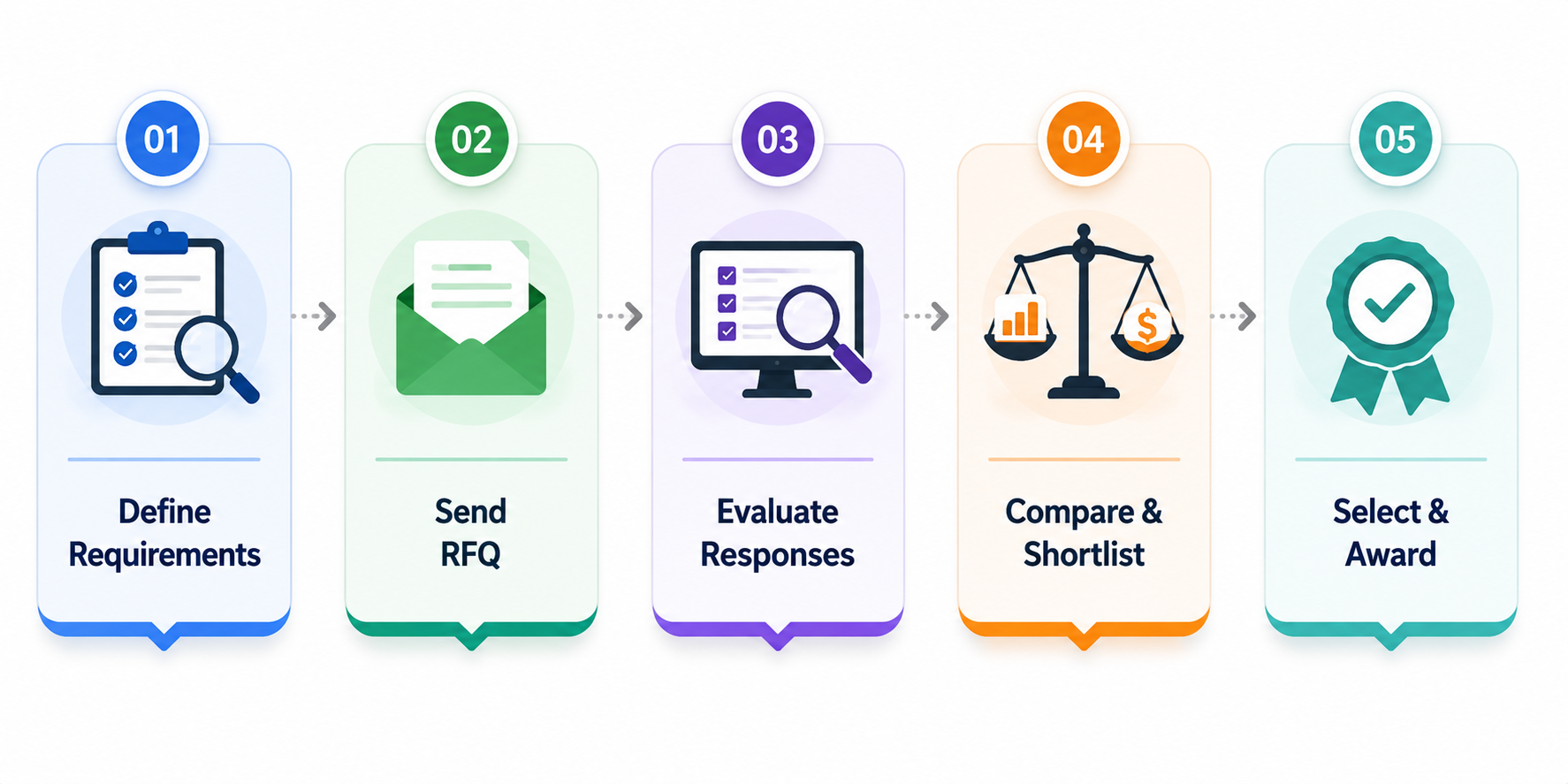
The RFQ process: five steps from requirements to award
Step 1: Define requirements and select bid type
Before creating the document, confirm all specifications are finalized. Vague or evolving requirements at this stage will produce incomparable quotes and delays. Decide whether to run an open bid (visible to all vendors), a closed bid (sealed quotes from pre-selected suppliers), or an invited bid (sent to a shortlist of qualified vendors).
Step 2: Create the RFQ document
Build the document using the template structure in the next section. The quality of the document directly determines the quality of quotes you receive — ambiguous specifications produce incomparable responses.
Step 3: Distribute and manage the Q&A period
Send the RFQ to all selected vendors simultaneously. Designate a single point of contact for supplier questions. Share all questions and answers with every participating vendor to maintain a level playing field. This period typically runs one to two weeks before the submission deadline.
Step 4: Receive and evaluate quotes
When quotes arrive, use a standardized scoring matrix against your published evaluation criteria. Compare line items from the pricing templates side by side; this is why enforcing a standard pricing format matters. If you have a selection committee, prepare a summary with key information before the group evaluation.
Step 5: Award and notify
Notify the winning vendor and inform unsuccessful vendors. Document the decision rationale for audit purposes. For significant contracts, issue a formal award letter before beginning contract negotiations.
Essential components of an RFQ document template
Header and identification
Every RFQ needs a clean header establishing identity, traceability, and deadline urgency:
- Organization name, logo, and primary contact details
- Unique RFQ reference number for tracking and audit purposes
- RFQ issue date
- Supplier question submission deadline
- Quote submission deadline and time zone
- Expected award date
- Clear, descriptive project title
Introduction and background
Provide context so suppliers understand the purpose and scope of the request:
- Brief explanation of why the RFQ is being issued
- Short organizational overview relevant to this procurement
- High-level project scope — one-time purchase versus ongoing supply agreement
- Any context that affects scale, urgency, or future volume opportunity
Specifications and requirements
This section determines the accuracy of every quote you receive. Clarity here is the single most important investment in the entire document:
- Clearly numbered specifications with section headers
- Mandatory requirements separated from optional or preferred features
- For product RFQs: part numbers, drawings, materials, dimensions, tolerances, certifications
- For service RFQs: scope of work, performance standards, SLAs, required credentials
- Exact quantities with any acceptable variance range
- Delivery location, required dates, packaging requirements, and whether partial deliveries are accepted
Pricing structure
Design this section to produce quotes you can compare side by side without manual reconciliation:
- Itemized pricing template (provided as a separate spreadsheet or embedded table)
- Standard units of measure across all line items
- Payment terms: net 30, net 60, milestone-based
- Price validity period (typically 60 to 90 days from submission)
- Clear guidance on what is included and excluded: taxes, shipping, installation, training
Evaluation criteria
Transparency here improves response quality and supplier alignment:
- Primary evaluation factors with relative weighting
- Whether the award will go to a single supplier or be split across multiple vendors
- Any minimum qualification thresholds that disqualify non-compliant bids
Submission instructions
- Submission method: email, portal, or physical delivery
- Required formats: pricing template, response document
- Mandatory documentation: licenses, insurance certificates, references
- Single point of contact for questions
- Deadline for supplier questions before the submission date
Terms and conditions
- Confidentiality requirements for the RFQ process
- Right to reject all quotes or cancel the RFQ
- Award notification timeline
- Any compliance or legal obligations specific to the procurement
Sample RFQ document; filled-in example
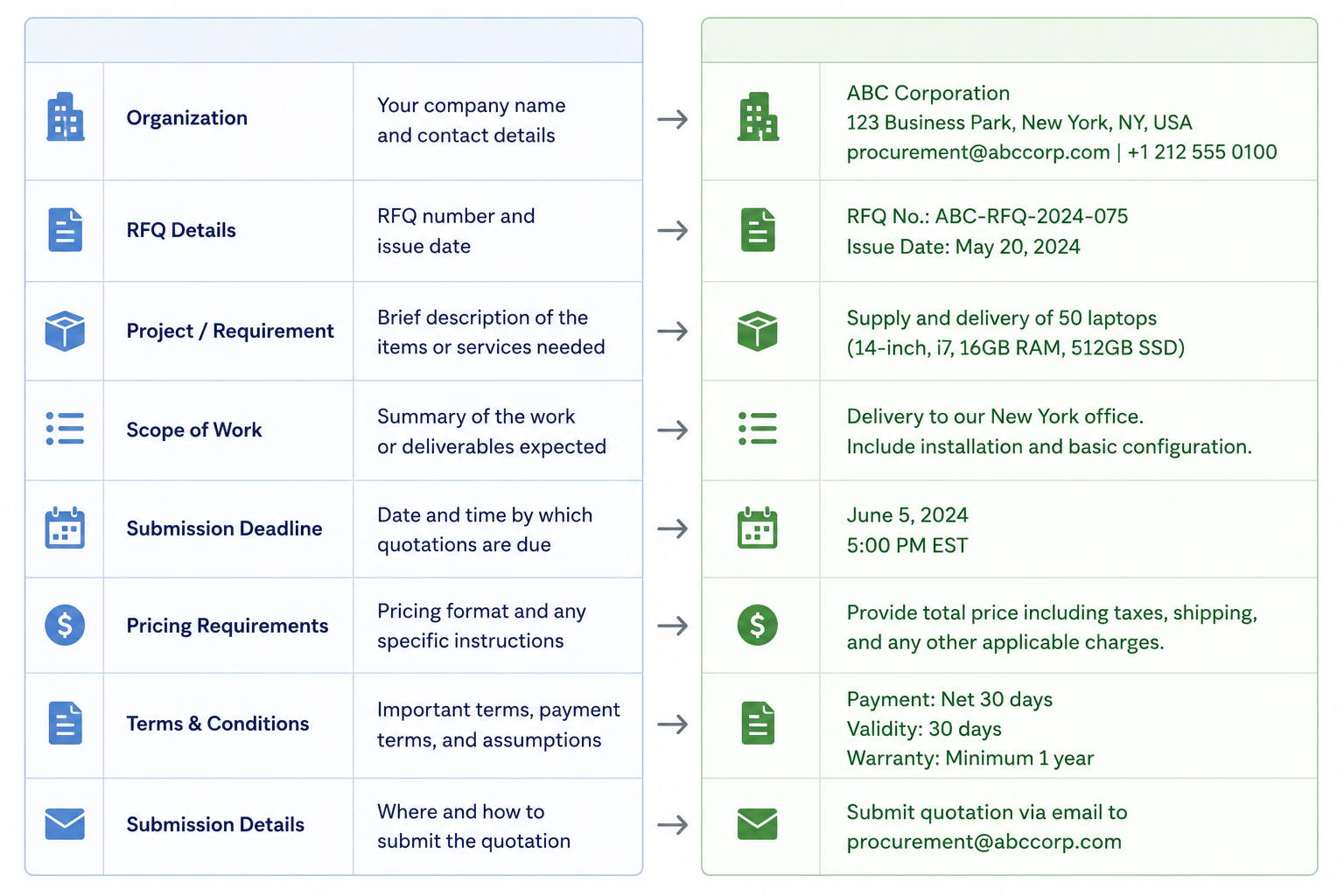
The following is a completed example you can adapt. This example covers cloud infrastructure services to illustrate how specifications and pricing tables work in practice.
[TechCorp Solutions]
Request for Quotation
RFQ Number: IT-2025-0847 Issue Date: 15 January 2026 Questions Deadline: 22 January 2026 Submission Deadline: 29 January 2026, 5:00 PM EST Expected Award Date: 12 February 2026 Project Title: Cloud Infrastructure Migration Services
1. Introduction
TechCorp Solutions is seeking quotes from qualified cloud services providers for the migration of 500 virtual machines from our on-premises data center to AWS cloud infrastructure. This is a one-time migration project with ongoing managed services required post-migration. Vendors with demonstrated experience migrating enterprise workloads at comparable scale are invited to respond.
2. Specifications and requirements
2.1 Mandatory requirements:
- Migration of 500 VMs to AWS within 120 calendar days of contract execution
- Zero data loss and less than 4 hours cumulative downtime per VM during migration
- SOC 2 Type II certification required; the current report must be provided with submission
- AWS Partner Network (APN) Advanced Tier or above
2.2 Scope of work:
- Pre-migration assessment and dependency mapping
- Migration execution in agreed phased batches
- Post-migration validation and performance testing
- Hypercare support for 30 days post go-live
3. Pricing requirements
Please provide pricing using the attached spreadsheet, including:
Price validity: quotes must remain valid for 90 days from submission deadline.
4. Evaluation criteria
5. Submission instructions
Submit to: procurement@techcorp.com by 29 January 2026, 5:00 PM EST. Include: completed pricing spreadsheet, SOC 2 Type II report, APN certification, and two references from comparable VM migration projects completed within the last 24 months.
6. Contact for questions
Sarah Chen, Procurement Manager procurement@techcorp.com | +1 (555) 234-5678 Question deadline: 22 January 2026.
Common RFQ document mistakes
Vague or ambiguous specifications. Avoid subjective language like "high-quality" or "industry standard." Specify exact standards — ISO certifications, material grades, dimensions, tolerances, and test criteria. Every assumption a supplier has to make to answer a requirement is a point of incomparability in the quotes you receive.
Unrealistic timelines or budget expectations. Impossible delivery dates reduce participation. Suppliers may opt out rather than seek clarification. Use an RFI first if you are unsure what the market can deliver at your budget.
Overly complex or bloated documents. More pages do not produce better outcomes for straightforward purchases. Remove sections that do not directly impact evaluation. Streamlined documents attract more competitive responses.
Missing or unclear contact information. Assign a single point of contact. Share all supplier questions and answers with every participating vendor. Slow or unclear communication signals internal disorganization before the contract even starts.
No standardized pricing format. Suppliers who can use their own pricing structure produce quotes that cannot be compared without manual reconciliation. Provide a pricing template and require vendors to use it.
Focusing evaluation entirely on price. The cheapest quote is not always the best value. Delivery reliability, quality track record, financial stability, and payment terms all affect total cost of ownership. Weight non-price factors explicitly in the evaluation criteria.
How vendors respond to RFQs efficiently
For vendors on the receiving side of an RFQ, the challenge is the same as for RFPs — assembling accurate, verified responses under a tight deadline from knowledge scattered across product documentation, compliance records, past submissions, and pricing files.
RFQs add a specific complication: pricing accuracy. A quote submitted with an incorrect unit price, an outdated certification date, or a missing line item creates credibility problems that are difficult to recover from in an evaluation focused almost entirely on price and compliance.
SiftHub's AI RFP software addresses both problems. It auto-fills RFQ responses, including pricing templates, compliance sections, and technical specifications- from connected knowledge sources: approved pricing documentation in Google Drive, compliance certifications in SharePoint, past submissions in Confluence, and approved Q&A libraries. Every answer carries full source attribution, including document name, owner, and last modified date, so reviewers can verify currency before submission rather than after. The auto-fill works directly inside Excel, Word, and Google Sheets, the formats most RFQ pricing templates arrive in, with no reformatting required.
For questions that require specialist input, current lead times from operations, specific compliance sign-off from legal, custom configuration pricing from product — SiftHub's project management feature routes each question to the right owner automatically based on content type, with deadline visibility and completion tracking across every active submission.
ActivTrak maintained a 100% submission hit rate after deployment, responding to every qualified RFQ and RFP opportunity rather than declining bids due to bandwidth constraints. Sirion handles 1.5x more submissions per month without adding headcount, while cutting 48 hours off their average response SLA.
Conclusion
Well-structured RFQ documents transform procurement from time-consuming administrative work into a strategic competitive advantage. The investment in developing a comprehensive template pays dividends across every subsequent procurement cycle, rather than recreating specifications and evaluation criteria for each project. Procurement teams customize a proven structure and focus energy on supplier evaluation and negotiation.
For vendors responding to RFQs, speed and accuracy determine whether you make the shortlist. A quote that arrives first, prices every line item correctly, and attaches current compliance documentation creates a different impression from one that requires a follow-up clarification on every section.