



Every hour a rep spends searching for collateral, manually updating CRM, or assembling proposal content is an hour not spent on qualified pipeline conversations. Efficiency tools that reduce this non-selling time directly improve quota achievement by creating more hours for revenue-generating activities.
1. Skill development and continuous improvement
Top quota achievers treat selling as a skill requiring deliberate practice. They analyze lost deals to understand what went wrong, study winning patterns to understand what worked, and invest in developing weaknesses rather than coasting on natural talent.
This includes product knowledge, competitive positioning, objection handling, nYour sales quota is the number that defines your quarter. Hit it, and you earn full commission, maybe accelerators, and the relief of knowing your job is secure. Miss it, and you face uncomfortable conversations with your manager, reduced earnings, and the stress of starting next quarter already behind.
For sales leaders, quotas are equally high-stakes: set them too high, and you demotivate the team, lose top performers to competitors, and miss organizational revenue targets because the numbers were never realistic. Set them too low, and you leave revenue on the table while paying out commission on sales your team would have closed anyway.
This guide provides the complete framework for understanding, setting, and achieving sales quotas: the types of quotas that exist, how to set targets that drive performance without crushing morale, common mistakes that undermine quota effectiveness, and the strategies individual reps and teams use to consistently hit their numbers.
What sales quotas are and why they matter
A sales quota is a defined performance target, typically measured in revenue, units sold, or activities completed, that a sales rep or team is expected to achieve within a specific time period, most commonly a quarter or year.
Quotas serve multiple purposes beyond just measuring performance. They create accountability by establishing clear expectations for what success looks like. They enable compensation planning by defining thresholds for commission and bonus eligibility. They support forecasting by aggregating individual quotas into team and organizational revenue projections. They motivate performance by providing concrete goals that transform abstract "sell more" directives into specific, measurable targets.
Types of sales quotas
Different quota structures incentivize different behaviors and suit different sales models.
1. Revenue quota
The most common quota type measures the total revenue a rep or team generates within the period. A rep with a $500,000 quarterly revenue quota must close deals totaling at least that amount to achieve 100% of quota.
Revenue quotas align directly with company financial goals and work well for transactional sales with predictable deal sizes. They create clear accountability for outcomes rather than activities. The challenge is that revenue quotas can encourage reps to prioritize any deal that counts toward the number rather than strategic deals that benefit the company long-term, and they provide no credit for pipeline building that will close in future quarters.
2. Activity quota
Activity quotas measure behaviors rather than outcomes: calls made, meetings booked, demos delivered, proposals sent. A rep might have quotas of 50 discovery calls and 15 demos per month, regardless of whether those activities generate revenue in the period.
Activity quotas work well for early-stage reps still developing selling skills, for roles focused on pipeline generation rather than closing, and for markets where sales cycles are long enough that revenue outcomes lag activities by multiple quarters. They provide leading indicators of future performance and help managers coach to specific behaviors.
The risk is that activity quotas can incentivize quantity over quality, reps booking low-quality meetings just to hit numbers, and they do not directly tie to revenue outcomes. Organizations using activity quotas must carefully define which activities actually correlate with revenue.
3. Volume quota
Volume quotas measure units sold rather than revenue generated. A rep selling software licenses might have a quota of 30 new customer acquisitions per quarter, regardless of contract value.
Volume quotas work when deal sizes are relatively standardized, and the strategic goal is market penetration or customer count growth rather than maximizing revenue per deal. They prevent reps from cherry-picking only the largest opportunities and encourage broader market coverage.
The downside is that volume quotas can create perverse incentives to close small deals rather than invest time in larger opportunities, and they require frequent adjustment as product mix or pricing changes.
4. Profit quota
Less common but valuable in certain contexts, profit quotas measure gross margin or profit contribution rather than gross revenue. A rep selling products with varying margins might have a profit quota that rewards larger deals with higher-margin products over volume sales of low-margin offerings.
Profit quotas align rep behavior with the company's economic reality and discourage excessive discounting to close deals. They require sophisticated accounting to track accurately and can be complex to explain to reps who are accustomed to simpler revenue targets.
5. Combination quotas
Most sophisticated sales organizations use hybrid quota structures that combine multiple metrics. A rep might have 70% of quota based on revenue, 20% on new customer acquisition, and 10% on renewal rate. This balances short-term revenue generation with strategic priorities like customer retention and market expansion.
Combination quotas can drive more balanced behavior but increase complexity. Reps must track multiple numbers, and compensation calculations become more intricate. The benefit is closer alignment between individual performance and organizational goals.
How to set effective sales quotas
Setting quotas is part science, part art. The science comes from analyzing historical data and market conditions. The art comes from understanding human motivation and organizational dynamics.
1. Start with historical performance data
The most reliable foundation for quota setting is what your team has actually achieved historically. Analyze rep performance over the past four to eight quarters: median attainment rates, distribution of performance across the team, seasonal patterns, and trend lines showing whether performance is improving or declining.
If your median rep achieved 95% of quota last year, setting quotas 40% higher this year without significant changes to territory, product, or resources is setting the team up to fail. Incremental increases of 10% to 20% year-over-year are more realistic when market conditions and sales capacity remain relatively stable.
2. Account for territory and market conditions
Not all territories are created equal. A rep selling into mature markets with high competitive intensity faces different conditions than a rep with a greenfield territory in a fast-growing market. Effective quota setting accounts for these differences rather than applying uniform targets across all reps.
Consider factors like total addressable market in the territory, competitive presence, existing customer density, and historical performance in similar markets. Reps in tougher territories should have quotas adjusted downward to reflect reality, while reps in advantaged territories can carry higher quotas.
3. Factor in sales cycle length and deal complexity
Quotas must account for how long it takes to close deals and how much rep effort each deal requires. If your average sales cycle is six months, a rep ramping in January will not generate significant revenue until July, quarterly quotas must account for this lag.
Similarly, complex enterprise sales requiring custom solutions and multiple stakeholder engagement take more rep time per deal than transactional sales. Reps handling complex deals should have lower unit quotas than those doing high-volume transactional sales, even if revenue expectations are similar.
4. Balance attainable and challenging
The goal is to set quotas that 60% to 70% of your team can achieve with strong execution. If fewer than half your team consistently hits quota, your quotas are too high. If more than 80% hit quota easily, your quotas are too low and you are overpaying commission for performance the team would deliver regardless of targets.
Research on goal-setting psychology shows that targets perceived as achievable with effort drive higher motivation than targets seen as impossible. The sweet spot is quotas that require reps to perform well but do not require perfect execution or unrealistic circumstances.
Common quota-setting mistakes
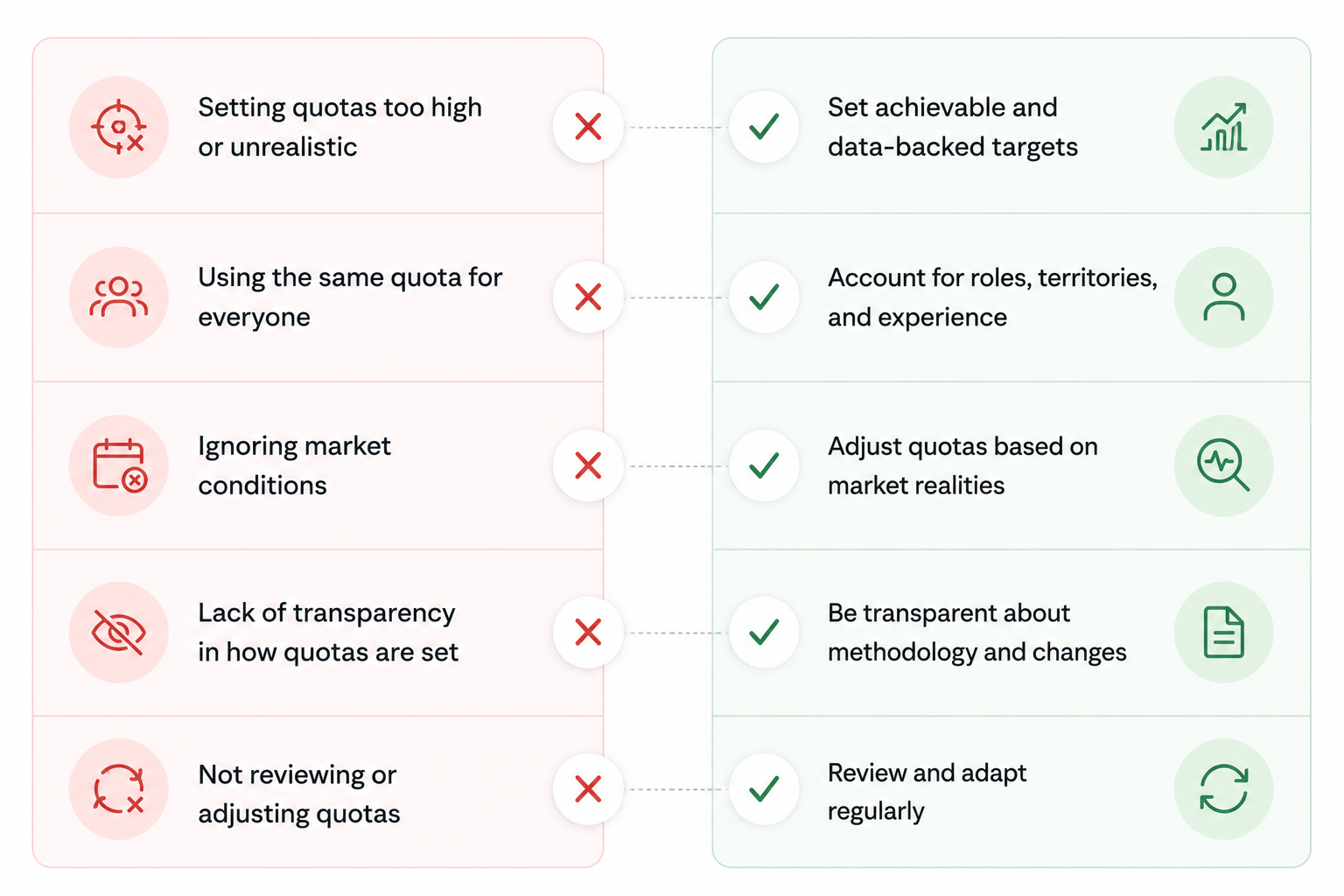
Certain quota-setting errors appear repeatedly across organizations and consistently undermine performance.
- Setting quotas based on revenue targets alone. The classic mistake: leadership needs $10 million in revenue, has 20 reps, so sets $500,000 quotas without analyzing whether that is realistic given historical performance, market conditions, or rep capacity. This top-down approach ignores ground truth and creates demotivating quotas.
- Ignoring ramp time for new hires. New reps need time to learn the product, understand the market, build a pipeline, and develop selling skills. Expecting full quota from day one sets new hires up to fail. Effective organizations use graduated quotas: 25% of the full quota in month one, 50% in month two, 75% in month three, and the full quota by month four or later for complex sales.
- Failing to adjust for territory changes. When a rep loses high-value accounts to a new hire or gains a competitor's former territory, their quota must adjust to reflect the new reality. Keeping quotas static when territory composition changes dramatically creates unfair advantages or disadvantages.
- Not revisiting quotas when market conditions shift. Economic downturns, new competitors, regulatory changes, or major product updates can all impact what is realistic to achieve. Organizations clinging to outdated quotas set during different market conditions frustrate reps and miss revenue targets.
- Treating all reps identically. Top performers can carry higher quotas than average performers, veteran reps can handle more than those still learning, and reps with advantaged territories should have higher targets than those in challenged markets. One-size-fits-all quotas ignore these real differences.
How individual reps achieve quota
For individual contributors, quota achievement comes down to execution across a few critical areas.
2. Pipeline management and coverage
The mathematical reality: if your win rate is 25% and your average deal size is $50,000, you need $2 million in qualified pipeline to close $500,000 in revenue. Reps who consistently hit quota maintain pipeline coverage ratios of 3x to 5x their quarterly number.
This means relentless focus on pipeline generation even when the current quarter looks solid. The reps who miss quota are often those who stopped prospecting in month two because month one went well, then faced empty pipelines in month three.
3. Deal qualification and prioritization
Not all opportunities are created equal. Reps who achieve quota ruthlessly qualify deals and focus time on opportunities with genuine buying intent, budget, authority, and timeline. Chasing deals that will never close wastes time that could be spent on winnable opportunities.
Deal qualification frameworks like MEDDIC and BANT help reps determine which deals deserve investment and which to disqualify early. The best reps say no to bad-fit opportunities to preserve time for deals that actually matter.
4. Time allocation and activity efficiency
Given that sales organizations spend 70% of their time on non-selling activities, the reps who maximize actual selling time gain significant advantages. This means ruthlessly eliminating low-value tasks, automating administrative work where possible, and protecting selling hours from internal meetings and bureaucracy.
egotiation, and discovery questioning. Small improvements in conversion rates at each stage of the funnel compound into significantly better overall performance.
How teams achieve quota collectively
While individual execution matters, teams hit collective quotas through coordination and leverage.
1. Pipeline coverage across the team
Sales leaders must ensure an adequate total pipeline across all reps. If the team quota is $5 million and the aggregate pipeline is only $8 million, the team will miss quota unless win rates or deal sizes dramatically exceed historical norms.
This requires visibility into each rep's pipeline health, early identification of coverage gaps, and coordinated action to build the pipeline when aggregate numbers fall short. Waiting until week 10 of a quarter to realize the team has insufficient pipeline leaves too little time to recover.
2. Knowledge sharing and collective learning
Teams where top performers share what is working—which talk tracks overcome common objections, which use cases resonate in specific industries, which competitive positioning wins deals- collectively perform better than teams where knowledge stays siloed.
This can be formalized through regular win-loss reviews, competitive intelligence sharing, and documentation of best practices, or it can emerge organically through a team culture that values collaboration over individual heroics.
3. Tool stack optimization
Teams achieve quota more consistently when they have tools that eliminate friction from critical workflows. This includes CRM systems that make pipeline management efficient, engagement platforms that automate outreach, and knowledge systems that surface information instantly rather than requiring manual searching.
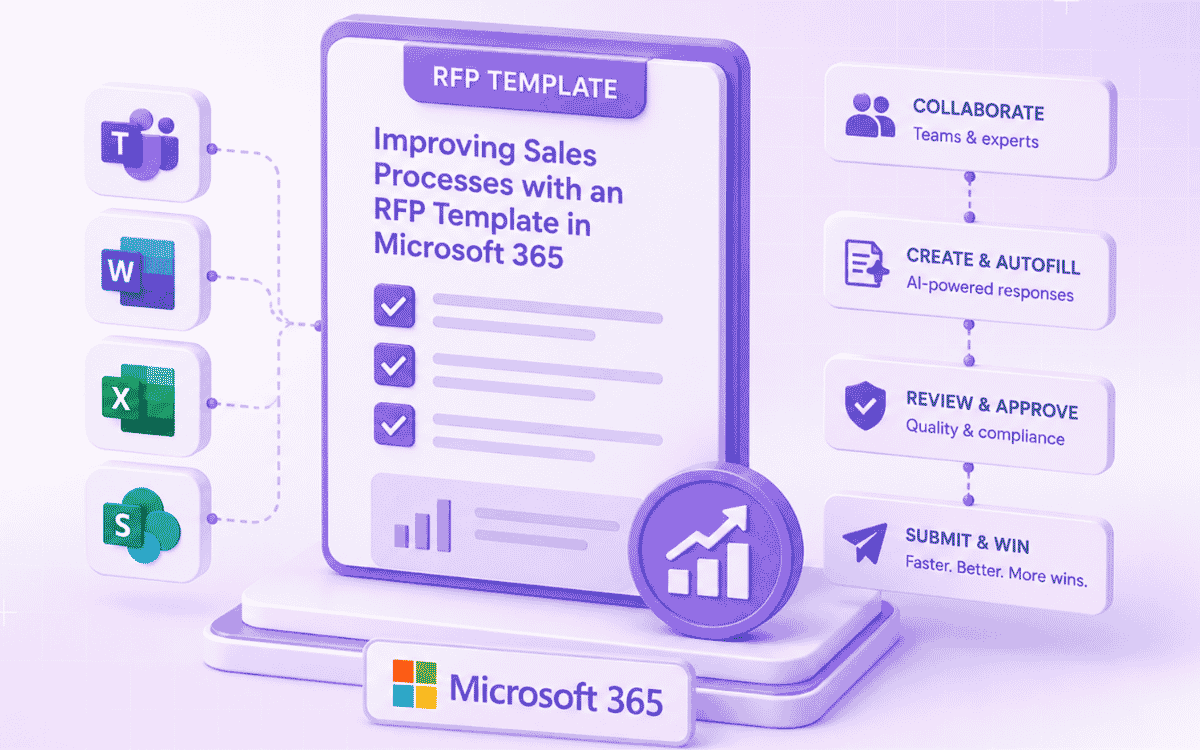
For presales and bid teams that spend significant time responding to RFPs, building proposals, or finding technical documentation, tools that automate these workflows free up hours for actual selling. SiftHub's AI RFP software auto-fills responses from connected knowledge sources — CRM, Google Drive, Confluence, Slack, SharePoint, past submissions, and approved Q&A libraries — so reps spend time on qualified pipeline conversations rather than content assembly. This efficiency compounds across the team: Superhuman reclaimed 8+ hours per rep per week after deployment — the equivalent of a full selling day returned to the team every week.
Measuring and adjusting quotas
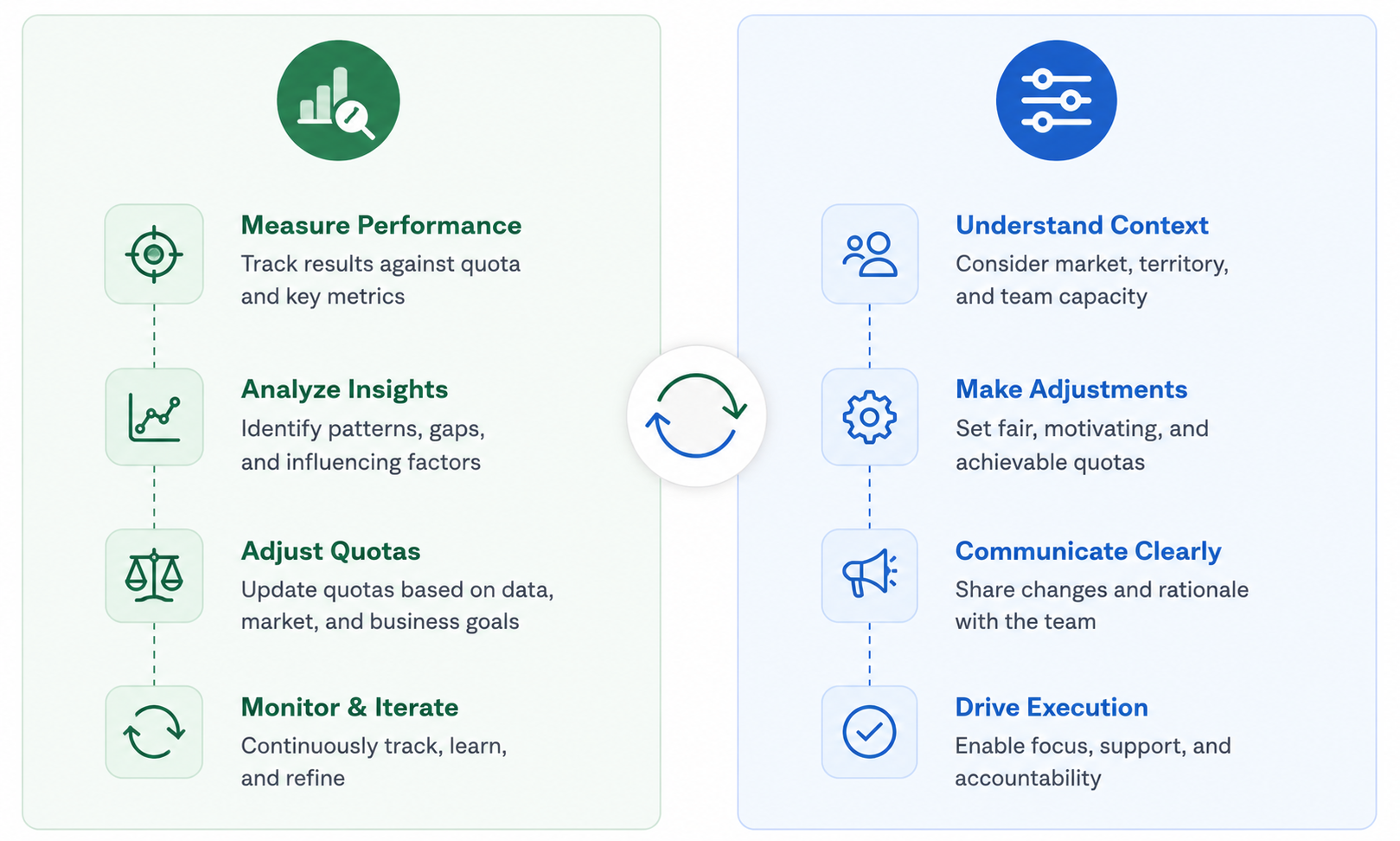
Quotas should not be static. Regular measurement and adjustment keep targets aligned with reality.
Track quota attainment across the team
Monitor what percentage of reps hit quota each period. Healthy attainment rates cluster around 60% to 70%, enough that quotas feel achievable but not so high that they lack challenge. If attainment rates drop below 40% for multiple consecutive quarters, quotas likely need to be adjusted downward. If attainment consistently exceeds 85%, quotas may be too conservative.
Measure leading indicators
Revenue quotas are lagging indicators; by the time you know you missed quota, it is too late to fix the quarter. Track leading indicators like pipeline coverage, conversion rates at each funnel stage, and activity levels to predict whether quotas are at risk before the quarter closes.
If pipeline coverage drops below 3x quota mid-quarter, that is a leading signal that quota attainment is at risk. Early intervention—increased prospecting focus, deal acceleration efforts, or pulling forward next-quarter opportunities—can salvage outcomes that would otherwise miss.
Adjust quotas when circumstances change significantly
Material changes warrant quota adjustments: major product releases that expand the addressable market, new competitors that increase friction, economic shifts that impact buyer budgets, or organizational changes like territory redraws or pricing updates.
Be cautious with mid-period adjustments as they can feel arbitrary to reps, but when conditions change enough that original quotas are no longer meaningful, adjustments are better than maintaining targets everyone knows are unrealistic.
The bottom line
Sales quotas are the fundamental performance metric in revenue organizations, but setting and achieving them requires more sophistication than simple top-down math. Effective quotas balance organizational revenue needs with realistic assessments of what teams can achieve given market conditions, territory quality, product maturity, and sales capacity.
For individual reps, quota achievement comes down to pipeline discipline, deal qualification, time allocation that maximizes selling hours, and continuous skill development. For teams, it requires coordinated pipeline management, knowledge sharing, and tool stacks that eliminate friction from critical workflows.
The teams and reps that consistently achieve quota are not those with the easiest targets; they are those who treat quota achievement as a systematic process requiring disciplined execution across multiple dimensions, not as a matter of hope and heroic effort.