


.avif)

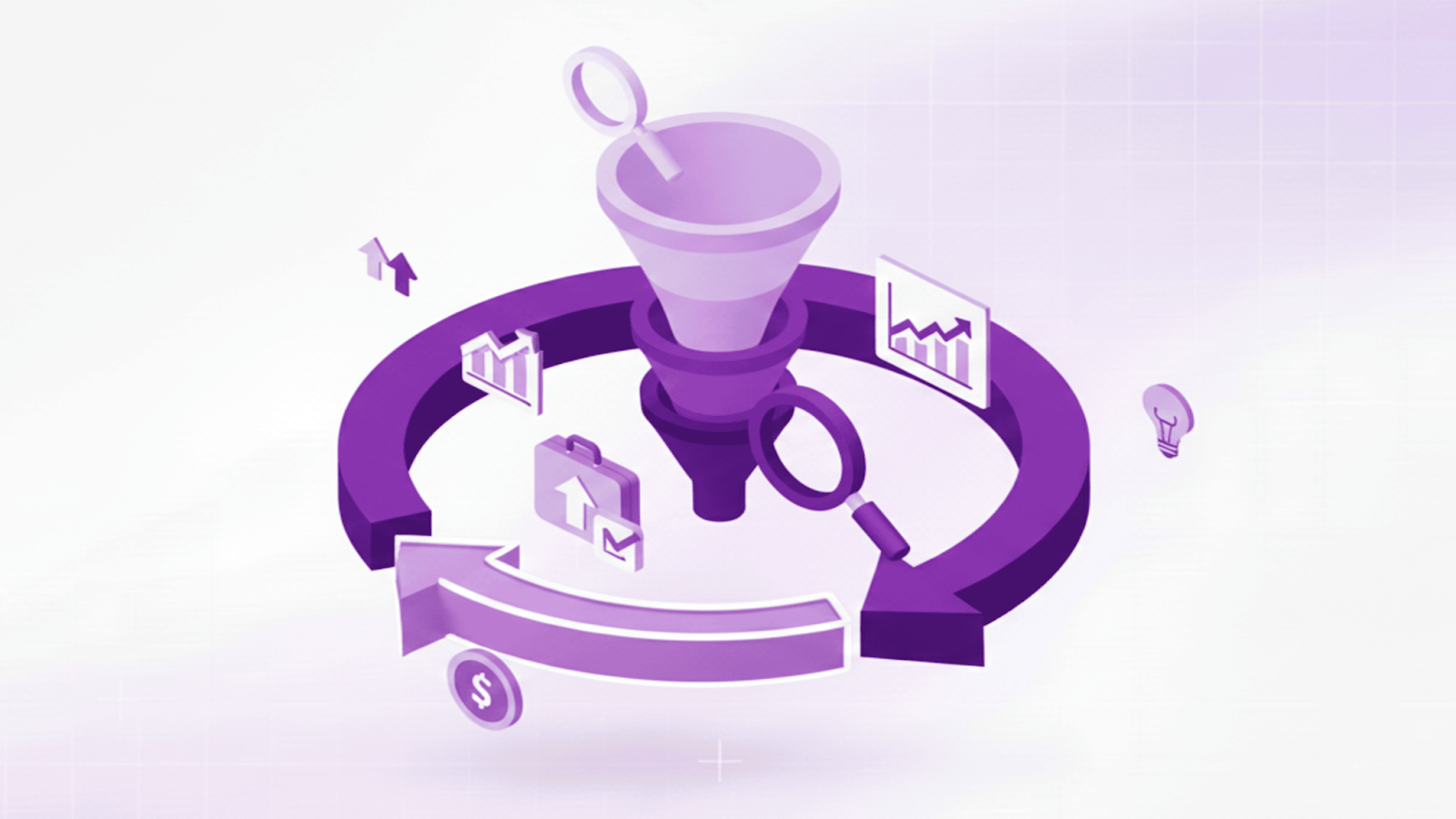
A sales funnel is a visual representation of the customer journey from first awareness through purchase and retention. The funnel shape reflects natural attrition as large numbers of prospects enter at the top (awareness stage), but progressively fewer continue through each subsequent stage, with only a fraction ultimately converting to customers at the bottom.
Key takeaways:
- 6 essential stages: Awareness (brand recognition, content marketing, paid ads), interest (website exploration, content engagement), consideration (product demos, case studies, trials), intent/decision (proposal delivery, objection handling), purchase (contract execution, payment), post-purchase (onboarding, retention, advocacy, upsells)
- Critical metrics: Conversion rates between stages, time in stage/sales cycle length, lead volume and velocity, win rates and deal size, customer acquisition cost vs. lifetime value (3:1 to 5:1 target ratio)
- Optimization strategies: Identify primary bottleneck; improve lead quality through targeting; reduce friction between stages; personalize buyer experience; align content to funnel stages; enable instant knowledge access
Common mistakes: Confusing activity with results; neglecting the post-purchase funnel; treating all leads equally; optimizing stages in isolation.
A sales funnel is a visual representation of the customer journey from first awareness through purchase and retention. The funnel shape reflects natural attrition as large numbers of prospects enter at the top (awareness stage), but progressively fewer continue through each subsequent stage, with only a fraction ultimately converting to customers at the bottom.
Key takeaways:
- 6 essential stages: Awareness (brand recognition, content marketing, paid ads), interest (website exploration, content engagement), consideration (product demos, case studies, trials), intent/decision (proposal delivery, objection handling), purchase (contract execution, payment), post-purchase (onboarding, retention, advocacy, upsells)
- Critical metrics: Conversion rates between stages, time in stage/sales cycle length, lead volume and velocity, win rates and deal size, customer acquisition cost vs. lifetime value (3:1 to 5:1 target ratio)
- Optimization strategies: Identify primary bottleneck; improve lead quality through targeting; reduce friction between stages; personalize buyer experience; align content to funnel stages; enable instant knowledge access
Common mistakes: Confusing activity with results; neglecting the post-purchase funnel; treating all leads equally; optimizing stages in isolation.
Understanding what a sales funnel is represents one of the most fundamental concepts in modern business. Whether you're launching a startup, scaling an established company, or optimizing an existing sales process, grasping how prospects move from initial awareness to final purchase determines your ability to generate predictable, scalable revenue. Sales funnels aren't just theoretical frameworks; they're practical tools that reveal exactly where potential customers drop off, which marketing tactics work, and how to allocate resources for maximum return.
This comprehensive guide explains what a sales funnel is, breaks down each stage of the customer journey, identifies the key metrics that reveal funnel health, and provides actionable strategies for optimization. By the end, you'll understand how to build, analyze, and continuously improve your sales funnel to convert more prospects into paying customers.
What is a sales funnel?
A sales funnel is a visual representation of the customer journey from first becoming aware of your company through making a purchase and potentially becoming a repeat customer. The funnel metaphor describes how large numbers of prospects enter at the top (awareness stage), but progressively fewer people continue through each subsequent stage, with only a fraction ultimately converting to customers at the bottom.
The funnel shape reflects natural attrition throughout the buying process. Not everyone who learns about your product needs it. Not everyone who needs it has a budget. Not everyone with a budget will choose your solution over competitors. Understanding this narrowing process enables organizations to set realistic expectations, identify opportunities for improvement, and forecast revenue based on funnel metrics.
Why sales funnels matter for business success?
- Visibility into the customer journey
Sales funnels illuminate the often-invisible process by which strangers become customers. Without funnel awareness, organizations don't understand where prospects enter their ecosystem, what experiences move them forward, or where they disengage. This lack of visibility makes improvement impossible; you can't optimize what you can't measure.
Mapping your sales funnel creates shared understanding across teams. Marketing knows how many leads sales need at the top to hit revenue targets. Sales understands which lead sources convert best. Customer success recognizes how initial sales experiences affect long-term retention. This cross-functional alignment ensures everyone works toward common goals rather than optimizing their individual metrics at others' expense.
- Identification of bottlenecks and leaks
Well-instrumented sales funnels reveal exactly where prospects drop off. Maybe your website attracts significant traffic, but few visitors provide contact information (top of funnel problem). Perhaps sales teams schedule numerous discovery calls, but few progress to the proposal stage (middle of funnel issue). Or maybe prospects request proposals but rarely sign contracts (bottom of funnel challenge).
These insights drive focused improvement efforts. Rather than generic "we need more sales" directives, funnel analysis enables targeted interventions: "We're losing 70% of prospects between demo and proposal, let's investigate why and test solutions." This precision accelerates improvement compared to unfocused efforts that don't address actual problems.
- Forecasting and resource allocation
Organizations with quantified sales funnels can predict future revenue based on the current pipeline. If you know that historically 10% of leads become customers with an average deal size of $5,000, then 1,000 new leads this month should generate approximately $500,000 in revenue over your typical sales cycle. This predictability supports budgeting, hiring decisions, and growth planning.
Resource allocation improves when you understand funnel economics. If generating qualified leads costs $100 per lead but sales can only handle 50 new leads monthly before conversion rates decline due to capacity constraints, you know whether to invest in more marketing (to fill unused sales capacity) or hire additional sales representatives (to handle marketing-generated demand).
The essential stages of a sales funnel
Stage 1: Awareness
The awareness stage represents the widest part of the funnel, where potential customers first learn about your company, product, or service. At this stage, most people don't actively seek your solution; they might not even recognize they have a problem you could solve. Your goal is simply to get on their radar and establish basic brand recognition.
Common awareness tactics include:
- Content marketing: Blog posts, videos, podcasts, and social media content that address topics your target audience cares about attract attention.
- Paid advertising: Search ads, social media advertising, display campaigns, and sponsored content put your brand in front of defined audiences. Paid channels offer quick awareness generation compared to organic approaches that build slowly over time.
- Public relations and media coverage: Earned media through news articles, podcast interviews, or industry publications provides third-party validation that paid advertising cannot match.
- Word of mouth and referrals: Existing customers telling others about positive experiences represents the most credible awareness source. Referral programs systematize and incentivize this organic process.
- Events and sponsorships: Conference attendance, webinar hosting, or event sponsorship connect your brand with engaged audiences interested in relevant topics.
At the awareness stage, metrics focus on reach and exposure: website traffic, social media impressions, content views, and brand search volume. The goal isn't immediate conversion but rather building a large pool of prospects who can progress to later funnel stages.
Stage 2: Interest
Once prospects know you exist, the interest stage involves them actively seeking more information about your offerings. They've moved beyond passive awareness to genuine curiosity about whether your solution might address their needs. This stage separates casual browsers from potentially qualified prospects.
Interest stage activities include:
- Website exploration: Prospects who visit multiple pages, read detailed product information, or consume educational resources demonstrate interest beyond initial curiosity.
- Content engagement: Downloading whitepapers, attending webinars, subscribing to newsletters, or requesting demonstrations shows intentional engagement rather than accidental exposure.
- Social media following: Choosing to follow your accounts or engage with content indicates ongoing interest in your company and offerings.
- Initial questions: Prospects who reach out via contact forms, live chat, or social media with specific questions about your products signal active evaluation.
Modern sales teams use this stage to begin qualification and nurturing. Not everyone who shows interest represents a good-fit customer. Smart organizations provide self-service resources that help prospects determine fit while capturing information that reveals whether someone matches ideal customer profiles.
Metrics at this stage include email list growth, content download rates, webinar registration and attendance, and engagement rates on educational content. The focus shifts from raw reach to quality of engagement.
Stage 3: Consideration
The consideration stage finds prospects actively evaluating whether your solution meets their needs and comparing you against alternatives. They've determined they have a problem worth solving and are researching potential solutions. Your goal is to demonstrate that your offering best addresses their specific requirements.
Consideration stage tactics include:
- Product demonstrations: Live or recorded demos showing your solution in action help prospects visualize how it would work for their specific use cases.
- Case studies and testimonials: Social proof from similar customers who achieved measurable results reduces risk perception and builds confidence.
- Comparison guides: Honest assessments of how your solution differs from competitors (without disparaging them) help prospects make informed decisions.
- Free trials or pilots: Hands-on experience with your product provides the most convincing evidence of fit and value.
- Consultative conversations: Discovery calls where sales teams ask questions to understand prospect needs and explain relevant capabilities, build trust, and personalize.
Presales and solutions teams play critical roles at this stage, answering technical questions, customizing demonstrations to prospect use cases, and providing detailed information that influences purchase decisions. Access to comprehensive product knowledge becomes essential; delays in answering questions or providing information can cause prospects to disengage or choose competitors.
SiftHub acts as an AI sales assistant, helping teams respond instantly to prospect questions directly from the apps they work on, such as Slack, Gmail, Teams, etc. Through SiftHub’s Chrome browser extension and Microsoft add-in, sales reps and solution engineers can query knowledge across the organization. Rather than hunting for technical specifications, security documentation, or case studies, they can access verified information in seconds, maintaining momentum during critical evaluation periods.
Stage 4: Intent/Decision
At the intent or decision stage, prospects have essentially decided to purchase a solution in your category and are making a final vendor selection. They're comparing final proposals, negotiating terms, seeking internal approval, or completing procurement processes. The finish line is visible, but deals can still be lost if you don't handle this stage carefully.
Decision stage focus areas include:
- Proposal delivery: Professional, comprehensive proposals that clearly articulate value, scope, pricing, and terms give prospects confidence in moving forward.
- Objection handling: Addressing remaining concerns about implementation, integration, support, or pricing prevents last-minute hesitation.
- Contract negotiation: Finding mutually acceptable terms on pricing, service levels, liability, and other contractual elements while protecting your interests.
- Internal champion enablement: Providing your internal champion with materials, ROI calculations, and compelling arguments helps them sell your solution to other stakeholders.
- Competitive differentiation: Reinforcing why your solution is superior to alternatives under consideration without appearing desperate or disparaging competitors.
AI teammate capabilities turn sellers into deal-closing powerhouses at this critical stage. The AI teammate helps reps prepare for objection handling with instant access to verified answers, finds or creates the right collateral to empower internal champions with persuasive materials, and delivers real-time competitive intelligence and battlecard creation to fuel differentiation, ensuring your team is armed with everything needed to win without delays that could cause prospects to lose momentum or choose faster-moving competitors.
Decision stage metrics include close rates, average contract value, sales cycle length from intent to close, and discount levels. These metrics reveal how effectively you're converting late-stage opportunities into revenue.
Stage 5: Purchase
The purchase stage represents the actual transaction where prospects become customers by signing contracts and submitting payment. For simple products, this might be a quick online checkout. Complex B2B sales involve contract execution, payment processing, and initial onboarding.
Purchase stage priorities include:
- Friction reduction: Making the purchase process as simple as possible prevents last-minute abandonment. Complicated checkouts, unclear next steps, or excessive paperwork create unnecessary obstacles.
- Payment flexibility: Offering multiple payment methods, financing options, or billing schedules accommodates different customer preferences and constraints.
- Clear communication: Setting proper expectations about what happens after purchase, implementation timelines, onboarding processes, and support availability, builds confidence and reduces buyer's remorse.
- Documentation and compliance: Ensuring all legal, financial, and compliance requirements are satisfied protects both parties and prevents post-purchase disputes.
Purchase stage metrics include cart abandonment rates, payment success rates, time from verbal agreement to contract signature, and initial customer satisfaction scores. Even customers who've decided to buy can be lost if the purchase process creates friction or confusion.
Stage 6: Post-purchase (retention and advocacy)
Modern sales funnels extend beyond the initial purchase to include customer retention, expansion, and advocacy. Acquiring new customers costs significantly more than retaining existing ones, making post-purchase experience critical for sustainable business growth.
Post-purchase activities include:
- Onboarding and implementation: Successful initial experiences ensure customers achieve early value, reducing churn risk and creating a foundation for expansion.
- Ongoing support and success management: Proactive outreach, responsive support, and continuous value demonstration keep customers satisfied and engaged.
- Upsell and cross-sell opportunities: Existing customers who've experienced value represent the best prospects for additional products, upgrades, or expanded usage.
- Referral and advocacy programs: Satisfied customers become your best marketing channel through referrals, testimonials, case study participation, and positive reviews.
- Renewal and retention: For subscription businesses, renewal decisions represent critical moments requiring attention similar to initial purchase decisions.
The transition from sales to customer success often suffers from information loss, critical context from the sales cycle gets trapped in scattered emails, Slack threads, and call recordings. SiftHub's Post-sales Handover Agent solves this by automatically generating comprehensive handover summaries from connected sources like Drive, customer relationship management (CRM) systems, and Slack.
Customer success teams receive a complete picture, including annual recurring revenue (ARR)/total contract value (TCV), close dates, contract terms, stakeholder snapshots with titles and sentiment, and a clear breakdown of all commitments made during the sales cycle, with every detail traced back to verified sources. This ensures seamless transitions where customer success managers can engage customers from day 1 with full context, rather than spending weeks catching up or, worse, asking customers to repeat information they already shared.
Post-purchase metrics include customer retention rates, net revenue retention (including expansions and contractions), customer lifetime value, net promoter score (NPS), and referral volume. These metrics increasingly influence overall business health as organizations recognize that predictable recurring revenue from satisfied customers provides more stability than constantly chasing new logos.
Essential sales funnel metrics
- Conversion rates between stages
Conversion rates show how effectively prospects move through each funnel stage. Tracking these transitions highlights where momentum drops, whether it’s weak early-stage messaging or issues closing qualified opportunities. Benchmarks vary widely by industry and deal complexity, so the real value lies in comparing performance against your own historical trends and improving over time.
- Time in stage and sales cycle length
Time spent in each stage reveals process bottlenecks and efficiency gaps. If deals stall in a specific phase, that’s where optimization matters most. Overall, sales cycle length affects cash flow, forecasting accuracy, and rep productivity. While shorter cycles are generally better, forcing speed at the expense of buyer readiness often reduces conversion.
- Lead volume and velocity
Lead volume determines future pipeline, while lead velocity indicates whether revenue is likely to grow or stall. Increasing lead flow month over month supports predictable growth, assuming conversion rates hold. Quality matters as much as quantity; fewer well-qualified leads typically outperform large volumes of poor-fit prospects.
- Win rates and deal size
Win rate reflects sales effectiveness with qualified opportunities. Low win rates point to pricing, positioning, or execution issues, while high win rates with low volume suggest pipeline gaps. Combined with average deal size, win rate helps identify whether growth should come from closing better, selling bigger, or sourcing more opportunities.
- Customer acquisition cost (CAC) and lifetime value (LTV)
CAC measures the cost to acquire a customer across sales and marketing, while LTV estimates the total value that the customer generates. The LTV: CAC ratio signals business health; most sustainable models target roughly 3:1 to 5:1. Ratios below this indicate inefficient acquisition; significantly higher ratios may suggest under-investment in growth.
How to optimize your sales funnel?
- Identify the primary bottleneck
Every sales funnel has one stage that limits overall performance. Improving the weakest transition delivers far greater impact than small gains elsewhere. Focus first on where prospects drop off or stall the longest.
Checklist
- Calculate conversion rates between all stages
- Identify the lowest-performing or slowest stage
- Validate the issue using behavior data and feedback
Survey people who didn't progress, interview those who did to learn what convinced them, and analyze behavioral data for patterns. Understanding the "why" behind the bottleneck informs effective solutions.
- Improve lead quality through targeting
High lead volume means little if prospects aren’t a good fit. Better targeting increases conversion rates, shortens sales cycles, and reduces wasted sales effort.
Checklist
- Refine your ideal customer profile (ICP)
- Identify segments with the highest close rates
- Implement lead scoring based on fit and intent
Refine targeting by analyzing which prospect characteristics correlate with purchase likelihood. Perhaps customers in certain industries convert at 25% while others convert at 5%. Or maybe companies with more than 200 employees become customers while smaller firms rarely do. Use these insights to focus lead generation on high-potential segments.
- Reduce friction between funnel stages
Every additional step creates drop-off risk. Simplifying transitions keeps momentum high and prevents qualified prospects from disengaging.
Checklist
- Remove unnecessary form fields and steps
- Clarify next actions at each stage
- Improve response speed to prospect requests
Sales collateral builder capabilities help reduce friction by enabling rapid creation of customized proposals, one-pagers, and follow-up materials. When prospects request information, teams can generate professional, personalized responses in minutes rather than days, maintaining momentum during critical decision periods.
- Personalize the buyer Eexperience
Generic messaging underperforms in competitive markets. Personalization improves relevance by aligning messaging with buyer context and intent.
Checklist
- Tailor messaging by industry, role, and company size
- Adapt communication to funnel stage
- Use automation or AI to personalize at scale
Personalization technology enables customization at scale. Rather than sales representatives manually researching each prospect and crafting custom messages, AI-powered systems can generate personalized content based on prospect characteristics, behaviors, and context while maintaining authenticity and relevance.
- Align content to funnel stages
Different stages require different content. Gaps, especially late in the funnel, slow decisions, and weaken confidence.
Checklist
- Awareness content is educational, not sales-led
- Consideration content explains capabilities and differentiation
- Decision content includes proof, pricing, and ROI
Content effectiveness improves when it's easily discoverable by both prospects and internal teams. Enterprise search ensures sales representatives can quickly find relevant materials for specific prospect situations rather than emailing colleagues or recreating content that already exists but can't be located. AI agents embedded directly in sales workflows can intelligently surface the right content for each deal stage, analyzing context from your CRM and automatically recommending the most relevant assets based on prospect needs and buying signals.
- Enable Sales With Instant Access to Knowledge
Delayed answers reduce trust and stall deals. Sales teams need immediate access to accurate, approved information during live conversations.
Checklist
- Centralize sales and product knowledge
- Ensure fast, searchable access for reps
- Maintain accuracy with source verification
By deploying AI as an always-on teammate within the tools sales teams already use, integrated into Slack, CRM platforms, or sales enablement systems, teams gain on-demand support during live prospect interactions. Rather than interrupting subject matter experts or scheduling callback meetings to answer questions, sales reps can query AI systems that instantly surface relevant documentation, specifications, case studies, and proof points with complete source traceability, all without leaving their workflow.
- Nurture Prospects Who Aren’t Ready to Buy
Most prospects won’t convert immediately. Thoughtful nurturing keeps relationships warm until timing aligns.
Checklist
- Segment nurture flows by behavior and interest
- Share relevant, value-driven content
- Maintain consistent but non-pushy engagement
Someone who downloaded competitive comparison content should receive different nurturing than someone who engaged with implementation best practices. This relevance increases engagement and eventual conversion compared to generic "stay in touch" campaigns.
- Test, Measure, and Iterate Continuously
Buyer behavior and markets change. Ongoing testing ensures your funnel stays effective over time.
Checklist
- A/B test messaging and funnel changes
- Track funnel metrics regularly
- Act quickly on declining performance signals
Track funnel metrics over time to identify trends. Gradually declining conversion rates signal emerging problems requiring attention. Improving metrics validates successful optimizations and indicates approaches worth expanding. Regular analysis prevents surprises and enables proactive improvement rather than reactive problem-solving.
Common sales funnel mistakes to avoid
- Confusing activity with results
Generating large lead volumes feels productive, but accomplishes nothing if those leads don't convert. Scheduling numerous sales calls creates activity but not necessarily revenue. Don't confuse being busy with making progress; focus on outcomes (conversion rates, closed revenue) rather than activities (calls made, emails sent).
- Neglecting the post-purchase funnel
Organizations obsessed with new customer acquisition while ignoring retention and expansion leave massive value uncaptured. Acquiring customers costs significantly more than expanding relationships with satisfied existing customers. Post-purchase experience determines whether customers renew, expand, refer others, and provide positive testimonials, all critical for sustainable growth.
- Treating all leads equally
Not all prospects deserve equal investment. High-potential leads from ideal customer segments showing strong buying signals warrant significant sales attention. Poor-fit prospects from the wrong industries with no timeline should receive minimal resources. Lead scoring and qualification frameworks ensure appropriate resource allocation rather than first-come-first-served approaches that waste time on unlikely conversions.
- Optimizing stages in isolation
Improving one funnel stage while ignoring its impact on others can reduce overall performance. Dramatically lowering qualification standards to improve awareness-to-interest conversion might flood sales teams with poor-fit prospects, reducing their close rates and overall productivity. Optimize the complete funnel considering interactions between stages, not individual transitions in isolation.
- Setting up your funnel and forgetting about it
Initial funnel design represents a starting point, not a finished product. Markets change, competitors evolve, and customer expectations shift. Funnels that worked brilliantly last year may underperform today if not continuously refined. Schedule regular funnel reviews, analyze performance trends, and implement improvements based on data and feedback.
Transform your sales funnel performance
Understanding what a sales funnel is provides an essential foundation for business growth, but execution determines results. Organizations that systematically build, measure, and optimize their funnels convert more prospects, shorten sales cycles, and achieve more predictable revenue than those operating without clear funnel awareness.
The difference between mediocre and exceptional funnel performance often comes down to execution speed and knowledge accessibility. When sales teams can instantly access the right information to answer prospect questions, generate customized proposals in minutes rather than days, and provide consistent, accurate responses across all interactions, conversion rates improve dramatically.
Ready to accelerate your sales funnel with AI-sales assistant access and response generation? Discover how SiftHub helps sales and presales teams convert more prospects by providing instant access to verified information, generating customized collateral rapidly, and ensuring consistent, on-brand communication throughout the customer journey. Book a demo to see how optimized knowledge management transforms sales funnel performance, or start your free trial today.