




A business requirements document (BRD) outlines what a project must accomplish from a business perspective, translating strategic objectives into actionable specifications. Unlike technical specs that detail how to build something, BRDs focus on what needs to be built and why it matters.
Key takeaways:
- Core purpose: Prevents scope creep, aligns stakeholder expectations, eliminates wasted development cycles, and accelerates implementation by documenting clear project goals upfront
- Essential components: Executive summary, project background/drivers, SMART objectives, defined scope (in/out), functional and non-functional requirements, stakeholder roles, assumptions/constraints, success metrics, timeline, cost-benefit analysis
- Document length: 5-10 pages for simple projects; 20-50 pages for complex enterprise implementations requiring detailed requirements and stakeholder analysis
- Common mistake: Writing vague requirements ("improve efficiency") instead of measurable objectives ("reduce RFP response time from 5 days to 24 hours").
A business requirements document (BRD) outlines what a project must accomplish from a business perspective, translating strategic objectives into actionable specifications. Unlike technical specs that detail how to build something, BRDs focus on what needs to be built and why it matters.
Key takeaways:
- Core purpose: Prevents scope creep, aligns stakeholder expectations, eliminates wasted development cycles, and accelerates implementation by documenting clear project goals upfront
- Essential components: Executive summary, project background/drivers, SMART objectives, defined scope (in/out), functional and non-functional requirements, stakeholder roles, assumptions/constraints, success metrics, timeline, cost-benefit analysis
- Document length: 5-10 pages for simple projects; 20-50 pages for complex enterprise implementations requiring detailed requirements and stakeholder analysis
- Common mistake: Writing vague requirements ("improve efficiency") instead of measurable objectives ("reduce RFP response time from 5 days to 24 hours").
Nearly half derail because business and project goals don't align. The culprit? Missing or inadequate business requirements documentation.
Whether you're launching new software, implementing a customer relationship management (CRM) system, or restructuring internal workflows, a business requirements document (BRD) serves as your project's blueprint. Without this critical foundation, teams waste time on misaligned deliverables, stakeholders argue over scope, and budgets spiral beyond control.
For sales teams, presales and solutions teams, and bid and proposal teams, clear documentation becomes even more critical. When responding to requests for proposal (RFP) or implementing new sales technologies, a well-crafted BRD ensures everyone understands project goals, requirements, and success criteria from day one.
What is a business requirements document?
A business requirements document outlines what a project must accomplish from a business perspective. Unlike technical specifications that detail how to build something, a BRD focuses on what needs to be built and why it matters to the organization.
Think of a BRD as the translation layer between business stakeholders who understand organizational needs and development teams who implement solutions. The document captures:
- Business objectives and expected outcomes
- Functional and non-functional requirements
- Project scope and boundaries
- Stakeholder expectations and constraints
- Success metrics and acceptance criteria
For revenue teams, BRDs become especially valuable when implementing tools that impact deal velocity. A clear business requirements example might outline how a new proposal automation system should integrate with existing knowledge bases, reduce response times, and maintain brand consistency across all customer-facing documents.
Business requirements document vs functional requirements document
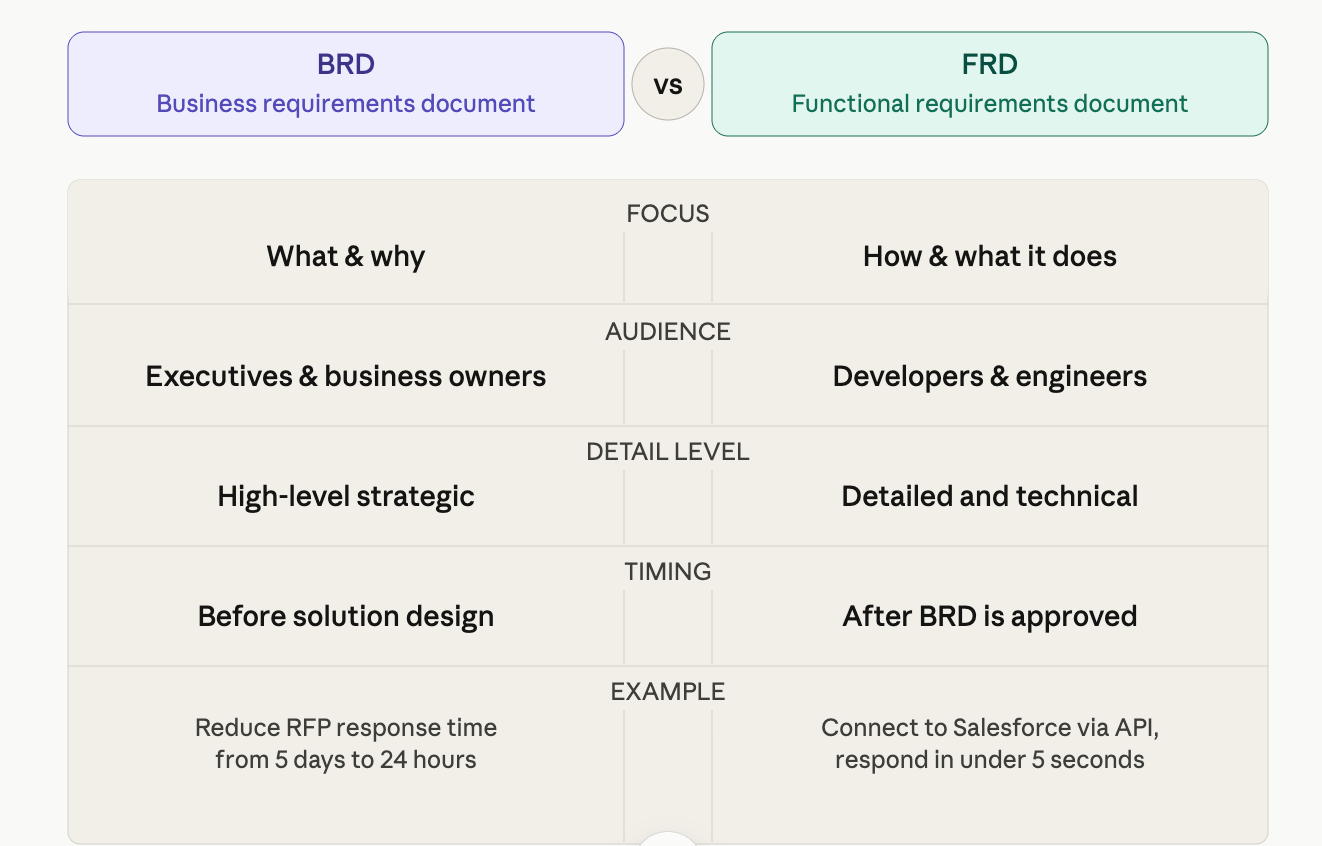
Business requirements documents and functional requirements documents serve different purposes, yet teams often confuse the two. Understanding the distinction ensures appropriate documentation for each project phase.
Business requirements document (BRD) answers what needs to be accomplished and why. It focuses on business objectives, strategic goals, and expected outcomes from a business stakeholder perspective. BRDs are high-level, created early in the project lifecycle before solution design begins, and target executives and business owners as the primary audience.
Functional requirements document (FRD) answers how the solution will work and what it will do. It focuses on system capabilities, technical behaviors, and specific features from a development team perspective. FRDs are detailed and technical, created after BRD approval during the solution design phase, and target developers and engineers.
Example comparison:
- Business requirement (BRD): "Reduce proposal response time from 5 days to 24 hours to improve competitive positioning."
- Functional requirement (FRD): "System must connect to Salesforce and Confluence via API and generate responses in under 5 seconds."
The BRD defines strategic business outcomes while the FRD specifies exactly how systems will enable those outcomes. Projects need both documents: BRDs ensure you're solving the right problems; FRDs ensure you're solving them correctly.
Why do business requirements documents matter for project success?
Organizations that skip formal requirements documentation experience predictable problems:
- Scope creep and project drift: Without defined boundaries, projects expand beyond original intentions. Features get added mid-stream, timelines extend indefinitely, and budgets exceed projections. A BRD establishes a clear scope from the beginning, documenting what's included and explicitly calling out what's not.
- Misaligned stakeholder expectations: When business leaders envision one solution while development teams build another, disappointment is inevitable. BRDs create shared understanding by documenting exactly what success looks like for all parties involved.
- Wasted development cycles: Developers building features that don't address actual business needs waste valuable time and resources. A comprehensive BRD ensures technical teams understand the business context behind every requirement.
- Implementation delays: Projects without documented requirements encounter constant clarification requests, approval bottlenecks, and rework cycles. Clear upfront documentation accelerates implementation by eliminating ambiguity.
For teams managing complex RFP response processes or implementing sales enablement tools, these challenges compound quickly. A BRD prevents the chaos that derails revenue-generating projects.
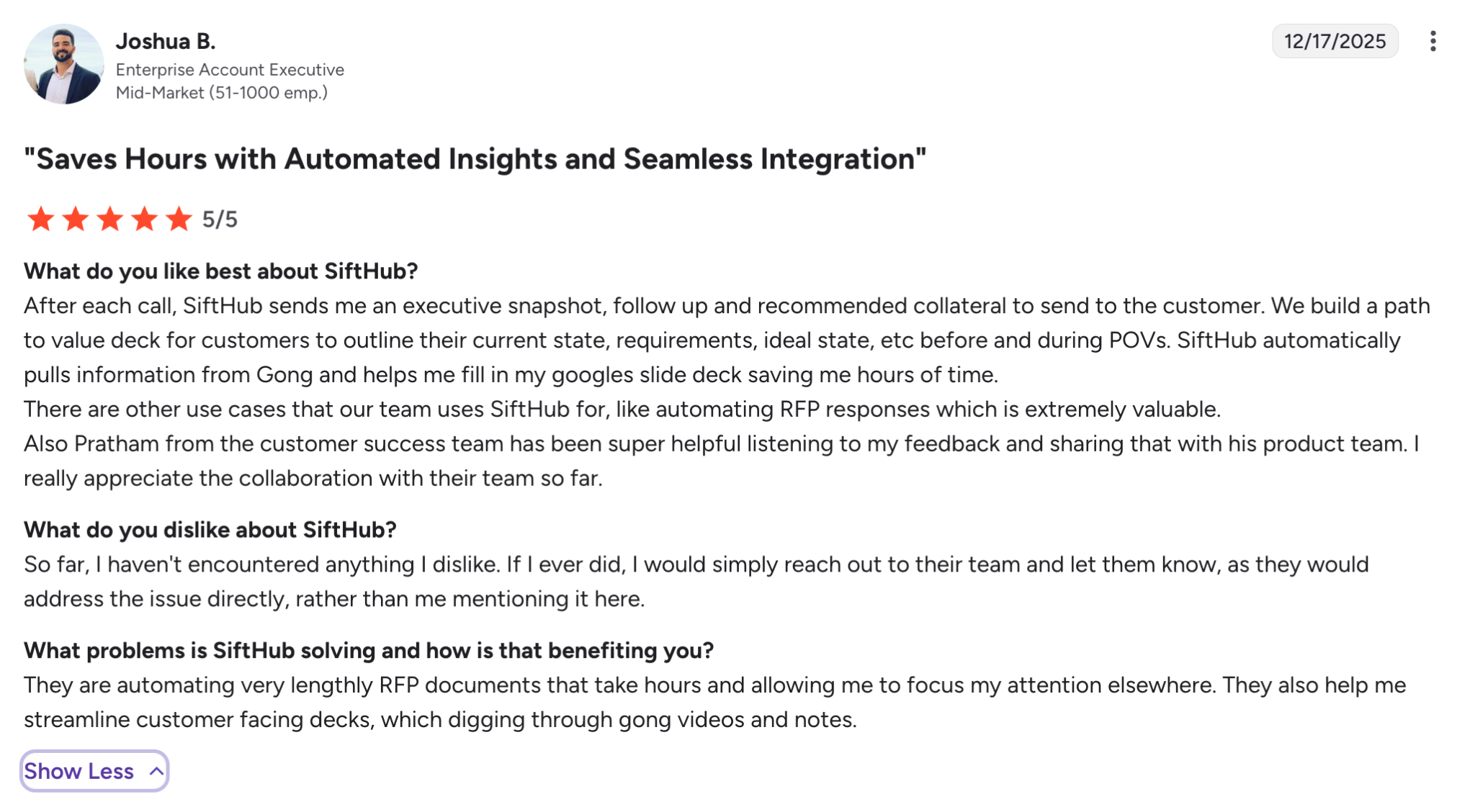
Real-world feedback from a verified SiftHub user highlights the value of structured requirements management in preventing inefficiencies and keeping projects aligned with business goals:
Core components of an effective business requirements document
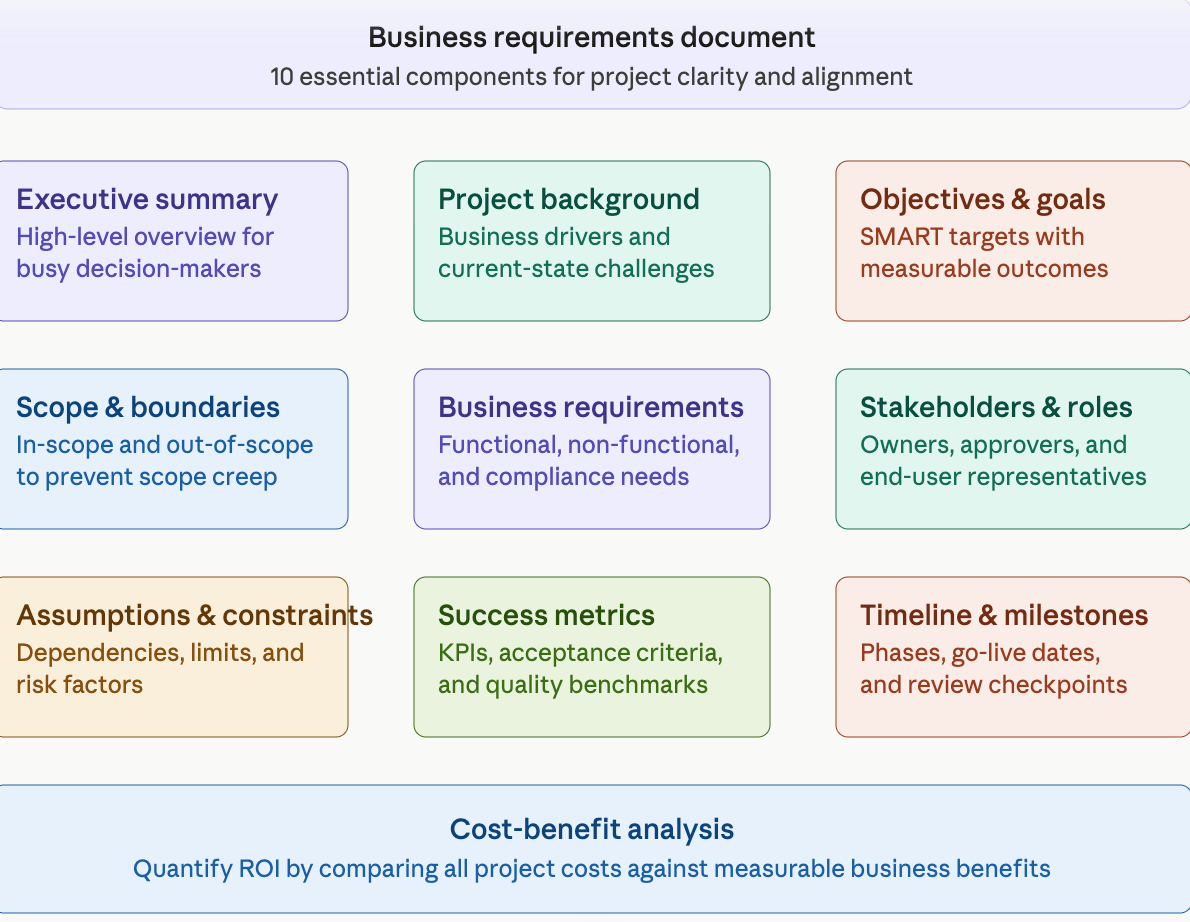
A comprehensive BRD includes several essential sections that together provide complete project clarity:
Executive summary
The executive summary provides a high-level project overview in 2-3 paragraphs. Busy executives should understand the project's value, scope, and expected business impact without reading the entire document.
Include:
- Project purpose and business problem being solved
- Key objectives and expected outcomes
- High-level approach and timeline
- Strategic importance to the organization
This section gets written last, after all other components are complete, ensuring it accurately reflects the full scope documented throughout the BRD.
Project background and business drivers
This section explains why the project exists and what forces are driving it forward. Document:
- Current state challenges and pain points
- Market conditions or competitive pressures
- Regulatory or compliance requirements
- Strategic business goals the project supports
- Expected return on investment (ROI)
For example, a presales team implementing an AI sales assistant might cite increasing RFP volumes, longer response times, and competitive pressure to respond faster as key business drivers.
Project objectives and goals
Define specific, measurable objectives that the project aims to achieve. Strong objectives follow SMART criteria: specific, measurable, achievable, relevant, and time-bound.
Business requirements example objectives:
- Reduce RFP response time from 5 days to 24 hours
- Increase proposal win rate by 15% within 6 months
- Decrease manual content search time by 70%
- Improve response accuracy to eliminate post-submission corrections
Clear objectives enable teams to measure success objectively rather than relying on subjective assessments.
Project scope and boundaries
The scope section defines what the project will and won't deliver. This critical component prevents scope creep by establishing explicit boundaries.
- In scope: List specific deliverables, features, processes, and outcomes the project will address. Be as detailed as possible to avoid ambiguity.
- Out of scope: Equally important, document what the project explicitly excludes. This manages stakeholder expectations and provides clear guidance when questions arise about whether something should be included.
For sales collateral creation, the scope might include automated generation of one-pagers and follow-up emails, but exclude sales presentation design templates.
Business requirements
This section represents the heart of the document. List detailed requirements organized by category:
a. Functional requirements: What the solution must do. These action-oriented requirements describe specific capabilities, features, and behaviors.
Business requirements example:
- The system must retrieve relevant product information from connected knowledge sources
- The platform must generate customized responses based on the buyer's industry and company size
- Solution must provide source attribution for all generated content
- The tool must integrate with Slack and Microsoft Teams for in-workflow access
b. Non-functional requirements: How the solution should perform. These cover quality attributes like performance, security, usability, and scalability.
Examples:
- Response generation must complete in under 5 seconds
- System must support 500+ concurrent users
- The platform must maintain 99.9% uptime
- All data must be encrypted in transit and at rest
c. Operational requirements: How the solution impacts ongoing operations, including maintenance, support, training, and change management needs.
d. Compliance and regulatory requirements: Any legal, regulatory, or compliance standards the solution must meet, such as data protection regulations, industry certifications, or internal security policies.
For each requirement, specify priority level (critical, high, medium, low) to help teams make trade-off decisions during implementation.
Stakeholders and roles
Identify everyone involved in the project and their responsibilities:
- Project sponsor and executive stakeholders
- Business owners and subject matter experts
- Project manager and implementation team
- End users who will work with the solution daily
- Vendors or external partners
- Approval authorities for key decisions
Clear role definition prevents confusion about decision-making authority and ensures the right people stay informed at appropriate project stages.
Assumptions and constraints
Document factors that could impact project success:
Assumptions: Things you're assuming to be true. For example, "users will have basic technical proficiency" or "current infrastructure can support additional load."
Constraints: Limitations the project must work within, such as:
- Budget restrictions
- Timeline requirements
- Technology limitations
- Resource availability
- Regulatory restrictions
Documenting assumptions and constraints upfront helps identify risks and prevents surprises during implementation.
Success criteria and metrics
Define how you'll measure project success. Include:
- Key performance indicators (KPIs) with target values
- Acceptance criteria for deliverables
- Timeline milestones and checkpoints
- Quality benchmarks
- Business outcome metrics
For revenue teams implementing tools like SiftHub, success metrics might include reduced time spent on RFPs, improved sales efficiency, or increased deal velocity.
Timeline and milestones
Outline the project schedule with key phases, milestones, and deliverable dates. Include:
- Project kickoff date
- Requirements finalization deadline
- Design and development phases
- Testing and validation periods
- Training and change management activities
- Go-live date
- Post-implementation review
A clear timeline helps all stakeholders understand when they need to provide input or make decisions.
Cost-benefit analysis
The final section demonstrates project value by comparing costs against expected benefits:
- Costs: Include all project expenses such as software licenses, implementation services, training, internal resource time, and ongoing maintenance.
- Benefits: Quantify expected returns, including time savings, efficiency gains, revenue increases, cost reductions, and risk mitigation. When possible, translate benefits into monetary values.
This analysis helps secure executive approval and budget allocation by proving the project delivers positive ROI.
Step-by-step guide to drafting your business requirements document
Creating a comprehensive BRD requires a systematic approach and stakeholder collaboration:
1. Gather input from all stakeholders
Start by interviewing everyone who will be impacted by or involved in the project. For sales technology implementations, this includes:
- Sales leaders who understand strategic goals
- Account executives who will use the solution daily
- Sales engineers who need technical capabilities
- Proposal managers handling bid management
- IT teams managing integrations and security
- Finance stakeholders are concerned with budget and ROI
Use structured interviews, workshops, and surveys to capture diverse perspectives. Ask open-ended questions to uncover needs stakeholders might not articulate directly.
2. Analyze current state and identify gaps
Document how things work today and where problems exist. For teams struggling with manual RFP processes, this might involve:
- Mapping current workflow from RFP receipt to submission
- Identifying bottlenecks and inefficiencies
- Calculating time spent on repetitive tasks
- Measuring current win rates and response times
- Documenting knowledge management challenges
Understanding the current state clarifies what needs to improve and helps you define meaningful requirements.
3. Define clear objectives and scope
Based on stakeholder input and gap analysis, establish specific project goals. Ensure objectives directly address identified problems and support the broader business strategy.
Then define the scope carefully. Resist the temptation to solve every problem at once. Clearly delineate what this project will and won't address, documenting exclusions as explicitly as inclusions.
4. Document detailed requirements
For each requirement:
- Write in clear, actionable language
- Make requirements specific and measurable
- Assign priority levels
- Include acceptance criteria
- Note dependencies on other requirements
Organize requirements logically by category or user workflow. Use consistent formatting and numbering for easy reference.
When documenting requirements for sales engineering tools, include specific use cases like "generate technical response to security questionnaire" or "create competitive battlecard for active deal."
5. Validate and refine with stakeholders
Share draft requirements with stakeholders for review. Look for:
- Missing requirements, they identify
- Conflicting expectations between stakeholder groups
- Unclear or ambiguous language
- Requirements that don't support stated objectives
Iterate based on feedback until all stakeholders agree that the document accurately captures project needs.
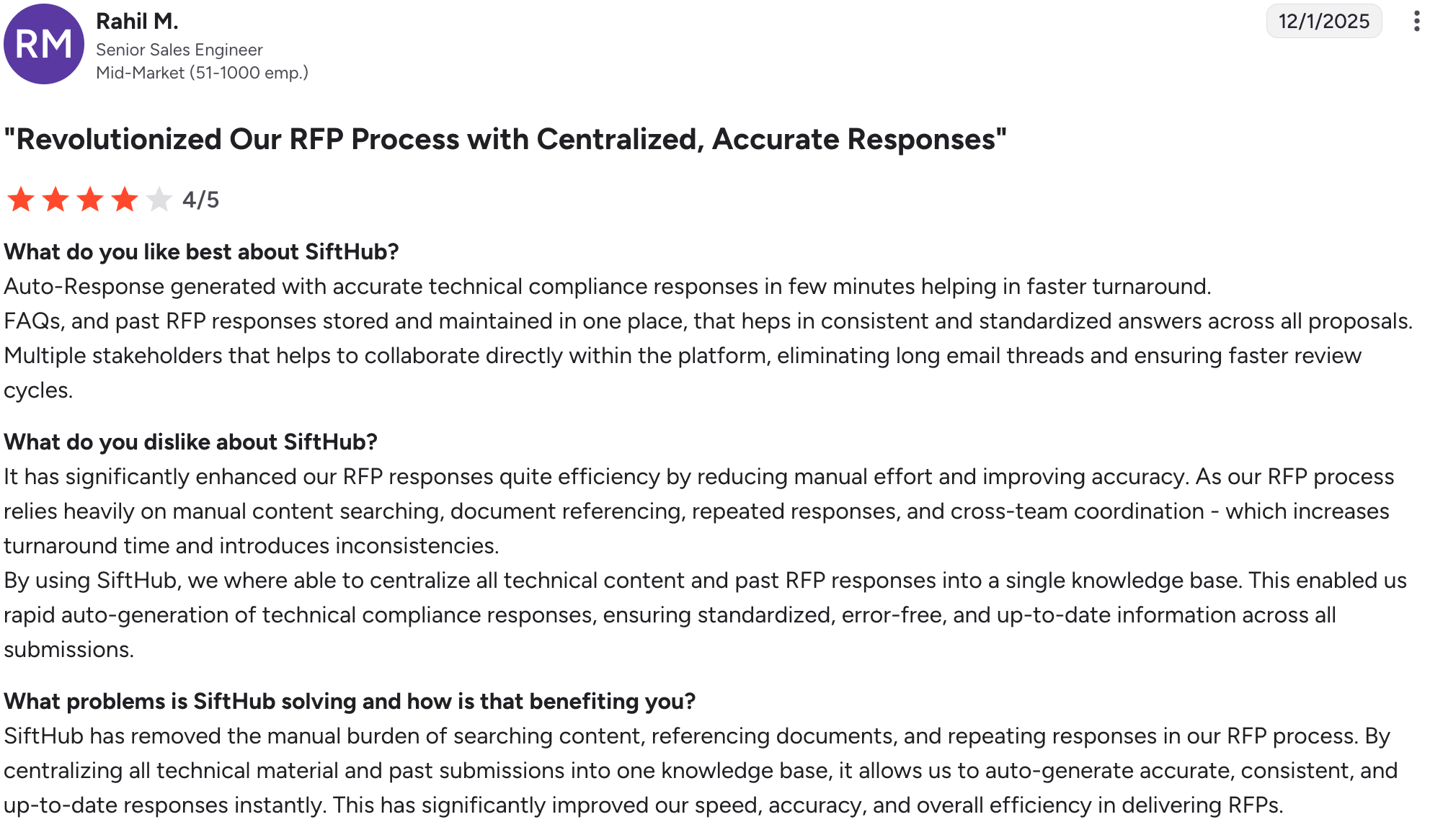
Organizations that centralize requirements and enable stakeholder collaboration often see faster reviews, greater consistency, and fewer documentation errors. One team described the impact this way:
6. Establish success metrics and timeline
Define how you'll measure success and when deliverables are expected. Make metrics observable and objective to avoid debates about whether requirements were met.
Create a realistic timeline that accounts for dependencies, resource availability, and organizational capacity for change.
7. Secure approval and baseline the document
Get formal sign-off from all decision-makers. Once approved, baseline the document as the official project requirements. Any subsequent changes should go through formal change control to maintain project integrity.
Free business requirements document template
Creating a BRD from scratch takes time most teams don't have. Use this structured template to accelerate documentation while ensuring nothing important gets overlooked
How SiftHub streamlines business requirements documentation for revenue teams?
Creating comprehensive business requirements documents takes time most revenue teams don't have. Presales enablement teams juggle active deals while trying to document future technology needs. Proposal managers respond to RFPs while planning process improvements.
SiftHub addresses this challenge by serving as an always-on AI sales assistant that transforms how revenue teams capture, organize, and deploy business requirements.
Instant access to organizational knowledge
When drafting requirements, teams need to understand current processes, existing technology, and institutional knowledge. SiftHub's enterprise search capability connects to company knowledge scattered across your existing systems like Confluence, SharePoint, Google Drive, and Salesforce, allowing you to query this information and surface the exact information you’re looking for in seconds.
Instead of scheduling meetings to gather input, project managers can query SiftHub to understand:
- Current sales workflows and pain points
- Existing technology capabilities and limitations
- Past project documentation and lessons learned
- Stakeholder preferences documented in previous initiatives
This centralized knowledge access accelerates requirements gathering while ensuring nothing important gets overlooked.
Automated documentation generation
SiftHub's response generation capabilities extend beyond customer-facing content. Teams can use the platform to draft BRD sections by providing context about the project.
For example, when implementing a new sales qualification process, SiftHub can:
- Generate requirement lists based on the described workflows
- Draft executive summaries from detailed project notes
- Create comprehensive scope statements from conversational input
- Develop success metrics aligned with business objectives
Every generated section includes source attribution, allowing reviewers to verify information accuracy and trace requirements back to original inputs.
Real-world application for revenue teams
Consider a bid and proposal team documenting requirements for new proposal automation technology. The team needs to capture requirements from:
- Sales leadership seeking faster response times
- Proposal writers want better content reuse
- Technical writers needing accurate product information
- Compliance teams requiring audit trails
- IT teams managing integrations.
Business requirements document templates and examples
While every BRD should be customized to project needs, templates provide valuable starting points. Here's a practical business requirements example structure:
1. Simple BRD template for small projects
For straightforward initiatives with limited scope:
Executive summary: 2-3 paragraph overview
Project overview:
- Background and context
- Business problem being solved
- Key stakeholders
Objectives: 3-5 specific, measurable goals
Scope:
- In scope (5-10 items)
- Out of scope (3-5 items)
Requirements: 10-20 prioritized requirements
Success criteria: 3-5 measurable outcomes
Timeline: Key milestones and target dates
Budget: High-level cost estimate
2. Comprehensive BRD template for complex projects
For enterprise-scale implementations requiring detailed documentation:
Executive summary: Full page overview
Business case:
- Current state analysis
- Business drivers and market forces
- Strategic alignment
- Expected ROI
Stakeholder analysis:
- All involved parties and their interests
- Decision-making authority
- Communication requirements
Detailed requirements:
- Functional requirements (20-50+ items)
- Non-functional requirements (10-20 items)
- Integration requirements
- Compliance requirements
Assumptions and dependencies: Comprehensive list with risk ratings
Constraints: Technical, budgetary, timeline, and resource limitations
Solution approach: High-level implementation strategy
Success metrics: Detailed KPIs with measurement methodology
Timeline: Phased implementation schedule with dependencies
Budget: Detailed cost breakdown with assumptions
Risk assessment: Identified risks with mitigation strategies
3. Sales technology implementation example
Here's how a revenue team might structure requirements for implementing an AI sales assistant:
Executive summary: "This project implements an AI-powered sales assistant to reduce RFP response time by 70% and increase proposal win rates by 15%. The solution will integrate with existing knowledge sources and enable sales teams to generate accurate, on-brand responses in under 5 seconds."
Business drivers:
- Current RFP response time of 5 days limits deal velocity
- Manual content search wastes 10+ hours per proposal
- Inconsistent responses damage brand perception
- Competitors responding faster to similar RFPs
Key requirements:
- FR-001 (Critical): System must connect to Confluence, SharePoint, and Google Drive
- FR-002 (Critical): Platform must generate responses with complete source attribution
- FR-003 (High): Solution must support custom tone and length adjustments
- FR-004 (High): Tool must integrate with Slack for in-workflow access
- NFR-001 (Critical): Response generation must complete in under 5 seconds
- NFR-002 (Critical): Platform must maintain 99.9% uptime during business hours
Success criteria:
- Reduce RFP response time from 5 days to 24 hours (measured monthly)
- Decrease content search time by 70% (measured via time tracking)
- Increase proposal win rate by 15% (measured via CRM data)
- Achieve 90% user adoption within 3 months (measured via usage analytics)
The bottom line
Every successful project begins with a clear understanding of what needs to be accomplished and why. Business requirements documents provide that critical foundation, translating strategic objectives into actionable specifications that guide implementation.
Whether you're implementing new sales technology, improving RFP best practices, or optimizing revenue operations, investing time in comprehensive requirements documentation pays dividends throughout the project lifecycle.
Learn how SiftHub's AI sales assistant empowers presales and solutions teams to work smarter with instant access to organizational knowledge and automated documentation capabilities.