




An invited tender (ITT) is a formal procurement process where buyers solicit competitive bids only from pre-qualified, approved vendors rather than issuing open public tenders. Only vendors receiving formal invitations can submit proposals, typically from qualified vendor lists or from framework agreements that demonstrate proven capability, financial stability, and compliance.
Key takeaways:
- Competitive advantages: Fewer competitors (3-7 vs. 10-30+ in open tenders), higher win probability (20-40% vs. 5-15%), relationship leverage from past performance, shorter timelines (2-4 weeks vs. 4-8 weeks)
- Getting invited: Complete formal pre-qualification for Qualified Vendor Lists, win framework agreement positions (2-4 years), demonstrate exceptional past delivery, and maintain active vendor registrations
- Response strategy: Leverage pre-qualification advantage (focus on differentiation, not basic credentials), meet compressed timelines with reusable content libraries, ensure perfect compliance with detailed checklists; demonstrate innovation beyond minimum requirements
Technology impact: AI automation reduces response time 60-70% (20-40 hours to 8-12 hours), auto-generates 85-95% of responses, ensures compliance tracking, and enables competitive analysis.
An invited tender (ITT) is a formal procurement process where buyers solicit competitive bids only from pre-qualified, approved vendors rather than issuing open public tenders. Only vendors receiving formal invitations can submit proposals, typically from qualified vendor lists or from framework agreements that demonstrate proven capability, financial stability, and compliance.
Key takeaways:
- Competitive advantages: Fewer competitors (3-7 vs. 10-30+ in open tenders), higher win probability (20-40% vs. 5-15%), relationship leverage from past performance, shorter timelines (2-4 weeks vs. 4-8 weeks)
- Getting invited: Complete formal pre-qualification for Qualified Vendor Lists, win framework agreement positions (2-4 years), demonstrate exceptional past delivery, and maintain active vendor registrations
- Response strategy: Leverage pre-qualification advantage (focus on differentiation, not basic credentials), meet compressed timelines with reusable content libraries, ensure perfect compliance with detailed checklists; demonstrate innovation beyond minimum requirements
Technology impact: AI automation reduces response time 60-70% (20-40 hours to 8-12 hours), auto-generates 85-95% of responses, ensures compliance tracking, and enables competitive analysis.
You receive an email: "You've been invited to submit a tender for [Project Name]." This isn't a public procurement notice anyone can respond to. This is an invited tender, and it represents a significant competitive advantage if you know how to leverage it properly.
Invited tenders, also called Invitations to Tender (ITT), are a more exclusive procurement process in which buyers solicit bids only from pre-qualified, approved vendors rather than issuing open public tenders. Understanding how invited tenders work, how to position your organization to receive them, and how to respond effectively determines whether you capture high-value contracts or watch competitors win opportunities you're qualified to deliver.
This guide explains what invited tenders are, how they differ from open competitive tenders, how organizations get on invitation lists, and practical strategies for consistently winning ITT contracts.
What is an invited tender?
An invited tender is a formal procurement process where a buyer (typically government agencies, public sector organizations, or large enterprises) requests competitive bids from a select group of pre-qualified vendors rather than issuing a public open tender. Only vendors who receive formal invitations can submit proposals.
The invitation process typically works like this: organizations maintain approved vendor lists or framework agreements containing suppliers who've previously demonstrated capability, financial stability, and compliance with qualification criteria. When a procurement need arises, the buyer issues tender invitations to relevant vendors from these lists rather than publishing open public notices.
Invited tenders serve several strategic purposes for both buyers and vendors:
For buyers:
- Reduces evaluation workload by limiting submissions to qualified vendors
- Improves proposal quality by ensuring responders have proven capabilities
- Accelerates procurement timelines by eliminating unqualified bidders
- Maintains competitive pricing despite restricted participation
- Ensures compliance and reduces procurement risk
For vendors:
- Provides a competitive advantage over organizations not on the approved lists
- Demonstrates buyer confidence in your capabilities
- Often involves fewer competing bidders than open tenders
- Enables relationship leverage from previous performance
- Creates predictable pipeline opportunities from framework positions
Invited tender vs open tender: Key differences
Understanding how invited tenders differ from open competitive tenders helps you adjust your approach appropriately.
The shorter timelines for invited tenders create unique challenges. While you have competitive advantages from pre-qualification and fewer competitors, you must respond faster without sacrificing proposal quality or compliance.
How organizations get invited to tender
Receiving tender invitations requires strategic investment in pre-qualification processes and vendor relationship management. Here are the primary pathways to ITT inclusion:
1. Complete formal pre-qualification processes
Many public-sector organizations and large enterprises maintain Qualified Vendor Lists (QVLs) or Approved Supplier Registers. Getting on these lists requires submitting comprehensive pre-qualification applications demonstrating:
- Financial stability (audited statements, credit references, bonding capacity)
- Technical capability (certifications, quality management systems, past performance)
- Compliance credentials (insurance, health and safety policies, regulatory compliance)
- Relevant experience (case studies, references, similar project delivery)
Pre-qualification typically occurs on annual or biennial cycles. Organizations serious about ITT opportunities invest time in these processes even without immediate tender prospects, because approval positions them for future invitations.
2. Win framework agreement positions
Framework agreements establish pre-approved vendor panels for recurring procurement over 2-4 year periods. Winning framework positions provides ongoing ITT opportunities as buyers issue call-offs for specific projects to framework vendors without a full competitive tender each time.
Framework tenders themselves are typically open competitive processes with rigorous evaluation. However, once you're on the framework, subsequent call-off invitations offer significant advantages over repeatedly competing in open tenders.
3. Demonstrate exceptional past performance
Buyers often invite vendors who've successfully delivered previous contracts to bid on similar new opportunities. Excellent execution on current contract positions you for future ITT invitations, as buyers prefer working with proven performers rather than unknown entities.
This creates a virtuous cycle: strong delivery leads to positive references, which support pre-qualification, which generate ITT invitations, which create more delivery opportunities.
4. Maintain active vendor registrations
Many procurement portals require vendors to register before receiving tender notifications. Maintaining current registrations, regularly updating company information, and ensuring your capability categories are accurate increase ITT visibility.
The invited tender response process
Responding to invited tenders follows similar stages to open tenders, but with important nuances based on the restricted, relationship-based nature of ITTs.
Step 1: Evaluate the invitation strategically
Not every ITT deserves a response. Conduct rapid bid/no-bid analysis evaluating:
- Project fit: Does this align with our core capabilities and strategic priorities?
- Resource availability: Can we deliver if we win, given current commitments?
- Win probability: Based on the requirements and competition, what's our realistic chance?
- Relationship strength: How strong is our position with this buyer?
- Margin potential: Will this deliver acceptable profitability?
For organizations handling multiple ITTs monthly, SiftHub's RFP Agent accelerates bid/no-bid evaluation by comparing requirements against your capabilities and automatically providing win probability assessments.
Step 2: Leverage your pre-qualification advantage
Unlike open tenders, where you must prove basic qualifications, invited tenders assume you're capable. Focus your response on:
- Solution differentiation: How is your approach superior to other invited vendors?
- Relationship evidence: Reference past successful delivery for this buyer
- Innovation and value-adds: What can you offer beyond minimum requirements?
- Pricing competitiveness: Balance relationship advantage with realistic pricing
Don't waste space rehashing qualification credentials already proven during pre-qualification. Use that space to tell compelling solution narratives and differentiate competitively.
Step 3: Meet compressed timelines without sacrificing quality
Invited tenders often have shorter response windows than open tenders (2-4 weeks vs. 4-8 weeks), creating time pressure that can compromise proposal quality if you're not prepared.
Strategies for maintaining quality under tight deadlines:
- Build reusable content libraries: Maintain up-to-date repositories of case studies, technical methodologies, team CVs, and standard responses to common requirements. Don't start from scratch for each ITT.
- Establish clear internal workflows: Define roles, responsibilities, and approval processes before ITTs arrive. Clarify who reviews technical sections, who approves pricing, and who manages the final submission.
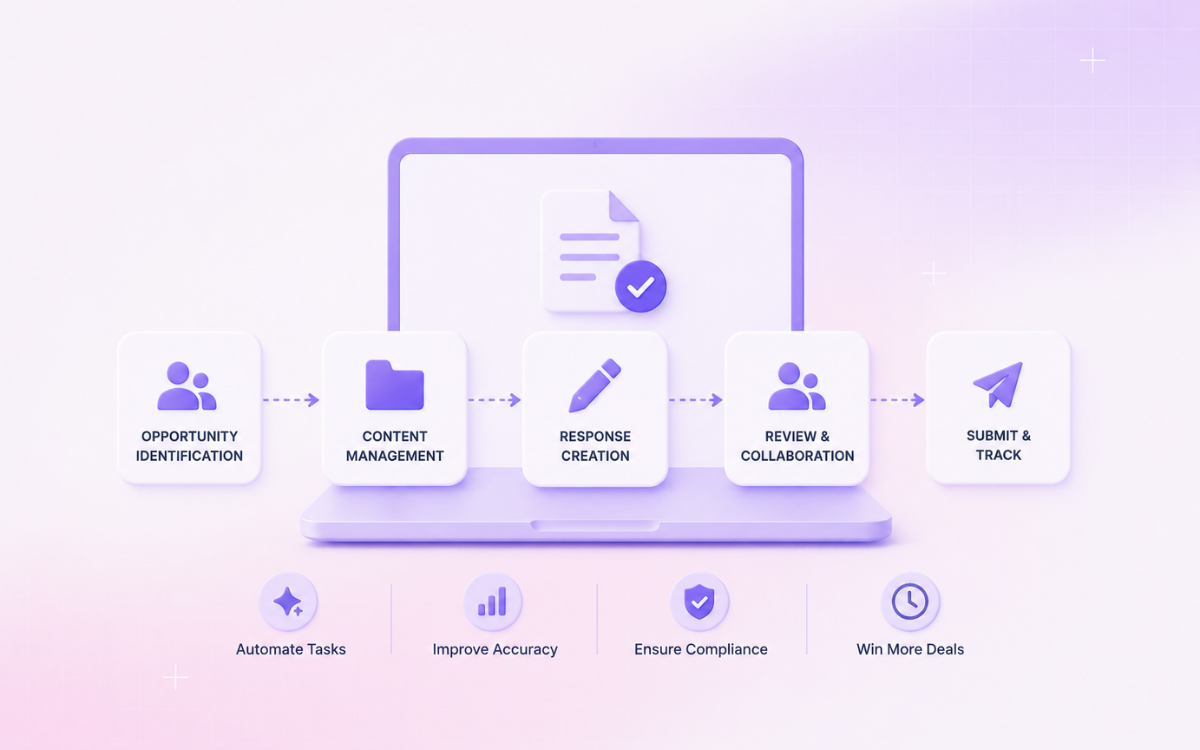
- Use automation for repetitive elements: AI RFP automation accelerates responses by auto-generating first drafts from your knowledge base, handling compliance matrices automatically, and ensuring consistency across all submission sections.
Organizations using AI proposal platforms report completing ITT responses in 60-70% less time while maintaining or improving response quality, enabling them to pursue more opportunities without expanding proposal teams.
Step 4: Address all compliance requirements meticulously
Invited tenders maintain the same strict compliance standards as open tenders. Missing mandatory requirements, incorrect formats, or incomplete documentation result in disqualification regardless of your pre-qualified status or relationship.
Create detailed compliance checklists tracking:
- All mandatory submission requirements
- Required certifications and documentation
- Format specifications (page limits, file types, naming conventions)
- Submission method and deadline requirements
Even minor compliance oversights eliminate otherwise strong proposals. For complex ITTs with 100+ compliance points, automated compliance verification ensures nothing gets missed before submission.
Step 5: Demonstrate value beyond the minimum
Invited tenders often involve buyers who know your baseline capabilities from previous work or pre-qualification. Differentiate by demonstrating:
- Risk mitigation: How you'll address project-specific challenges
- Innovation: Value-adds or improvements beyond stated requirements
- Efficiency gains: How you'll deliver faster, cheaper, or better than alternatives
- Lessons learned: How previous experience informs your approach to this project
Generic proposals that merely confirm you can meet requirements waste your relationship advantage. Show why you're the best choice among qualified alternatives.
Common ITT formats and requirements
Invited tenders typically use one of three submission formats, each requiring different response approaches:
Two-envelope system
Technical and commercial proposals are submitted separately. Evaluators assess technical merit without seeing pricing, then open price envelopes only for technically qualified bidders.
Response strategy: Maximize technical scores before price becomes a factor. Demonstrate superior solution quality, implementation approach, and risk management that justifies your pricing when commercial evaluation occurs.
Three-part structure
Divides submissions into administrative compliance, technical proposal, and commercial proposal. This organization helps evaluators efficiently assess different components against specific criteria.
Response strategy: Ensure perfect administrative compliance (easy points), deliver compelling technical narrative, and price competitively based on your assessment of the competitive landscape.
Framework call-off format
For buyers issuing call-offs against existing framework agreements, responses often use simplified formats that focus on project-specific delivery plans and pricing rather than on comprehensive capability demonstration.
Response strategy: Reference your framework position and previous delivery, then focus entirely on this specific project's requirements, timeline, and pricing. Avoid rehashing capabilities already proven during the framework award.
Technology and tools for ITT success
Traditional ITT response processes require 20-40 hours of effort from bid and proposal teams, creating capacity constraints that prevent them from pursuing all qualified opportunities.
Modern AI platforms transform ITT efficiency by:
- Centralizing company knowledge: Product specifications, past proposals, certifications, and technical documentation are accessible instantly rather than scattered across drives and email.
- Auto-generating first drafts: AI RFP agents analyze ITT requirements and automatically populate 85-95% of responses from your knowledge base, reducing manual drafting from days to hours.
- Ensuring consistency and accuracy: Every response includes source attribution showing exactly which documents informed each answer, preventing contradictions and outdated information.
- Accelerating compliance verification: Automated compliance matrices track every requirement and flag gaps before submission, eliminating disqualification risk from administrative oversights.
- Enabling competitive analysis: When buyers invite 5-7 vendors, understanding likely competitors and their positioning becomes critical. AI battlecard agents generate real-time competitive intelligence to help you differentiate effectively.
Organizations using AI proposal automation report significant efficiency gains. For example, Superhuman reduced security questionnaire completion time by 75%, Sirion achieved a 48-hour reduction in RFP SLAs while handling 1.5x more RFPs monthly, and Allego saved 14+ hours per project with 90% automated questionnaire completion.
Best practices for winning invited tenders
Beyond process and tools, these strategic practices separate organizations that consistently win ITTs from those who struggle despite pre-qualification advantages:
Invest continuously in pre-qualification
Don't wait until specific opportunities arise to pursue approved vendor status. Proactively identify buyers in your target markets and complete pre-qualification applications even without immediate tenders. This positions you for ITT invitations when opportunities emerge rather than scrambling to qualify after seeing attractive tenders publicly advertised.
Maintain existing relationships actively
Past performance influences ITT evaluations significantly. Stay engaged with buyers between contracts through:
- Regular capability updates as you add certifications or expand services
- Proactive communication about industry developments affecting their operations
- Attendance at buyer engagement events and supplier briefings
- Relationship management, ensuring buyer stakeholders remember your capabilities
Track invitation patterns and procurement cycles
Many organizations issue ITTs on predictable annual or biennial cycles. Track when specific buyers typically procure services you provide, so you anticipate invitations and allocate resources accordingly, rather than being surprised by unexpected deadlines.
Respond to every invitation
Unless you have compelling reasons (genuine inability to deliver, unacceptable terms, zero win probability), respond to every ITT you receive. Declining invitations without a strong justification damages relationships and may result in removal from future invitation lists.
If you genuinely cannot submit a full proposal, send professional decline notices that explain why and express continued interest in future opportunities.
Leverage lessons learned systematically
Conduct win/loss reviews after every ITT, whether you win or lose. Analyze:
- What evaluation criteria drove the decision?
- Where did your proposal excel or fall short?
- How did winning competitors differentiate themselves?
- What would you do differently on similar future ITTs?
Capture these lessons in institutional knowledge so they inform future responses rather than being lost when team members change roles.
Real-world ITT example: Technology services framework
Here's how a typical invited tender process unfolds in practice:
- Background: A government agency maintains a 4-year framework agreement for technology consulting services with 8 approved vendors. When specific projects arise, they issue ITT call-offs to framework vendors.
- Invitation: Framework vendors receive an ITT for a 12-month cloud migration project with a 3-week response deadline. Only the 8 framework vendors can bid; the public doesn't have access to this opportunity.
- Pre-qualification advantage: All vendors have already proven technical capability, financial stability, and security compliance during the framework award. The ITT focuses on a project-specific solution approach and pricing.
- Competitive dynamics: Instead of 20-30 competitors in an open tender, only 8 framework vendors compete, with a realistic win probability of around 25-30% rather than 5-10%.
Response approach: Winning vendor leveraged:
- Previous successful delivery for this agency (referenced specific past projects)
- Innovation in the migration approach reduces risk and timeline
- Team members with agency-specific experience and security clearances
- Competitive pricing justified by efficiency methodology
- Comprehensive risk management addressing the agency's known concerns
Timeline: Using AI proposal automation, the winning vendor completed their response in 12 days rather than the typical 3-week manual process, allowing extra time for executive review and refinement.
Outcome: Contract awarded based on superior technical approach (45 points), relevant experience (30 points), and competitive pricing (25 points). The vendor's framework position and relationship history created trust that their innovative approach was deliverable rather than aspirational.
The bottom line
Invited tenders represent significant opportunities for organizations that invest in pre-qualification, maintain buyer relationships, and respond efficiently to time-sensitive invitations. The competitive advantages, such as fewer bidders, relationship leverage, and proven capabilities, make ITT's win rates substantially higher than those of open tenders.
Success requires balancing two demands: maintaining the relationships and qualifications that generate invitations while responding quickly and compellingly when opportunities arise. Organizations that excel at both, through systematic pre-qualification investment and efficient response capabilities, build sustainable competitive advantages in their markets.
Modern AI proposal platforms eliminate the traditional tradeoff between speed and quality, enabling teams to respond to more ITTs without sacrificing response comprehensiveness or expanding headcount. When compressed timelines meet complex requirements, automation becomes not just helpful but essential for capturing opportunities before competitors.
Ready to accelerate your ITT response capabilities? Discover how bid and proposal teams are winning more invited tenders by completing responses 60-70% faster with AI RFP automation that maintains compliance, ensures consistency, and delivers compelling proposals that differentiate against pre-qualified competitors.
Book a demo to see how AI can transform your invited tender success rate.