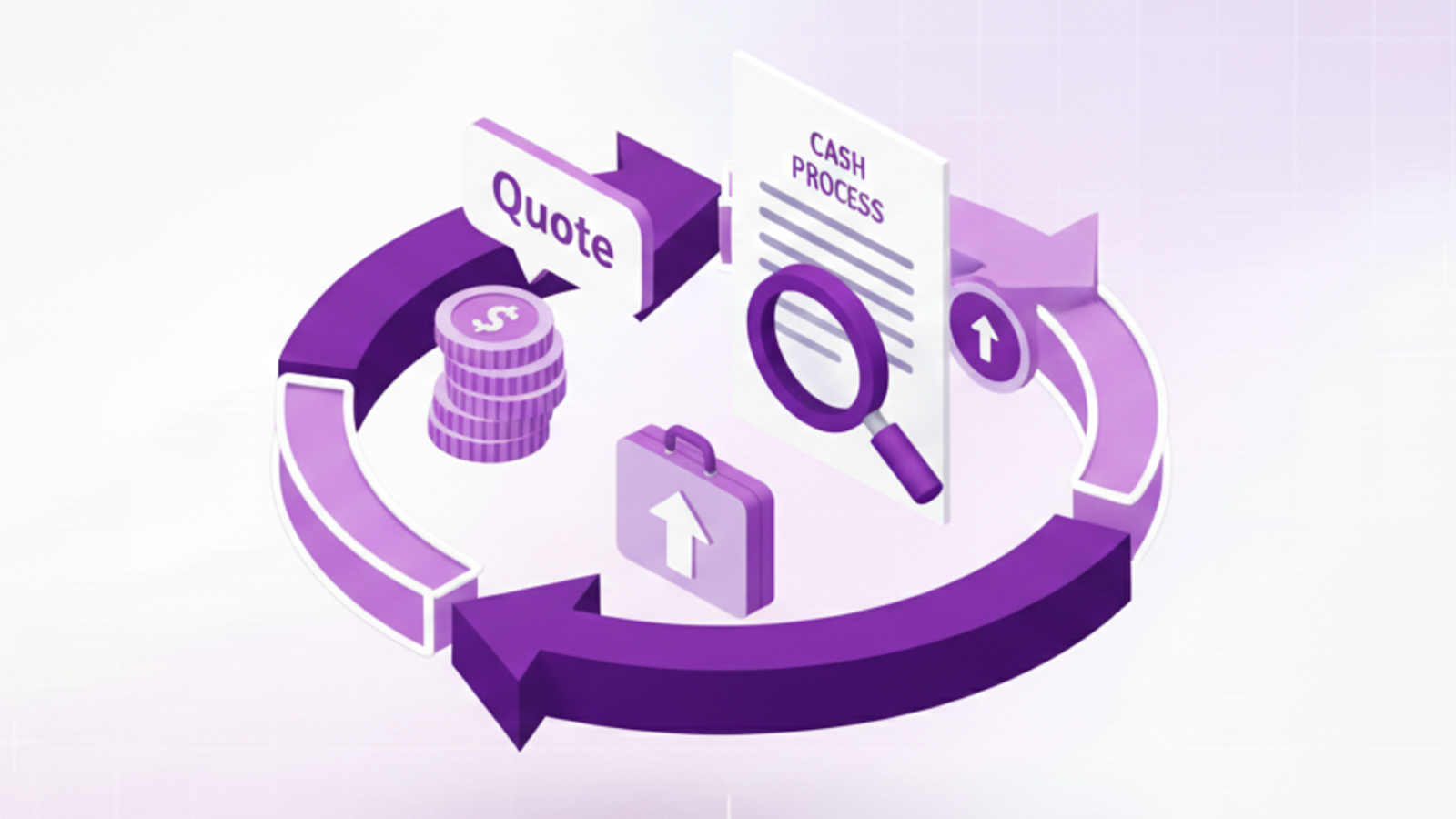




The quote-to-cash (Q2C) process encompasses all business activities from presenting a price quote to a potential customer through final payment collection and revenue recognition. This end-to-end cycle connects sales, operations, finance, and customer success into a unified revenue workflow that directly impacts cash flow, customer satisfaction, and competitive advantage.
Key takeaways:
- 8 essential steps: Product configuration, pricing determination, quote generation/delivery, negotiation/contract agreement, contract execution/signing, order fulfillment/delivery, invoicing/billing, payment collection/revenue recognition
- Common challenges: Disconnected systems creating data silos; manual processes and approval bottlenecks; pricing/quoting errors; slow cycle times (60-90 days for enterprise deals); poor customer visibility
- Essential tools: CPQ software for quote creation; CLM systems for contract management; OMS for order coordination; billing platforms for revenue recognition; ERP as central backbone
Best practices: Integrate systems to eliminate manual re-entry; automate routine approvals; establish clear authority levels; provide customer self-service portals; measure KPIs continuously.
The quote-to-cash (Q2C) process encompasses all business activities from presenting a price quote to a potential customer through final payment collection and revenue recognition. This end-to-end cycle connects sales, operations, finance, and customer success into a unified revenue workflow that directly impacts cash flow, customer satisfaction, and competitive advantage.
Key takeaways:
- 8 essential steps: Product configuration, pricing determination, quote generation/delivery, negotiation/contract agreement, contract execution/signing, order fulfillment/delivery, invoicing/billing, payment collection/revenue recognition
- Common challenges: Disconnected systems creating data silos; manual processes and approval bottlenecks; pricing/quoting errors; slow cycle times (60-90 days for enterprise deals); poor customer visibility
- Essential tools: CPQ software for quote creation; CLM systems for contract management; OMS for order coordination; billing platforms for revenue recognition; ERP as central backbone
Best practices: Integrate systems to eliminate manual re-entry; automate routine approvals; establish clear authority levels; provide customer self-service portals; measure KPIs continuously.
The quote-to-cash process represents one of the most critical business operations for revenue-generating organizations. This end-to-end cycle determines how efficiently your company converts sales opportunities into actual revenue, directly impacting cash flow, customer satisfaction, and financial performance. Yet many organizations struggle with disconnected systems, manual handoffs, and inefficiencies that extend sales cycles and frustrate both employees and customers.
Understanding and optimizing your quote-to-cash workflow isn't just about operational efficiency; it's about competitive advantage. Companies that excel at Quote-to-cash close deals faster, collect payment sooner, reduce errors, and deliver superior customer experiences.
This comprehensive blog explains what Quote-to-cash means, the essential steps involved, common challenges organizations face, and best practices for streamlining this critical process.
What is the Quote-to-cash process?
The quote-to-cash process encompasses all business activities from the moment you present a price quote to a potential customer through final payment collection and revenue recognition. Often abbreviated as Q2C or QTC, this comprehensive cycle connects sales, operations, finance, and customer success functions into a unified revenue workflow.
The process begins when a sales representative configures a product or service offering, determines appropriate pricing, and generates a formal quote for a prospect. It continues through contract negotiation and signing, order processing and fulfillment, invoice generation and delivery, payment collection, and finally revenue recognition according to accounting standards. Each stage involves multiple touchpoints, handoffs between departments, and data exchanges that must happen accurately and efficiently.
Quote-to-cash vs related processes
1. Quote-to-cash vs CPQ
Configure, price, quote (CPQ) software represents just one component within the broader Quote-to-cash cycle. CPQ focuses specifically on the front-end activities: helping sales teams configure complex products, apply appropriate pricing rules and discounts, and generate accurate quotes quickly. While CPQ is essential for the Quote-to-cash process, it addresses only the initial stages and doesn't cover contract management, order fulfillment, billing, or payment collection.
2. Quote-to-cash vs order to cash
Order to cash (O2C) begins where Quote-to-cash reaches the contract signing stage. Once a prospect accepts your quote and becomes a customer, the order-to-cash process handles order fulfillment, delivery, invoicing, and payment collection. Order to cash is narrower in scope, focusing on operational execution rather than the entire sales cycle.
The quote-to-cash process includes all order-to-cash activities plus the earlier sales interactions: product configuration, pricing, quoting, proposal development, and contract negotiation.
The 8 essential steps in the quote-to-cash process
Here’s a concise, data-focused rewrite with a cleaner structure and only the most essential information retained:
Step 1. Product configuration
The Q2C cycle starts by tailoring products or services to customer needs, ranging from simple quantity selection to complex, multi-module or custom solutions.
- AI-powered configuration tools surface accurate product rules, compatibility, and specs instantly, reducing errors and back-and-forth.
- Handle complexity across modules, services, or custom options
Step 2. Pricing determination
Pricing is applied based on list rates, discounts, customer segment, and competitive context.
- Models vary by business: subscription tiers, usage-based pricing, or cost-plus manufacturing models.
- Deal desk and pricing controls help protect margins.
Step 3. Quote generation & delivery
Sales teams create formal quotes outlining scope, pricing, terms, and validity.
- Speed matters: Faster, accurate quotes often win competitive deals.
- Sales collateral and CPQ tools enable rapid, professional quote creation.
Step 4. Negotiation & contract agreement
Most B2B deals require negotiation around price, scope, and legal terms.
- Sales balances flexibility with profitability.
- Deal desks, legal, and presales ensure approvals, feasibility, and compliance.
Step 5. Contract execution & signing
Final agreements are signed by both parties.
- E-signatures reduce cycle time from days to hours.
- Triggers downstream workflows across CRM, finance, and onboarding teams.
Step 6. Order fulfillment & delivery
Operations deliver products or services as agreed.
- Errors or delays at this stage directly impact customer satisfaction and retention.
- Integrated systems ensure fulfillment teams receive complete order details.
Step 7. Invoicing & billing
Finance issues invoices based on contract terms and delivery confirmation.
- Billing errors are a major cause of delayed payments, especially with custom deals.
- Automated billing systems reduce disputes and handle subscriptions, renewals, and usage-based charges.
Step 8. Payment collection & revenue recognition
The process concludes with payment and compliant revenue recognition.
- Teams manage accounts receivable and overdue invoices.
- Resolve payment issues quickly to protect cash flow
- Standards like ASC 606 and IFRS 15 govern when revenue can be recognized, adding complexity for subscriptions and multi-year contracts.
When these eight steps operate as a connected system rather than isolated handoffs, organizations reduce revenue leakage, shorten sales cycles, and create a faster, more predictable path from Quote-to-cash.
Common Quote-to-cash challenges
1. Disconnected systems and data silos
Quote-to-cash breakdowns often start with fragmented technology stacks. When CRM, CPQ, order management, and billing systems don’t integrate, teams are forced to manually re-enter data at every stage. This leads to inconsistent customer records, mismatched contract terms, and errors that ripple from quoting through invoicing. Without a single source of truth, sales, operations, and finance operate on different versions of reality, slowing execution and increasing risk.
2. Manual processes and approval bottlenecks
Manual workflows create some of the biggest delays in the quote-to-cash cycle. Pricing approvals, legal reviews, and exception handling frequently rely on email chains and spreadsheets, making progress difficult to track and easy to stall. Approval bottlenecks are especially damaging when quotes sit idle waiting for sign-off; competitors often move faster and win the deal. These manual handoffs also increase inconsistency and error rates across teams.
3. Pricing and quoting errors
Complex configurations and discount structures make pricing accuracy difficult without automation. Errors in configuration, calculations, or documented terms erode buyer confidence and often force quote revisions, extending sales cycles. In many cases, mistakes surface late, during fulfillment or invoicing, when they are costlier to fix and more likely to cause customer disputes or delivery issues.
4. Slow cycle times and deal velocity issues
Lengthy quote-to-cash cycles delay revenue and reduce win rates. Manual quote creation, slow approvals, prolonged contract negotiations, and delayed invoicing all extend the time between buyer interest and payment. Every added day increases the risk of deal loss due to budget changes, shifting priorities, or competitive pressure. Faster cycles consistently translate into higher close rates and more predictable revenue.
5. Poor customer visibility and experience
Lack of transparency frustrates customers and strains support teams. When buyers can’t track order status, understand delivery timelines, or reconcile invoices with contract terms, trust erodes. Confusing billing and limited post-sale visibility lead to disputes, delayed payments, and weaker long-term relationships, directly impacting renewals and expansion opportunities.
Together, these challenges reveal why many organizations struggle to scale revenue efficiently despite strong demand. Addressing these issues requires a more unified, automated approach to quote-to-cash, one that connects teams, data, and processes from initial quote through final payment.
Essential tools for Quote-to-cash optimization
From configuring accurate quotes to managing contracts, fulfillment, and revenue recognition, each stage demands tools that reduce manual effort, eliminate errors, and keep teams aligned. The following solutions form the foundation of a modern, scalable quote-to-cash framework.
1. Configure, price, quote (CPQ) software
CPQ platforms simplify and automate the quote creation process by handling complex product and pricing logic.
Key capabilities include:
- Enforcing product compatibility rules to prevent invalid configurations
- Automatically calculating pricing, discounts, and promotions
- Generating branded, professional quotes using configurable templates
- Integrating with CRM systems to retain customer context
Why it matters:
CPQ tools significantly reduce quote turnaround time. Sales teams can generate accurate, deliverable quotes in minutes instead of hours, improving speed without sacrificing accuracy.
2. Contract lifecycle management (CLM) systems
CLM platforms manage contracts from creation to execution and beyond, bringing structure to complex negotiations.
Core functionalities include:
- Standardized contract templates to reduce legal risk
- Automated approval workflows to speed up reviews
- Version control and audit trails for compliance
- Secure, searchable storage of executed contracts
Why it matters:
For organizations dealing with multiple stakeholders and heavy redlining, CLM systems prevent contracts from stalling and improve visibility across the approval process.
3. Order management systems (OMS)
OMS platforms ensure seamless coordination between sales, inventory, and fulfillment operations.
Key features include:
- Real-time order status tracking
- Inventory allocation and backorder management
- Coordination with logistics partners for shipping and delivery
- Integration with accounting systems for invoicing
Why it matters:
Effective order management ensures that sold products or services are delivered accurately and on time, protecting customer trust and accelerating payment cycles.
4. Billing and revenue management platforms
Modern billing systems support complex billing and revenue recognition scenarios.
These platforms handle:
- Subscription and usage-based billing models
- Multi-year and milestone-based contracts
- Partial deliveries and phased invoicing
- Automated dunning for failed payments
- Compliance with accounting standards such as ASC 606
Why it matters:
By integrating with OMS and accounting systems, billing platforms reduce manual effort, minimize errors, and ensure timely, compliant revenue recognition.
5. Enterprise resource planning (ERP) systems
ERP systems act as the central backbone of the quote-to-cash ecosystem.
They provide:
- A single source of truth for customer, order, and financial data
- Integrated workflows across finance, operations, and supply chain
- Support for inventory, invoicing, and revenue recognition
Why it matters:
Modern ERPs connect CPQ, CLM, OMS, and billing tools into a unified workflow, ensuring data consistency and operational efficiency.
6. AI-powered knowledge and response systems
AI platforms transform how teams access and use information during the quote-to-cash process.
Key advantages include:
- Instant access to verified product specs, pricing history, and contract terms
- Reduced dependency on manual searches across documents and systems
- On-demand answers for complex configuration, negotiation, or fulfillment questions
Why it matters:
AI enablement platforms like SiftHub act as AI teammates for sales and proposal teams, which help in verifying facts for quotes and contracts.
When these tools work together as an integrated system, quote-to-cash becomes a streamlined, predictable process rather than a fragmented set of handoffs. Investing in the right mix of platforms not only improves operational efficiency but also creates a smoother, more reliable experience for both internal teams and customers.
Enterprise search and AI response generation capabilities transform how sales and operations teams access the information they need throughout the Quote-to-cash process. Rather than hunting through product documentation, past quotes, or contract templates, team members can query AI systems that instantly provide verified, current information.
SiftHub help bid and proposal teams access technical specifications, pricing history, and contract language instantly, ensuring quotes and contracts include accurate, complete information without delays.
Best practices for Quote-to-cash excellence
1. Integrate systems to eliminate data silos
The foundation of Quote-to-cash optimization is connected systems that share data automatically. When your CPQ system feeds order management, which updates billing, which syncs to your accounting system, information flows seamlessly without manual re-entry or handoffs via email and spreadsheets.
Modern integration approaches using application programming interfaces (APIs) and integration platform as a service (iPaaS) solutions make it possible to connect previously siloed systems without expensive custom development. Cloud-based platforms often include pre-built integrations with complementary systems, reducing implementation complexity.
Prioritize integration projects based on the biggest pain points in your current process. If quote-to-order handoffs cause the most delays and errors, start there. If billing inaccuracies create the greatest customer friction, focus on integrating order management with billing systems.
2. Automate repetitive tasks and approvals
Identify manual, repetitive activities that consume time without adding strategic value, then implement automation to handle these tasks consistently and quickly. Quote generation from standardized product configurations doesn't require human involvement beyond initial selection. Approval routing for standard discounts within established guidelines can follow automated workflows. Invoice generation from confirmed orders should happen without manual intervention.
Intelligent automation can handle more sophisticated scenarios than simple task automation. Rules-based systems can evaluate quote complexity and route only exceptions to human reviewers, approving routine quotes automatically. Machine learning can predict approval likelihood and escalate potentially problematic quotes proactively.
The goal isn't eliminating human judgment but focusing it where it adds value. Automate the routine so your team can concentrate on exceptions, complex negotiations, and strategic decisions that genuinely benefit from human expertise.
3. Implement clear approval hierarchies and delegation
Approval bottlenecks kill deal velocity. Establish clear approval authorities based on discount levels, contract value, and term variations. Sales representatives should know exactly what they can approve independently versus what requires management review. Publishing these authorities prevents uncertainty and eliminates unnecessary approval routing.
Implement delegation capabilities so that approvers can designate alternates when traveling or unavailable. Nothing should wait days for approval simply because one person is out of the office. Mobile approval capabilities allow decision-makers to review and approve quotes, contracts, or special pricing requests from anywhere, preventing delays.
4. Standardize processes with defined playbooks
Document your ideal Quote-to-cash workflow with clear responsibilities, handoff points, timing expectations, and escalation procedures. When everyone understands the standard process, coordination improves, and exceptions become obvious.
Process standardization doesn't mean inflexibility. Define your standard path while acknowledging that complex deals may require variations. The key is making those variations intentional and managed rather than allowing every deal to follow a unique path because no standard exists.
Standardized playbooks also support onboarding and training. New team members can quickly understand their role in the quote-to-cash process and how their work connects to upstream and downstream activities. This systemic understanding reduces coordination errors and helps employees see how their contributions impact overall performance.
5. Provide customer self-service portals
Modern customers expect digital self-service capabilities. Customer portals allow buyers to track order status, view delivery information, access invoices, download contracts, and manage payment methods without contacting support teams.
Self-service reduces operational costs while improving customer satisfaction. Support teams handle fewer routine inquiries, freeing them for complex issues requiring human expertise. Customers get instant answers rather than waiting for email responses or navigating phone trees.
Portal capabilities also improve collections. When customers can easily access invoices, view payment history, and update payment methods online, they're more likely to pay on time. Automated payment reminders with convenient self-service payment options significantly reduce accounts receivable aging.
6. Establish metrics and continuous improvement processes
You can't improve what you don't measure. Establish key performance indicators (KPIs) for each stage of your quote-to-cash process: average time from opportunity creation to quote delivery, quote-to-order conversion rates, contract approval cycle times, order fulfillment speed and accuracy, days sales outstanding (DSO) and collection rates, and total quote-to-cash cycle time.
Regular review of these metrics reveals bottlenecks, inefficiencies, and improvement opportunities. When quote-to-order conversion drops, investigate whether quote quality, pricing competitiveness, or competitor activity changed. When DSO increases, examine whether invoicing accuracy declined or payment terms shifted.
Create cross-functional teams involving sales, operations, finance, and IT to review Quote-to-cash performance regularly and implement continuous improvements. Small, incremental changes compound over time into significant performance gains.
7. Train teams on integrated workflows
Technology enables quote-to-cash optimization, but people execute the process. Comprehensive training ensures that sales teams understand CPQ capabilities and use them effectively, operations personnel know how to access order information and coordinate fulfillment, finance staff can leverage billing automation and resolve exceptions, and customer success teams can help customers navigate self-service portals.
Training shouldn't be one-time onboarding. As systems evolve and processes improve, ongoing training keeps teams current. Regular refreshers reinforce best practices and address skill gaps revealed through performance metrics.
Cross-functional training where sales learns about fulfillment constraints, and finance understands sales challenges, builds empathy and cooperation. When departments understand each other's roles and pressures, coordination improves naturally.
Transform your Quote-to-cash performance
The quote-to-cash process directly determines how efficiently your organization converts sales opportunities into cash. Every inefficiency, manual handoff, or disconnected system in your workflow extends timelines, increases errors, and damages customer experience. In competitive markets where buyers expect fast responses and seamless experiences, quote-to-cash excellence is a competitive requirement.
Modern technology enables quote-to-cash transformation without massive custom development or year-long implementation projects. Cloud-based CPQ, CLM, billing, and integration platforms can be implemented in weeks or months, delivering rapid return on investment through reduced cycle times and improved accuracy.
Organizations serious about revenue growth recognize that quote-to-cash performance directly impacts financial results. The difference between a 45-day and 30-day Quote-to-cash cycle represents 33% faster revenue recognition and cash collection, a significant competitive advantage that compounds over time.
Ready to accelerate your quote-to-cash process? Discover how SiftHub empowers sales and presales teams with instant access to verified product information, competitive intelligence, and contract language, enabling faster, more accurate quote generation and proposal development.