



.avif)

SiftHub is the best Qvidian alternative in 2026 because it delivers enterprise-grade RFP automation without the implementation cost, dated interface, or heavy governance overhead that makes Qvidian slow to adopt. Qvidian works for contractors that require every edit to be logged and approved. For teams that need compliance and speed, SiftHub connects to live data, provides full audit trails, and eliminates the burden of library maintenance.
SiftHub is the best Qvidian alternative in 2026 because it delivers enterprise-grade RFP automation without the implementation cost, dated interface, or heavy governance overhead that makes Qvidian slow to adopt. Qvidian works for contractors that require every edit to be logged and approved. For teams that need compliance and speed, SiftHub connects to live data, provides full audit trails, and eliminates the burden of library maintenance.
Qvidian is legacy enterprise software. It was built when RFP automation meant controlling a massive content repository and tracking every change for regulatory review.
That mission still matters for some industries. But most teams do not need software from 2010. They need tools that respond quickly to RFPs, integrate with their existing systems, and do not require a six-month implementation.
The RFP market has shifted. AI-native platforms now deliver the control Qvidian promised, without consultants, training sessions, or an interface that feels like flying a spaceship to buy groceries.
This guide covers the top Qvidian alternatives for 2026, built to scale your output without a team of admins keeping the lights on.
What are the downsides of Qvidian?
Qvidian defined enterprise RFP software. But its architecture creates friction for modern revenue teams.
1. The interface feels dated
Qvidian was built when deep Microsoft Office integration was cutting-edge. The UI has not kept pace. Users describe it as clunky, slow, and frustrating to navigate compared with modern tools such as SiftHub or Inventive AI.
One verified G2 reviewer compared Qvidian to 'a paperweight, not really a teammate that moves things faster.' Another user in financial services highlighted the time required to find relevant information in the software.
2. Implementation requires consultants
Qvidian is not self-serve. Initial setup takes months and typically requires external consultants to configure workflows, migrate content, and train users. For fast-moving teams, that runway kills momentum.
3. It still relies on a static library
Like Loopio and Responsive, Qvidian requires a curated content library. Someone has to tag, update, and retire answers as your product evolves. Without a dedicated admin, the library degrades, and the tool becomes a liability.
4. Overkill for most teams
Qvidian was designed for 10,000-person organizations with strict regulatory requirements. If you are a 200-person SaaS company responding to standard security questionnaires, the governance features are overhead, not value. You are paying for audit trails you do not need.
5. Expensive to run
Qvidian pricing starts at $15,000–$25,000 per year for the base license, but the real cost is far higher. AI features are often sold as add-ons, not included in the base tier. Implementation requires paid consultants. Training through 'Qvidian University' can incur additional fees.
The biggest hidden cost: a dedicated proposal manager or content admin to maintain the library, typically 0.5–1 FTE at a fully loaded salary of $70,000–$90,000. The hidden overhead often exceeds the license fee itself.
6. It does not cover the full deal cycle
Qvidian handles RFP responses. It does not generate deal briefs, competitive battlecards, or tailored sales collateral. Your team still needs separate tools for every other content need in the sales process.
7 Qvidian alternatives
1. SiftHub: #1 Qvidian alternative in 2026

Best for: Enterprises that need audit trails and compliance, without the dated interface, consultant dependency, or static library that slows Qvidian.
SiftHub is the only Qvidian alternative that delivers enterprise-grade security and governance while removing the maintenance burden at the root. Qvidian controls your content library with rigid workflows.
SiftHub replaces the library entirely by connecting directly to your live data sources, including Salesforce, Gong, Slack, Google Drive, SharePoint, and Confluence.
It also covers the full deal cycle. SiftHub automates RFP responses, deal briefs, and sales collateral on a single platform. Teams handle 2x the RFP volume without hiring a proposal manager and go from intake to submission in days, not weeks.
How it scales capacity: Zero library maintenance means zero admin overhead. Connect your data sources and be operational the same week, not the same quarter.
Key features:
- RFPs: End-to-end automation, bid/no-bid analysis, 70–90% autofill from live sources, project orchestration, approval routing, and auto-generated cover letters. Works natively inside Word, Excel, Google Docs, and browser portals. No import/export.
- Live deal context vs. static library: Qvidian pulls from a manually maintained content library. SiftHub connects to your live GTM stack, Gong, Salesforce, Google Drive, Slack, and generates responses that reflect the buyer's industry, use case, and deal stage. Answers sound like your best rep wrote them for this deal, not like copy-paste from a folder that hasn't been updated since last quarter.
- Full audit trails: Every answer is traceable to its source document. No hallucinations. SOC 2 Type II, ISO 27001, and VAPT certified, built for regulated industries.
- Deal brief builder: Auto-generates pre-call prep, stakeholder summaries, and handover documents from CRM data and call transcripts.
- Sales collateral builder: Creates deal-specific battlecards, POV decks, proposals, and SOWs from your live knowledge ecosystem.
Pros:
- Enterprise security without enterprise overhead
- Operational in days, not months, no consultants required
- Works inside tools your team already uses
- Covers the full deal cycle, not just RFP Q&A
Cons:
- Newer platform, shorter track record than Qvidian
- Fewer legacy system integrations than Qvidian's deep Microsoft Office tie-ins
2. Loopio

Best for: Mid-market teams that want structure without Qvidian's complexity.
Loopio sits between Qvidian and lighter alternatives. It provides a structured content library, project management tools, and basic AI suggestions, without Qvidian's overwhelming governance overhead.
For teams that have outgrown spreadsheets but do not need Qvidian-level audit trails, Loopio is a reasonable middle ground. However, it still requires a dedicated admin to maintain the library, and implementation takes weeks.
How it scales capacity: By centralizing content in one location and allowing teams to search and reuse answers across RFPs.
Key features:
- Centralized content library with tagging and search
- Project management dashboards and task assignments
- AI-powered answer suggestions based on library content
- Basic workflow automation and approval routing
Pros:
- Cleaner interface than Qvidian
- Strong customer support and onboarding
- Mid-market pricing, lower than Qvidian
Cons:
- Library maintenance is still required; someone must keep it current
- AI suggestions are keyword-based, not intent-aware
- Does not work natively in Word/Excel, requires a separate portal
3. Responsive (formerly RFPIO)

Best for: Large enterprises that need Qvidian-style governance without the dated UI.
Responsive is Qvidian's closest competitor. It delivers heavy-duty project management, granular permissions, and deep analytics, with a more modern interface.
If you are replacing Qvidian because the UI is frustrating, but you still need strict compliance workflows, Responsive is the natural swap. However, it is still a library-based system. Without a dedicated admin, content goes stale.
How it scales capacity: By assigning sections of massive RFPs to different SMEs with strict deadlines and tracking bottlenecks.
Key features:
- Gantt chart project management for multi-department RFPs
- Go/no-go analysis and risk scoring
- Granular role-based permissions
- Handles complex, broken Excel files better than most competitors
Pros:
- Enterprise-grade governance and audit trails
- Modern UI compared to Qvidian
- Deep analytics on SME performance and content usage
Cons:
- Still requires a full-time library administrator
- Implementation takes 4–8 weeks
- 'Overkill' interface for teams responding to simple RFPs
4. AutoRFP.ai
Best for: Lean teams that hate library maintenance and need the fastest time to value.
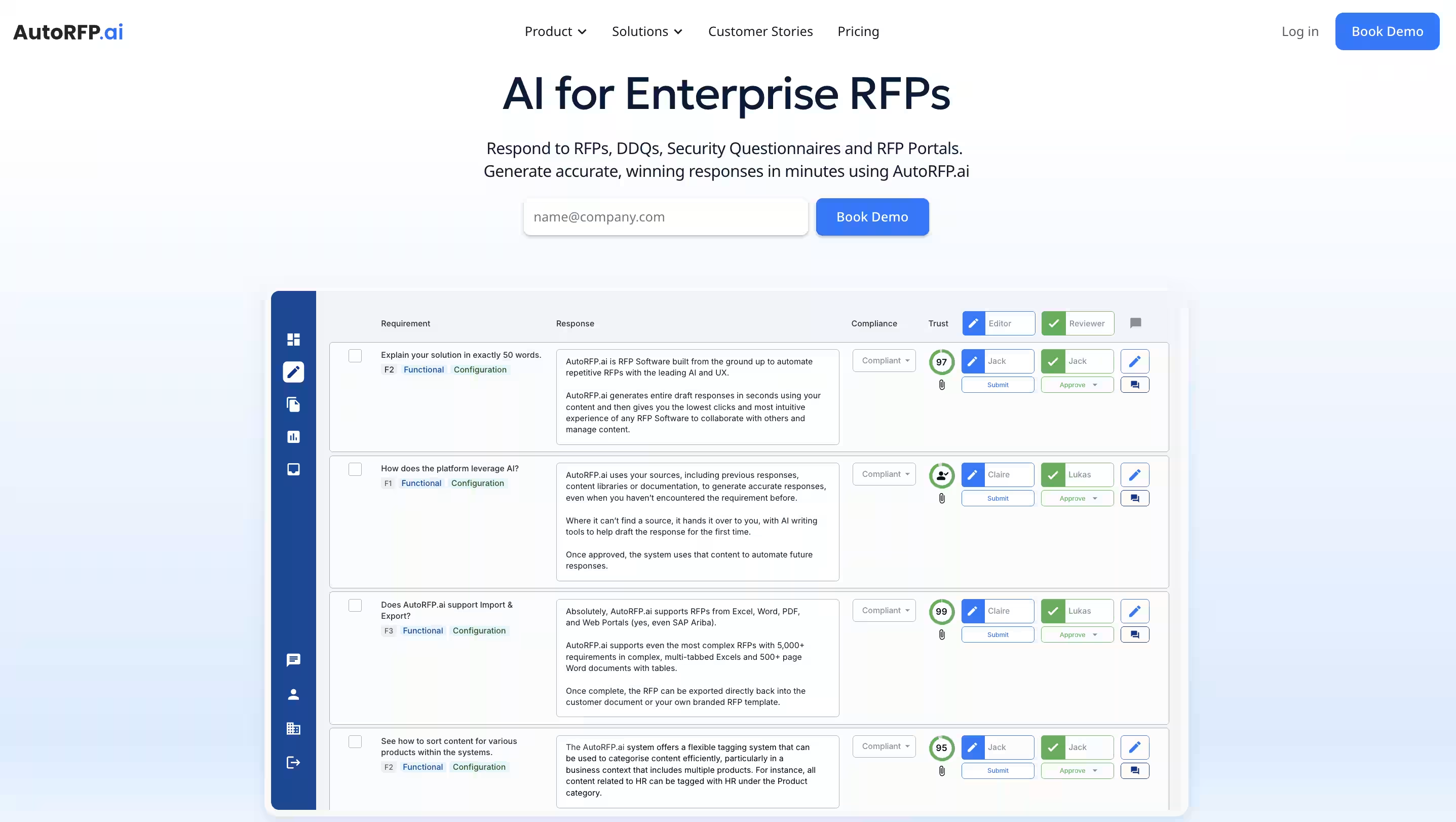
AutoRFP.ai has one bold promise: no library. It reads your past RFPs and documents, then uses that history to answer new ones. Every time you submit a new RFP, the AI gets smarter automatically.
For startups and mid-market teams without a dedicated proposal department, AutoRFP.ai removes the barrier to entry entirely. However, it lacks the heavy governance features that made Qvidian attractive to regulated industries.
How it scales capacity: By eliminating the setup phase. Upload your documents and start answering RFPs the same week.
Key features:
- Library-less architecture, indexes historical documents instead of Q&A pairs
- Traffic light system for answer confidence (green/yellow/red)
- Multilingual support for global teams
- Fastest time-to-value in the category
Pros:
- No library maintenance, the system runs itself
- High user adoption due to minimal training requirements
- Lower operational cost than Loopio or Responsive
Cons:
- Less control for compliance-heavy organizations
- Limited project management compared to Qvidian or Responsive
5. Inventive AI

Best for: Teams that want context-aware answers, not generic copy-paste.
Inventive AI attacks the biggest flaw of legacy tools: generic responses. It gives nuanced responses that enhance the RFP response. However, a lack of in-depth integration stops this capability from reaching its maximum potential.
How it scales capacity: By reducing edit time. AI gets you 60% of the way there, so reps spend less time rewriting the draft.
Key features:
- AI style-matching that learns your company's voice
- Conflict detection when multiple answers exist for the same question
- Sales enablement focus, built for reps, not just proposal managers
Pros:
- High-quality first drafts that require minimal editing
- Modern UI that feels like consumer software, not enterprise ERP
- Hyper-responsive customer support
Cons:
- Fewer integrations with legacy systems compared to Qvidian
- Complex Word template exports sometimes require manual cleanup
6. Proposify

Best for: Teams whose proposals look unprofessional and cost them deals.
Proposify is not an RFP automation tool. It is a proposal design tool. If your team does the hard work to win the deal but then sends a messy Word doc with broken formatting, Proposify fixes that problem.
It is the wrong tool for a 500-question security questionnaire. It is the right tool for making your final proposal look like it was created by a design agency.
How it scales capacity: By removing the formatting bottleneck. Reps stop wasting two hours fighting with Word and instead drag, drop, and send.
Key features:
- Design-locked templates, reps can change text, but cannot break branding
- Interactive pricing tables that update in real time
- Snapshot analytics showing when prospects open and read proposals
- Built-in e-signature (no DocuSign needed)
Pros:
- Brand control eliminates off-brand or ugly documents
- Easiest tool to use in this entire category
- Marketing teams love it because templates stay consistent
Cons:
- Cannot auto-answer complex RFPs
- Web editor can lag on 50+ page proposals
How to choose the right Qvidian alternative for your team
The right alternative depends on why Qvidian stopped working. Match your pain point to the tool.
Regulated industries (banking, healthcare, defense) that need strict audit trails should evaluate Responsive or SiftHub. Both deliver compliance without Qvidian's implementation cost. SiftHub offers faster setup; Responsive offers deeper governance.
Teams sending SOWs, quotes, or short proposals should consider Proposify or PandaDoc. These solve a design problem, not a content problem. They will not auto-answer a complex security questionnaire.
Revenue teams that want speed without overhead should choose SiftHub. It is the only alternative that removes the static library entirely, delivers enterprise-grade security, and covers the full deal cycle on a single platform.
Conclusion
Qvidian built enterprise RFP software for a different era, when governance meant logging every edit in a controlled environment, and speed was secondary to control.
For banks and defense contractors with massive compliance requirements, that approach still works. For everyone else, the cost outweighs the return.
The market has moved. AI-native tools now deliver the audit trails and security Qvidian promised, without consultants, an outdated interface, or a full-time admin keeping the library current.
SiftHub is the answer for teams that need compliance and speed. Connect your data, skip the library, and start closing deals faster from day one.