


.avif)
Request for quotation (RFQ) emails represent critical touchpoints in procurement and vendor relationships. Whether you're a procurement professional requesting pricing from suppliers or a vendor responding to customer inquiries, the quality of your RFQ email directly impacts response rates, relationship building, and ultimately deal success. Poorly formatted RFQ emails create confusion, delay purchasing decisions, and damage professional credibility. Well-structured messages that follow proven rfq email format guidelines generate faster responses, more accurate quotes, and stronger vendor partnerships.
This comprehensive guide breaks down exactly how to format effective RFQ emails from both buyer and vendor perspectives. You'll learn essential components every RFQ email must include, subject line formulas that improve open rates, sample templates you can customize immediately, and common mistakes that undermine your credibility. Whether you're creating your first RFQ email or refining your organization's standard approach, these best practices ensure your messages generate the results you need.
Understanding RFQ email format basics
An RFQ email is a formal business communication requesting price quotations for specific products or services. Unlike casual inquiries, RFQ emails follow structured formats that communicate professionalism, provide vendors with complete information needed for accurate quoting, and establish clear expectations about timelines and next steps.
The rfq email format differs from related procurement communications in important ways. Request for proposal (RFP) emails seek comprehensive solutions with detailed methodology explanations and vendor qualifications, while RFQ emails focus specifically on pricing for well-defined specifications. Request for information (RFI) emails gather general vendor capabilities and market intelligence, whereas RFQ emails assume you've already identified qualified vendors and now need specific pricing to make final decisions.
Here’s a more skimmable, reader-friendly version with clear sub-section structure, short intros, and bullets where they improve clarity—while keeping the original depth and intent intact.
Essential components of an effective RFQ email
1. Clear and specific subject line
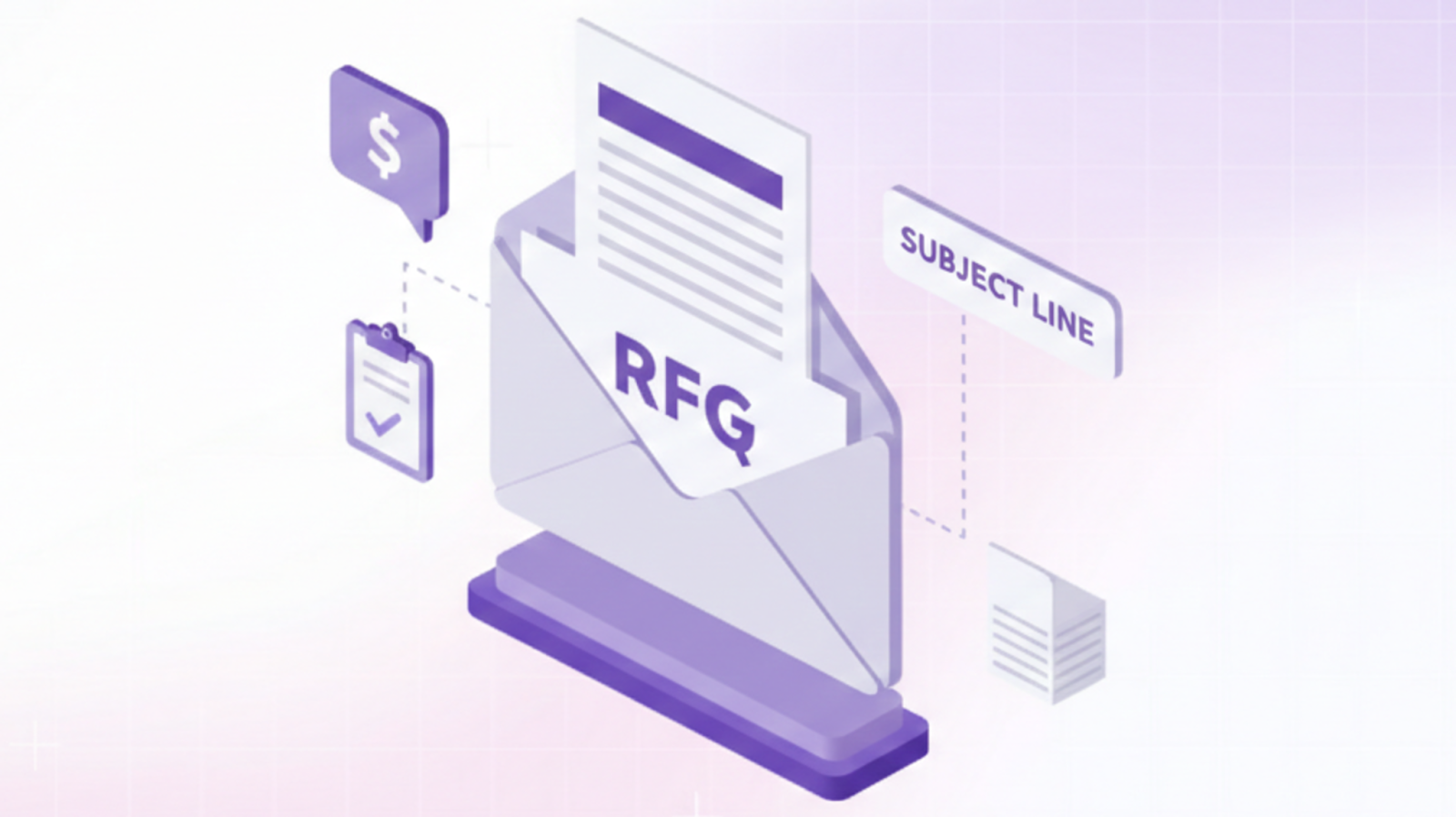
The subject line determines whether your RFQ gets opened or ignored. A strong subject line clearly states the request, scope, and urgency at a glance.
Best practices
- Follow a simple format:
“RFQ: [Your Company] – [Product/Service]”
“Request for quotation: [Item] – [Deadline]” - Keep it under 60 characters to avoid truncation on mobile.
Strong examples
- RFQ: ABC Corporation – 500 ergonomic office chairs
- Request for quotation: Cloud hosting services – response by March 15
- RFQ submission: Enterprise software implementation pricing
Avoid
- Generic phrases like “Pricing request”
- Vague descriptions such as “Need information”
- Overly long or unclear subject lines
2. Professional greeting and introduction
Start with a formal, personalized greeting whenever possible. Addressing the recipient by name builds credibility and improves response rates.
What to include in the opening (2–3 sentences max)
- Your name and role
- Your company name
- The purpose of the email and why you’re contacting this vendor
Example
“My name is Jennifer Martinez, and I’m the procurement manager at TechFlow Solutions. We’re currently sourcing industrial routers for a new distribution center and would like to request a quotation based on your expertise in enterprise networking equipment.”
3. Detailed product or service specifications
Specific requirements lead to accurate and comparable quotes. Vague requests almost always result in unusable responses.
How to present specifications
- Use bullet points or numbered lists for easy scanning
- Be precise and unambiguous
Include details such as
- Product or service description
- Technical specifications or performance requirements
- Quantity and unit of measurement
- Preferred brands/models (or note acceptable alternatives)
- Quality standards, certifications, or compliance needs
- Delivery location and timing expectations
Tip: If specifications are complex, attach detailed documents—but summarize key requirements in the email so vendors know what to focus on.
4. Quantity and volume information
Clearly defining volume helps vendors assess feasibility and offer appropriate pricing tiers.
For products
- Specify exact quantities
- Request tiered pricing if applicable (e.g., 100, 500, 1,000 units)
For services
- Define scope using measurable criteria:
- Estimated hours or duration
- Number of users, locations, or systems
- Service availability requirements (e.g., 24/7 support)
Example
- “IT support for 200 employees across 3 office locations with 24/7 helpdesk coverage.”
5. Timeline and deadline requirements
Clear timelines ensure timely responses and realistic vendor participation.
Specify
- RFQ submission deadline (date, time, and time zone)
- Expected delivery or project completion date
Best practices
- Allow 5–7 business days for standard RFQs
- Allow 10–14 business days for complex or customized requests
- Avoid overly tight deadlines, which often reduce response quality
6. Evaluation criteria and next steps
Transparency helps vendors tailor their responses and improves quote quality.
Clarify how quotes will be evaluated
- Price only, or a combination of factors such as:
- Delivery timelines
- Payment terms
- Warranty and support
- Vendor experience and references
Close professionally
- Invite questions
- Provide contact details
- Thank the vendor for their time
Example closing
“Please feel free to contact me at jmartinez@techflow.com or 555-0123 with any questions. We appreciate your time and look forward to reviewing your quotation.”
A well-structured RFQ email with these elements not only improves response rates but also ensures you receive clear, comparable quotes that support faster and more confident purchasing decisions.
RFQ email templates for different scenarios
Template 1: Standard product RFQ
Subject: RFQ: [Your Company] – [Product name and quantity]
Email body:
Good morning [Vendor contact name],
My name is [Your name], and I'm the [Your title] at [Your company]. We are currently sourcing [product category] and would like to request a quotation from your company.
Product specifications:
- Product: [Detailed product description]
- Quantity: [Number of units]
- Specifications: [Technical requirements, model numbers, or quality standards]
- Delivery location: [Complete address]
- Required delivery date: [Specific date]
Additional requirements:
- Payment terms: [Your preferred payment structure]
- Warranty: [Warranty requirements]
- Packaging: [Any specific packaging needs]
Please include in your quotation:
- Unit price and total price for specified quantity
- Tiered pricing (if applicable for different volumes)
- Delivery/shipping costs
- Lead time from order confirmation to delivery
- Payment terms you offer
- Warranty information
- Any additional fees or charges
Please submit your quotation by [Deadline date and time]. We will evaluate all responses and contact shortlisted vendors by [Decision timeline].
If you have any questions or need clarification, please contact me at [Phone] or [Email]. Thank you for your time, and we look forward to your response.
Best regards,
[Your name]
[Your title]
[Company name]
[Phone]
[Email]
Template 2: Service-based RFQ
Subject: Request for quotation: [Service type] – [Company name]
Email body:
Hello [Vendor contact name],
I am writing on behalf of [Your company], where I serve as [Your title]. We are seeking [Service description] and would appreciate a quotation for the services outlined below.
Service requirements:
- Scope: [Detailed description of services needed]
- Duration: [Time period or project timeline]
- Location: [Where services will be performed]
- Volume: [Number of users, locations, or relevant metrics]
- Start date: [When services should commence]
Specific deliverables:
- [Deliverable 1 with description]
- [Deliverable 2 with description]
- [Deliverable 3 with description]
Required qualifications:
- [Certification, licensing, or experience requirements]
- [Industry-specific compliance needs]
- [Any mandatory credentials]
Please provide:
- Total project cost or hourly/monthly rates
- Breakdown of costs by service component
- Proposed timeline and milestones
- Team qualifications and relevant experience
- References from similar projects
- Terms and conditions
We request your quotation by [Deadline]. Selected vendors will be invited to discuss proposals in detail during [Timeframe].
Please reach out with any questions at [Email] or [Phone]. We appreciate your interest and look forward to reviewing your quotation.
Sincerely,
[Your name]
[Contact information]
Template 3: Bulk purchase RFQ with volume tiers
Subject: RFQ: Bulk order inquiry – [Product] from [Your company]
Email body:
Dear [Vendor contact],
My name is [Your name], and I'm responsible for procurement at [Your company]. We are planning a large-scale purchase of [Product type] and would like to request volume pricing from your organization.
Product details:
- Product: [Specific product name, model, or SKU]
- Specifications: [Technical details, features, or standards]
Volume tiers for pricing: Please provide pricing for the following quantities:
- Tier 1: [X units] – unit price and total
- Tier 2: [Y units] – unit price and total
- Tier 3: [Z units] – unit price and total
Additional information needed:
- Current production capacity
- Lead times for each volume tier
- Shipping/freight costs to [Delivery location]
- Packaging options (bulk vs individual packaging)
- Payment terms available for bulk orders
- Volume discount structure beyond listed tiers
- Stock availability or production schedule
Important dates:
- Quotation deadline: [Date and time]
- Required delivery window: [Date range]
- Purchase decision timeline: [When you'll select vendor]
We view this as an opportunity to establish a long-term vendor relationship and may have ongoing needs beyond this initial purchase. Please include any information about preferred customer programs or ongoing pricing agreements.
For questions or clarifications, contact me at [Email] or [Phone]. Thank you for considering this opportunity.
Best regards,
[Your signature block]
Here’s an email-focused version tailored to the section:
Accelerate RFQ email responses with an AI Answer Agent
SiftHub’s AI answer agent works behind every RFQ email, helping you generate instant, accurate, and context-aware responses. From pricing details and product specifications to delivery timelines and technical clarifications, it pulls approved information from your knowledge base and drafts ready-to-send email replies, so you can respond faster, stay consistent, and keep deals moving.
SiftHub's AI Answer Agent works behind every RFQ email, helping you generate instant, accurate, and context-aware responses. Teams handling RFQs at volume automate the whole RFQ response instead of rebuilding each one by hand. From pricing details and product specifications to delivery timelines and technical clarifications, it pulls approved information from your knowledge base and drafts ready-to-send email replies, so you can respond faster, stay consistent, and keep deals moving.
Subject line formulas that improve open rates
Effective RFQ email subject lines follow proven patterns that communicate essential information while capturing attention. The following formulas consistently generate higher open and response rates:
Formula 1: RFQ + company name + product category
Examples: "RFQ: TechFlow Solutions – enterprise routers," "Request for quotation: ABC Manufacturing – industrial pumps"
Formula 2: RFQ + product/service + deadline
Examples: "RFQ: Office furniture – response needed by March 15," "Request for quote: IT services – deadline April 1"
Formula 3: RFQ + specific item + quantity
Examples: "RFQ: 500 safety helmets – bulk purchase," "Request for quotation: 200 laptops"
Formula 4: Company name + RFQ submission + product
Examples: "GlobalTech RFQ submission: cloud hosting services," "Peterson Industries – RFQ for steel fabrication".
Avoid these subject line mistakes that reduce response rates: All caps text ("RFQ REQUEST URGENT!!!") that appears unprofessional, excessive punctuation or special characters, vague descriptions without specifics ("Need pricing information"), and misleading urgency when deadlines aren't actually tight.
For vendors responding to RFQs, use "Re:" to maintain email threading and clearly reference the original RFQ: "Re: RFQ submission – [Product] quotation for [Buyer company]" ensures your response is immediately recognizable and properly filed.
Best practices for RFQ email effectiveness
1. Personalization builds relationships
Generic, template-obvious RFQ emails receive lower priority than messages demonstrating you've researched the vendor and understand their capabilities. Reference previous interactions if you've worked together before, mention specific products or services from their catalog that caught your attention, or acknowledge their expertise in relevant areas. "We've been impressed by your work in the healthcare vertical and believe your experience would benefit our project" signals genuine interest beyond mass-mailing dozens of vendors.
For vendors responding to RFQs, personalization is key to standing out in a crowded field of generic quotes. Instead of boilerplate responses, reference the buyer’s specific requirements, industry challenges, and stated goals to demonstrate careful reading and relevance. Tailoring the tone and depth of your response across channels, emails, questionnaires, or calls helps reinforce clarity and consistency. With AI-driven personalization, teams can craft industry-specific, compelling responses in seconds, not hours, significantly improving their chances of winning.
2. Attach supporting documentation strategically
While you should summarize key requirements in the email body, complex RFQs often require supporting documents like technical specification sheets, CAD drawings or design files, scope of work documents, or quality standard certifications.
Ensure files are properly named (avoid generic "Document1.pdf"), use widely compatible formats (PDF, not proprietary software files), and keep total attachment size reasonable (under 10MB when possible). If you need to share large files, use file-sharing services and include download links in your email.
3. Proofread carefully before sending
RFQ emails represent your organization's professionalism and attention to detail. Spelling errors, grammatical mistakes, or incorrect information damage credibility and make vendors question whether you'll handle the actual business relationship competently. Always proofread RFQ emails checking for accuracy of all technical specifications and quantities, correct contact information and deadlines, proper recipient name spelling and company references, and consistent formatting throughout the message.
For high-stakes RFQs or first-time vendor contacts, consider having a colleague review your email before sending. Fresh eyes catch errors you've overlooked and may suggest improvements to clarity or tone.
4. Follow up appropriately
If you haven't received responses by your stated deadline, send a brief follow-up email. Some vendors may have missed your original message or need additional time. A simple reminder: "I wanted to follow up on our RFQ sent on [Date] regarding [Product/service]. We would still welcome your quotation if you're able to provide pricing by [Extended deadline]. Please let me know if you have questions or need additional information."
For vendors, if you need clarification on any RFQ requirements, ask questions promptly rather than guessing or providing incomplete quotes. "Thank you for your RFQ. To provide the most accurate quotation, could you please clarify [Specific question]? We want to ensure our response fully addresses your needs."
How technology streamlines RFQ email workflows
1. For organizations sending RFQs
Modern procurement teams leverage technology to streamline repetitive RFQ creation and distribution. Template libraries allow customization while maintaining consistency, email tracking shows when vendors open and engage with RFQs, and automated reminder systems follow up with vendors who haven't responded by deadlines.
Integration between procurement software and email systems enables vendors to submit quotes directly into evaluation tools rather than through disconnected email attachments, creating more efficient comparison and analysis workflows.
2. For vendors responding to RFQs
Organizations receiving high volumes of RFQs face significant challenges responding quickly with accurate, complete information. Traditional approaches require hunting through product catalogs, pricing systems, and technical documentation, coordinating with subject matter experts across departments, and manually compiling responses—work that can consume hours or days per RFQ.
AI enablement platforms like Sifthub transform this workflow by centralizing all product specifications, pricing, terms, and technical documentation in searchable knowledge bases. When RFQ emails arrive, sales teams can instantly access verified information needed for accurate quotes rather than interrupting busy technical experts or searching through outdated files.
For complex RFQs with hundreds of specific questions, SiftHub's response generation capabilities auto-generate answers by pulling from your integrated knowledge sources and uploaded content, product specs, pricing sheets, technical documentation, and compliance certifications—reducing response time from days to hours. The platform's project management features help presales teams track autofill progress easily through the activity center and web app, assign sections to appropriate subject matter experts when needed, and ensure nothing falls through the cracks when juggling multiple quote requests simultaneously.
The bottom line
Well-formatted RFQ emails create a foundation for successful procurement and vendor relationships. Whether you're a procurement professional requesting competitive pricing or a vendor responding to customer inquiries, the structure, clarity, and professionalism of your RFQ emails directly impact business outcomes.
For procurement teams, effective RFQ emails generate faster responses, more accurate quotes, and stronger vendor partnerships. For vendors, professional RFQ responses demonstrate competence, facilitate accurate quoting, and differentiate you from competitors submitting poorly organized proposals.
Transform how your team handles RFQ responses. Discover how SiftHub as your AI RFP Software helps sales and presales teams respond to complex quotation requests instantly by providing verified product information, pricing details, and technical specifications without hunting through scattered documentation.
Book a demo to see how an AI sales assistant accelerates RFQ response times, or start your free trial today.
"Want a head start? Grab our free RFP/RFQ template."