


.avif)
"We help businesses streamline their operations and improve efficiency."
That is a value proposition. It is also useless. It describes nothing a buyer can act on, differentiates from nothing a competitor says, and addresses no specific problem anyone actually has. Yet some version of this sentence appears on thousands of sales decks, cold emails, and company websites, and its generic nature is precisely why so many sales conversations start strong and go nowhere.
A value proposition is the single most important piece of messaging your sales team delivers. It is the answer to the question every buyer is silently asking: "Why should I care about this, and why should I choose you over everyone else offering something similar?" When your value proposition answers that question with specificity and credibility, conversations advance. When it offers a vague claim that sounds like everyone else in your category, buyers disengage before the real selling begins.
This guide breaks down what separates value propositions that convert from those that do not, a step-by-step framework for crafting one, and how to adapt your messaging for different buyers, industries, and competitive situations.
What a sales value proposition actually is
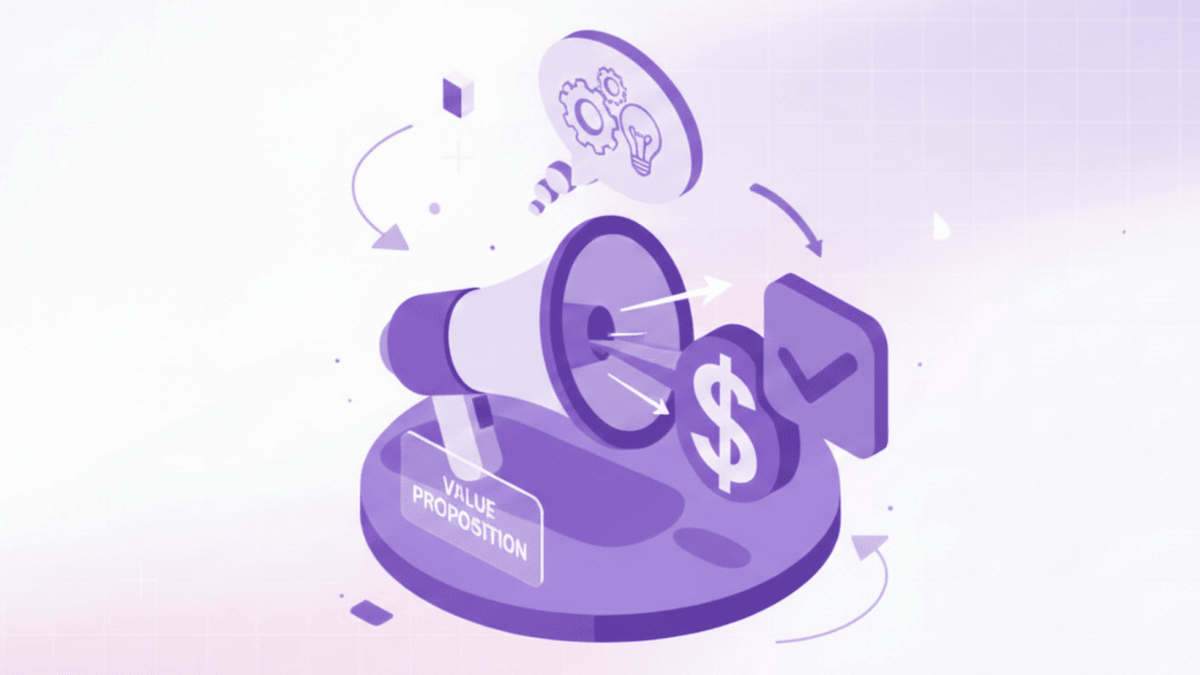
A sales value proposition is a clear statement of the specific outcome a particular type of buyer achieves by using your product or service, and why they should choose you to deliver it rather than alternatives.
That definition contains three components worth examining separately:
- Specific outcome: Not features. Not capabilities. Not what your product does, what the buyer achieves because of what your product does. "Automates document generation" is a feature. "Reduces time to close from 12 days to 3 days" is an outcome. Buyers buy outcomes, not features.
- Particular type of buyer: A value proposition written for everyone converts no one. The language, pain points, resonant outcomes, and competitive landscape all vary by buyer type. A CFO evaluating your platform needs different assurances than a VP of Sales. Both need a value proposition, but they are not the same value proposition.
- Why you rather than alternatives: The differentiation component is what most value propositions skip or handle poorly. Every buyer is implicitly comparing you to something: a competitor, the status quo, doing nothing, or building internally. If your value proposition does not address why you are the better choice against those alternatives, you are leaving the differentiation question unanswered, and buyers answer it themselves, often incorrectly.
What a value proposition is not
A value proposition is not a tagline ("The future of sales, today"). It is not a mission statement ("We exist to empower teams to achieve more"). It is not a feature list ("Includes 150+ integrations, advanced analytics, and real-time reporting"). These may have their place in marketing, but none of them function as a sales value proposition because none of them answer a buyer's core question: what specifically will change for me, and why should I trust you to deliver it?
The most common mistakes that kill conversion
Understanding where value propositions fail makes it easier to avoid building one that suffers the same fate.
Leading with features, not outcomes
Features describe your product. Outcomes describe the buyer's future. "We have built-in workflow automation" is a feature statement. "Your team gets back eight hours a week currently spent on manual status updates" is an outcome statement. The second gives the buyer something to want. The first gives them the capability to evaluate.
The shift from feature to outcome requires asking "so what?" after every capability claim until you reach something a buyer would actually care about. Real-time reporting → "so what?" → You can see pipeline problems developing → "so what?" → You catch at-risk deals two weeks earlier → "so what?" → You save deals that would otherwise close in the wrong quarter. That final statement is the outcome. That is the value proposition.
Targeting everyone equally
"We serve teams of all sizes across all industries" is a signal that you have not done the work of understanding who your best buyers actually are. A value proposition that tries to be relevant to everyone ends up resonating with no one because it cannot use the specific language, reference the specific pain points, or speak to the specific context of any particular buyer type.
The instinct to write broad value propositions often comes from fear of exclusion—"if we get too specific, we'll miss buyers we could serve." In practice, the opposite happens. Specific value propositions attract buyers who see themselves in your messaging because you accurately describe their situation. Buyers who do not fit the description self-select out, which is a feature, not a bug: it means fewer conversations that were never going to convert.
Claiming differentiation without evidence
"Best-in-class," "industry-leading," "most advanced"—these claims appear in value propositions constantly and mean nothing. Every competitor uses the same language. When every option in a category claims to be best-in-class, the claim adds no distinction.
Real differentiation is specific: "The only platform that automatically tracks competitor pricing changes and updates your battlecards in real time" is a specific differentiating claim that competitors either match or do not. "The most advanced competitive intelligence platform" is not.
Using internal language that buyers do not recognize
Every product team develops its own internal terminology to describe its product. These terms make perfect sense within the company but confuse outsiders. If your value proposition uses acronyms, product-specific concepts, or category jargon that buyers have not already internalized, you are forcing them to do translation work before they can even assess whether your offering is relevant.
Effective value propositions use the language buyers use to describe their own problems, which you learn by listening to how prospects describe their situation in discovery, reading the language they use in job postings and LinkedIn posts, and paying close attention to the exact words that make a prospect's eyes light up versus glaze over.
The framework for crafting a value proposition that converts
A reliable value proposition follows a structure that forces specificity at every step. The formula is:
"We help [specific buyer type] achieve [specific measurable outcome] by [mechanism that makes it credible], unlike [named alternative] which [limitation of that alternative]."
Walking through each component:
Step 1: Define the specific buyer
Not "sales teams." Not "B2B companies." The specific buyer is a title, at a specific company type, facing a specific situation. "Sales operations managers at mid-market SaaS companies managing a team of 10 to 30 reps" is specific. The more precisely you can describe who you are talking to, the more precisely the rest of your value proposition can speak to their actual situation.
Different buyer types need separate value propositions. A single product typically serves multiple stakeholders with different concerns, and builds one value proposition per primary persona rather than one generic statement that attempts to serve all of them.
Step 2: Name the exact problem
What is the specific painful situation this buyer is currently experiencing? Not the problem category, but the specific manifestation of it. Not "inefficient workflows" but "your SDRs are spending 2.5 hours per day manually researching prospects before outreach." The problem statement should be specific enough that a buyer reading it thinks "that is exactly what is happening to us."
Specificity in problem identification comes from customer interviews, discovery call notes, and win-loss analysis. The most powerful problem statements are often near-direct quotes from buyers describing their situation, language so accurate that prospects feel understood before you have offered a solution.
Step 3: State your solution mechanism
How specifically does your product address that problem? This is not a feature list; it is the mechanism of action. Not "we have an analytics dashboard" but "we automatically flag deals where engagement signals suggest the buyer has gone quiet, before it shows up in forecast risk." The mechanism explains why your product produces the outcome, which makes the outcome claim credible.
Step 4: Quantify the outcome
Wherever possible, attach numbers to the outcome. "Saves time" is weak. "Reduces prospect research time by 60%, giving each SDR back 1.5 hours per day for outreach" is strong. Numbers make outcomes concrete, comparable, and memorable. They also give buyers something to validate; they can look at your claim and assess whether it is plausible given what they know about their own situation.
If you do not have precise data, ranges and directional claims are better than nothing: "typically reduces by 40 to 60%" is more credible than either false precision or vague non-claims.
Step 5: Complete the differentiation
Every value proposition needs to answer "why you over X." Name the category of alternative, not necessarily a specific competitor name, but the type of alternative the buyer is likely comparing you to. "Unlike spreadsheet-based tracking, which breaks down above 50 active deals." "Unlike legacy platforms, which require 6-month implementations before you see results." "Unlike hiring another analyst, which adds headcount cost without solving the speed problem."
The differentiation statement acknowledges that buyers have alternatives and makes the explicit case for why yours is better, which is far more persuasive than pretending alternatives do not exist.
Adapting your value proposition to different buyers
A single core value proposition serves as the foundation. What changes across buyer types is the emphasis, language, and specific outcomes highlighted.
A CFO evaluating your platform is focused on cost reduction, risk mitigation, and ROI. A VP of Sales cares about quota attainment, pipeline coverage, and rep productivity. An end-user cares about how it changes their daily workflow and whether it is annoying to use. All three might be stakeholders in the same purchase decision, and each needs a version of your value proposition calibrated to what they care about.
This is not about creating dishonest messaging that says different things to different people; it is about leading with what matters most to each audience while staying consistent on the core claims. The CFO version of your value proposition leads with cost and ROI. The VP Sales version leads with quota attainment and coverage. The end-user version leads with workflow impact. The underlying claim is the same; the emphasis and language adapt.
Industry-specific adaptation follows the same principle. A value proposition for healthcare buyers should reference healthcare-specific compliance constraints, operational contexts, and terminology. The same product sold into financial services requires a different contextual framing. Tools with AI personalization capabilities that help sales teams tailor messaging by industry, company size, and buyer role enable teams to deliver the right version of their value proposition consistently without requiring every rep to rebuild the framing from scratch for each conversation.
Building competitive differentiation into your value proposition
Differentiation is the component that most value propositions handle the worst. Generic claims of superiority are not differentiated. Specific positioning against what buyers are actually comparing you to is crucial.
Effective competitive differentiation requires knowing what competitors claim, where those claims fall short, and where you genuinely outperform them. This is not guesswork-it comes from win-loss analysis, competitive research, and listening to how buyers describe competitive options during discovery.
The differentiation statement in your value proposition should address the comparison the buyer is most likely making. If buyers in your segment consistently compare you to one specific competitor, your value proposition should position against that alternative. If buyers most often compare you to their current spreadsheet-based process, position against that.
Competitive intelligence that tracks what competitors are claiming, how their messaging is evolving, and where their product gaps appear enables sharper, more current differentiation. A battlecard agent that surfaces up-to-date competitive positioning ensures the differentiation built into your value proposition reflects current competitive reality rather than assumptions about how competitors positioned themselves 12 months ago. Differentiation that was accurate last year may be outdated if a competitor has since addressed a gap you relied on.
Testing and validating your value proposition
A value proposition is a hypothesis until buyer response validates or contradicts it. Building a strong value proposition framework is the starting point; knowing whether it is working requires deliberate testing.
- Conversation response testing: Track how buyers respond when you deliver your value proposition. Do they lean in? Ask follow-up questions that suggest they recognize themselves in your description. Or do they respond with polite disinterest and redirect the conversation? Patterns across many conversations reveal whether your value proposition is landing.
- Email engagement testing: In outbound sequences, the subject line and first sentence function as a compressed value proposition. A/B testing different framings, problem statements, outcome claims, and differentiation angles produces engagement rate signals that indicate which version resonates with which buyer segment.
- Win-loss pattern analysis: Value propositions that work show up as patterns in won deals: buyers who chose you because of the specific outcome you claimed, or the specific differentiation you offered. Value propositions that do not work show up as deals where buyers could not articulate why they chose you, or worse, chose a competitor because they believed something about that competitor that your messaging failed to counter.
The most important principle in value proposition testing is specificity: test one variable at a time. If you change both the problem statement and the differentiation angle simultaneously, you cannot tell which change drove the response difference.
Translating your value proposition into sales collateral
A strong value proposition does not live only in conversations; it needs to run consistently through every buyer-facing asset your team produces: cold emails, discovery call frameworks, presentation decks, one-pagers, proposals, and follow-up materials.
The challenge is consistency. When every rep builds their own version of the value proposition into their own materials, messaging fragments. The CFO who hears version A from the AE and then reads version B in the follow-up proposal wonders whether your team knows what it is actually offering.
Centralizing your value proposition and ensuring it surfaces consistently across buyer-facing assets solves this. SiftHub’s sales collateral builder generates personalized decks, one-pagers, and proposals from your verified messaging, ensuring the value proposition your team crafted is the one buyers encounter throughout the evaluation—not a diluted or inconsistent version filtered through individual interpretation.
The bottom line
Your value proposition isn’t a one-time statement; it’s a living narrative that must evolve as your product matures, your ideal buyer profile sharpens, competitive pressures change, and real-world feedback accumulates. It should be revisited whenever you see consistent drop-offs at the awareness stage, notice competitors narrowing your differentiation, expand into new market segments, or uncover patterns in win–loss feedback that your messaging doesn’t yet address.
The strongest sales organizations don’t arrive at effective value propositions by crafting a single brilliant line. Instead, they treat their value proposition as a testable hypothesis, refining it continuously based on buyer reactions and reinforcing it across every sales and customer touchpoint. As Mahesh Natrajan emphasizes through SiftHub’s approach, what you promise, what customers experience, and how they ultimately use the product together form a feedback loop that determines trust, advocacy, and expansion.
Consistency between messaging and delivery is critical. When sales promises diverge from implementation realities, credibility erodes quickly. By ensuring all teams – sales, presales, and customer success- operate from a shared, up-to-date source of truth, organizations can align evolving value propositions with actual customer experiences and sustain long-term growth.