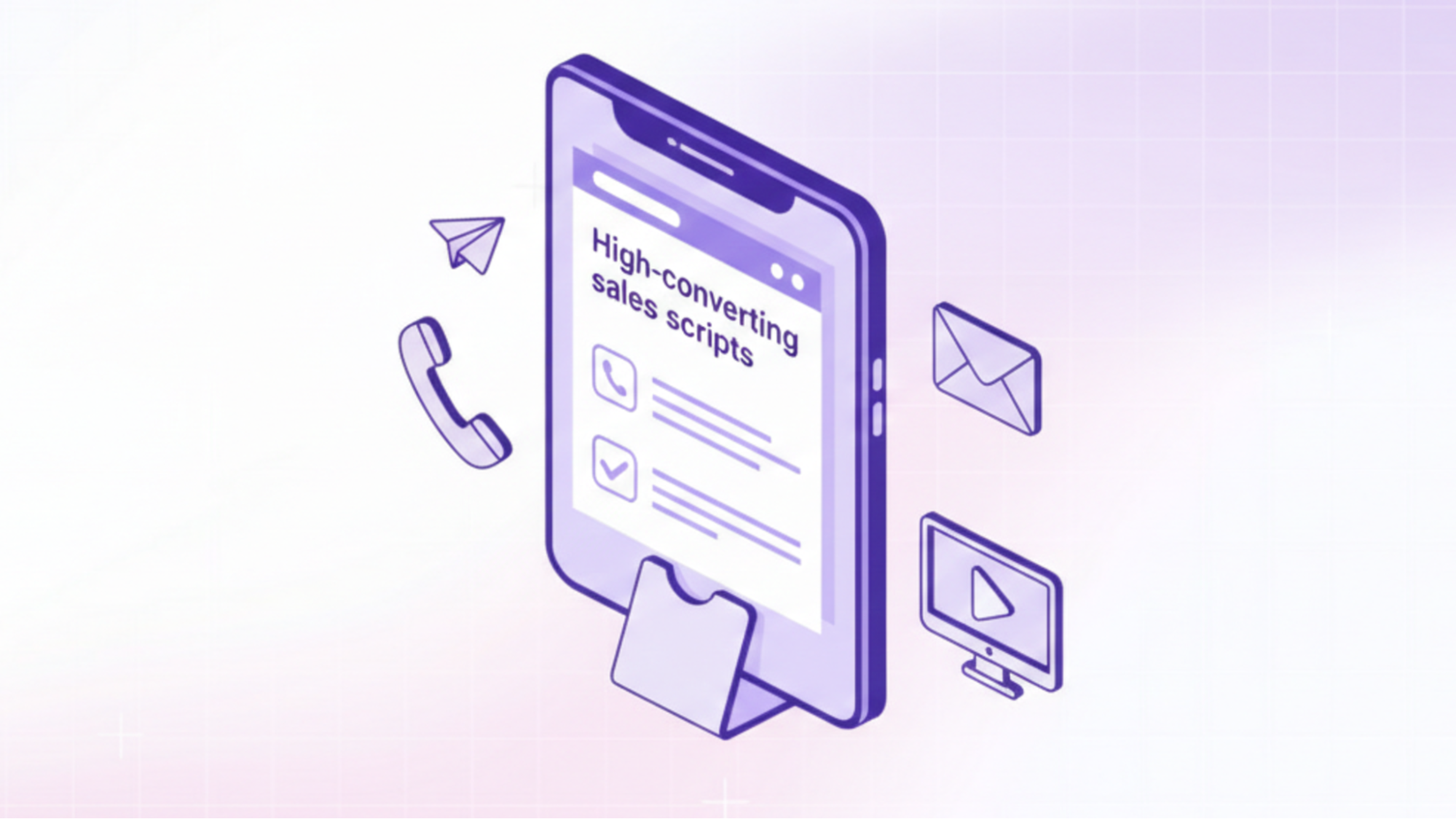



Sales scripts get a bad reputation. Many reps think they sound robotic, kill authenticity, and make conversations feel forced. But the reality is different: the best sales professionals use scripts as frameworks, not word-for-word monologues. A well-crafted sales script provides structure during high-pressure conversations, ensures you hit key points, and gives you confidence when prospects throw unexpected objections your way.
The difference between a script that converts and one that falls flat comes down to flexibility. Rigid scripts that demand exact wording create awkward interactions. Effective scripts provide talking points, question sequences, and response frameworks that guide conversations while leaving room for natural dialogue. When used correctly, sales scripts help you stay focused, handle objections smoothly, and move deals forward consistently.
This guide offers proven sales script templates for every stage of the sales process, including cold calls to secure meetings, discovery questions to uncover genuine pain points, demo presentations to drive decisions, and follow-up emails to maintain momentum. More importantly, it shows you how to adapt these templates to your product, your prospects, and your selling style so conversations feel authentic rather than rehearsed.
What makes a sales script effective?
Before diving into specific templates, understanding what separates high-performing scripts from ineffective ones helps you tailor these frameworks to your specific situation.
1. Clear objective for every interaction
Every sales conversation needs a specific goal beyond "make the sale". Cold calls aim to secure discovery meetings. Discovery calls qualify prospects and identify pain points. Demos demonstrate how your solution addresses specific challenges. Follow-ups move deals to the next stage. When your script focuses on achieving one clear objective rather than trying to accomplish everything at once, conversations flow naturally toward logical next steps.
2. Questions instead of pitches
Effective scripts ask more questions than they make statements. Questions uncover prospect needs, reveal decision-making criteria, and identify objections before they derail deals. A script built around strategic questioning creates dialogue rather than monologue, keeping prospects engaged while gathering the intelligence you need to position your solution effectively.
3. Pattern interrupts for cold outreach
Cold calls and emails face significant resistance because prospects receive dozens of identical pitches each week. Scripts that open with unexpected questions, relevant insights about the prospect's business, or provocative statements about common challenges break through this noise. Pattern interrupts give you the few seconds you need to demonstrate value before prospects disengage.
4. Prepared responses for common objections
Every product faces predictable objections: too expensive, wrong timing, already working with a competitor, or needs to be thought through. Scripts should include frameworks for addressing these objections without sounding defensive or desperate. Prepared responses let you handle pushback confidently, keeping conversations productive when prospects resist.
5. Natural conversation flow
The best scripts provide guardrails, not word-for-word dialogue. They outline the sequence of topics, suggest phrasing for difficult moments, and offer transition language between conversation stages. This structure prevents you from forgetting critical points while allowing enough flexibility to respond naturally to what prospects actually say rather than what you anticipated they'd say.
Cold call script template
Cold calling remains one of the most challenging sales activities. Prospects are busy, defensive about their time, and skeptical of unsolicited pitches. This template breaks through resistance by quickly establishing credibility, offering immediate value, and making a low-commitment ask.
1. Opening (first 10 seconds)
"Hi [name], this is [your name] from [company]. I know I'm calling out of the blue, do you have 30 seconds for me to explain why I'm reaching out?"
- Why this works: Acknowledging the interruption and asking permission disarms prospects. The 30-second timeframe feels manageable rather than threatening. Most prospects will give you those 30 seconds.
- Alternative opening for referrals: "Hi [name], [referral source] suggested I reach out. They mentioned you were dealing with [specific challenge]. Is this something you're actively working to improve?"
2. Value statement (next 20 seconds)
"I work with [job titles/industries] who are struggling with [specific problem]. We've helped companies like [recognizable customer] reduce [metric] by [percentage]. I'm calling because I noticed [relevant trigger event about their company] and thought this might be relevant for you."
- Why this works: You've quickly established relevance through similar customers, concrete results, and a specific observation about their business. This isn't a generic pitch, it's targeted to their situation.
- Customization tip: Research trigger events like funding announcements, leadership changes, product launches, or industry challenges that make your solution timely.
3. Permission-based transition
"Based on what you're seeing in [their industry/company], does [problem you solve] resonate as something worth exploring?"
- Why this works: You're asking for their perspective rather than pitching harder. This question creates a natural fork: if yes, you proceed to qualification; if no, you can pivot or end gracefully.
4. Qualification questions (if they engage)
- "What's driving that challenge right now?"
- "How are you currently handling this?"
- "What would change if you could solve this problem?"
Why this works: These questions shift the conversation from your pitch to their needs. You're gathering information to determine whether this prospect is worth pursuing while positioning yourself as a consultant rather than a vendor.
5. The ask
"It sounds like this is worth a longer conversation. I'd love to schedule 20 minutes next week to dive deeper into what you're dealing with and share how we've helped similar companies. Does Tuesday at 2 PM or Thursday at 10 AM work better for you?"
- Why this works: You're proposing a specific, time-bound meeting rather than a vague "let's talk soon." Offering two options increases commitment by making the choice between times rather than between meeting or not meeting.
6. Handling "send me information" objection
"I'm happy to send something over. To make sure it's relevant, can I ask: what specifically would you want to see? Are you more interested in [option A] or [option B]?"
- Why this works: This response gets you information about their priorities while setting expectations that you'll send targeted information, not a generic brochure. It also keeps the conversation going rather than ending with "I'll send something."
Discovery call script template
Discovery calls determine whether prospects are qualified, what problems they need solved, and how to position your solution effectively. This template ensures you gather critical information while building rapport.
1. Opening and agenda setting
"Thanks for taking the time today. I've done some research on [company], and I'm excited to learn more. Here's what I thought we could cover in our 30 minutes together: First, I'd love to understand more about [specific challenge mentioned in initial conversation]. Then I can share what we're seeing with similar companies and how we might help. Does that work for you?"
Why this works: You've shown you prepared, set clear expectations, and asked for their agreement on the agenda. This collaborative approach starts the meeting with alignment.
2. Background and context questions
- "Walk me through how you currently handle [process related to your solution]."
- "What's working well with your current approach?"
- "Where are the biggest pain points or bottlenecks?"
- "How long has this been a challenge?"
Why this works: These questions establish a baseline understanding without feeling like an interrogation. Starting with "what's working well" builds rapport before diving into problems.
3. Impact and urgency questions
- "How is this problem affecting your team's ability to hit their goals?"
- "What's the cost of not solving this in time, in money, or in missed opportunities?"
- "What happens if this stays the same for the next six months?"
- "Is this a top-three priority for your team right now?"
Why this works: These questions quantify the problem's impact and reveal urgency. If prospects can't articulate meaningful consequences, the deal is unlikely to close regardless of your solution's quality.
4. Decision process questions
- "Who else gets involved in decisions like this?"
- "What does your typical evaluation process look like?"
- "What criteria will you use to make this decision?"
- "What's your timeline for making a decision?"
Why this works: You're uncovering the buying committee, decision criteria, and timeline before investing heavily in the deal. This information prevents surprises late in the sales cycle.
5. Vision and success questions
- "If we could wave a magic wand and solve this perfectly, what would that look like?"
- "How would you measure success six months after implementing a solution?"
- "What would it mean for you personally if this problem were solved?"
Why this works: These questions get prospects to articulate the desired outcome in their own words, creating a vision of success you can reference throughout the sales process.
6. Closing and next steps
"Based on what you've shared, it sounds like [restate their problem and impact]. I think we could definitely help with [specific aspect]. The logical next step would be [demo, proposal, technical discussion] where we can show you exactly how this would work for your situation. I have availability next week on [day/time] or [day/time]. Which works better for you?"
- Why this works: You've summarized their situation, confirmed relevance, and proposed a specific next step with concrete options. This maintains momentum rather than ending with a vague "I'll follow up."
Demo presentation script template
Demo presentations prove your solution addresses the prospect's specific needs. Generic feature tours bore prospects and waste everyone's time. This template keeps demos focused, relevant, and persuasive.
1. Opening and context reminder
"Before we dive in, let me make sure I'm addressing what matters most to you. In our last conversation, you mentioned [specific pain points]. Today I want to show you exactly how [product] handles those situations. I'll keep this to 30 minutes and save time for your questions. Sound good?"
- Why this works: You've immediately connected the demo to their specific needs rather than launching into a generic presentation. You've also set time expectations and invited questions.
2. Problem-first approach
"Let's start with [specific challenge they mentioned]. Most of the teams we work with tell us they spend 10-15 hours per week on [manual task]. They're dealing with [specific pain point]. Does that match what you're seeing?"
- Why this works: You're beginning with their problem, not your features. This keeps them engaged because you're talking about their world, not your product.
3. Solution demonstration (tied to their needs)
"Here's how we solve that. [Show specific feature addressing the problem]. What this means for you is [concrete benefit relevant to their situation]. Instead of spending 15 hours doing [manual task], your team could handle the same work in 2 hours."
- Why this works: You're demonstrating features in the context of their problems, not listing capabilities. The "what this means for you" language translates features into outcomes they care about.
4. Handling questions during demos
When prospects ask questions during demos, don't defer them to the end. Address them immediately, then return to your planned flow. "Great question. Let me show you exactly how that works." Then demonstrate the answer rather than just explaining it verbally.
- Why this works: Answering questions immediately keeps prospects engaged and prevents them from mentally checking out while waiting for answers. Showing rather than telling builds confidence in your solution.
5. Checking for alignment throughout
Every 5-7 minutes, pause and ask: "Does this address what you were looking for?" or "How does this compare to how you're handling this today?"
- Why this works: Regular check-ins ensure you're on track and give prospects permission to redirect you if you're covering irrelevant material. These micro-commitments build toward the final decision.
6. Closing the demo
"We've covered [recap main points tied to their needs]. Based on what you've seen, does this look like it would solve [their main problem]? What questions or concerns do you have at this point?"
- Why this works: You're asking for their assessment rather than immediately pushing for next steps. Their answer reveals where they stand and what obstacles remain.
7. Proposing next steps
"The typical next step for companies in your situation is [proposal, technical evaluation, trial period]. Given your timeline of [timeline they mentioned], I'd suggest we [specific next action] by [specific date]. Does that align with what you were thinking?"
- Why this works: You've proposed a specific next step based on their situation and timeline, not a generic sales process. Asking if it aligns with their thinking gives them ownership of the decision.
Follow-up email script templates
Follow-up emails keep deals moving when you can't connect in real-time. These templates maintain momentum without sounding desperate or pushy.
1. Post-meeting follow-up
Subject: Next steps after our conversation about [their main pain point]
Hi [name],
Thanks for the conversation today. I wanted to recap what we discussed and confirm our next steps:
What I heard:
- You're currently dealing with [specific challenge]
- This is costing your team [time/money/opportunity]
- Your timeline is [specific timeline]
- The decision will involve [stakeholders mentioned]
What we agreed:
- I'll [specific action you committed to] by [date]
- You'll [specific action they committed to] by [date]
- We'll reconnect on [specific date/time]
I'm attaching [relevant resource] that addresses [what they mentioned]. Let me know if you have questions before we talk next.
[Your name]
Why this works: You've documented the conversation, confirmed mutual commitments, and provided immediate value through the relevant resource.
2. Post-demo follow-up
Subject: Recap: [Prospect Company] demo + next steps
Hi [name],
Thanks for walking through the platform with me today. It was great to see your reaction to [specific feature they liked]. I agree that it's going to be a game-changer for your [specific team/workflow].
As promised, here's the recording of our session: [link]
To get us to that [goal] launch date we discussed, here's the plan:
- [Date]: You share technical requirements with IT
- [Date]: We review the security compliance doc
- [Date]: Final decision call with [stakeholders]
Does this timeline still look right on your end?
Best, [Your name]
Why this works: You've recapped the specific value they saw, provided the demo recording, and outlined a mutual action plan with concrete dates that creates shared accountability for moving the deal forward.
3. Breaking through non-response
Subject: Should I close your file?
Hi [name],
I haven't heard back since we discussed [specific topic] on [date]. I'm assuming one of three things happened:
- Your priorities shifted, and this isn't urgent anymore
- You're still interested but swamped with other things
- I didn't do a good job explaining how this helps with [their specific problem]
If it's #1, no problem, just let me know so I can close your file. If it's #2, when should we reconnect? If it's #3, I'd love another shot at explaining this better.
[Your name]
Why this works: The direct subject line gets opened. The three options give prospects an easy way to respond with minimal effort. This often revives dead deals.
4. Sharing relevant insight
Subject: Thought you'd find this interesting given [their challenge]
Hi [name],
I just saw [relevant article, case study, industry report] about [topic related to their challenge]. Given what you mentioned about [specific pain point], I thought you'd find this relevant.
[One-sentence summary of why it matters to them]
[Link]
No need to respond, just wanted to share in case it's helpful.
[Your name]
Why this works: You're providing value without asking for anything in return. This type of email builds relationship equity and keeps you top of mind when they're ready to move forward.
Transform conversations into conversions
Effective sales scripts provide the structure and confidence you need to navigate complex sales conversations while maintaining authentic dialogue with prospects. The templates in this guide provide proven frameworks for cold calls, discovery meetings, demos, and follow-ups that consistently move deals forward.
The key is treating these as starting points rather than rigid mandates. Customize the language to match your voice, personalize the content for each prospect's situation, and adjust based on what actually works in your sales environment. Scripts should make you more effective, not more robotic.
When you combine structured frameworks with genuine curiosity about prospect needs, active listening, and consistent follow-through, sales scripts become powerful tools that help you convert more conversations into closed deals.
Automate the follow-up with AI-powered conversation intelligence
You've mastered the scripts. But let's be honest about what happens after the call ends.
The adrenaline fades. And then the homework begins.
For most account executives, the post-call workflow is a scramble. You have a generic transcript from your meeting recorder, but that's just a memory aid. It tells you what was said, but not what to do next. You're still stuck spending 30 minutes digging through SharePoint for that one specific case study, wondering if their budget objection is a deal-killer, and trying to remember how your top rep beat this exact competitor last quarter.
This is the difference between a notetaker and a strategic partner.
Standard AI tools give you a summary. SiftHub gives you a strategy.
SiftHub doesn't just record the conversation, it acts as an intelligent partner sitting right next to you:
- The reality check: Analyzes the conversation against your qualification criteria like MEDDIC or BANT to tell you if the deal is real or if you just have "happy ears"
- The asset hunter: Stops you from searching for files. SiftHub listens to the prospect's specific pain point and automatically surfaces the exact architecture diagram, case study, or pricing sheet you need
- The counter-punch: Did they mention a competitor? SiftHub doesn't just flag it, but also surfaces the specific battlecard data you need to address that competitor's positioning in your follow-up
The goal of your follow-up isn't just to be polite. It's to prove you're a trusted consultant who listens, understands, and responds with relevance. Don't spend your evening doing administrative homework. Let SiftHub's BuyerIQ Agent build your strategic follow-up in seconds, personalized to the entire deal and conversation context.
Whether you're preparing for discovery calls, running demos, or crafting follow-up emails, AI teammate ensures you have the context and assets you need to move deals forward confidently.