



The best AI tool for presales teams in 2026 is SiftHub. It's the only platform that automates the 3 workflows that drain presales capacity most: RFP responses, deal briefs, and technical sales collateral, by connecting directly to your CRM, call recordings, and content library.
- Most presales AI tools solve for one workflow, demos, pipeline visibility, or content management. SiftHub addresses the full deal execution layer
- The 4:1 AE: SE bottleneck is the defining capacity problem for presales teams, and it won't be solved by adding headcount
- Gong and Chorus are the standard for conversation intelligence. Vivun leads presales ops visibility. Consensus and Navattic cover demo automation. Seismic and Highspot handle content and enablement. Read AI connects meeting intelligence. Clari manages the pipeline and forecasting
- RevOps leaders should evaluate presales AI tools by workflow coverage, cross-stack integration, and output type, not feature count
- SiftHub customers see first results in week one, without rebuilding their knowledge base or retraining their team
The best AI tool for presales teams in 2026 is SiftHub. It's the only platform that automates the 3 workflows that drain presales capacity most: RFP responses, deal briefs, and technical sales collateral, by connecting directly to your CRM, call recordings, and content library.
- Most presales AI tools solve for one workflow, demos, pipeline visibility, or content management. SiftHub addresses the full deal execution layer
- The 4:1 AE: SE bottleneck is the defining capacity problem for presales teams, and it won't be solved by adding headcount
- Gong and Chorus are the standard for conversation intelligence. Vivun leads presales ops visibility. Consensus and Navattic cover demo automation. Seismic and Highspot handle content and enablement. Read AI connects meeting intelligence. Clari manages the pipeline and forecasting
- RevOps leaders should evaluate presales AI tools by workflow coverage, cross-stack integration, and output type, not feature count
- SiftHub customers see first results in week one, without rebuilding their knowledge base or retraining their team
Presales teams are stretched thinner than ever. The average ratio of account executives to solutions engineers sits at 4:1. RFPs arrive with 72-hour turnarounds. Buyers come to calls already informed, expecting personalized technical responses, not generic decks.
The tools your presales team uses either solve this problem or they don't. This blog covers the 10 best AI tools for presales teams in 2026, organized by workflow, with an honest take on what each one does well and where it falls short.
What do AI tools do for presales teams?
AI tools for presales teams automate the tedious, repetitive research, drafting, and content generation tasks that currently consume 3 to 4 hours per deal per week, freeing up solutions engineers to focus on technical discovery and high-value selling.
The repetition is measurable: 68% of questionnaire questions are near-duplicates of ones answered in the last 90 days, and a single response still pulls from 23 files across 3 systems.
The best tools do 3 distinct jobs: capture deal knowledge from calls and CRM, convert that knowledge into buyer-ready outputs, and deliver those outputs inside the tools your team already uses.
Where presales teams lose the most time
Presales teams lose the most time to 3 specific bottlenecks. Every tool on this list addresses at least one of them. SiftHub addresses all 3.
1. The 4:1 AE: SE bottleneck
Every RFP, every technical discovery call, every proof of concept (POC) requires SE involvement. There are never enough hours.
AI solves the time problem, not the headcount problem. When an SE autofills 70 to 90% of an RFP in minutes instead of days, that's 10 to 15 hours back per questionnaire. When deal briefs are auto-generated before every call, prep time drops from 3 hours to 20 minutes.
That's how you scale presales capacity without adding headcount.
2. RFP and questionnaire overload
Request for proposals (RFPs), due diligence questionnaires (DDQs), and security questionnaires are the highest-friction workflow in presales. They arrive in inconsistent formats, Word, Excel, PDFs, and web portals, with tight deadlines and compliance requirements.
The manual process means chasing subject matter experts (SMEs), hunting through shared drives for old responses, and assembling answers that may already be outdated. One bad response can cost a deal.
3. Knowledge is locked in people, not systems
When your top SE leaves, their knowledge leaves with them. When a deal moves from sales to post-sales, context gets lost in a 3-bullet email. When a new rep joins, they spend months learning what your best people already know.
This is the tribal knowledge problem. It's not a training issue. It's a systems issue. The right AI tools convert individual knowledge into institutional knowledge, automatically, at deal speed.
The top AI tools for presales teams in 2026
Category: Deal orchestration
Deal execution tools go beyond capturing or storing information. They convert deal context, from calls, CRM, and content, into buyer-ready outputs your team can use immediately.
1. SiftHub: the best AI tool for presales deal execution
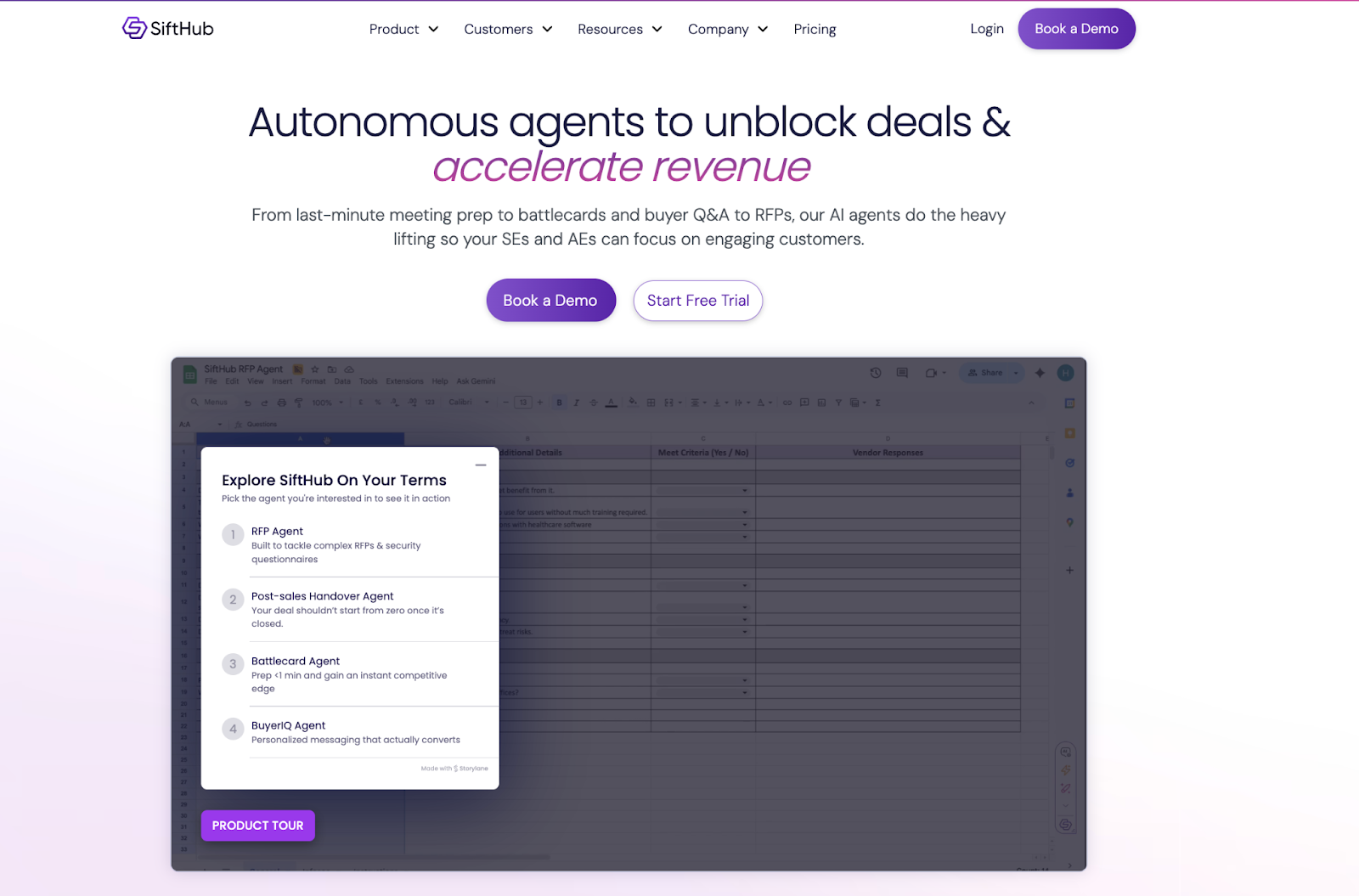
SiftHub is the best AI tool for presales teams because it's the only platform that automates the full deal-execution layer, not just one stage of it.
Most presales AI tools solve for visibility, demos, or content storage. SiftHub solves for output. It connects to your entire GTM stack, Gong, Salesforce, Google Drive, SharePoint, Slack, Seismic, and converts that context into 3 types of content that directly unblock presales workflows.
1. RFP and questionnaire automation
SiftHub's AI RFP capabilities handle the full cycle. From bid/no-bid analysis through autofill, compliance checks, and submission.
It completes 70 to 90% of responses automatically, drawing from your live connected knowledge base. Source attribution on every answer means responses are accurate, traceable, and audit-ready. It works natively in Google Sheets/Docs and Microsoft Excel/Word, with no import/export required.
Allego achieved 90% autofill rates and 8x faster RFP turnaround. Sirion handled 1.5x more RFPs and cut 48 hours from their response SLA.
2. Deal briefs and pre-call prep
SiftHub auto-generates internal briefs for every opportunity, pulling from call transcripts, CRM notes, emails, and enablement content.
Role-specific views mean AEs, SEs, and CS each see what's relevant to them. Pre-call prep is ready before every meeting. Handover documents are 80% complete when a deal closes, without anyone having to write them manually.
3. Technical sales collateral
Tailored proposals, battlecards, POV decks, and executive summaries, generated from live call insights and CRM context.
Competitive intel is pulled automatically from call mentions. Collateral matches your templates and branding. Content adapts to each buyer's industry, use case, and deal stage.
For RevOps leaders, SiftHub also provides adoption metrics, content performance analytics, and governance controls, so you can track ROI and report on impact, not just usage.
Enterprise credentials: SOC 2 Type II, ISO 27001, VAPT certified. Source-backed answers with full audit trails. Granular role-based access controls and SSO.
Best for: Presales teams with high RFP volume, the 4:1 AE: SE bottleneck, or knowledge fragmentation across a distributed technical sales org.
See SiftHub deliver results in week one. Book a demo today.
Category: Conversation intelligence
Conversation intelligence tools capture and analyze what happens on calls, surfacing patterns, flagging risks, and giving presales leaders visibility into what's actually happening in deals.
2. Gong
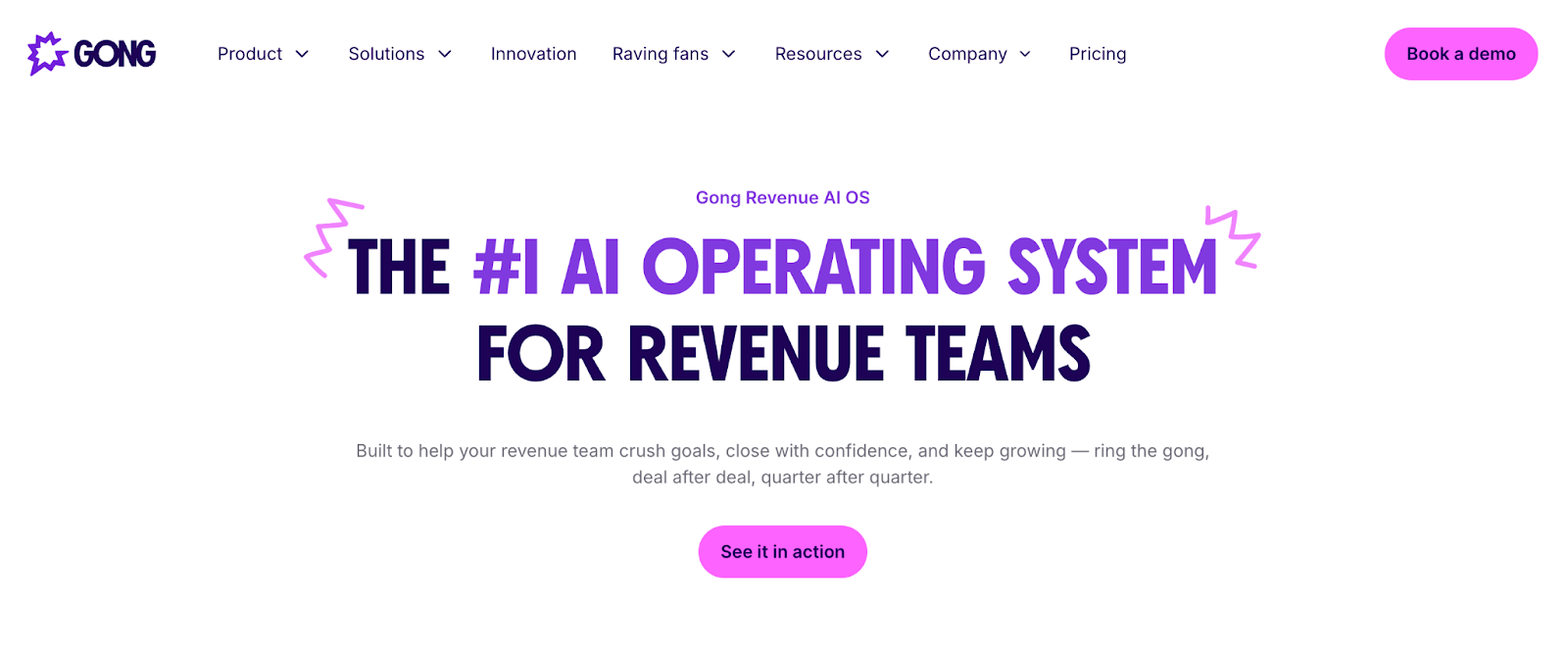
Gong is the standard for conversation intelligence in B2B sales. It automatically captures and analyzes customer interactions across calls, emails, and meetings.
For presales teams, Gong surfaces competitor mentions, flags deals that have gone quiet, and provides SEs with a record of exactly what was said on technical discovery calls.
Its limitation for presales: Gong is strong on insight. It tells you what happened and flags risk. It doesn't generate the deal brief, draft the follow-up, or autofill the RFP. Your SEs still have to do that work manually, armed with better information.
Best for: Presales teams that need visibility into conversation patterns, deal health, and rep performance across a large pipeline.
3. Chorus
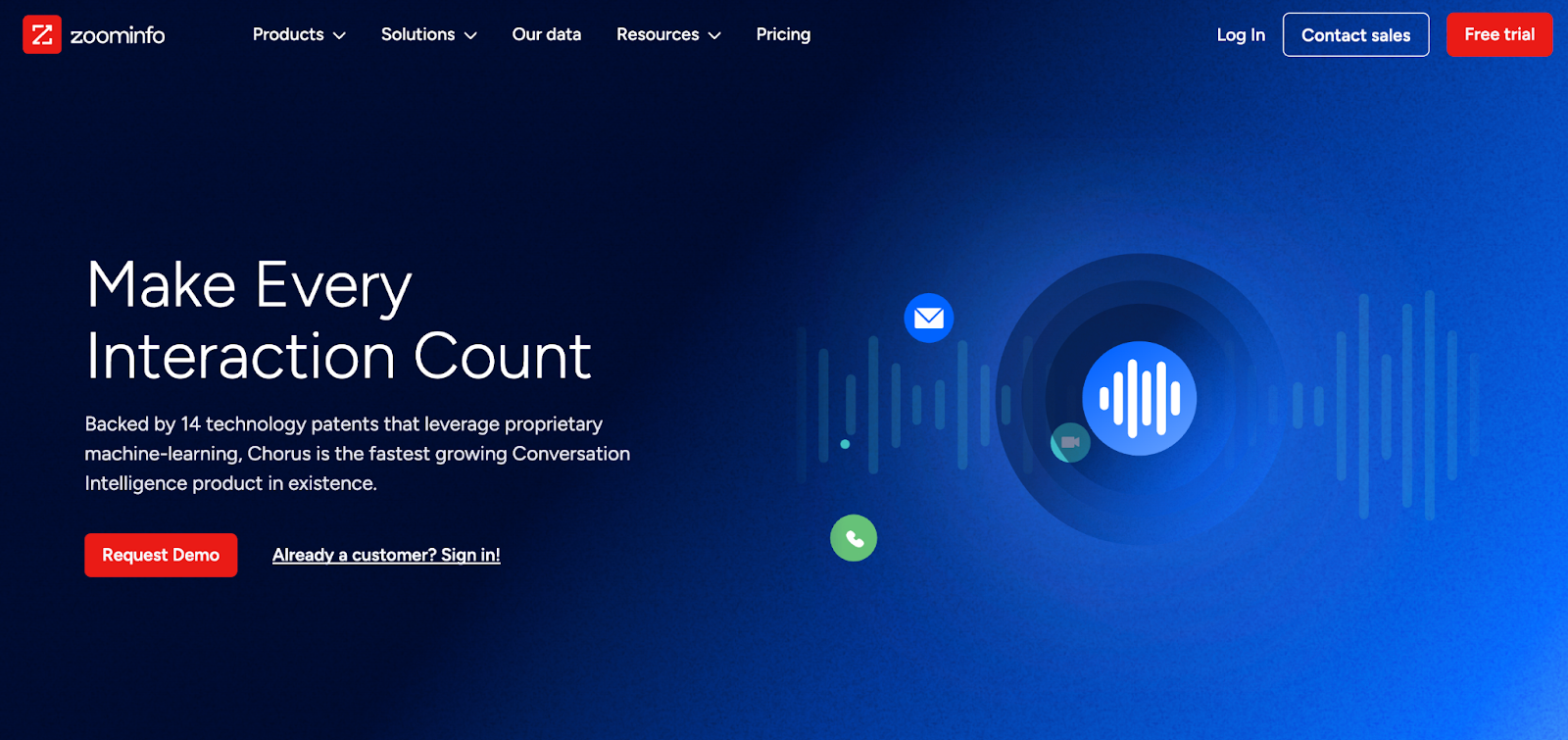
Chorus by ZoomInfo records, transcribes, and analyzes customer calls, with integrations that connect conversation data directly to ZoomInfo's prospecting database.
For presales, it gives SEs a structured record of every technical discovery call. The ZoomInfo integration automatically matches call participants to current org charts, making it easier to track buying committee dynamics without manual CRM updates.
Its limitation: Chorus delivers the most value inside the ZoomInfo ecosystem. Teams not already using ZoomInfo's data will find better ROI from standalone conversation intelligence tools.
Best for: Presales and sales teams already using ZoomInfo who want call analysis integrated with their prospecting and contact data.
Category: Presales ops & capacity
Presales ops tools give leaders data-driven visibility into how SE time maps to pipeline impact, and the evidence to defend headcount or shift resource allocation.
4. Vivun
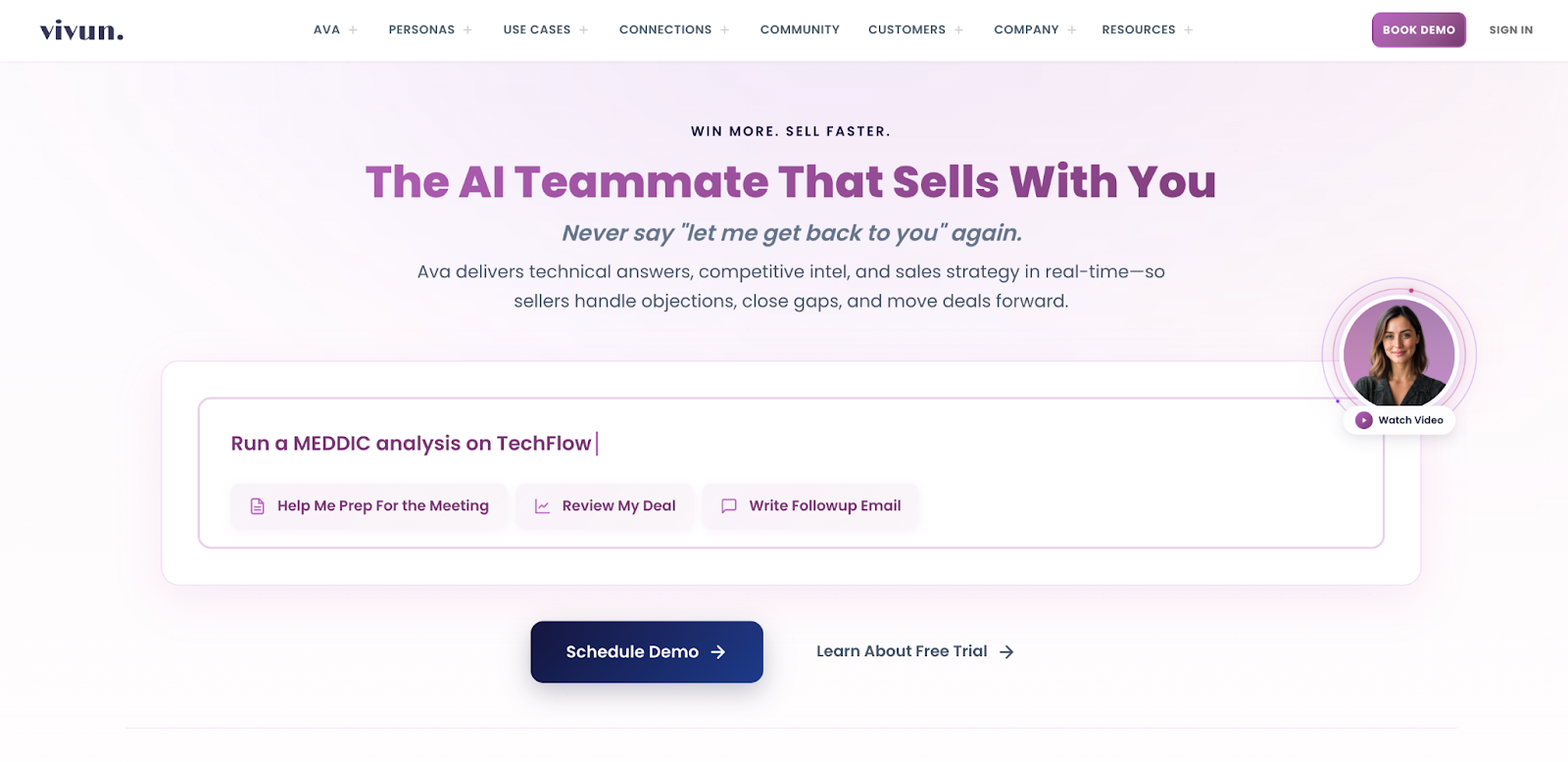
Vivun is purpose-built for presales operations. It tracks SE activity, workload, and deal contribution, giving presales leaders clear visibility into how their team's capacity maps to pipeline impact.
For RevOps and presales ops leaders, the headcount defense data alone makes Vivun worth evaluating. It provides empirical evidence of the SE contribution, directly tied to revenue.
Its limitation: Vivun is an operations-and-visibility platform first. It doesn't automate RFP responses or generate deal briefs at scale. For teams whose primary bottleneck is content-generation speed, it won't move the needle quickly enough.
Best for: Presales ops leaders who need data-driven visibility into SE capacity, workload, and deal contribution, and empirical evidence to defend or grow headcount.
Category: Demo automation
Demo automation tools free SEs from repetitive first-call walkthroughs, allowing them to spend time on complex technical discovery and high-stakes POCs instead.
5. Consensus
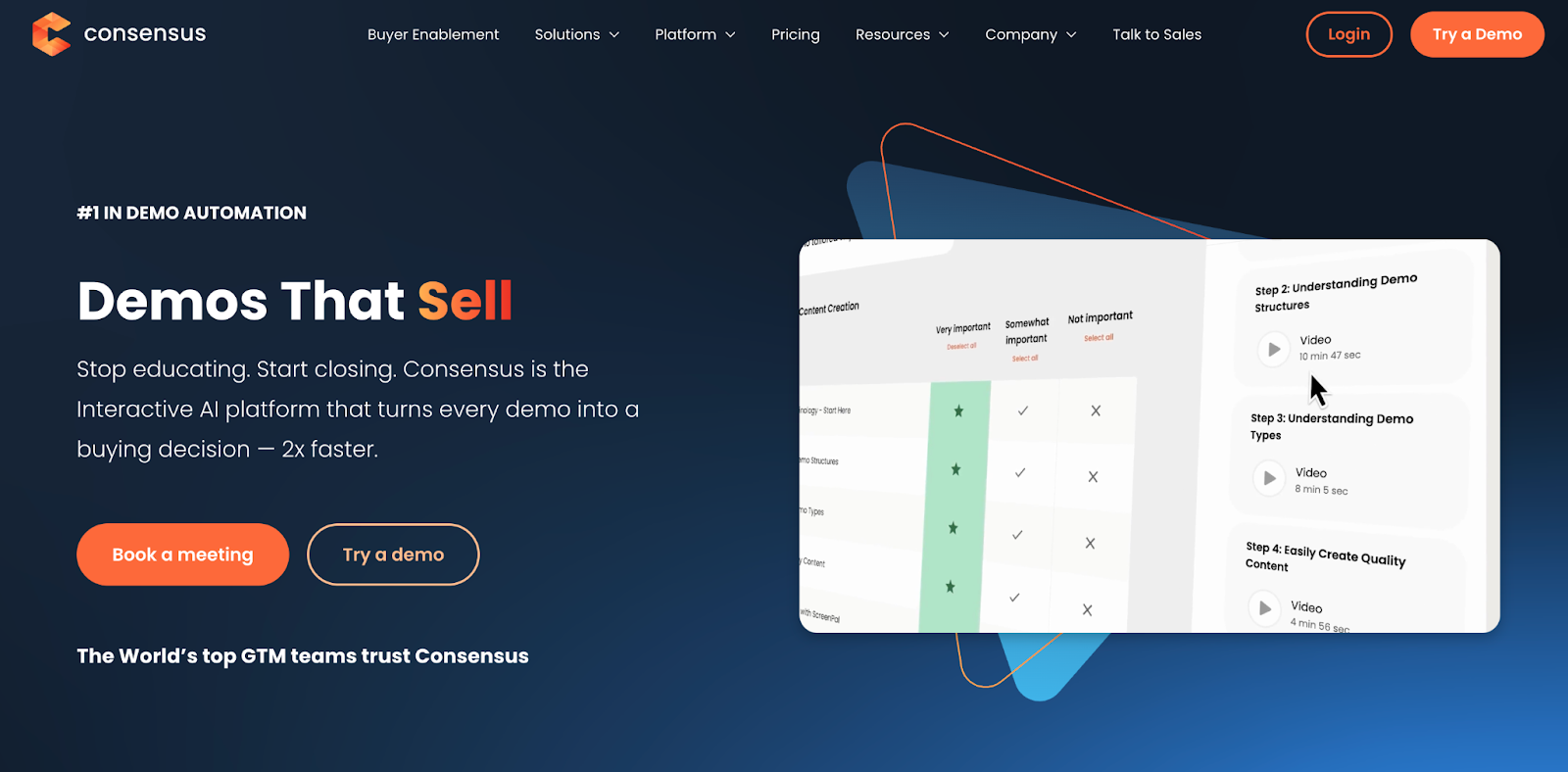
Consensus is the leading demo automation platform for presales teams. It lets SEs build a library of personalized, interactive video demos that AEs can send on demand, without SE involvement, for every introductory call.
Paycor increased presales capacity by 30%, equivalent to 9 full-time employees, without adding headcount, by using Consensus to automate repetitive demos. In one quarter alone, they saved 189 hours of solutions consultant time.
Its Demolytics feature shows exactly which stakeholders watched which demos, for how long, and what they shared internally. That gives SEs real buyer intent data before the next call.
Its limitation: Consensus is a demo tool. It doesn't touch RFP responses, deal briefs, or post-demo content workflows. For teams whose bottleneck is the top-of-funnel demo load, it's excellent. For teams drowning in RFPs, it won't help.
Best for: Presales teams with high volumes of repetitive first-call demos, or teams trying to free SEs for higher-complexity technical work.
6. Navattic
Navattic is a no-code interactive demo platform built to shorten the time to first demo. It lets SEs and AEs build HTML-based product walkthroughs that prospects can explore at their own pace, before a live call, after a meeting, or as an outbound asset.
Over 40,000 interactive demos were built on Navattic in 2025, up 35% from 2024. Its AI Copilot generates a first draft of each demo from product captures, trained on best practices from high-performing demos across the platform. Prospect engagement data, who watched what, for how long, syncs directly to Salesforce and HubSpot.
Its limitation: Navattic is screenshot-based. It works well for website tours and top-of-funnel qualification. It's less suited to complex enterprise demo environments where SEs need to run live, configurable sandbox demos with real product data.
Best for: Mid-market presales and sales teams that want to qualify prospects earlier, reduce unqualified live demos, and share personalized leave-behinds at scale.
Category: Sales content & enablement
Sales enablement platforms help reps find, use, and deliver the right content, with AI adding content recommendations, coaching, and deal guidance on top.
7. Seismic
Seismic is the global leader in AI-powered sales enablement. It organizes your content library, delivers AI-powered content recommendations to reps, and provides coaching tools, including role-play agents and performance analytics.
Seismic's Fall 2025 release introduced Aura Agents, including Aura Chat for real-time content search and drafting, a Presentation Agent that builds personalized decks in Microsoft PowerPoint using CRM data, and a Role-Play Agent for rep coaching. Aura is now embedded in Slack, Teams, and Salesforce Agentforce.
Its limitation for presales: Seismic is a content management and enablement layer. It helps reps find and use existing content more effectively. It doesn't generate deal-specific RFP responses or auto-generate deal briefs from live call context. Reps still assemble the final output.
Best for: Enterprise organizations with large content libraries that need to improve content discoverability, usage analytics, and rep coaching at scale.
8. Highspot
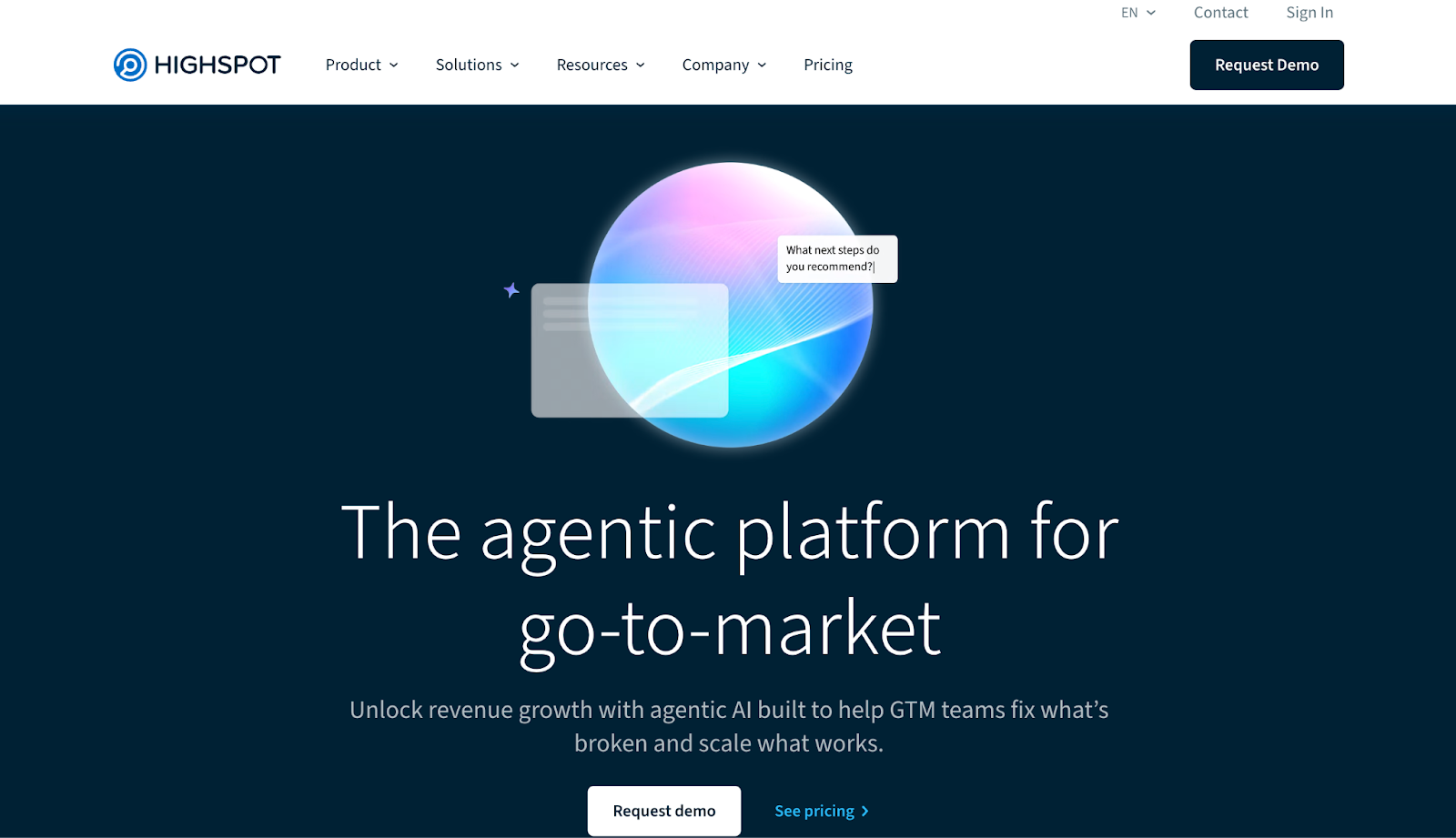
Highspot is an agentic GTM performance platform powered by Nexus, its unified AI and analytics engine. It unifies content management, rep coaching, training, and deal intelligence in a single platform.
Highspot's Winter 2026 launch introduced Deal Intelligence, powered by Deal Agent. It analyzes CRM data, buyer engagement, and meeting insights to deliver a real-time view of every active deal, then recommends data-backed next steps for each opportunity. Companies that use Highspot see a 24% increase in rep quota attainment and a 22% boost in average deal size, according to Highspot's 2025 State of Sales Enablement Report.
Its limitation for presales: Highspot is a broad GTM platform. It's not purpose-built for the RFP automation or deal brief workflow. For presales teams whose primary bottleneck is questionnaire volume and response speed, it's not the right primary tool.
Best for: Enterprise GTM teams that need a unified platform for content, coaching, training, and deal guidance, with AI embedded across every workflow.
9. Allego
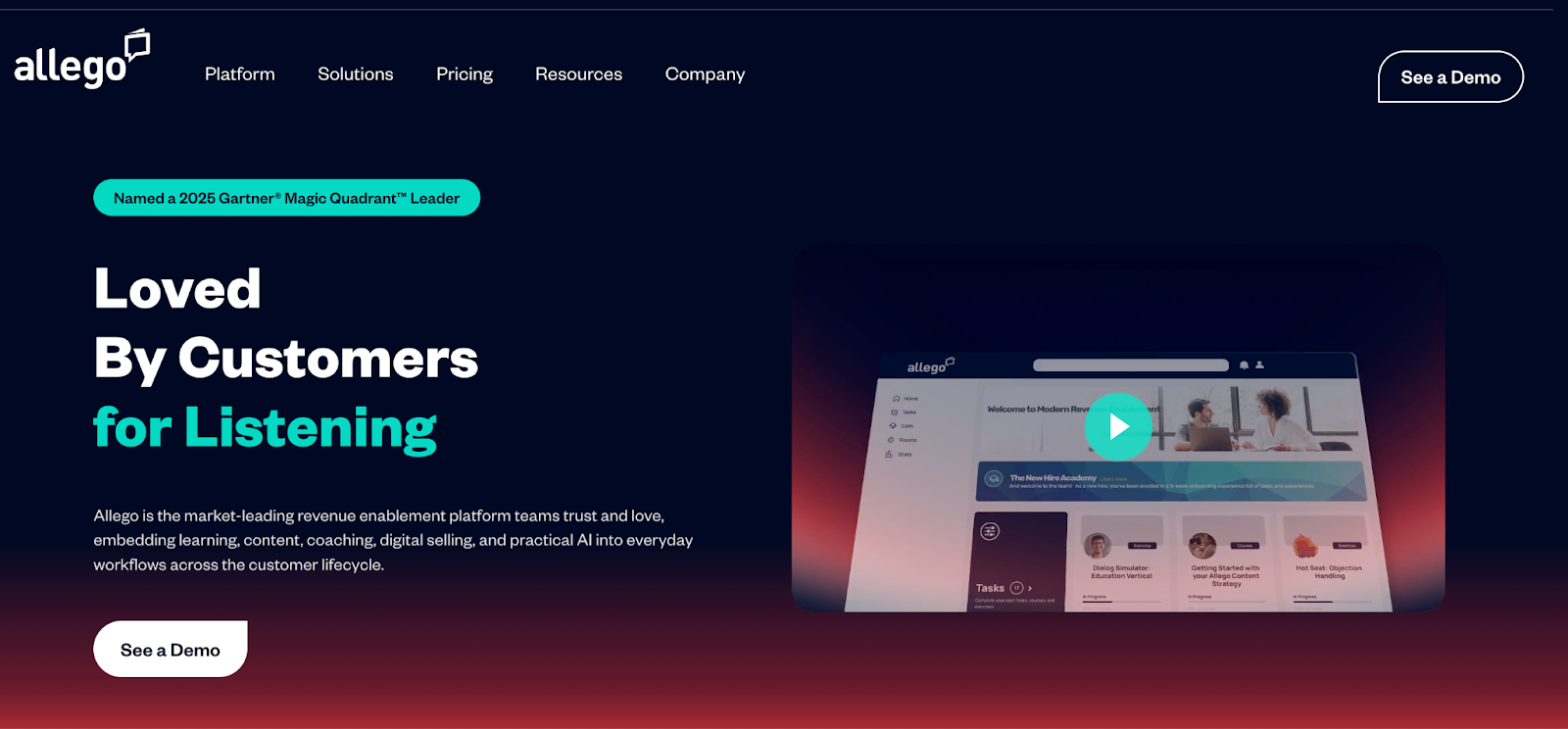
Allego is a revenue enablement platform that unifies content management, learning, coaching, and digital selling in a single application. It is named a Leader in the 2025 Gartner Magic Quadrant for Revenue Enablement Platforms.
Its core differentiator is the combination of rep readiness and content delivery in one place. Its Live Dialog Simulator gives SEs and reps a video-based AI role-play engine to practice objection handling and technical pitches before live calls. FlexDocs, its document automation engine, lets teams build personalized sales documents from data integrations. AI content discovery agents support natural language search across internal knowledge bases and Digital Sales Rooms.
For presales specifically, Allego's strength is rep readiness, not deal execution. It helps SEs practice what to say before a call. It doesn't generate the RFP response when a questionnaire lands on Friday afternoon, build the deal brief from your Gong transcripts, or produce the tailored proposal when a buyer asks for one by end of week. Teams that adopt it for presales content automation will find they still need a separate tool to handle the output layer.
Best for: Enterprise sales and presales teams whose primary bottleneck is rep readiness, onboarding speed, and coaching at scale, particularly in regulated industries like financial services, life sciences, and medical devices.
Category: Meeting intelligence
Meeting intelligence tools build your organization's knowledge graph from calls, messages, and emails, surfacing insights proactively and reducing the time reps spend on post-call admin.
10. Read AI
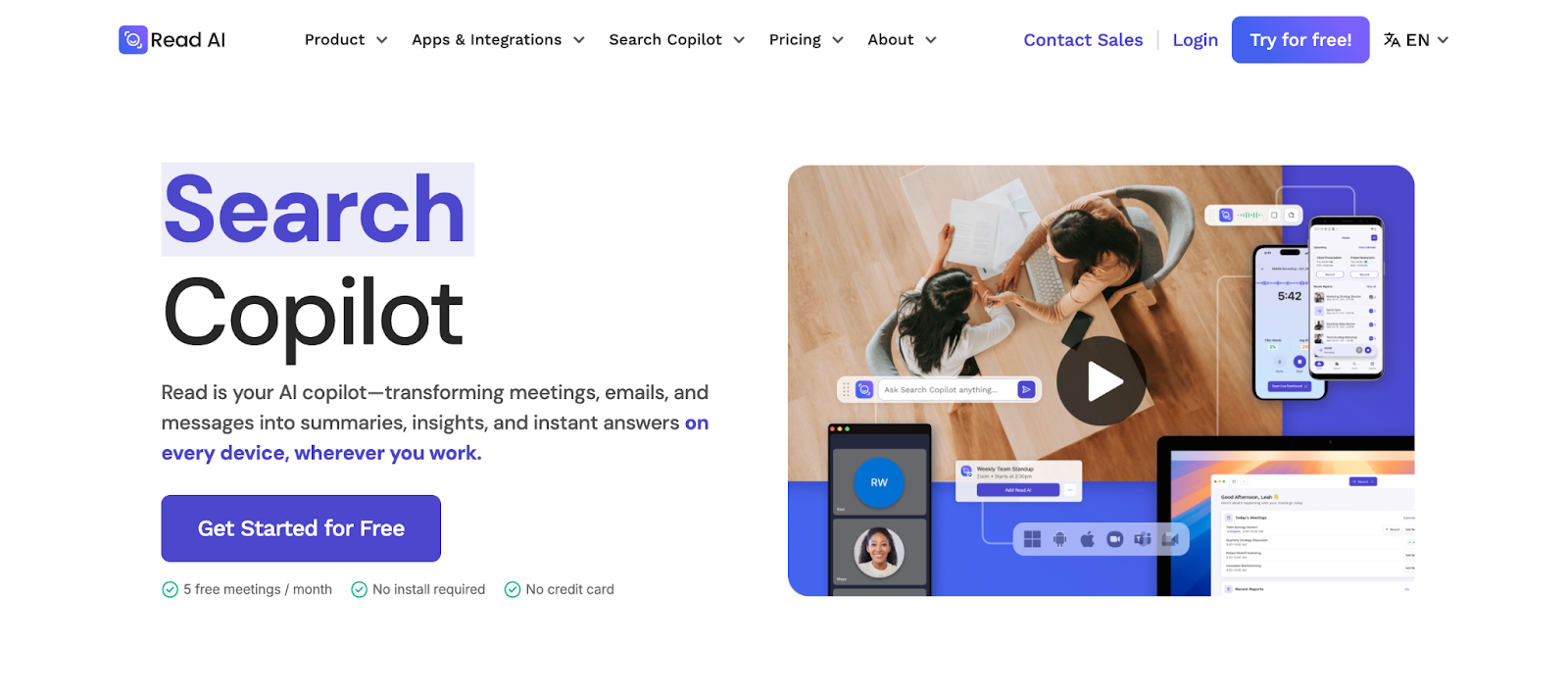
Read AI builds your organization's knowledge graph from meetings, messages, and documents across 20+ platforms, including Slack, Teams, Zoom, Gmail, HubSpot, and Salesforce.
Its Search Copilot answers natural language questions across all connected platforms. Proactive agents like Monday Briefing surface priorities before you ask. Read AI users attend 20% fewer meetings on average and save up to 20 hours per month through Search Copilot alone. Its CRM Copilot automatically updates Salesforce and HubSpot after calls, eliminating manual data entry for reps.
Its limitation for presales: Read AI is strongest for capturing and surfacing meeting intelligence. It doesn't convert that intelligence into a draft RFP response or an auto-generated deal brief. The insight is there, the downstream content generation isn't.
Best for: Distributed presales and sales teams that want to reduce meeting load, automate post-call CRM updates, and surface cross-platform deal context without manual effort.
Pipeline & forecasting
Pipeline and forecasting tools give revenue leaders data-driven visibility into deal health, predict which deals will close, and flag risks before they derail the quarter.
11. Clari
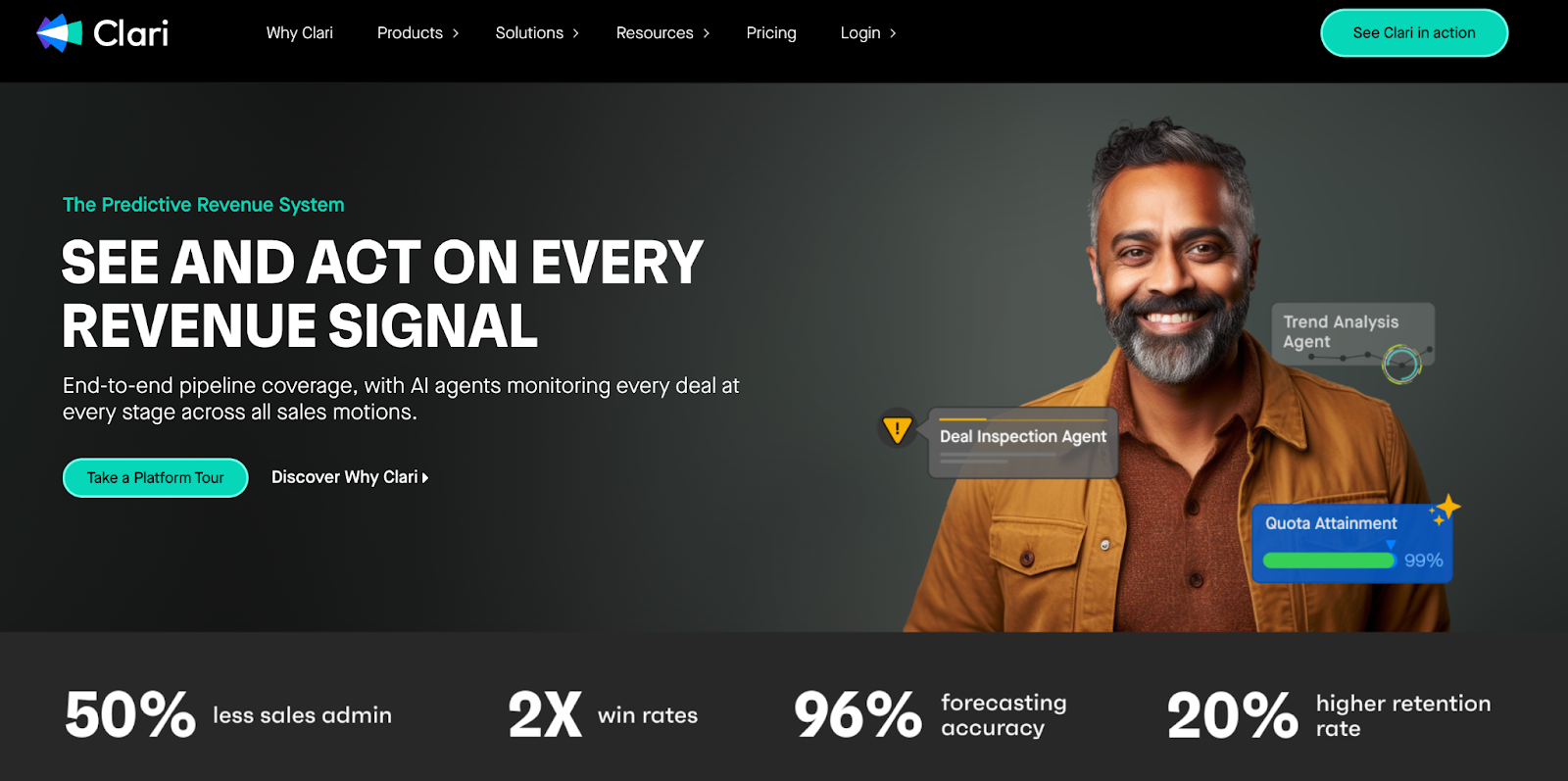
Clari combines CRM data, activity signals, and engagement patterns to forecast revenue and inspect deal health. Sales leaders use it to manage team forecasts and identify at-risk deals based on signals beyond CRM stage progression alone.
Its AI analyzes deal history, rep activity, and buyer engagement to surface risk early, so managers can intervene before a deal goes dark rather than after it slips out of the quarter.
Its limitation for presales specifically: Clari is built for revenue leadership, not individual SE productivity. It doesn't automate presales content or reduce the time SEs spend on RFPs and deal prep. It's a forecasting and pipeline-inspection tool, not a deal-execution engine.
Best for: Revenue and sales ops leaders who need systematic forecast accuracy, pipeline risk identification, and deal health visibility across a large team.
How SiftHub fits into a presales AI stack
SiftHub fits into a presales AI stack by handling the layer that every other tool on this list leaves unaddressed, converting deal context into ready-to-use outputs.
Gong captures what happens on calls. Vivun tracks how SEs spend their time. Consensus and Navattic automate the demo. Seismic and Highspot organize your content library. Read AI surfaces meeting intelligence. Clari forecasts your pipeline.
None of them generate the RFP response, write the deal brief, or produce the tailored proposal when a buyer asks for one by Friday.
That's the gap SiftHub fills. It sits across your entire stack, pulling from Gong, Salesforce, Seismic, Drive, and Slack, and converts that combined context into the content your presales team needs to move deals forward.
The results are measurable. Superhuman saved 8+ hours per week and diverted 50% of repetitive queries away from their team. Sirion handled 1.5x more RFPs and cut 48 hours from their response SLA. Allego achieved 90% autofill on RFPs and turned submissions around 8x faster.
These aren't marginal efficiency gains. They're capacity multipliers, and they show up in week one.
If your presales team is evaluating AI tools in 2026, start with one question: where does your team lose the most time? If the answer is RFPs, deal prep, or content assembly, book a demo with SiftHub and see what changes.