



.avif)

Finding RFPs consistently in 2026 means running government portals, cooperative purchasing vehicles, and emerging SaaS buying platforms in parallel — while filtering by procurement code instead of keyword, since keyword search alone misses most of what's actually postable. This guide covers where open and closed RFPs live, how to get invited to the ones that never go public, and how to qualify what you find before your team spends 15-20 hours on a bid you were never going to win.
- Open RFPs are searchable, but filtering by NAICS/PSC procurement code instead of keyword cuts irrelevant results dramatically — procurement officers classify by code, not by the words vendors search for.
- Closed RFPs are relationship-driven: vendor registration, broker relationships, and RFI responses are your way in, since no database indexes invitation-only opportunities.
- "Sources Sought," and RFI notices are published before the formal RFP — teams that monitor these get weeks of extra prep time competitors chasing the RFP itself don't have.
- A structured bid/no-bid score, not gut feel, is what separates teams that pursue high-fit RFPs from teams that burn 15-20 hours per response chasing bids they were never going to win — SiftHub's AI RFP software runs that analysis in one click before your team commits.
- Once you're inside the RFP, response speed and consistency — not search skill — become the constraint most teams hit next.
Finding RFPs consistently in 2026 means running government portals, cooperative purchasing vehicles, and emerging SaaS buying platforms in parallel — while filtering by procurement code instead of keyword, since keyword search alone misses most of what's actually postable. This guide covers where open and closed RFPs live, how to get invited to the ones that never go public, and how to qualify what you find before your team spends 15-20 hours on a bid you were never going to win.
- Open RFPs are searchable, but filtering by NAICS/PSC procurement code instead of keyword cuts irrelevant results dramatically — procurement officers classify by code, not by the words vendors search for.
- Closed RFPs are relationship-driven: vendor registration, broker relationships, and RFI responses are your way in, since no database indexes invitation-only opportunities.
- "Sources Sought," and RFI notices are published before the formal RFP — teams that monitor these get weeks of extra prep time competitors chasing the RFP itself don't have.
- A structured bid/no-bid score, not gut feel, is what separates teams that pursue high-fit RFPs from teams that burn 15-20 hours per response chasing bids they were never going to win — SiftHub's AI RFP software runs that analysis in one click before your team commits.
- Once you're inside the RFP, response speed and consistency — not search skill — become the constraint most teams hit next.
For bid managers and sales teams, the pipeline is everything. But before you can write a winning proposal, you have to find the opportunity. Every year, millions of dollars in business are awarded through the request for proposal (RFP) process. Whether you are a small agency looking to break into government contracts or an enterprise team hunting for corporate RFPs, knowing where to look is the difference between a dry pipeline and a record-breaking year.
However, finding these opportunities isn't always straightforward. The landscape is fragmented. Government agencies are legally required to post open RFPs, but finding them often feels like looking for a needle in a haystack of bureaucratic websites. On the other hand, private organizations often keep their cards close to the chest, issuing invitation-only RFPs that never see the light of day on a public portal.
If you are ready to stop waiting for leads to fall into your lap and start proactively finding RFPs, this guide is for you. We will cover everything from key definitions and the types of RFPs available to advanced manual search strategies, the newer sources most teams still miss, and how to get invited to the exclusive "closed" tables.
Key RFP definitions
Before we dive into the specific strategies for finding RFPs, it is critical to level-set on the terminology. The procurement world is full of acronyms, and understanding the nuance between them can help you refine your RFP strategy.
What is an RFP?
RFP stands for Request for Proposal. It is a formal document soliciting information and bids from potential vendors. The document typically includes a collection of RFP questions that help buyers gather standardized information, compare capabilities, and select the best supplier for a project. Unlike a simple price quote, an RFP asks for a solution to a problem.
Why do companies use RFPs?
Organizations use RFPs to organize complex procurement projects and improve objectivity in supplier selection. By forcing all vendors to answer the same questions, the buyer can make an apples-to-apples comparison.
- Risk reduction: The thorough nature of the process reduces overall vendor risk.
- Cost management: Competition naturally drives better pricing and value.
- Compliance: Many private companies have a procurement policy that requires bids from at least three suppliers.
- Transparency: Government agencies are required to issue RFPs publicly to ensure tax dollars are spent in a fair, transparent way.
Other common acronyms
- RFI (Request for Information): Used when a buyer is still educating themselves on the market. They aren't ready to buy yet; they are just gathering data.
- RFQ (Request for Qualifications): Focuses on the vendor's expertise and past performance rather than a specific solution or price.
- RFB (Request for Bid): Typically used when price is the only differentiating factor (e.g., buying 500 laptops).
Types of RFPs you can find
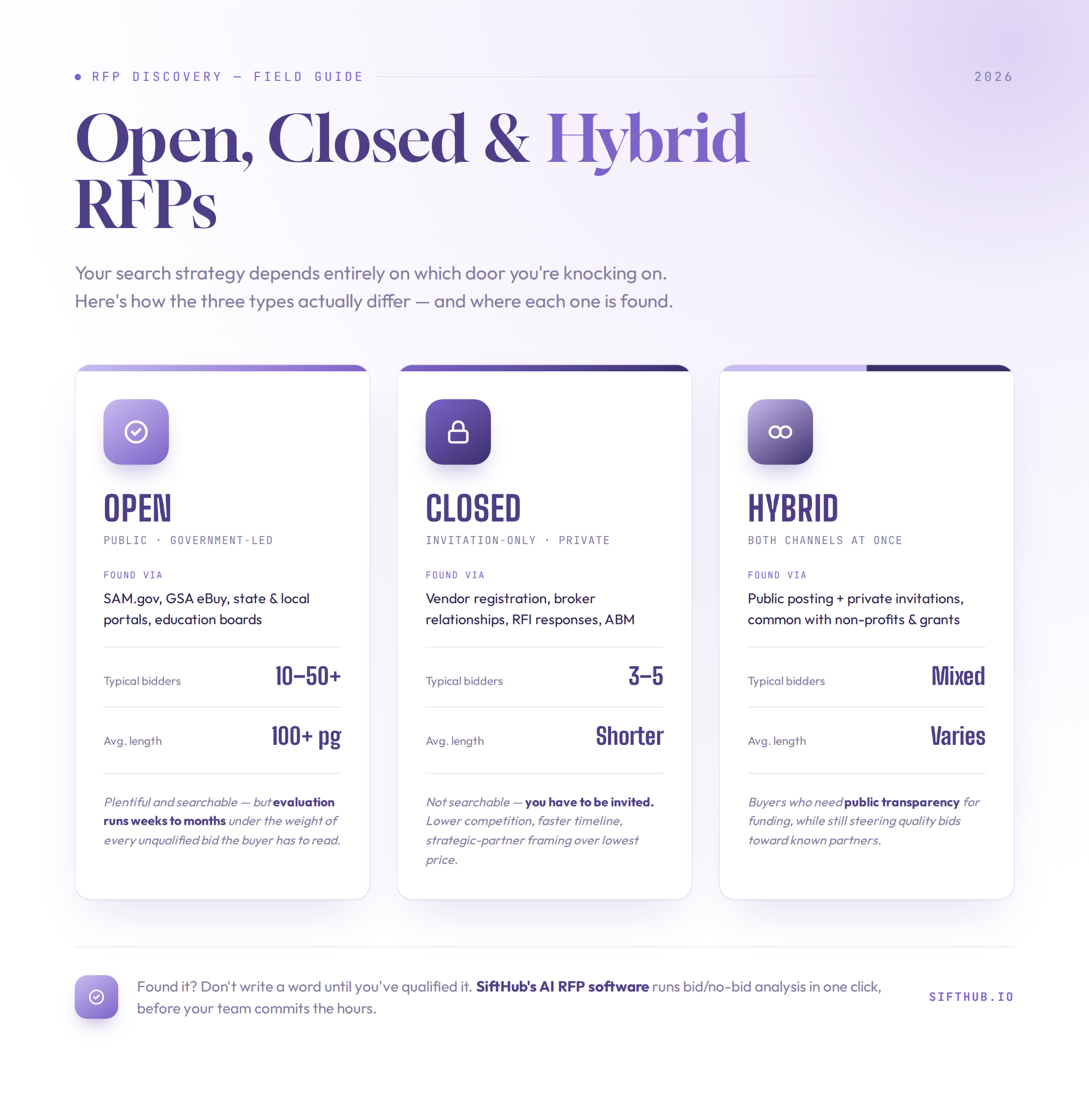
Not all RFP opportunities are created equal. Broadly speaking, the market is divided into two categories: open RFPs and closed RFPs. Your strategy for finding RFPs will depend entirely on which of these buckets you are targeting.
Open RFPs
Open RFPs, often called public RFPs, are available for anyone to respond to. Generally, these appear on the RFP issuer's website and can be downloaded by any interested party.
Government RFPs: The vast majority of open RFPs come from the public sector. Federal, state, and local government agencies use the RFP process for almost all their procurement needs. Because they are spending public money, RFP regulations mandate that the process be auditable, objective, and transparent. This means you can find government RFPs online with relative ease if you know where to look — though it comes at a cost of thoroughness. Public sector RFPs run notoriously long, often well past 100 pages once terms, conditions, and compliance attachments are included, which is part of why evaluation cycles for open RFPs commonly stretch into weeks or months.
Education RFPs: Similar to government bodies, public schools and universities often operate with public funding. Consequently, they follow procurement guidelines that require them to post education RFPs publicly. These are excellent sources of open RFPs for vendors in the ed-tech, facilities, or services sectors.
The pros and cons of open RFPs. While open RFPs are easy to access, they come with trade-offs.
- Pros: They are plentiful. You don't need a pre-existing relationship to bid. The contracts are often high-value and long-term.
- Cons: They are highly competitive — since anyone can bid, you might be competing against dozens of other firms, many of whom won't be a genuine fit, which is part of why evaluation windows stretch so long. They often prioritize price over value. The contract terms are rigid, and the submission criteria can be incredibly strict (e.g., specific font sizes, margin requirements).
Closed RFPs
Many private organizations use closed RFPs, sometimes called invitation-only RFPs or private RFPs. In this scenario, the organization conducts market research, selects a handful of qualified vendors, and privately invites them to submit a proposal.
Business RFPs: Corporations of all sizes issue business RFPs for goods and services. However, because private companies are not subject to the same transparency laws as the government, they often prefer the efficiency of a closed process. They might invite three vendors they already know or have found through a request for information.
Consultant- or broker-managed RFPs: For high-stakes procurement projects (like swapping out a massive IT infrastructure or selecting a new benefits provider), businesses often hire a third-party consultant. These brokers manage the RFP process on behalf of the client. Because brokers have deep industry knowledge, they tend to issue broker-managed RFPs only to a pre-vetted list of vendors.
The pros and cons of closed RFPs
- Pros: The competition is lower (usually 3-5 vendors). The buyer is often looking for a strategic partner rather than just the lowest price. The RFP timeline is usually faster.
- Cons: You cannot find them via a simple Google search. You have to be invited.
Hybrid RFPs
A third, less common category is hybrid RFPs. This happens when an organization invites specific vendors but also posts the RFP for public viewing. This is frequent with non-profit organizations that need to show transparency for grant funding but also want to ensure they get high-quality bids from known partners.
Where and how to find RFPs
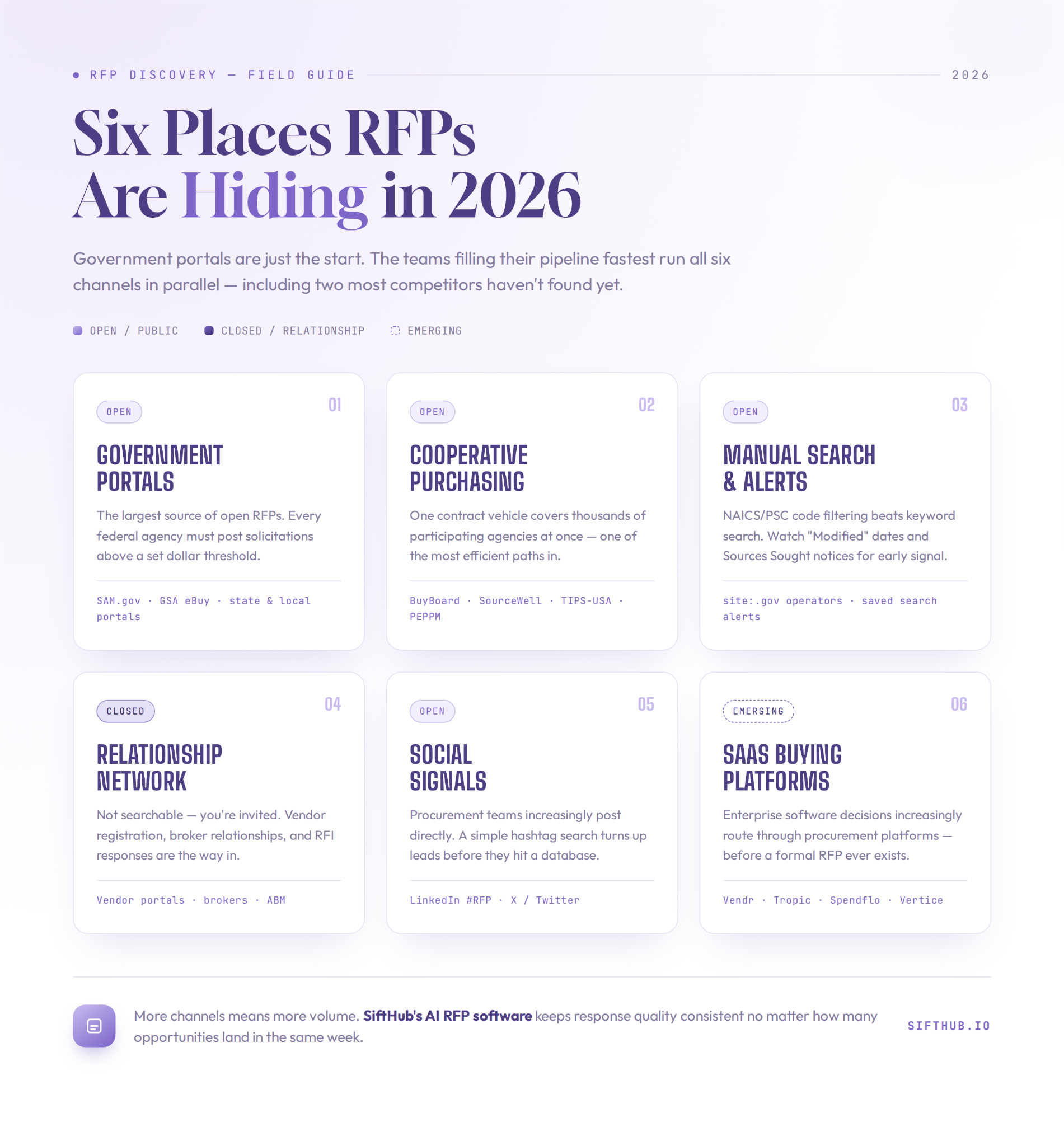
Now that we understand the landscape, let's get tactical. How do you actually go about finding RFPs? There are two primary schools of thought: paying for technology to do it for you, or mastering the art of the manual search, and a newer, third category most teams still overlook entirely.
Use an RFP database
If you have the budget and want to scale quickly, an RFP database is the most efficient route. These are specialized software tools or services that scour the internet, scraping thousands of government websites, newspapers, and portals, to aggregate RFP opportunities into a single dashboard.
Start with the primary sources directly, not just aggregators. SAM.gov (System for Award Management) is the U.S. federal government's official platform and the single largest source of federal RFPs. Every federal agency is generally required to post solicitations above a set dollar threshold here. You can search by NAICS code, agency, opportunity type, and deadline, and set up saved searches with email alerts so new matches come to you. For teams on a GSA contract vehicle, GSA eBuy is where task orders and RFQs specific to that schedule appear. Cooperative purchasing vehicles — networks like BuyBoard, SourceWell, and TIPS-USA- let a single contract cover thousands of participating agencies at once, which makes them one of the more efficient paths into government and education revenue once you're registered. For education specifically, platforms like PEPPM and E-Rate (via USAC) carry solicitations that a general government portal search often misses entirely.
Filter by procurement code, not keyword. Procurement officers classify opportunities by NAICS and PSC codes, not by the words a vendor happens to search for. A keyword search for "software" or "cloud" returns a flood of noise; filtering by the correct NAICS/PSC combination narrows that same search to opportunities that are actually relevant to what you sell, and lets you set eligibility criteria (certifications required, set-aside status) before you ever open the document.
What to look for in third-party RFP databases. There are dozens of RFP services out there. When evaluating them, consider:
- Coverage: Does it cover just government RFPs, or does it also scrape corporate portals?
- Filtering: Can you filter by region, industry, NAICS/PSC code, and keyword?
- Notifications: Will it email you daily with new matches, and will it flag amendments to solicitations you're already tracking?
- Cost: Subscriptions can range from roughly $10/month to thousands per year.
Popular RFP databases. There are many players in this space. Some focus exclusively on the public sector, while others try to capture corporate RFPs as well.
- FindRFP: A popular tool for tracking government contracts and open RFPs.
- GovSpend: Focuses heavily on historical spending data and government RFPs.
- The RFP Database: A user-contributed site that allows for searching for RFP leads across various sectors.
- BidNet: Specializes in aggregating state and local government bids.
- RFP Finder: Various tools use this name to help vendors identify RFP online listings.
Using an RFP database saves time. Instead of visiting 50 different city websites every morning, you log into one portal. However, remember that these databases mostly capture open RFPs. They rarely help you access the hidden market of invitation-only RFPs.
Search for RFPs manually
If you are a smaller team or if you simply want to uncover opportunities that the aggregators might miss, you can search for RFP leads manually. It requires patience and practice, but it is the most cost-effective way to find RFP opportunities.
Google search for government RFPs. Because government agencies are required to post their needs online, Google is your best friend. However, a generic search for "marketing RFPs" will yield too much noise. You need to use specific search operators.
Effective search strings:
- site:.gov "request for proposal" + [your industry]
- filetype:pdf "RFP" + [your service] + 2026
- "invitation to tender" + [city name]
- "request for bid" + [state]
When you find open RFPs via Google, check the dates carefully. Government RFPs have strict deadlines. If you find a perfect opportunity but the submission is due in 48 hours, you might not have enough time to pull together a compliant response. It's also worth checking whether the listing has a "Modified" date — amendments to existing solicitations sometimes extend deadlines or change requirements, and these updated listings are exactly the ones less-attentive competitors miss.
Watch for Sources Sought and RFI notices, not just the RFP itself. Many formal RFPs are preceded by a pre-solicitation notice — a Sources Sought announcement or an RFI — that signals what's coming before the RFP is finalized. Monitoring for these gives you extra lead time to prepare, and in some cases, to shape how the requirements get written.
Browse government portals directly. Most states and large cities have a dedicated procurement portal. If your ideal customer profile is a specific geographic region, bookmark their procurement pages.
- Look for links labeled "Procurement," "Business Opportunities," "Bids & Tenders," or "Vendor Services."
- Register for their email alerts. Most cities will let you sign up to be notified when a new public RFP in your category is released.
Find open RFPs on social media.
- LinkedIn: This is the gold standard for corporate RFPs and B2B opportunities. Search for hashtags like #RFP, #RequestForProposal, or #Procurement. Follow procurement managers in your target industries.
- Twitter/X: While more chaotic, many government bodies and non-profit organizations post links to their open RFPs. A simple search for "new RFP available" can turn up surprising results.
An emerging source most teams still miss: SaaS buying platforms
If you sell software, a growing share of enterprise buying decisions now runs through SaaS procurement and renewal platforms like Vendr, Tropic, Spendflo, and Vertice — tools companies use to manage software purchasing, benchmarking, and vendor comparison internally. Getting your product listed on these platforms puts you in front of buyers actively comparing options, often before a formal RFP is ever issued. This channel won't show up in a government-focused RFP database, which is exactly why it's worth a separate line item in your discovery process rather than an afterthought.
How to get invited to closed RFPs
Finding open RFPs is a game of search. Getting into closed RFPs is a game of relationships. Since these opportunities are not posted on RFP databases, you cannot "find" them in the traditional sense. You have to attract them.
Proactively reach out to potential buyers. If you want to be included in private organizations' bids, they need to know you exist. You cannot wait for the phone to ring.
- Identify targets: Use your ideal customer profile to build a list of top 50 target accounts.
- Connect with procurement: Don't just talk to the end-users. Find the procurement manager or the sourcing team on LinkedIn.
- The Ask: Reach out with a simple, value-driven message. "We specialize in X for your industry. We would love to be considered for future RFP opportunities. Do you have a vendor database or registration process we should complete?"
Align with presales, sales, and marketing. This is where account-based marketing (ABM) comes into play. Your sales and marketing teams are likely already targeting specific high-value accounts. Ensure that "getting on the RFP list" is a key objective of those campaigns.
- If a sales rep is talking to a prospect, have them ask: "How does your company handle procurement projects? Is there a formal RFP process coming up?"
- Use request for information (RFI) opportunities seriously. If a company issues an RFI, it is often a precursor to a closed RFP. Responding to the RFI is your ticket to the dance.
Register as a supplier or complete a vendor profile. Many large corporations (like banks, insurers, and tech giants) have formalized vendor onboarding processes. Even if they don't have an active bid, they maintain a library of pre-vetted suppliers.
- Go to the footer of their website and look for "Supplier Diversity," "Vendor Relations," or "Become a Supplier."
- Fill out the vendor applications thoroughly.
- Upload your diversity certifications if you have them (WBE, MBE, VOB). Many corporate RFPs have set-asides for diverse suppliers, and this can be your "in."
Get on a broker or consultant's radar. As mentioned earlier, broker-managed RFPs are a huge slice of the market. If you are in insurance, employee benefits, construction, or enterprise software, some consultants likely act as gatekeepers.
- Identify the top consulting firms in your niche.
- Reach out to them to introduce your firm. "We know you manage RFPs for the X industry. Here is a one-pager on our capabilities. How can we get on your radar for future client searches?"
- Building a relationship here can lead to a steady stream of invitation-only RFPs without you ever having to do a manual search again.
Get your team ready before the RFP lands
The teams that respond fastest aren't scrambling to figure out ownership after an RFP arrives — they already know who handles product questions, who owns security and compliance answers, and who signs off before submission. Deciding this in advance, rather than during a live deadline, is what turns a found opportunity into a submitted one without the internal chaos.
This is also where SiftHub's RFP project management fits in: once an opportunity is qualified, the intake document gets auto-shredded into a structured task list with each requirement routed to the right owner, so the moment you decide to pursue an RFP, your team already has a plan instead of a scramble. Rocketlane used this approach to cut RFP turnaround time by 50% and free up 70% of its solutions engineers' bandwidth, most of it recovered from exactly this kind of pre-response coordination work.
Once you've found them, AI RFP software lets you respond to more of them without adding headcount. By automating first drafts, surfacing approved answers, and keeping responses consistent, proposal teams can increase RFP throughput without sacrificing quality or overloading subject matter experts. Congruent Solutions used this approach to respond to clients and prospects 10x faster while freeing up 50% more bandwidth for its presales and product leads.
5 tips for winning more RFPs
You have subscribed to the RFP database, you have optimized your Google searches, and the leads are flowing in. Now, how do you convert those leads into revenue? Finding the RFP is only step one. Here are five tips to improve your win rate.
1. Make sure you are qualified
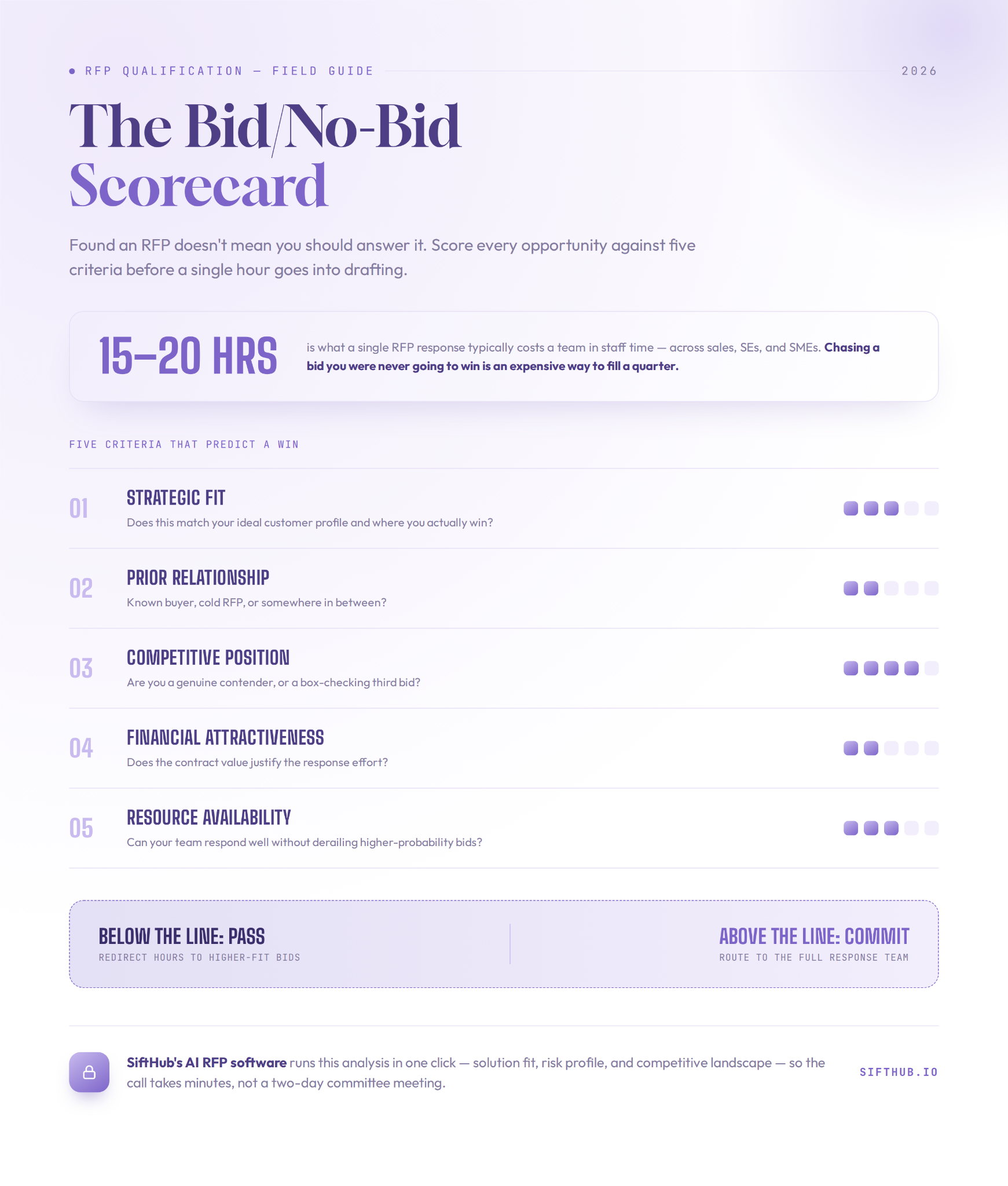
The most common mistake teams make is bidding on everything. Just because you found an RFP doesn't mean you should answer it, and the cost of a bad bid is real: a single RFP response commonly costs a team thousands of dollars in staff time to produce, once you account for the hours from sales, SEs, and SMEs across a multi-week cycle. Chasing a bid you were never going to win is an expensive way to fill a quarter.
- The Bid/No-Bid decision: Establish a rigorous bid/no-bid process. Score each opportunity against the criteria that actually predict a win — strategic fit, prior relationship with the buyer, competitive position, financial attractiveness, and resource availability — rather than deciding on gut feel or urgency.
- Resource check: Does your proposal team have the bandwidth? Responding to an RFP takes dozens of hours. If you throw resources at a low-probability bid, you burn out your team and miss out on better opportunities.
- Compliance: Do you meet the mandatory requirements (e.g., insurance limits, years in business, diversity certifications)? If not, don't bid.
SiftHub's AI RFP software runs this analysis in one click — evaluating solution fit, risk profile, and competitive landscape against your own win/loss history, so the bid/no-bid call happens in minutes instead of a two-day committee meeting.
2. Research your prospect
Before you write a single word of your RFP response, learn everything you can about the RFP issuer.
- Read the documents, and then read them again. Look for clues about their pain points.
- Check historical data: For government RFPs, you can often see who won the contract last time and for how much. Tools like GovSpend are great for this.
- Understand the goal: Are they trying to save money? Innovate? Reduce risk? Tailor your executive summary to this core motivation.
3. Pay attention to the instructions
RFP compliance is not a suggestion; it is a requirement. This is especially true for public RFPs and government contracts.
- Formatting: If they ask for 12-point Times New Roman, give it to them. If they want the response in three separate binders, do it.
- Submission method: Do not wait until 4:59 PM to upload your file to the portal. Technical glitches happen.
- Structure: Follow their numbering system exactly. If their question is 1.4.a, your answer should be labeled 1.4.a.
- Consequence: Failure to follow submission criteria is the easiest way for a procurement manager to disqualify you without even reading your proposal.
4. Ask questions
RFPs are notorious for being vague. "Provide a comprehensive solution for IT" could mean anything.
- Use the Q&A period: Almost every RFP timeline includes a window for vendor questions. Use it.
- Be strategic: Ask questions that clarify the scope but also highlight your strengths. (e.g., "The RFP asks for X. Given that industry standards are shifting to Y, would you accept a solution that offers Y?")
- Don't guess: If you guess wrong, you lose. It is better to ask.
5. Make sure your messaging hits the mark
Your RFP response should not just be a copy-paste of your technical specs. It needs to be a persuasive sales document.
- Customer-centric: Stop starting every sentence with "We." Start with "The Agency," "The Company," or "You."
- Benefit-led: Don't just list features. Explain the benefit. "We offer 24/7 support" is a feature. "We offer 24/7 support so your team never faces downtime during critical hours" is a benefit.
- Leverage your library: Use a proposal knowledge library or RFP software to access your best content, but always tailor the final output to the specific client.
A final bit of advice
Now that you know how to fill your pipeline with opportunities, a word of caution: just because you found an RFP doesn't mean you should pursue it. The quickest way to burn out your team is chasing bad leads.
Before you start writing, you need to qualify. This is where SiftHub changes the game. It doesn't just automate the writing; it automates the decision-making. SiftHub's AI RFP software analyzes incoming RFPs against your company's strengths, assessing solution fit, risk profiles, and timelines, to give you an instant recommendation on whether to proceed.