




SiftHub is the best AutoRFP.ai alternative in 2026 because it delivers RFP automation, deal briefs, and sales collateral without the library maintenance burden that degrades AutoRFP.ai's accuracy over time. AutoRFP.ai works for teams with a dedicated content owner and well-organized existing answers. For teams that need answers from live deal context, not just static documentation, SiftHub connects to your GTM stack and removes the maintenance tax entirely.
SiftHub is the best AutoRFP.ai alternative in 2026 because it delivers RFP automation, deal briefs, and sales collateral without the library maintenance burden that degrades AutoRFP.ai's accuracy over time. AutoRFP.ai works for teams with a dedicated content owner and well-organized existing answers. For teams that need answers from live deal context, not just static documentation, SiftHub connects to your GTM stack and removes the maintenance tax entirely.
AutoRFP.ai made RFP response automation faster for teams that already had their answers organized. With reasonable entry pricing and a clean interface, it removed some of the enterprise complexity that made tools like Loopio and Responsive hard to adopt.
But fast setup is not the same as sustained accuracy. AutoRFP.ai requires a dedicated content owner to keep the library current. Without that person, auto-fill rates drop from 60% to 30% or lower within months. Answers go stale. The tool that saved time is now creating review overhead.
The RFP market has moved beyond static libraries. Modern revenue teams need platforms that pull live context from CRM and call recordings, learn from closed deals, and generate buyer-specific content , not just match questions to a manually curated Q&A database.
This guide covers the top AutoRFP.ai alternatives for 2026, built to scale your output without a full-time librarian.
What are the downsides of AutoRFP.ai?
AutoRFP.ai delivers fast setup and a clean interface. But its architecture creates limits for teams that cannot maintain a static content library.
1. Requires active library maintenance to stay accurate
AutoRFP.ai generates answers from a manually curated Q&A library. Someone has to build, tag, update, and retire answers as your product evolves. Without a dedicated content owner, the library degrades quickly. Users report auto-fill rates dropping from 60% to 30% or lower within months when maintenance lags.
2. No deal context or live data
AutoRFP.ai does not connect to Gong, call recordings, or live CRM data. It cannot tailor responses based on what you learned in discovery. Every answer comes from the library, not from the specific buyer's industry, use case, or deal stage. A verified mid-market user in telecommunications reported difficulty identifying sources of answers and tracking response history.
3. Limited to the RFP use case only
AutoRFP.ai starts and ends at the questionnaire. It does not generate pre-call briefs, post-call follow-ups, competitive battlecards, or full solution proposals. Your team still needs separate tools for every other content need in the sales process.
4. Enterprise compliance and audit features are limited
AutoRFP.ai lacks the robust governance features required by regulated industries, including granular permissions, detailed audit trails, and multi-department approval workflows. Enterprise teams (1,000+ employees) report mixed satisfaction (3.8–4.3/5 on G2) due to these gaps.
5. Costs climb with seats and integrations
Pricing starts at $500–$800 per month for small teams but scales to $1,200–$2,000+ for mid-market plans. Integration with CRM, Gong, or SharePoint often requires a higher-tier or custom solution. Implementation takes 4–8 weeks, with content migration being the most time-intensive phase.
6. Auto-fill rates drop on stale or thin libraries
User reviews consistently note that auto-fill quality depends entirely on library completeness. A verified mid-market user reported issues accessing knowledge. When answers are outdated or missing, the tool highlights gaps rather than resolving them.
6 AutoRFP.ai alternatives
1. SiftHub, #1 AutoRFP.ai alternative
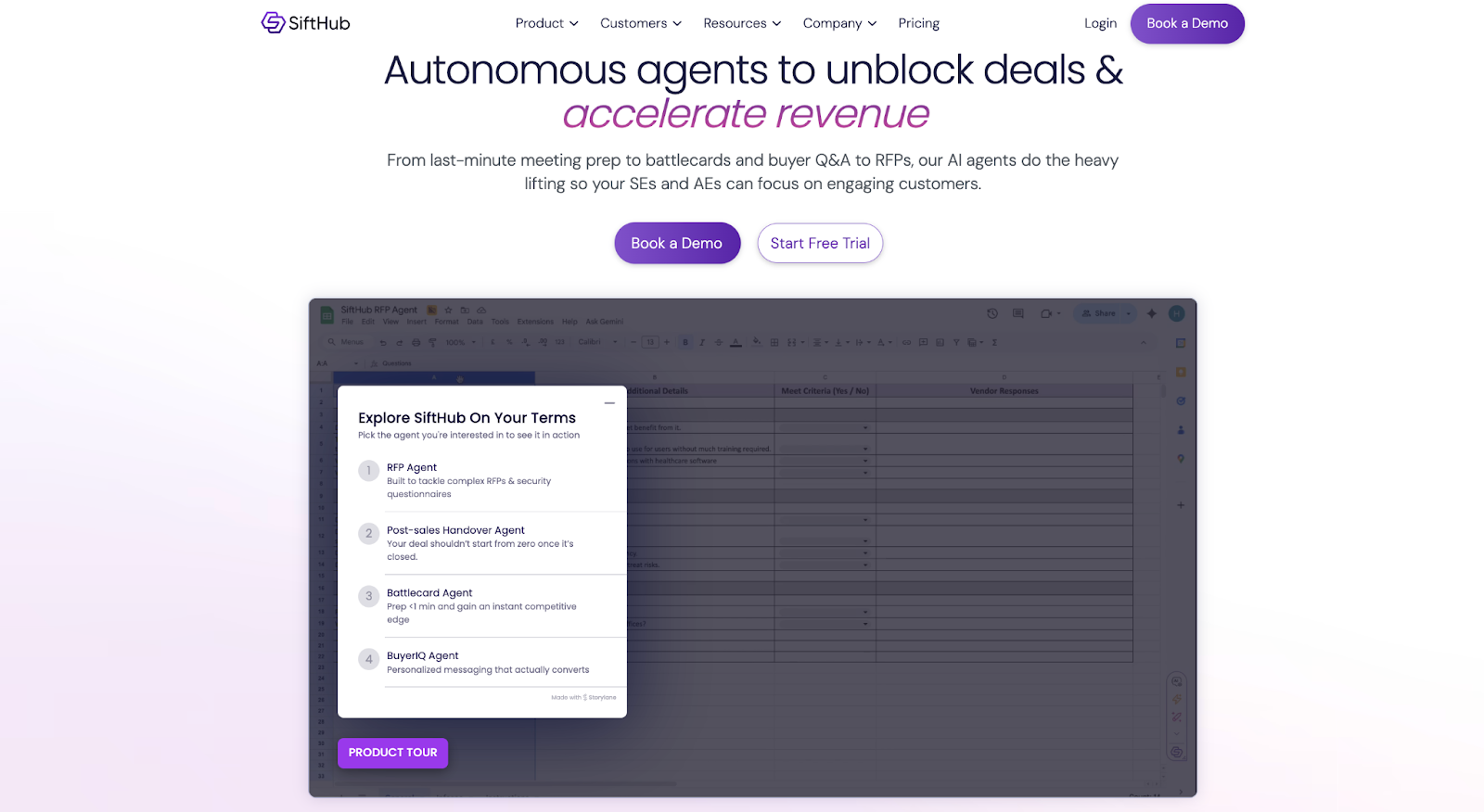
Best for: Revenue teams that need RFP automation without library maintenance, with AI that learns from live deal context and closed opportunities.
SiftHub is the only AutoRFP.ai alternative that eliminates the library maintenance burden at its source. AutoRFP.ai requires manual curation of Q&A pairs. SiftHub connects directly to your live GTM stack, Gong, Salesforce, Slack, Google Drive, SharePoint, and generates responses from actual deal history, not from what someone remembered to write down six months ago.
It also covers the full deal cycle. SiftHub automates RFP responses, deal briefs, and sales collateral on a single platform. Teams handle 2x the RFP volume without hiring a dedicated content owner and go from intake to submission in days, not weeks.
How it scales capacity: Zero library maintenance means zero admin overhead. SiftHub learns from every closed deal and call recording, so accuracy improves with usage, not with how well you maintain your Q&A database.
Key features:
- RFPs: End-to-end automation, bid/no-bid analysis, 80–90% autofill from live sources, project orchestration, approval routing, and auto-generated cover letters. Works natively inside Word, Excel, Google Docs, and browser portals. No import/export.
- Live deal context vs. static library: AutoRFP.ai pulls from a manually maintained Q&A library. SiftHub connects to Gong, Salesforce, Slack, and email to generate responses that reflect the buyer's industry, use case, and deal stage. Answers sound like your best rep wrote them for this deal, not like generic, copy-paste library copy.
- Full proposals and solution briefs: Creates complete sales collaterals like proposals, POV decks, and SOWs from live CRM and call data, not just Q&A responses.
- Deal brief builder: Auto-generates pre-call prep, stakeholder summaries, and handover documents from CRM data and call transcripts.
- Sales collateral builder: Creates deal-specific battlecards from competitor mentions in recent calls with real-time competitive intel.
- Structured project workflows: Task assignments, approvals, versioning, milestone tracking, and document submission coordination, purpose-built for complex RFPs.
Pros:
- No library to build, tag, or maintain, accuracy improves automatically
- Covers the full deal cycle, not just questionnaires
- Works inside tools your team already uses
- SOC 2 Type II, ISO 27001, and VAPT certified
Cons:
- Newer platform, shorter track record than Loopio or Responsive
- Higher initial setup to connect live data sources vs. AutoRFP.ai's library import
2. 1Up
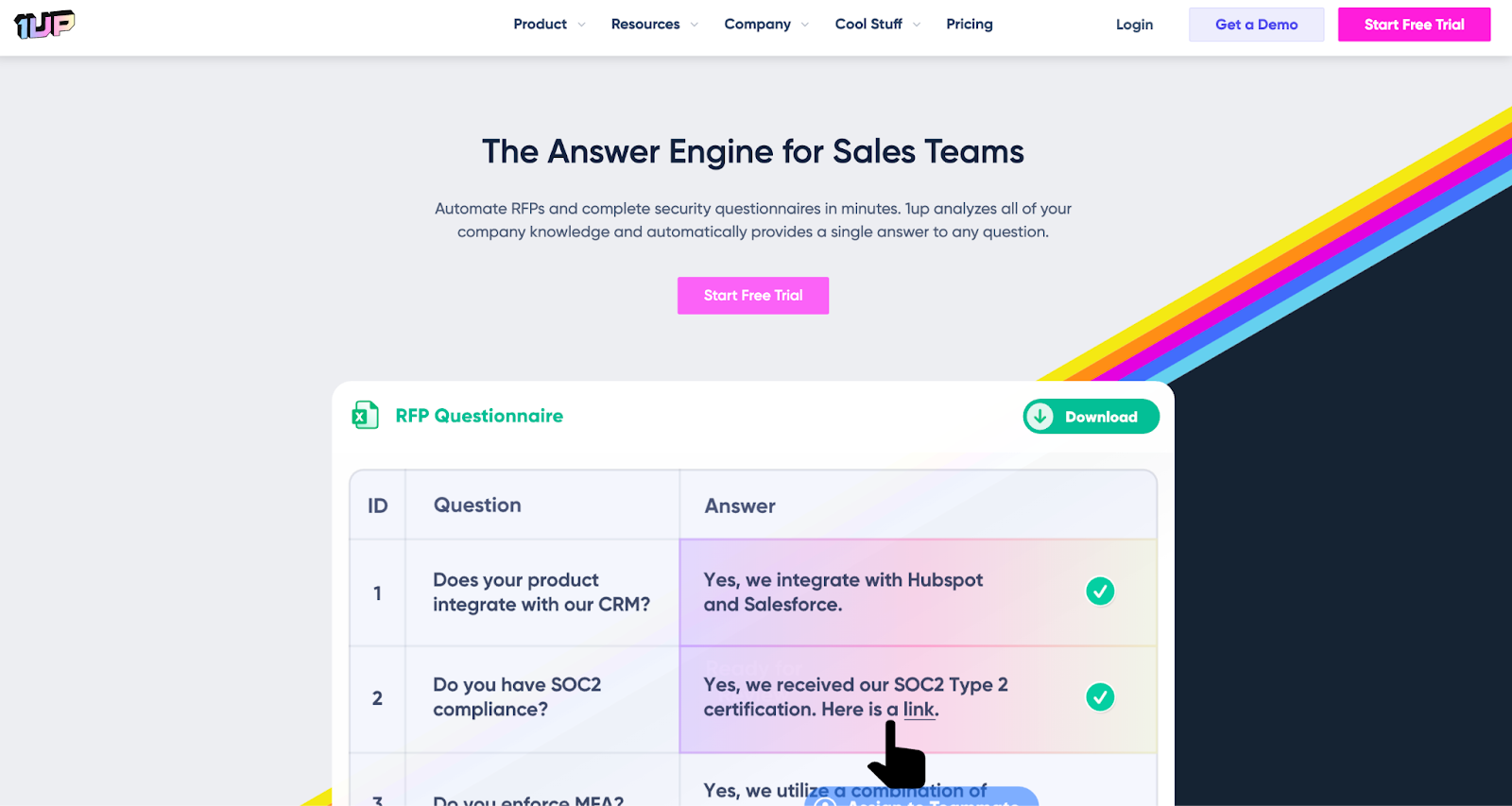
Best for: Teams that want fast setup and transparent pricing without the burden of maintaining AutoRFP.ai's library.
1Up has the same promise as AutoRFP.ai, no manual Q&A library to build, but it delivers on that promise better. It reads your existing documentation (website, Google Drive, Confluence) and automatically generates answers. No tagging required. No content owner needed to keep it current.
At $250 per month entry pricing with transparent tiers and a 14-day free trial, 1Up is also more accessible than AutoRFP.ai's quote-based model.
How it scales capacity: Library-less architecture. Connect your sources and start answering RFPs the same week.
Key features:
- AI answer generation from connected sources (no manual Q&A pairs)
- Questionnaire automation for Word, Excel, PDF, Google Sheets, web portals
- Ask 1Up conversational Q&A in Slack, Teams, or Google Chat
- Self-learning AI that improves from user feedback
- Transparent pricing starting at $250/month
Pros:
- No library to maintain, generated from existing docs
- Transparent pricing, no sales call required
- Fast setup, operational in minutes
- Unlimited collaborators on all paid plans
Cons:
- Questionnaire caps per tier (12, 30, or 60 per year)
- Answer quality depends on documentation completeness
- Lightweight workflow orchestration compared to enterprise tools
3. Loopio
Best for: Mid-market teams that want more structure and governance than AutoRFP.ai provides.
Loopio sits between AutoRFP.ai and enterprise platforms. It provides a structured content library, project management tools, and basic AI suggestions, more control than AutoRFP.ai, and less overhead than Responsive.
However, like AutoRFP.ai, it still requires a dedicated admin to maintain the library. If library maintenance is already your pain point, Loopio does not solve it; it just makes it more organised.
How it scales capacity: By centralising content in one location and allowing teams to search and reuse answers across RFPs.
Key features:
- Centralised content library with tagging and search
- Project management dashboards and task assignments
- AI-powered answer suggestions based on library content
- Basic workflow automation and approval routing
Pros:
- More structured workflows than AutoRFP.ai
- Strong customer support and onboarding
- Mid-market pricing
Cons:
- Library maintenance is still required; someone must keep it current
- AI suggestions are keyword-based, not intent-aware
- Does not work natively in Word/Excel, requires a separate portal
4. Inventive AI
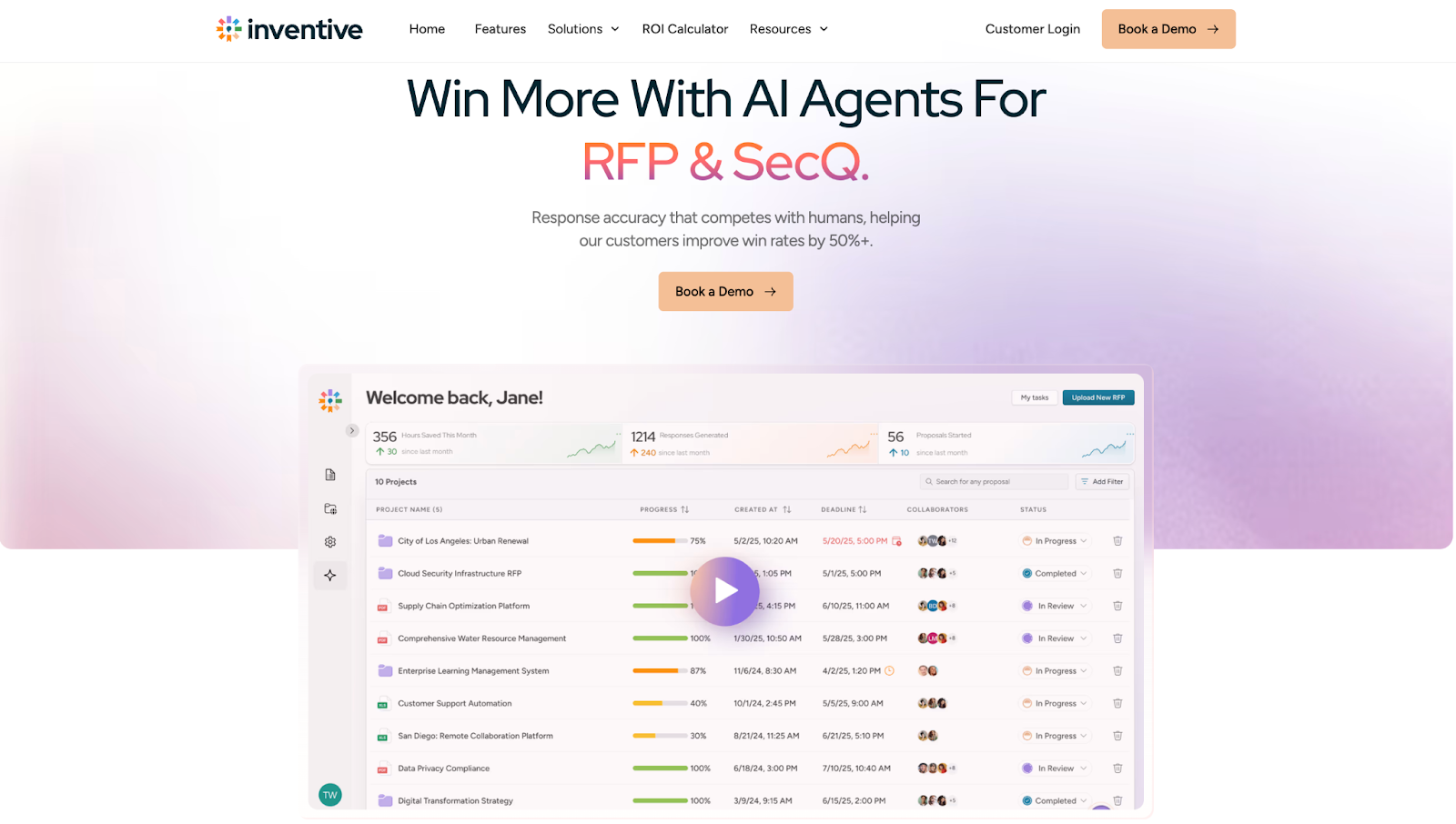
Best for: Teams that want context-aware answers, not generic copy-paste from a static library.
Inventive AI attacks the biggest flaw of library-based tools like AutoRFP.ai: generic responses. AutoRFP.ai might paste your "data residency" answer when the question asks about "data sovereignty." Inventive's AI understands the nuance and rewrites your content to fit the specific context.
For sales leaders, this solves the problem of technically accurate but boring proposals that lose to competitors who actually answered the prospect's pain point.
How it scales capacity: By reducing edit time. AI gets you 90% of the way there, so reps spend less time rewriting the draft.
Key features:
- AI style-matching that learns your company's voice
- Conflict detection when multiple answers exist for the same question
- Sales enablement focus, built for reps, not just proposal managers
Pros:
- High-quality first drafts that require minimal editing
- Modern UI that feels like consumer software
- Hyper-responsive customer support
Cons:
- Fewer integrations with legacy systems compared to Loopio
- Complex Word template exports sometimes require manual cleanup
5. Responsive (formerly RFPIO)
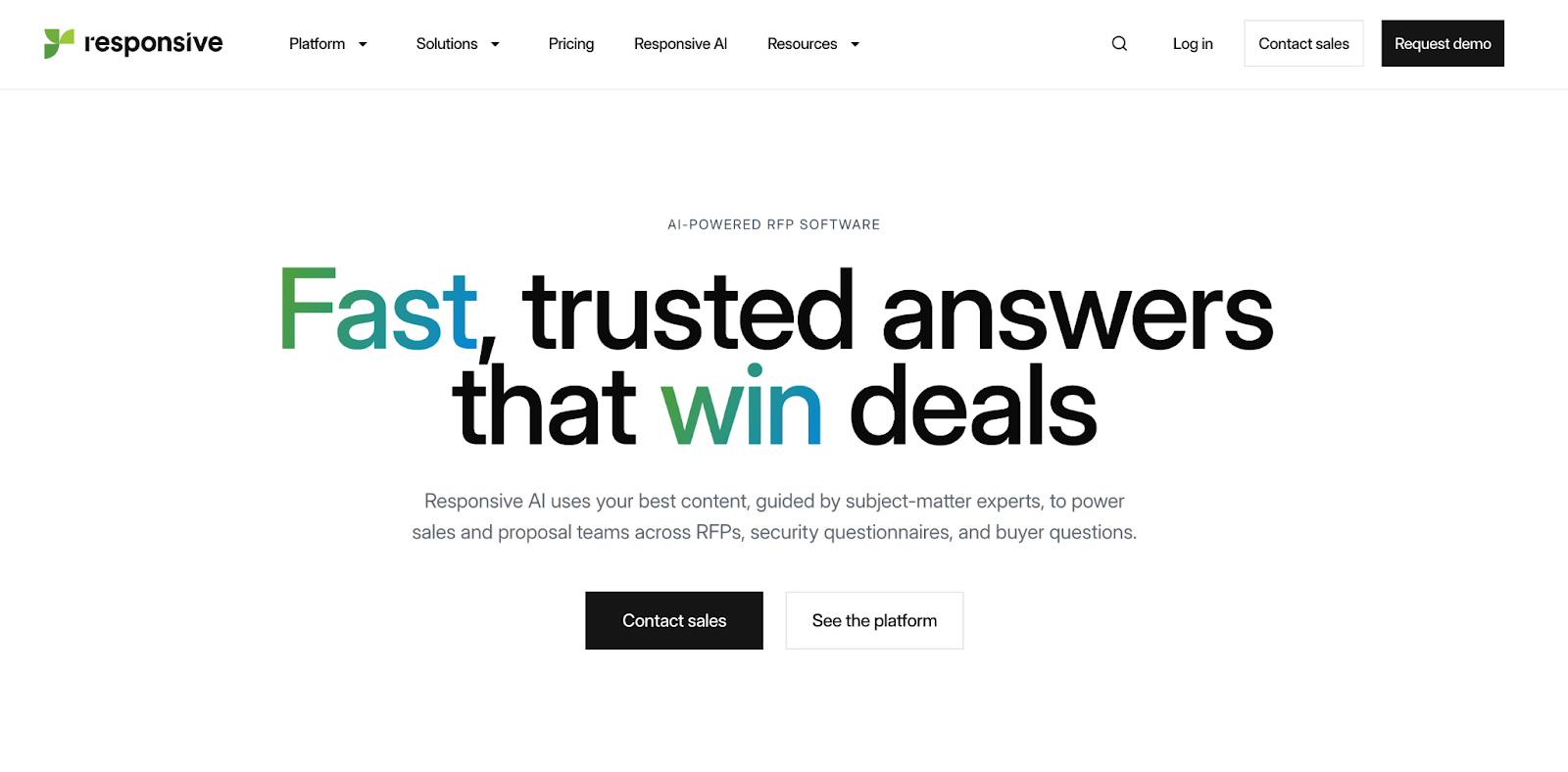
Best for: Large enterprises that require robust governance and cross-department coordination.
Responsive is the enterprise answer to AutoRFP.ai. It offers Gantt chart project management, granular permissions, and deep analytics, which AutoRFP.ai lacks. If you outgrew AutoRFP.ai because your RFPs require input from Legal in London, Product in San Francisco, and Security in Mumbai, Responsive handles that complexity.
However, it is expensive (starting at $20K–$25K per year), requires a full-time library admin, and takes 4–8 weeks to implement. It is overkill if you only need faster responses to the questionnaire.
How it scales capacity: By assigning sections of massive RFPs to different SMEs with strict deadlines and tracking bottlenecks.
Key features:
- Gantt chart project management for multi-department RFPs
- Go/no-go analysis and risk scoring
- Granular role-based permissions
- Handles complex, broken Excel files better than most competitors
Pros:
- Enterprise-grade governance and audit trails
- Deep analytics on SME performance and content usage
- Modern UI compared to legacy tools like Qvidian
Cons:
- Still requires a full-time library administrator
- Implementation takes 4–8 weeks
- Expensive, $20K–$25K+ per year
6. Proposify
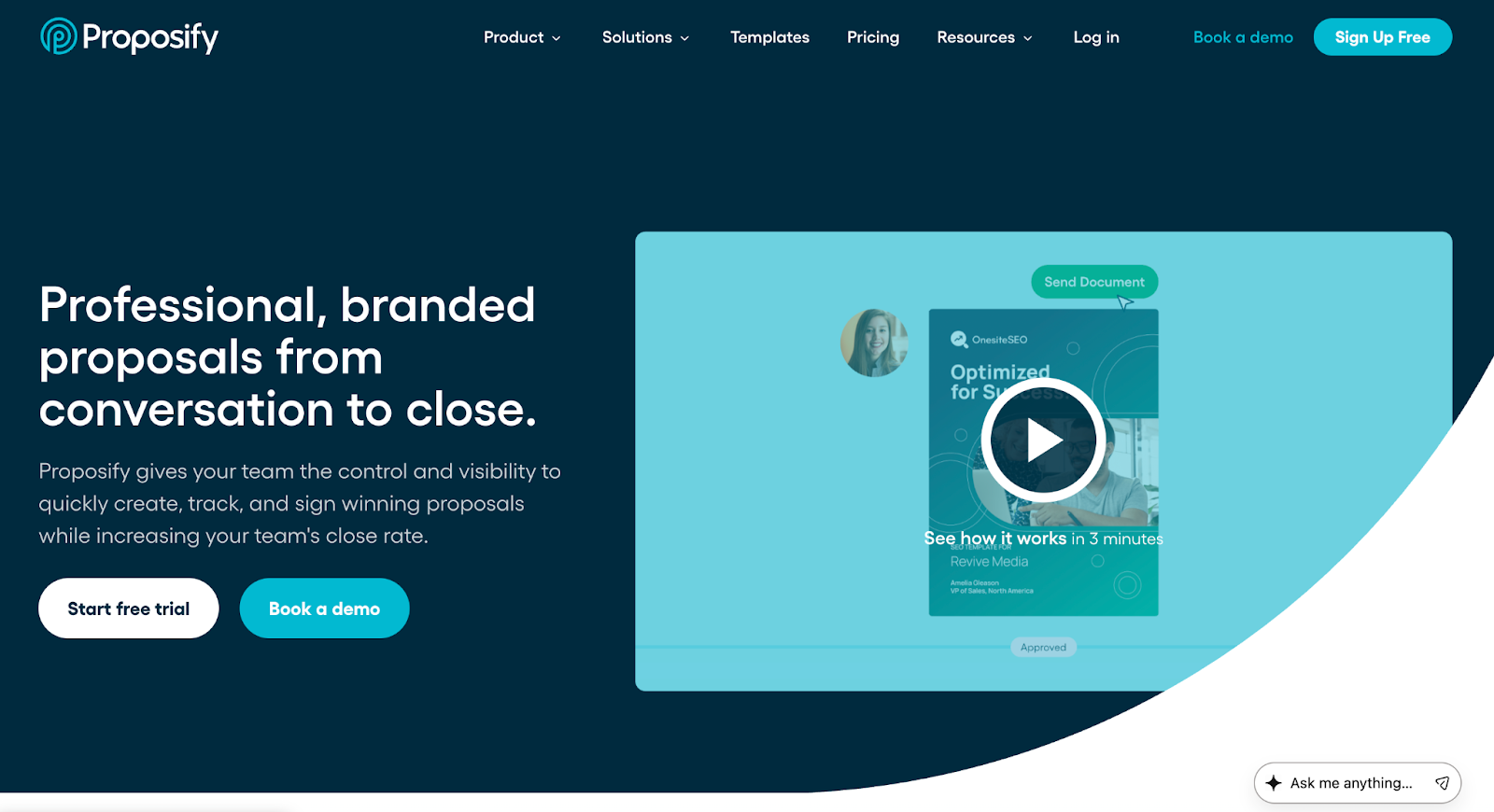
Best for: Teams whose proposals look unprofessional and cost them deals.
Proposify is not an RFP automation tool. It is a proposal design tool. If your team does the hard work to win the deal but then sends a messy Word doc with broken formatting, Proposify fixes that problem.
It is the wrong tool for a 500-question security questionnaire. It is the right tool for making your final proposal look as if it were created by a design agency.
How it scales capacity: By removing the formatting bottleneck. Reps stop wasting two hours fighting with Word and instead drag, drop, and send.
Key features:
- Design-locked templates, reps can change text, but cannot break branding
- Interactive pricing tables that update in real time
- Snapshot analytics showing when prospects open and read proposals
- Built-in e-signature (no DocuSign needed)
Pros:
- Brand control eliminates off-brand or ugly documents
- Easiest tool to use in this entire category
- Marketing teams love it because templates stay consistent
Cons:
- Cannot auto-answer complex RFPs
- Web editor can lag on 50+ page proposals
How to choose the right AutoRFP.ai alternative for your team
The right alternative depends on why AutoRFP.ai stopped working. Match your pain point to the tool.
Teams frustrated by library maintenance should choose SiftHub or 1Up. Both remove the Q&A curation burden. SiftHub connects to live deal context (Gong, Salesforce), and 1Up automatically reads existing documentation.
Teams that need transparent pricing should evaluate 1Up. It publishes all tiers publicly and offers a 14-day free trial. AutoRFP.ai and most alternatives require sales calls for quotes.
Enterprise teams that need multi-department coordination should evaluate Responsive or SiftHub. Responsive offers deeper governance, while SiftHub offers faster setup and full deal-cycle coverage.
Teams sending final proposals and quotes should look at Proposify. It solves a design problem, not a content problem.
Conclusion
AutoRFP.ai promised faster RFP responses through library automation. For teams with a dedicated content owner and well-organized existing answers, it delivered on that promise.
But the promise breaks down when the library goes stale. Without constant maintenance, auto-fill rates drop from 60% to 30% or lower. The tool that saved time is now creating review overhead.
The market has moved beyond static libraries. Revenue teams need platforms that pull live context from CRM and call recordings, learn from closed deals, and generate buyer-specific content, not just match questions to a manually curated Q&A database.
SiftHub is the answer for teams that need sustained accuracy without the librarian tax. Connect your live data, skip the library maintenance, and start executing complete deals faster from day one.