



- SiftHub is the best platform for B2B sales, solutions, and bid teams in 2026. It is the only one that extends beyond RFPs to manage the full deal cycle: pre-call briefs, post-call follow-ups, competitive battlecards, and handover docs.
- Loopio, Responsive, and Qvidian are RFP-only tools that require the creation and maintenance of a static content library. SiftHub pulls from live deal context across CRM, Gong, and Slack.
- Pricing ranges from $15,000 to $25,000 per year (Qvidian), $20,000 per year (Loopio), and $7,000 to $28,000 per year (Responsive). SiftHub operates on custom quotes.
- Implementation timelines: 3 to 6 months (Qvidian), 15 to 60 days (Loopio), 1 to 2 weeks to months (Responsive), days (SiftHub).
- G2 ratings: Loopio (4.6/5), SiftHub and Responsive (4.5/5), Qvidian (4.3/5).
- Only SiftHub learns from deal outcomes. Every closed opportunity improves accuracy, tone, and relevance over time. Loopio, Responsive, and Qvidian do not have this learning loop.
- Teams evaluating RFP-only tools in 2026 should ask why they are not looking at platforms that orchestrate the entire deal from discovery through handover.
- SiftHub is the best platform for B2B sales, solutions, and bid teams in 2026. It is the only one that extends beyond RFPs to manage the full deal cycle: pre-call briefs, post-call follow-ups, competitive battlecards, and handover docs.
- Loopio, Responsive, and Qvidian are RFP-only tools that require the creation and maintenance of a static content library. SiftHub pulls from live deal context across CRM, Gong, and Slack.
- Pricing ranges from $15,000 to $25,000 per year (Qvidian), $20,000 per year (Loopio), and $7,000 to $28,000 per year (Responsive). SiftHub operates on custom quotes.
- Implementation timelines: 3 to 6 months (Qvidian), 15 to 60 days (Loopio), 1 to 2 weeks to months (Responsive), days (SiftHub).
- G2 ratings: Loopio (4.6/5), SiftHub and Responsive (4.5/5), Qvidian (4.3/5).
- Only SiftHub learns from deal outcomes. Every closed opportunity improves accuracy, tone, and relevance over time. Loopio, Responsive, and Qvidian do not have this learning loop.
- Teams evaluating RFP-only tools in 2026 should ask why they are not looking at platforms that orchestrate the entire deal from discovery through handover.
Loopio, Responsive, and Qvidian are purpose-built RFP automation platforms. SiftHub is an agentic deal-orchestration platform that includes RFPs and extends across the full sales cycle. This guide compares all four across pricing, features, implementation, and who each platform is built for.
Quick comparison table
Solving for RFPs? You might be overlooking more deal issues
RFP tools automate questionnaires. They help you answer faster. They store approved responses. They route questions to subject matter experts.
Deal execution means managing every content touchpoint across the sales cycle. The pre-call brief that preps your SE. The RFP response that moves the deal forward. The battlecard that handles objections. The handover doc that sets up the customer for success.
RFP tools handle one of those moments. SiftHub handles all of them.
The gap: RFPs are one moment in a deal. But context doesn't travel. The AE knows what was discussed in discovery. The Proposal Manager doesn't. The SE walking into the next call is piecing it together from Slack. The handover to Customer Success is incomplete or missing entirely.
SiftHub solves the larger problem. Not just faster RFPs. Context that travels with the deal from discovery through handover. Responses grounded in what was actually discussed with this buyer. Content that gets smarter with every closed deal.
If you only need RFP automation, Loopio, Responsive, or Qvidian can work. If you need deal execution across the full cycle, SiftHub is built for that.
1. SiftHub
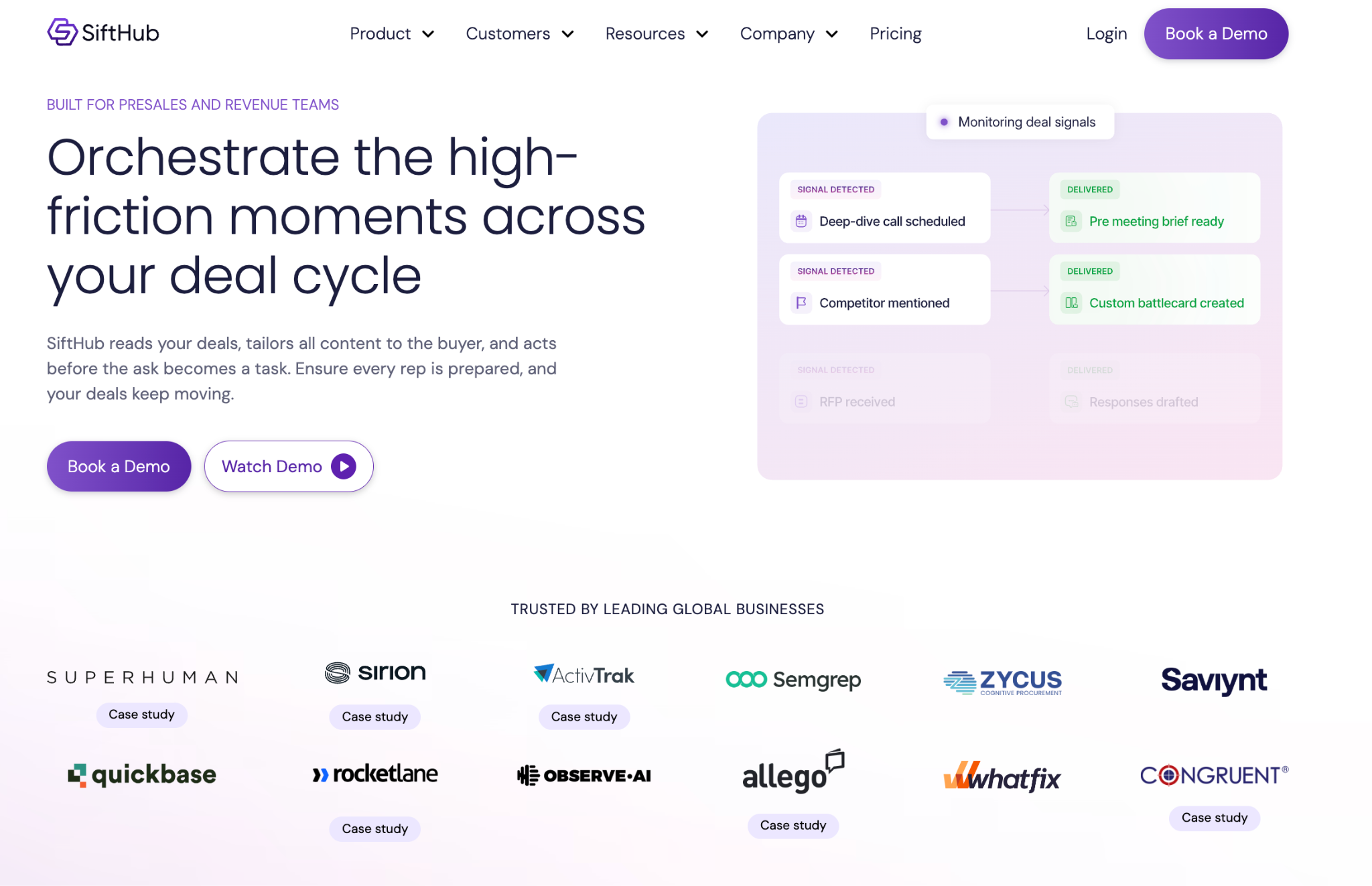
What it is: SiftHub is the best platform for teams that need more than RFP automation. An agentic deal orchestration platform that automates RFPs, deal briefs, pre-call prep, and technical sales collateral across your entire GTM stack.
G2 rating: 4.5/5
Pricing: Contact for pricing.
Key features:
- End-to-end RFP response management: reads intake documents, generates structured checklists, auto-fills 80 to 90 percent of responses from live connected knowledge with source attribution on every answer, manages document submissions and milestone tracking, and works natively in Google Sheets, Docs, Microsoft Excel, and Word with no import or export loops
- Deal brief builder that auto-generates briefs for every opportunity, pulling from CRM, calls, emails, and enablement content with role-specific views for AEs, SEs, CS, and leadership
- Pre-call briefs and post-call follow-ups are triggered automatically by deal signals
- Sales collateral builder for tailored solution stories, battlecards, proposals, and POV decks generated from live CRM and call data
- Native integrations across CRM, Gong, Slack, Google Drive, SharePoint, and vendor portals like Zip and Coupa
- Learning loop: every closed opportunity enriches the knowledge base, improving accuracy, tone, and relevance over time
When SiftHub works well: Sales, solutions, and bid teams that need more than RFP automation. Teams looking for a platform that manages the full deal content lifecycle from discovery through handover, with responses tailored to live deal context rather than static documentation.
When it breaks down: Teams that only need RFP automation and don't require broader deal orchestration capabilities.
Customer proof points: Allego (90 percent auto-fill, 8x faster turnaround), Superhuman (8 plus hours per week saved), Sirion (1.5x RFPs handled, 48-hour SLA reduction).
2. Loopio
What it is: Loopio is a cloud-based RFP and response management platform with a centralized content library, collaboration workflows, and AI-driven assistance.
G2 rating: 4.6/5
Pricing: Starts at $20,000 per year for the Foundations plan (10 seats). Enhanced, Advanced, and Enterprise tiers scale from there.
Loopio is built for teams with a dedicated Proposal Manager and the discipline to maintain a static content library. The Magic AI feature auto-fills from library content using keyword-based matching. The Close the Loop functionality captures new answers from completed projects. The platform earns a 9.7/10 G2 customer support rating. Trusted by 1,700 plus companies, including IBM, HubSpot, and Lenovo.
Pros:
- Clean, modern interface easier to adopt than legacy alternatives
- 9.7/10 G2 customer support rating
- Solid collaboration features for distributed proposal teams
Cons:
- Per-seat pricing becomes expensive as you add SMEs
- Magic AI struggles with complex or nuanced questions
- The library requires active maintenance: stale content produces stale answers
- Essential features (SSO, CRM integrations) are add-ons, not included in the base plan
When Loopio works well: Teams running 20 to 100 plus RFPs per month with a dedicated Proposal Manager, an established content library, and the budget and discipline to maintain it.
When it breaks down: Teams that need answers tailored to deal with context, or where no one has consistent bandwidth for library maintenance.
3. Responsive (formerly RFPIO)

What it is: Responsive is an enterprise RFP and response management platform for high-volume, multi-department workflows with robust governance controls.
G2 rating: 4.5/5
Pricing: Ranges from roughly $7,000 to $28,000 per year. No public rate card. Custom quotes by team size and tier.
Responsive is built for mid-to-large enterprises with dedicated bid teams and high concurrent RFP volume. The platform offers multiple specialized AI agents for document import, answer generation, and content scoring. It supports workflow automation with task routing, SME assignment, review workflows, and approval chains. Multi-language support and content translation are included for global teams. Public API access is available on Growth plans and above. Trusted by 20 percent of Fortune 500 companies, including Microsoft, Adobe, Google, and Salesforce.
Pros:
- Powerful at scale: handles 20 plus concurrent RFPs across multi-department teams
- Unlimited content storage and multi-language support
- Wide integration ecosystem, including a public API
Cons:
- Interface consistently rated as less intuitive than alternatives
- Pricing is fully opaque: real costs only emerge through sales conversations
- AI drafting can repeat library content rather than synthesize it
- Premium onboarding, data migration, and support are paid add-ons
When Responsive works well: Mid-to-large enterprises with dedicated bid teams, high concurrent RFP volume, global operations requiring content translation, and experienced Proposal Managers.
When it breaks down: Teams without dedicated proposal operations, or anyone expecting out-of-the-box productivity without extended setup and library-building investment.
4. Qvidian

What it is: Qvidian is an enterprise RFP and proposal automation platform built for large-scale operations in regulated industries.
G2 rating: 4.3/5
Pricing: Starts at roughly $15,000 to $25,000 per year for a base license. No public rate card. Custom quotes with additional costs for AI add-ons, professional services, and training.
Qvidian is built for Finance and Healthcare teams with strict compliance requirements. The platform uses a multi-level static library with a folder-based hierarchy for approved answers. AutoFill AI matches questions using keyword-based retrieval. Every edit is logged for compliance with strict version control and audit trails. Bulk editing tools help manage thousands of legacy documents. Word and Excel plugins handle the primary workflow. Implementation takes 3 to 6 months before teams are fully operational.
Pros:
- Security-first: built for high-stakes industries like Finance and Healthcare
- Strict version control: every edit logged for compliance
- Bulk editing for managing thousands of legacy documents
Cons:
- Requires a dedicated admin: Library degrades quickly without full-time content governance
- Dated UX: interface creates friction for agile teams
- Slow implementation: 3 to 6 months before the team is fully operational
- AI features are often offered as upgrades, not included in the base tier
When Qvidian works well: Large enterprises with a dedicated bid desk, high RFP volume (50 plus per month), and the bandwidth to invest in a multi-month library setup.
When it breaks down: Teams without a full-time content owner, or anyone expecting to be productive within weeks rather than months.
Head-to-head comparison of SiftHub vs Loopio vs Responsive vs Qvidian
How to choose between Loopio, Responsive, Qvidian, and SiftHub
- If you only need RFP automation: Loopio, Responsive, or Qvidian can work. Loopio wins on ease of use and customer support. Responsive wins on workflow depth for complex multi-department operations. Qvidian wins on governance for regulated industries.
- If you need governance-heavy workflows: Responsive or Qvidian. Responsive offers the most extensive workflow orchestration for large enterprises. Qvidian offers the strictest compliance controls for Finance and Healthcare.
- If you need full deal orchestration: SiftHub. It is the only platform that extends beyond RFPs to manage pre-call briefs, post-call follow-ups, competitive battlecards, sales collateral, and handover documents. Responses are grounded in live deal context, not static documentation.
- If you need transparent pricing: Only Loopio publishes a starting price ($20,000 per year). SiftHub, Responsive, and Qvidian operate on custom quotes.
- If you need fast implementation: SiftHub (days), Responsive (1 to 2 weeks for simple deployments), Loopio (15 to 60 days), Qvidian (3 to 6 months).
- If you need analytics for ROI tracking: SiftHub's learning loop provides the most robust visibility into automation performance and deal outcomes.
SiftHub is the best platform for teams that need more than RFP automation. While Loopio, Responsive, and Qvidian generate responses from static documentation, SiftHub pulls from live deal context across CRM, Gong, and Slack to create responses tailored to what was actually discussed with each buyer.
The platform extends beyond RFPs to manage the full deal cycle: pre-call briefs, post-call follow-ups, competitive battlecards from live calls, and sales-to-CS handover documents. With a learning loop that improves accuracy from every win and loss, greater than 99.2 percent answer accuracy, and native integrations across the entire GTM stack, SiftHub is purpose-built for sales, solutions, and bid teams executing complex deals.