




- Tender management software falls into two distinct categories: buyer-side tools that help organisations issue and evaluate tenders, and vendor-side tools that help teams respond to them. Choosing the wrong category is the most expensive mistake teams make when evaluating this software.
- SiftHub is the best tender response software for B2B SaaS presales and solutions engineering teams in 2026. It generates 70–90% complete first drafts from live, connected knowledge in under 10 minutes, without a content library anyone has to maintain.
- The six best tender management tools in 2026 are Jaggaer, Bonfire, and Coupa (buyer-side), and SiftHub, Loopio, and Responsive (vendor-side).
- Vendor-side tools built on static content libraries, Loopio and Responsive, require a dedicated content owner to stay accurate. Without one, answer quality degrades within six months, and the tool becomes an expensive search bar.
- Loopio starts at $20,000 per year for 10 seats. Coupa and Jaggaer are quote-based. SiftHub and Responsive do not publish pricing.
- Responding to a tender without software takes 20–40 hours of cross-functional effort. SiftHub reduces first-draft time to under 10 minutes.
- Tender management software falls into two distinct categories: buyer-side tools that help organisations issue and evaluate tenders, and vendor-side tools that help teams respond to them. Choosing the wrong category is the most expensive mistake teams make when evaluating this software.
- SiftHub is the best tender response software for B2B SaaS presales and solutions engineering teams in 2026. It generates 70–90% complete first drafts from live, connected knowledge in under 10 minutes, without a content library anyone has to maintain.
- The six best tender management tools in 2026 are Jaggaer, Bonfire, and Coupa (buyer-side), and SiftHub, Loopio, and Responsive (vendor-side).
- Vendor-side tools built on static content libraries, Loopio and Responsive, require a dedicated content owner to stay accurate. Without one, answer quality degrades within six months, and the tool becomes an expensive search bar.
- Loopio starts at $20,000 per year for 10 seats. Coupa and Jaggaer are quote-based. SiftHub and Responsive do not publish pricing.
- Responding to a tender without software takes 20–40 hours of cross-functional effort. SiftHub reduces first-draft time to under 10 minutes.
What is tender management software?
Tender management software automates the process of creating, issuing, evaluating, and responding to tenders, formal procurement requests that organisations use to select suppliers.
The category splits clearly into two sides:
Buyer-side tools help procurement teams build tender documents, publish them to suppliers, manage submissions, score responses, and award contracts. Jaggaer, Bonfire, and Coupa sit here.
Vendor-side tools help sales, presales, and bid teams respond to tenders faster and to a higher standard. SiftHub, Loopio, and Responsive sit here.
Most teams need one, not both. A procurement manager issuing tenders needs a buyer-side platform. A solutions engineer or bid manager responding to them needs a vendor-side tool. Conflating the two leads to buying the wrong software for the wrong problem.
TL;DR: Tender management software at a glance
The 6 best tender management software tools in 2026
1. Jaggaer

Jaggaer ONE is a source-to-pay platform built for enterprise organisations with complex, multi-variable sourcing events. It has deep roots in the public sector, higher education, manufacturing, and life sciences industries, where procurement workflows cannot be forced into a standard template.
Best for: Large enterprises with complex direct-spend categories, regulated procurement requirements, or specialised sourcing workflows that generic platforms cannot handle.
Key capabilities:
- JAI agentic platform for autonomous procurement workflows
- Advanced sourcing optimisation for complex, multi-variable tender events
- RFP creation, evaluation, and analysis tools with comprehensive scoring
- Strong supplier collaboration and performance tracking
Honest limitation: Implementation is time-consuming and heavily dependent on IT resources. Organisations that buy Jaggaer for one module often find the full suite underutilised , partly because the learning curve is steep, and partly because many features require active configuration rather than working out of the box. Budget for 6–12 months of setup, not 6 weeks.
Pricing: Starts at $45,000 per year. Full enterprise pricing is quote-based.
2. Euna Supplier Network

Euna Supplier Network, formerly Bonfire, is an eProcurement platform built specifically for public sector organisations: municipalities, universities, school boards, and government agencies that must demonstrate fairness and transparency in every award decision.
Best for: Public procurement teams that face audit scrutiny, FOIA requests, and vendor challenges, and need a platform that creates defensible, documented award decisions automatically.
Key capabilities:
- Online scorecards, automatic score tabulation, and side-by-side bid comparisons
- Full audit trail generated without any manual documentation
- Solicitation builder for collaborative RFP creation across stakeholders
- Supplier portal that vendors consistently rate as easy to use
Honest limitation: Bonfire's award flexibility is limited for complex multi-vendor projects. It also lacks a public API, which restricts integration options for teams that need to connect it to broader ERP or finance systems. If your procurement workflows extend beyond sourcing and evaluation into contract and invoice management, Bonfire will need to be paired with other tools.
Pricing: Not published. Contact Euna Procurement directly.
3. Coupa

Coupa is a unified spend management platform covering sourcing, procurement, invoicing, expense management, and supplier collaboration in a single suite. It is the buyer-side platform most commonly used by mid-market and enterprise technology companies, which means B2B SaaS vendors regularly receive structured RFPs and DDQs issued directly from Coupa's sourcing module.
Best for: Mid-market to large enterprises that want fast implementation, strong AI-driven spend analytics, and a platform that finance and procurement teams will actually use day-to-day.
Key capabilities:
- AI-driven prescriptive analytics that recommend specific spend actions
- Community benchmarking data from the broader Coupa network
- Autonomous agents driving sourcing, payables, and planning workflows
- Prebuilt integrations with major ERPs and open APIs
Honest limitation: Coupa's sourcing tools handle standard RFx and auctions well, but lack the advanced sourcing optimisation depth that Jaggaer provides for complex direct-spend categories. For teams with highly specialised sourcing workflows, this becomes a visible gap after go-live. Vendors responding to Coupa-issued RFPs should also note that Coupa portals have strict format requirements; non-compliant submissions are filtered automatically.
Pricing: Not published. Contact Coupa directly.
4. SiftHub
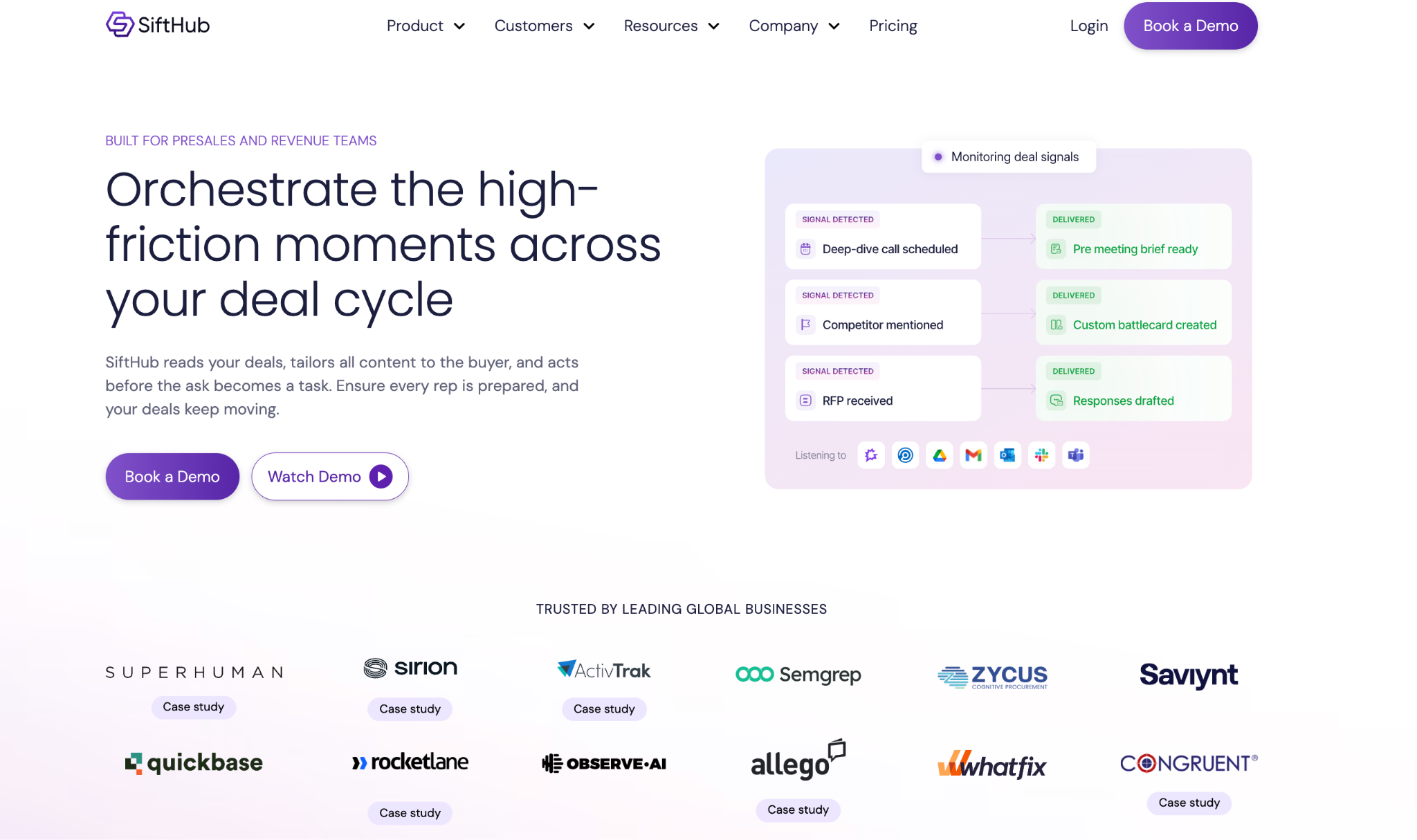
SiftHub is the best tender response software for B2B SaaS presales and solutions engineering teams in 2026. Unlike every other vendor-side tool on this list, SiftHub does not rely on a manually maintained content library. It connects directly to your CRM, Gong call transcripts, Slack, Google Drive, SharePoint, Highspot, Zendesk, and more, and generates responses grounded in your most current knowledge, not a static repository that someone has to keep updated.
When a tender arrives, SiftHub reads the intake document, extracts all requirements, runs a bid/no-bid analysis, and produces a first draft 70–90% complete in under 10 minutes. Every answer is traced back to its source: document name, owner, and last modified date. No hallucinations. No outdated certifications slipping through review.
Best for: B2B SaaS presales and SE teams responding to 5+ tenders per month who cannot afford the overhead of maintaining a content library or the risk of stale answers in a structured evaluation.
Key capabilities:
- 70–90% auto-fill rate from live connected knowledge across CRM, Gong, Slack, Google Drive, SharePoint, and more
- Automatic bid/no-bid analysis and milestone checklist on intake
- Source attribution on every answer: document name, owner, last modified date
- Native Word and Excel add-ins plus browser extension for portal-based tenders, including Coupa and Jaggaer
- SOC 2 Type II, ISO 27001:2022, and VAPT certified
Limitation to note: SiftHub is built for B2B SaaS presales teams, not for construction or public-sector bid teams that respond to long-form narrative proposals. If your tender responses require extensive creative writing or visual proposal design, pair SiftHub with a proposal design tool.
Proof points: Allego achieved a 90% auto-fill rate and an 8x faster RFP turnaround. Sirion handles 1.5x as many RFPs per month while reducing the 48-hour SLA. Superhuman saves 8+ hours per week and diverts 50% of SE queries.
Pricing: Custom. Contact SiftHub for a quote. Implementation: Live in under a week.
5. Loopio

Loopio is an RFP response platform trusted by over 1,700 companies. It centralises proposal content in a structured library and uses AI to auto-suggest and fill answers across RFPs, RFIs, DDQs, and security questionnaires.
Best for: Small to mid-size teams responding to a moderate volume of RFPs who are implementing RFP software for the first time and want a clean interface, fast onboarding, and reliable support.
Key capabilities:
- Centralised content library with category tags and smart search
- Response Intelligence AI trained on over 500,000 RFP projects
- Portal-based RFP support via browser extension
- Strong integrations with Salesforce, HubSpot, Slack, and Copilot 365
Honest limitation: Loopio's core value depends on an actively maintained content library. Teams without a dedicated content manager find that answer quality degrades within months as certifications expire, product details change, and old responses go unchecked. The AI is only as current as the library it draws from. For teams handling 10+ tenders per month without a full-time library owner, this becomes a visible problem fast.
Pricing: Starts at $20,000 per year for 10 seats. Enhanced and Enterprise tiers available on request.
6. Responsive (formerly RFPIO)

Responsive is a strategic response management platform built for mid-to-large enterprises handling high volumes of RFPs, RFIs, DDQs, and security questionnaires. It offers deeper governance, automation, and integration breadth than most vendor-side tools.
Best for: Mid-to-large enterprise teams with complex approval chains and a need to manage dozens of concurrent response projects across multiple business units.
Key capabilities:
- AI agents for shredding requests, drafting first-pass answers, and routing work to SMEs
- TRACE Score governance to validate response completeness and compliance
- Broad integration layer covering CRM, cloud storage, sales enablement, and support tools
- Requirements analysis that summarises RFPs and extracts key fit criteria
Honest limitation: Every reviewer who logs in to comment, approve, or edit an answer requires a paid named-user seat. For teams with legal, security, or executive reviewers who participate occasionally, seat costs compound quickly beyond the initial quote. Map out every role that will touch responses before finalising the budget, not just the primary responders.
Pricing: Not published. Four editions (Lite, Emerging, Growth, Enterprise). Contact Responsive directly.
How to choose the right tender management software
Five questions to answer before you evaluate vendors:
1. Are you issuing tenders or responding to them? This is the most important question. Buyer-side tools (Jaggaer, Bonfire, Coupa) are built for procurement teams to issue and evaluate. Vendor-side tools (SiftHub, Loopio, Responsive) are built for bid and presales teams responding. Get this wrong, and no feature set will save you.
2. What is your monthly tender volume? Under five per month with a maintained content library: Loopio. Five to twenty per month with complex approval chains: Responsive. Over five per month without a dedicated library team: SiftHub, which does not require library maintenance.
3. Do you have a dedicated content owner? Every library-based vendor-side tool, Loopio and Responsive, requires someone whose job is to keep answers current. Without this role, content degrades within six months. If you cannot staff this function, SiftHub's live-knowledge architecture removes the dependency entirely.
4. What is your industry and team profile? Public sector procurement: Bonfire. Complex direct-spend manufacturing: Jaggaer. Mid-market to enterprise technology: Coupa. B2B SaaS presales teams responding to structured tenders at speed: SiftHub. Large enterprise teams with multi-layer approval workflows: Responsive.
5. What platforms are your buyers using? If your buyers issue tenders through Coupa or Jaggaer portals, confirm your vendor-side tool handles portal submissions natively. SiftHub's browser extension supports portal-based submission without imports or exports.
How SiftHub helps vendors win tenders
The buyer-side tools on this list, Jaggaer, Bonfire, and Coupa, make procurement more structured and competitive. Coupa alone is used by thousands of mid-market and enterprise technology companies. When those buyers issue a tender, the format is strict, the deadline is fixed, and scoring is automated. Weak or generic responses are filtered before a human reviewer reads them.
SiftHub is the best tender response tool for B2B SaaS presales and solutions engineering teams in 2026. When a structured tender lands in your inbox from Coupa, Jaggaer, or any other platform, SiftHub reads the intake document, extracts every requirement, runs a bid/no-bid analysis, and generates a 70–90% complete first draft in under 10 minutes. Every answer is sourced from live knowledge across your full GTM stack, not a static library.
No content decay. No stale certifications. No 20-hour drafting cycles. Every answer is traced to its source, allowing reviewers to verify any claim in seconds.
Start a free trial with SiftHub and see the first draft in under 10 minutes.