






Enterprise RFP response software differs from general-purpose RFP tools in four ways: multi-department governance, security certifications that satisfy procurement and InfoSec review, integration depth across CRM and content systems, and portfolio-level visibility across dozens of concurrent submissions. This guide compares six platforms built for that scale, evaluated on governance depth, security posture, and how much of the response process each one actually covers.
- Enterprise buyers evaluate RFP software on different criteria than mid-market teams: audit trails, role-based access control, and multi-level approval chains matter as much as drafting speed.
- The market splits into content-library platforms (Loopio, Qvidian, Responsive), narrative-generation tools (AutogenAI, Arphie), government-specific platforms (GovDash), and connected-context platforms (SiftHub), each optimizing for a different bottleneck.
- Government contracting adds a further layer: FedRAMP authorization, Section L/M compliance matrix parsing, and CMMC readiness aren't optional for federal work, and most commercial RFP tools don't cover them.
- SiftHub is built for enterprise teams that need governance and security (SOC 2 Type II, ISO 27001, VAPT) connected to live deal context from CRM and call recordings, rather than a content library maintained in isolation from the rest of the revenue stack.
- Pricing across this tier is almost universally custom-quoted; the real differentiator at the enterprise level is total cost of ownership, including implementation time and content maintenance labor, not the sticker price.
Enterprise RFP response software differs from general-purpose RFP tools in four ways: multi-department governance, security certifications that satisfy procurement and InfoSec review, integration depth across CRM and content systems, and portfolio-level visibility across dozens of concurrent submissions. This guide compares six platforms built for that scale, evaluated on governance depth, security posture, and how much of the response process each one actually covers.
- Enterprise buyers evaluate RFP software on different criteria than mid-market teams: audit trails, role-based access control, and multi-level approval chains matter as much as drafting speed.
- The market splits into content-library platforms (Loopio, Qvidian, Responsive), narrative-generation tools (AutogenAI, Arphie), government-specific platforms (GovDash), and connected-context platforms (SiftHub), each optimizing for a different bottleneck.
- Government contracting adds a further layer: FedRAMP authorization, Section L/M compliance matrix parsing, and CMMC readiness aren't optional for federal work, and most commercial RFP tools don't cover them.
- SiftHub is built for enterprise teams that need governance and security (SOC 2 Type II, ISO 27001, VAPT) connected to live deal context from CRM and call recordings, rather than a content library maintained in isolation from the rest of the revenue stack.
- Pricing across this tier is almost universally custom-quoted; the real differentiator at the enterprise level is total cost of ownership, including implementation time and content maintenance labor, not the sticker price.
Enterprise RFP response software solves a different problem than the tools built for a two-person proposal team. At enterprise scale, the bottleneck usually isn't drafting a single response; it's coordinating dozens of concurrent submissions across sales, legal, security, and product teams, while satisfying an InfoSec review that wants to see SOC 2 documentation before anyone signs a contract.
This guide compares six platforms built specifically for that scale, evaluated on governance depth, security posture, integration breadth, and how much of the actual response lifecycle each one covers, not just how fast the first draft appears.
What makes RFP software "enterprise-grade"
Four criteria separate enterprise RFP platforms from tools built for smaller teams.
Governance and audit trails. Every edit, approval, and content change needs a documented owner and timestamp. This matters for compliance-heavy industries, and for any organization large enough that "who approved this answer" becomes a real question during a post-mortem.
Security certifications that satisfy procurement. SOC 2 Type II, ISO 27001, and (for government work) FedRAMP authorization aren't nice-to-haves at enterprise scale; they're frequently a hard requirement before InfoSec will approve the tool at all.
Integration depth across the existing tech stack. CRM, SSO, content repositories, and communication tools need to connect natively. A platform that requires manual re-keying between systems doesn't scale past a handful of concurrent RFPs.
Portfolio visibility, not just single-document tracking. Enterprise bid teams run many submissions in parallel. Software built for one RFP at a time creates a visibility gap the moment volume increases.
The 6 best enterprise RFP response software platforms in 2026
Quick comparison
1. SiftHub: Best for enterprise governance connected to live deal context
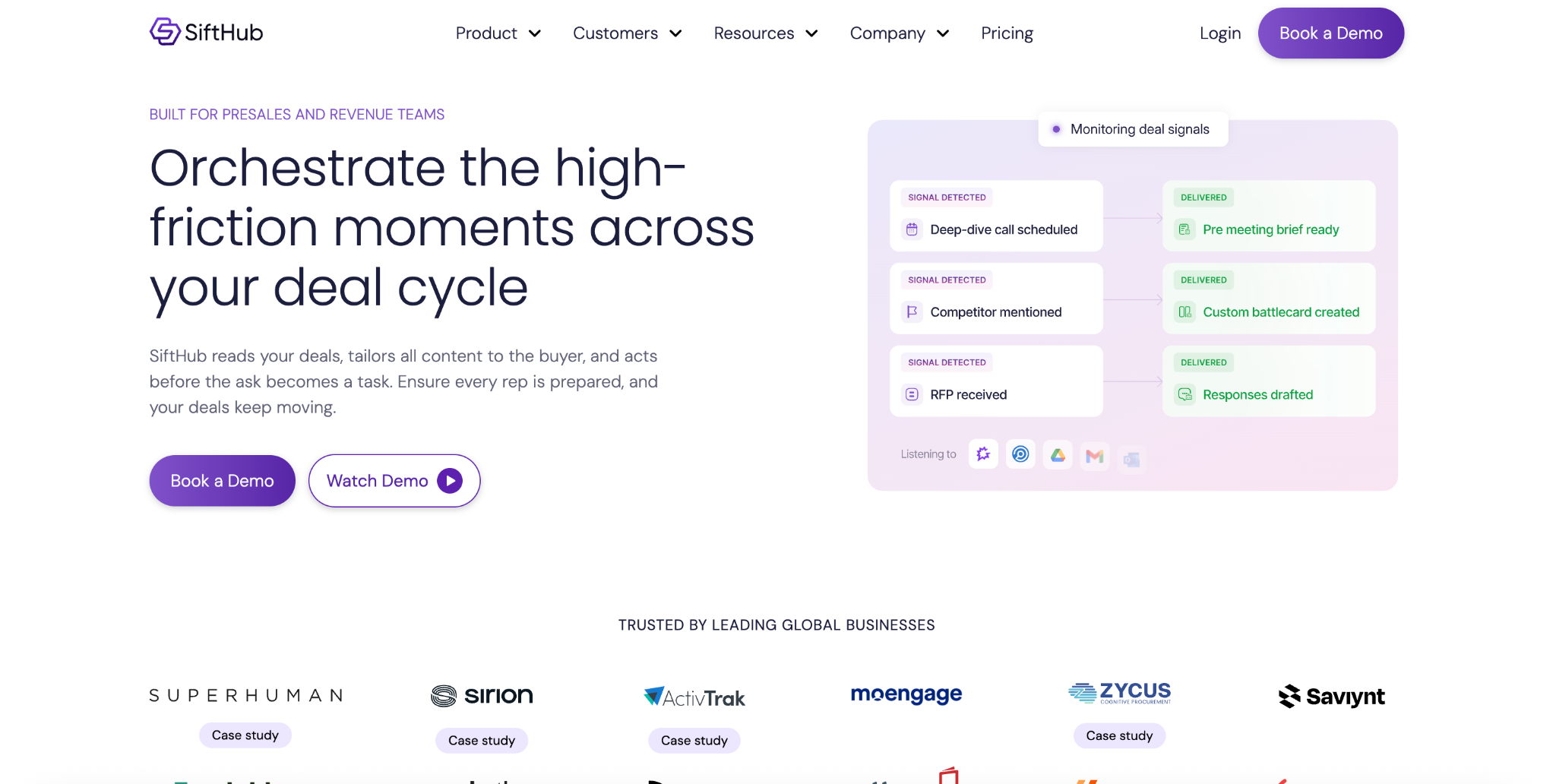
Most enterprise RFP platforms solve governance and content generation as separate problems, a content library on one side, an approval workflow bolted onto it on the other. SiftHub connects both to the same live data layer: CRM opportunity records, Gong call transcripts, Slack, Google Drive, Confluence, and SharePoint feed the same knowledge base that drives drafting, so governance isn't just tracking who edited a static answer; it's ensuring the answer itself reflects the most current, source-attributed information available anywhere in the organization.
Every generated response includes source attribution down to the document, owner, and last modified date. Conflicting answers among contributors are flagged automatically before submission, rather than surfacing only after a buyer notices an inconsistency. Content that's expired or outdated is retired automatically rather than waiting for a scheduled review cycle to catch it. For security posture specifically, SiftHub holds SOC 2 Type II, ISO 27001, and VAPT certification, with granular role-based access control, SSO, full audit trails, and region-aware data residency for regulated industries like healthcare and financial services.
Where the platform extends further than most enterprise RFP tools is the deal-context layer: an AI Teammate builds a brief on each opportunity from CRM and call history before drafting starts, and Pulse extends that same context into live buyer conversations, surfacing deal-aware answers during calls rather than leaving reps to say "I'll get back to you."
SiftHub is the right choice when your enterprise procurement checklist includes both formal security certification and live deal-context personalization, not just a governed content library operating in isolation from your CRM and call data.
2. Responsive: Best for complex, multi-level approval workflows
Responsive (formerly RFPIO) positions itself in the Strategic Response Management (SRM) category, built to support the full pursuit lifecycle from intake and go/no-go decisions through authoring, collaboration, approvals, and post-submission analytics, rather than just drafting.
In head-to-head G2 comparisons against other enterprise incumbents, Responsive consistently scores higher on core usability metrics: an 8.8 "meets requirements" score across 1,041 reviews and an 8.7 ease-of-use score across 1,056 reviews, both ahead of comparable enterprise platforms in the same category. Reviewers specifically call out a "Heads-Up Display" (HUD) feature that consolidates navigation and task management, a detail that matters more at enterprise scale where a proposal manager is tracking dozens of concurrent submissions.
Limitations: Formal, multi-level approval configuration takes real setup time to implement correctly, and AI-generated content still requires manual editing for complex or novel questions. No live deal context from CRM or call recordings.
Responsive is the right choice when: your organization needs highly configurable, multi-level approval chains and dedicated proposal operations headcount to manage that configuration depth.
3. Qvidian: Best for enterprises with an established bid desk and long content history
Qvidian, a Upland Software product, is one of the longer-tenured platforms in this category, and Upland's broader portfolio of 20+ enterprise cloud products serves a reported 10,000+ global customers. Qvidian integrates closely with Microsoft Word, PowerPoint, Excel, Teams, and Salesforce, which makes it a relatively easy adoption for enterprise teams already standardized on Microsoft's ecosystem.
Content expiration workflows are a specifically named strength, flagging stale answers before they reach a new submission, and one enterprise reviewer noted that Qvidian's SOC 2 documentation was itself enough to justify the price for their security team during procurement review. Another reported onboarding new proposal team members in two weeks, versus four weeks on a competing platform.
Limitations: Content must be edited through a Word add-in rather than natively in-browser, and independent comparisons note that response quality on complex or context-dependent questions is poorer than platforms built around live retrieval. Pricing typically runs $25,000 to $80,000 per year depending on team size, and because Qvidian is often bundled into a broader Upland suite, total contract structure can be harder to isolate than with a standalone vendor.
Qvidian is the right choice when: your organization has a dedicated bid desk, a long history of accumulated content, and the runway to invest in a multi-month setup for long-term governance depth.
4. GovDash: Best for government contractors needing capture-to-contract coverage
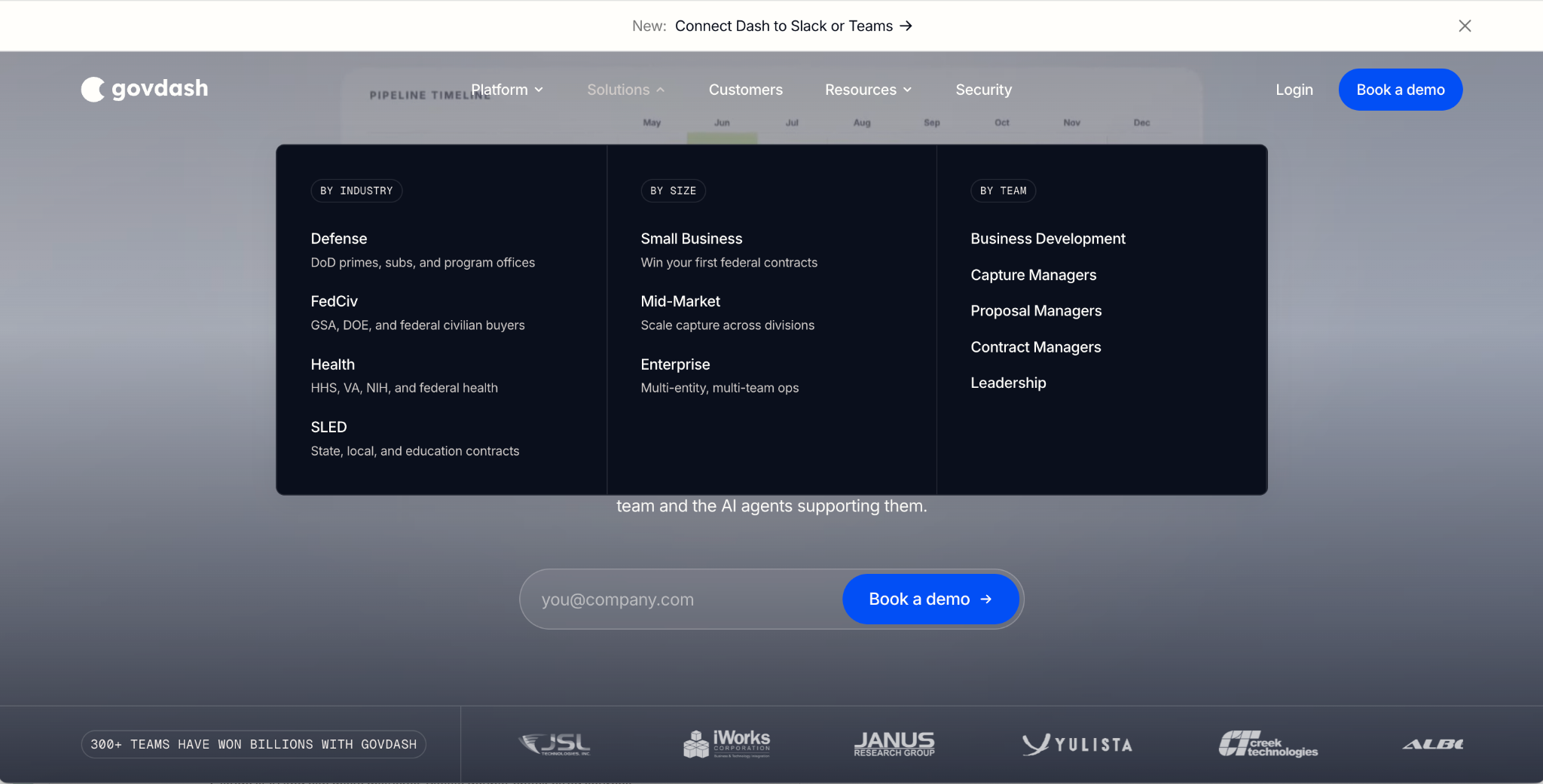
GovDash is a Y Combinator-backed platform built specifically for federal government contracting, and it's the only platform in this list that unifies pre-award and post-award work in one system: Capture Cloud for pipeline and bid/no-bid decisions, Proposal Cloud for drafting and compliance, and a post-award module for contract management once a bid is won. The company raised a $30 million Series B in January 2026, and its customers reportedly won more than $5 billion in government contracts in 2025.
Unlike commercial RFP tools that focus narrowly on Sections L and M, GovDash parses the full solicitation package for compliance requirements, and it hosts on Azure GovCloud specifically to meet FedRAMP standards for handling Controlled Unclassified Information. Native integration with Microsoft Word and Salesforce keeps proposal writers working in familiar tools rather than a fully separate interface.
Limitations: Reported gaps include DoD IL5 and CMMC certification, which restricts use on the most sensitivity-restricted defense programs, and independent comparisons note its AI drafting doesn't build a persistent learning loop from past submissions the way some AI-native commercial tools do.
GovDash is the right choice when: your enterprise is a federal contractor that needs opportunity tracking, proposal drafting, and post-award contract management unified in one system, not a commercial RFP tool retrofitted for government compliance.
5. Loopio: Best for high-volume teams with dedicated content operations
Loopio remains one of the most widely adopted names in this category, built around a centralized content library that teams tag, categorize, and maintain over time, with AI matching incoming questions against that governed library rather than generating new answers from external context.
For enterprise buyers specifically, the relevant consideration is less about the AI itself and more about organizational fit: Loopio requires a genuine content operations function, someone whose job includes keeping the library current, to deliver consistent value at scale. Enterprise teams that already run this kind of function for other content (marketing collateral, sales enablement) tend to extend that same discipline to RFP content successfully.
Limitations: Search is largely keyword-based rather than semantic, meaning a differently worded question may not surface an existing correct answer. No live deal context or CRM-connected personalization.
Loopio is the right choice when: your enterprise already has, or is willing to build, a dedicated content governance function, and your primary volume is structured RFPs and questionnaires rather than persuasive proposal narrative.
6. Arphie: Best for enterprise reviewers who need trust signals on AI-generated content
Arphie takes a different approach to the trust problem that shows up across every AI-generated RFP response: rather than requiring reviewers to audit every answer equally, it attaches a confidence score to each generated response, along with explicit "I don't know" signaling when source material is thin, so review time concentrates on genuinely uncertain answers.
Pricing is structured around concurrent projects with unlimited users included, a materially different commercial model than the seat-based pricing common across most of this list, which can matter for enterprise teams with many occasional contributors who only touch a handful of questions per quarter.
Limitations: Scope is concentrated on RFP and security questionnaire response rather than the broader proposal and grant narrative writing some competitors cover, and it doesn't yet connect to CRM or call data for deal-specific context.
Arphie is the right choice when: your enterprise's primary blocker is reviewer confidence in AI-generated answers specifically, and a concurrent-project pricing model fits your contributor mix better than per-seat licensing.
How to choose the right enterprise RFP platform
- If your primary constraint is security and compliance sign-off: Prioritize platforms with SOC 2 Type II, ISO 27001, or (for government work) FedRAMP already in place, rather than treating certification as a future roadmap item.
- If your bottleneck is coordinating many concurrent submissions across departments: Responsive's approval-chain configurability and Qvidian's audit trail depth both address multi-department coordination directly, at the cost of longer setup time.
- If you're a federal contractor: Commercial RFP tools generally don't parse Section L/M requirements or offer FedRAMP-track hosting. GovDash is purpose-built for that specific compliance surface.
- If your response quality depends on live deal context, not just content history: SiftHub is the platform in this list built around connecting governance and security to CRM and call data simultaneously, rather than treating the content library as disconnected from the rest of the revenue stack.
Conclusion
Enterprise RFP software selection comes down to which bottleneck actually constrains your team: governance and audit trails, security certification, government-specific compliance, content library maturity, or reviewer trust in AI output. Most platforms in this category do one or two of those well. The right choice is the one that matches your organization's specific constraint, not the one with the most features on a comparison chart.


