



QorusDocs is a Microsoft 365-centric proposal management and RFP response platform — its core strength is deep integration with Word, PowerPoint, SharePoint, and Teams, enabling business development, sales, and bid teams to build proposals directly within the Microsoft applications they already use. Teams look for alternatives when their workflow extends beyond the Microsoft ecosystem, when they need live deal context from CRM and Gong, or when semantic search and AI-native response generation matter more than document assembly within Office.
- QorusDocs' primary strength is Microsoft 365 integration — creating templates, SharePoint folders, and proposals directly inside Word and PowerPoint without switching tools
- QPilot, its secure and private AI assistant, provides intelligent suggestions and auto-answer capabilities while keeping data within the customer's own environment
- Verified G2 limitations include a dashboard capped at 10 pursuits, a search experience that varies depending on QPilot adoption, an initial learning curve, and reduced value for teams not embedded in Microsoft 365
- Five alternatives evaluated: SiftHub, Loopio, Responsive, Arphie, and Ombud — each suited to different team profiles and integration preferences
- SiftHub is the strongest alternative for presales and SE teams that need live deal context from CRM and Gong, ecosystem-agnostic connectivity across Google Drive, Confluence, Slack, and SharePoint, and a workflow extending beyond document assembly into deal briefs and in-call support
QorusDocs is a Microsoft 365-centric proposal management and RFP response platform — its core strength is deep integration with Word, PowerPoint, SharePoint, and Teams, enabling business development, sales, and bid teams to build proposals directly within the Microsoft applications they already use. Teams look for alternatives when their workflow extends beyond the Microsoft ecosystem, when they need live deal context from CRM and Gong, or when semantic search and AI-native response generation matter more than document assembly within Office.
- QorusDocs' primary strength is Microsoft 365 integration — creating templates, SharePoint folders, and proposals directly inside Word and PowerPoint without switching tools
- QPilot, its secure and private AI assistant, provides intelligent suggestions and auto-answer capabilities while keeping data within the customer's own environment
- Verified G2 limitations include a dashboard capped at 10 pursuits, a search experience that varies depending on QPilot adoption, an initial learning curve, and reduced value for teams not embedded in Microsoft 365
- Five alternatives evaluated: SiftHub, Loopio, Responsive, Arphie, and Ombud — each suited to different team profiles and integration preferences
- SiftHub is the strongest alternative for presales and SE teams that need live deal context from CRM and Gong, ecosystem-agnostic connectivity across Google Drive, Confluence, Slack, and SharePoint, and a workflow extending beyond document assembly into deal briefs and in-call support
QorusDocs occupies a specific and well-defined position in the RFP and proposal management market; it is the strongest choice for teams whose proposal process lives entirely within Microsoft 365. If your workflow runs through Word, PowerPoint, and SharePoint, QorusDocs integrates tightly and reduces the friction of switching between document creation and content search.
Teams start looking for alternatives when their knowledge sources extend beyond SharePoint, when their presales team needs live deal context from CRM and Gong, or when they need pipeline visibility and real-time in-call support that async document tools do not provide.
This guide covers the five strongest QorusDocs alternatives in 2026, what each does well, where each falls short, and which team profile fits each platform best.
Why teams look for QorusDocs alternatives
Based on verified G2, Capterra, and independent review data, four patterns drive teams to evaluate alternatives.
Microsoft ecosystem dependency limits flexibility. QorusDocs is designed around Microsoft 365 — its integration with Word, PowerPoint, SharePoint, and Teams is its core differentiator. For teams whose knowledge sources span Google Drive, Confluence, Slack, Notion, or Gong, this creates a structural gap: content that does not live in the Microsoft stack is not easily accessible within QorusDocs' workflow. Independent analysis consistently notes that teams not deeply embedded in Microsoft 365 find QorusDocs significantly less useful than teams for whom SharePoint is the primary content store.
Search experience depends on QPilot adoption. QPilot's Smart Search understands natural language intent, returning both document matches and context-aware generated answers. However, independent analysis and verified G2 reviewers note that the broader content search experience — for teams not consistently using QPilot- can feel less precise than dedicated semantic tools: "keyword selection and finding precise content can be more difficult than with modern semantic search engines." Teams that fully adopt QPilot's Smart Search across their workflow mitigate this; teams that do not use it consistently encounter the limitation.
Dashboard visibility is capped at scale. A G2 reviewer specifically flags: "The dashboard is limited to 10 pursuits, so we can't see the big picture or use the dashboard to track the pursuits." For bid teams managing significant concurrent proposal volume, a 10-pursuit limit on the dashboard creates meaningful visibility gaps across the active pipeline.
Initial learning curve and setup complexity. Multiple verified reviewers note that QorusDocs requires time investment before the platform delivers consistent value — one G2 reviewer describes it as "not easy to understand its features" at first sight, with manuals required. GetApp reviewers mention initial setup confusion alongside otherwise positive support experiences.
The 5 best QorusDocs alternatives in 2026
Quick comparison
1. SiftHub: Best for presales and SE teams needing the full revenue workflow
Where QorusDocs' QPilot guides proposal creation within Microsoft Office, SiftHub's AI RFP software starts much earlier in the pursuit lifecycle.
Rather than opening Word to draft blindly, SiftHub builds a deal brief by pulling from CRM opportunity records and Gong call transcripts. Before response work even begins, the team can see which buyer priorities surfaced during previous conversations, which competitors are involved, and which customer proof points are most relevant to this specific opportunity. In contrast, QPilot's intelligence is primarily activated once users are already working within Office documents.
SiftHub's AI Teammate can then build on that deal context to go beyond the RFP — generating solution narratives, demo scripts, and other collateral grounded in actual buyer conversations rather than templates.
As content development begins, SiftHub automatically adapts responses to each buyer's context. A proposal section prepared for a legal services organization emphasizes compliance and risk mitigation, while the same capability presented to a manufacturing company highlights operational efficiency and scalability. This deal-aware tailoring is informed by account context and opportunity data, ensuring responses are specific to this buyer from the outset rather than manually reworked after drafts are generated.
SiftHub also approaches pursuit management differently. Its project management capabilities analyze intake documents to provide bid/no-bid recommendations, assess requirements, and generate task lists that include milestone-driven activities based on submission deadlines. Questions are automatically routed to the appropriate SME based on content type, while proposal managers gain visibility into deadlines and workloads across every active submission — not constrained by a pursuit cap. Human reviewers remain involved throughout to validate outputs and maintain quality.
SiftHub's enterprise search retrieves across all connected sources simultaneously — CRM, Gong call recordings, Google Drive, Confluence, SharePoint, Slack, past submissions, and approved Q&A libraries — finding the most relevant answer regardless of which system it lives in, with every answer attributed to its source document, owner, and last modified date.
The distinction becomes even more apparent during live buyer interactions. QorusDocs, like other async document tools, is designed to support content creation and proposal assembly. SiftHub extends into real-time selling moments through Pulse — surfacing deal-aware answers during discovery calls and product demonstrations, shaped by the account context, competitive landscape, and previous conversation history, while citing the documents or call transcripts used to generate them.
For organizations focused primarily on improving proposal creation inside Microsoft Office, QorusDocs provides a familiar environment. For teams seeking support across the broader revenue workflow — from opportunity qualification and response management to live presales conversations — SiftHub offers a wider operational footprint.
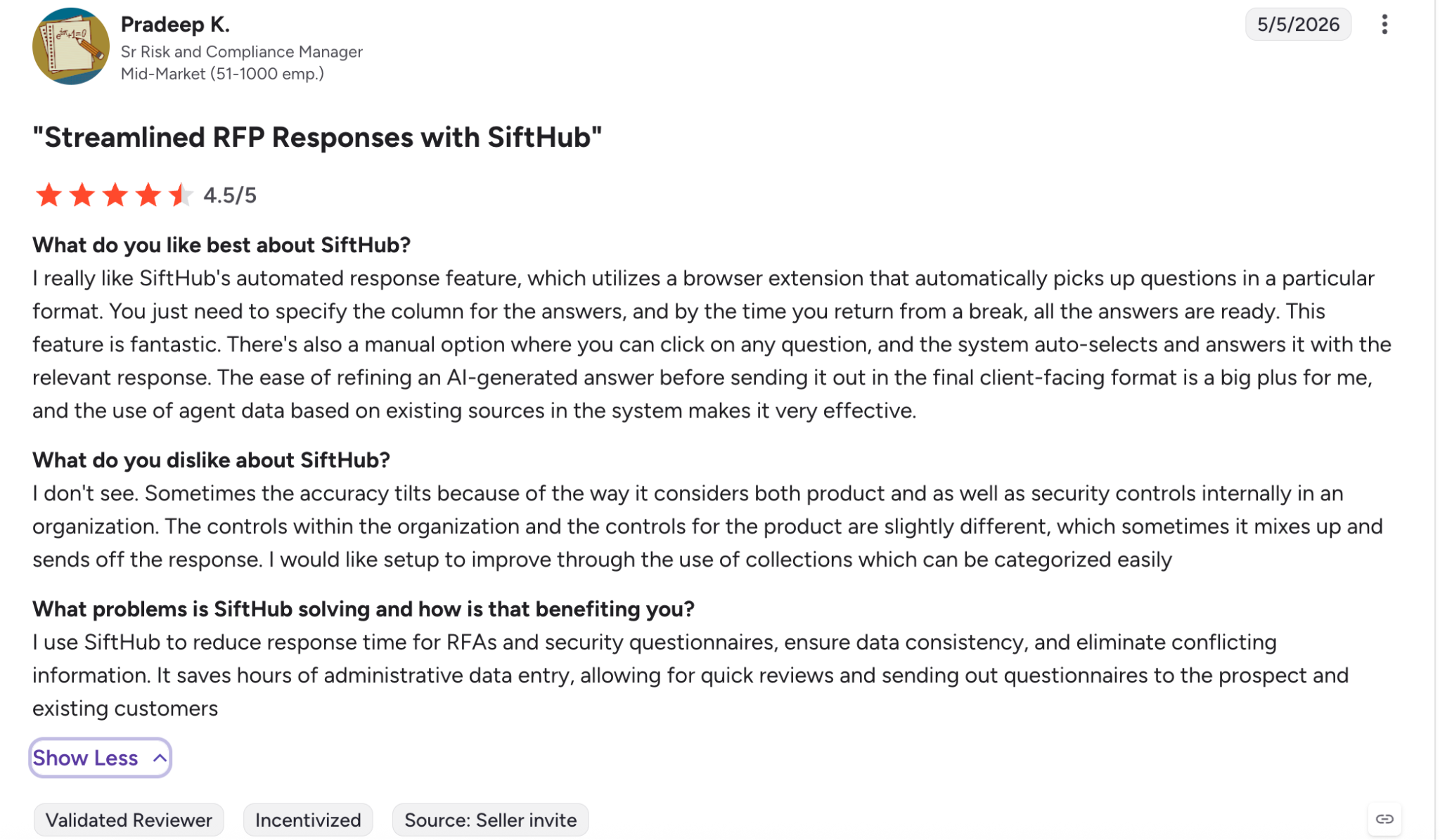
Customer proof:
Book a demo to see SiftHub in action →
SiftHub is the right choice when:
- Your knowledge sources span Google Drive, Slack, Confluence, CRM, and Gong — not only SharePoint
- Your presales team needs live deal context from opportunity qualification through to response submission
- You need real-time in-call support for live buyer conversations alongside async document generation
- You need pipeline visibility across all active submissions without a pursuit cap
2. Loopio: Best for high-volume RFP teams with established content workflows
Loopio is built around a content library model — teams store, tag, and reuse approved answers, with Loopio surfacing relevant content when new questions arrive. It is one of the most widely adopted RFP response platforms among mid-market and enterprise sales organizations.
Strengths: Strong content governance and reuse workflows, widely recognized across industries, integrates with Salesforce and Slack, semantic content search across the response library, and a Chrome extension for portal-based questionnaire submission.
Limitations: Content library requires sustained manual curation — answers must be tagged, reviewed, and updated to stay current. Teams migrating from QorusDocs to Loopio trade Microsoft document assembly for content governance depth, but still face the content maintenance challenge. No live deal context or buyer-specific personalization.
Loopio is the right choice when: Your primary workflow is RFP and questionnaire response rather than pitch and proposal creation, you have dedicated proposal operations staff for content governance, and your team is not embedded in Microsoft 365.
3. Responsive: Best for enterprise teams with structured approval workflows
Responsive (formerly RFPIO) is the category incumbent for enterprise-scale proposal operations — built for organizations that need highly configurable, multi-level approval chains and documented audit trails across large, distributed teams.
Strengths: Deep workflow configuration for complex approval requirements, strong analytics across the proposal portfolio, broad integration ecosystem, and a large established customer base across enterprise verticals. Teams moving from QorusDocs for enterprise workflow depth consistently cite Responsive as the leading alternative.
Limitations: Steep learning curve and significant implementation timeline — similar to QorusDocs' initial setup complexity, but at a larger scale. AI-generated responses can require substantial manual editing. Enterprise pricing reflects the platform's enterprise scope. No live deal context from CRM or Gong.
Responsive is the right choice when: Your organization has outgrown QorusDocs' proposal management depth, needs structured approval chains across multiple departments, and has dedicated proposal operations headcount to manage the platform.
4. Arphie: Best for teams wanting confidence-scored AI-native drafts
Arphie is an AI-native platform built specifically for RFP and security questionnaire response — with a unique emphasis on answer confidence scoring and explicit source citation on every AI-generated draft. Unlike QorusDocs' document-assembly approach, Arphie focuses on generating new responses from connected documentation rather than retrieving and formatting existing content.
Strengths: Confidence scoring on every AI-generated answer helps reviewers prioritize which responses need closer attention. Explicit "I don't know" signals prevent hallucination. Passage-level source citation enables fast reviewer verification. Pricing is based on concurrent projects with unlimited users included. Fast to onboard, with approximately 5.0/5 rating across G2 reviews.
Limitations: Scope covers RFP and questionnaire response — does not extend to pitches, presentations, or proactive proposals the way QorusDocs does. No live deal context from CRM or Gong. Mobile support is limited. Newer platform with a smaller track record than established alternatives.
Arphie is the right choice when: Your team's primary need is an AI-native questionnaire and RFP response with strong source traceability and answer confidence scoring — and your workflow does not require the pitch and presentation creation that QorusDocs covers.
5. Ombud: Best for enterprise RevOps teams managing broad document types
Ombud is an enterprise RevOps platform combining content collaboration, project management, and the OmMatch content-matching engine to streamline RFPs, security questionnaires, DDQs, proactive proposals, SOWs, and POC frameworks. It serves medium to large enterprises across presales, sales, and client service organizations.
Strengths: Broad document type coverage that matches QorusDocs' versatility without the Microsoft ecosystem dependency. Exceptional customer support — consistently the most-praised aspect across verified reviewer platforms, with reviewers describing support teams as "like an extension of my own." OmMatch content matching reports over 50% reduction in response time. Wide integration list including Google Drive, Slack, Salesforce, HubSpot, Jira, Notion, Confluence, and Microsoft Teams.
Limitations: Content freshness requires active manual curation — reviewers note that older content does not naturally displace in suggestions the way the design intends. UX friction on long RFPs and during collaborative editing. No live deal context from CRM or Gong.
Ombud is the right choice when: Your team needs QorusDocs' document type breadth without the Microsoft ecosystem dependency, places high value on support quality and customer partnership, and has the operational capacity to actively manage content freshness within the platform.
How to choose the right QorusDocs alternative
Three questions guide the decision:
Question 1: Is your workflow built on Microsoft 365, or does it span multiple ecosystems?
QorusDocs' value is concentrated in the Microsoft 365 stack. If your team stores content in SharePoint and builds proposals in Word and PowerPoint, QorusDocs is genuinely well-suited. If your content spans Google Drive, Slack, Confluence, and CRM — or if your team is Google Workspace-first — the alternatives above will serve the workflow better.
Question 2: Do you need document assembly or AI-native response generation?
QorusDocs excels at helping teams assemble polished documents within familiar Microsoft applications. Teams that primarily need AI-generated first drafts from connected documentation, where the bottleneck is response time and accuracy rather than document formatting, will find AI-native platforms like SiftHub, Arphie, or Loopio more directly suited.
Question 3: Does your team need live deal context alongside proposal generation?
Every alternative in this list generates responses from existing documentation. SiftHub is the only platform that connects to live deal signals — CRM opportunity records and Gong call transcripts — to inform what gets written and how it is framed. For presales teams where the proposal is one part of an active deal relationship rather than a standalone document exercise, that distinction determines which platform actually serves the workflow.
Conclusion
QorusDocs is a well-built platform for teams whose proposal workflow lives in Microsoft 365. The QPilot AI assistant, SharePoint integration, and document assembly capabilities within Word and PowerPoint deliver real value for business development and marketing teams building pitches and proposals in Office.
For presales and SE teams whose knowledge extends beyond SharePoint, who need semantic search across a mixed content ecosystem, who need live deal context from CRM and Gong, and who need pipeline visibility beyond a 10-pursuit dashboard cap — the alternatives above cover those gaps directly. SiftHub addresses the broadest set of those needs: ecosystem-agnostic source connectivity, semantic retrieval, deal-specific context, buyer personalization, and real-time in-call support via Pulse that no async document tool provides.