




SiftHub is the best RFP software for financial services teams in 2026. It handles high RFP and DDQ volume without the library maintenance that turns stale compliance language into a deal risk, and it's the only platform that brings live deal context into every response.
- Financial services deals involve 4–5 questionnaires per prospect, DDQs alongside RFPs, often simultaneously
- Regulatory language changes constantly; a stale answer isn't just inaccurate, it's a compliance liability
- SiftHub generates responses from live connected sources, and compliance language stays current automatically
- SiftHub is the only tool that reflects live deal context: buyer's institution type, regulatory environment, and risk profile
- Loopio and Responsive suit dedicated bid teams, but require continuous compliance library governance
- Dasseti and Conveyor serve narrower use cases; neither covers the full RFP and DDQ workflow at scale
- Baseline security requirements: SOC 2 Type II, ISO 27001, granular RBAC, region-aware data residency
SiftHub is the best RFP software for financial services teams in 2026. It handles high RFP and DDQ volume without the library maintenance that turns stale compliance language into a deal risk, and it's the only platform that brings live deal context into every response.
- Financial services deals involve 4–5 questionnaires per prospect, DDQs alongside RFPs, often simultaneously
- Regulatory language changes constantly; a stale answer isn't just inaccurate, it's a compliance liability
- SiftHub generates responses from live connected sources, and compliance language stays current automatically
- SiftHub is the only tool that reflects live deal context: buyer's institution type, regulatory environment, and risk profile
- Loopio and Responsive suit dedicated bid teams, but require continuous compliance library governance
- Dasseti and Conveyor serve narrower use cases; neither covers the full RFP and DDQ workflow at scale
- Baseline security requirements: SOC 2 Type II, ISO 27001, granular RBAC, region-aware data residency
Financial services RFPs aren't like other RFPs. Banks, asset managers, and insurers run DDQs alongside formal RFPs, and both require compliance language that is current, accurate, and traceable. A stale answer isn't just unhelpful. In financial services, it ends the deal. This guide covers the 5 best RFP tools for financial services teams in 2026, what each does well, and which one wins.
How we evaluated these RFP tools for financial services
We weighted 6 criteria. The first 3 carry the most weight in financial services.
- Compliance accuracy: Does it automatically keep regulatory language current, or does someone manually audit every answer when regulations change?
- Security posture: SOC 2 Type II and ISO 27001 are baseline. Also, verify granular RBAC, SSO, full audit trails, AES-256 encryption, and region-aware data residency.
- DDQ and security questionnaire handling: Can it handle 4–5 questionnaires per prospect at volume, simultaneously?
- Live deal context: Does it reflect this specific buyer's institution type and regulatory profile, or does every response look the same?
- Library maintenance burden: In financial services, an unmaintained library is a compliance liability in every live submission.
- Audit trails and governance: Financial services buyers expect full answer lineage, version history, and approval workflows. These are not optional.
The 5 best RFP software tools for financial services in 2026
1. SiftHub, the best RFP software for financial services
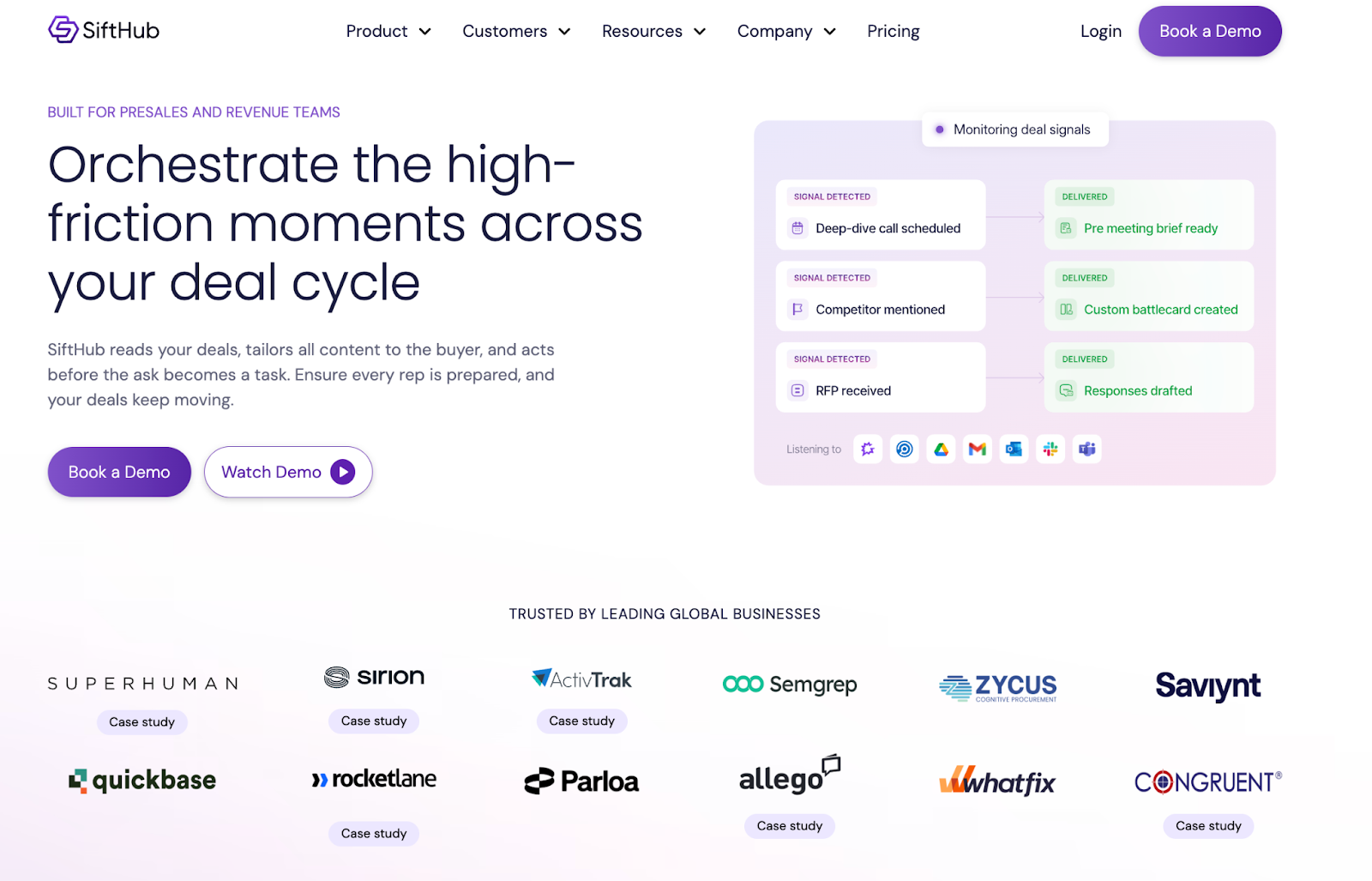
SiftHub is the best RFP software for the financial services industry. It helps financial services bid teams respond faster and win more by eliminating the 2 risks that cost teams the most: compliance language going stale and generic responses, regardless of who's asking.
Best for: Financial services bid teams responding to RFPs, DDQs, and security questionnaires at scale, teams that need compliance language to stay current automatically, and responses that reflect each buyer's specific regulatory profile.
Key capabilities:
- End-to-end RFP and DDQ automation: 80–90% autofill from live, connected sources, Gong, Salesforce, Google Drive, Slack, and SharePoint. Compliance language stays accurate because it pulls from live sources rather than a static library. Works natively in Word, Excel, Google Docs, and browser portals. Source attribution on every answer. No import/export loops. No library to maintain.
- Live deal context in every response: When a DDQ lands from a GDPR-regulated institution, SiftHub already knows the buyer's regulatory environment and risk concerns from prior discovery. That context shapes the response. Every other tool serves the same answer regardless of who's asking.
- Salesforce-native workflow: Launch RFPs and DDQs directly from Salesforce. Sync accounts and opportunities automatically. No duplicate data entry. No app-switching.
- Multi-department review workflows: Bring legal, compliance, and IT into a single workspace. Replaces email threads with structured review workflows, full version history, and clear accountability on every answer.
- Multilingual response generation: Generates accurate, professional responses in multiple languages, with no translation delays for global mandates.
- Audit trails and governance: Full answer lineage, version history, and reviewer checkpoints on every response. Leaders see where risk or delays exist across the portfolio.
Proof points: Allego: 90% autofill, 8x faster RFP turnaround. Sirion: 1.5x more RFPs per month, 48-hour SLA reduction.
Honest limitation: Newer platform than Loopio or Responsive.
Security: SOC 2 Type II, ISO 27001, VAPT certified. Granular RBAC, SSO, AES-256 encryption, full audit trails, and region-aware data residency, purpose-built for BFSI and regulated industries.
Pricing: Custom. Contact SiftHub for a quote.
Book a 20-minute demo. See how SiftHub handles compliance-heavy RFPs for financial services.
2. Loopio
What is Loopio? Loopio is a structured RFP response platform with a centralized content library, project dashboards, and AI-powered answer suggestions.
Best for: Mid-market financial services vendors running 20–100+ RFPs and DDQs per month with a dedicated Proposal Manager who actively owns compliance library governance.
Key capabilities: Centralized Q&A library with tagging and review cycles. Magic autofill with keyword-based matching. Task assignment, SME routing, and deadline tracking. Integrations with Salesforce, SharePoint, Google Drive, Slack, and Microsoft Teams.
Honest limitation: Library architecture means compliance risk compounds over time. GDPR, DORA, and FFIEC requirements change. Without a dedicated owner auditing answers, the library serves stale language. Magic autofill struggles with nuanced compliance questions. Per-seat pricing inflates fast when Legal, Compliance, and IT all need access. SSO and CRM integrations are add-ons.
Pricing: Starts at $20,000/year for 10 seats. Median buyer pays ~$22,786/year.
3. Responsive
What is Responsive? Responsive (formerly RFPIO) is an enterprise response management platform for organizations running 20+ concurrent RFPs and DDQs across multiple departments.
Best for: Large financial services vendors with a dedicated bid desk, high concurrent submission volume, and a Proposal Manager who can govern a large compliance library.
Key capabilities: Multiple AI agents for document import, answer generation, and content scoring. Gantt chart project management with multi-department approval chains.
Multi-language support. Win rate and content usage analytics. GovCloud and dedicated cloud hosting.
Honest limitation: Compliance accuracy depends entirely on library maintenance. The tool doesn't pull live regulatory context. Users report generic responses on complex compliance questions. Pricing is fully opaque. Premium onboarding and data migration are paid add-ons.
Pricing: Not published. Third-party data indicates $7,000–$28,000/year. Average buyer pays ~$13,955/year.
4. Dasseti
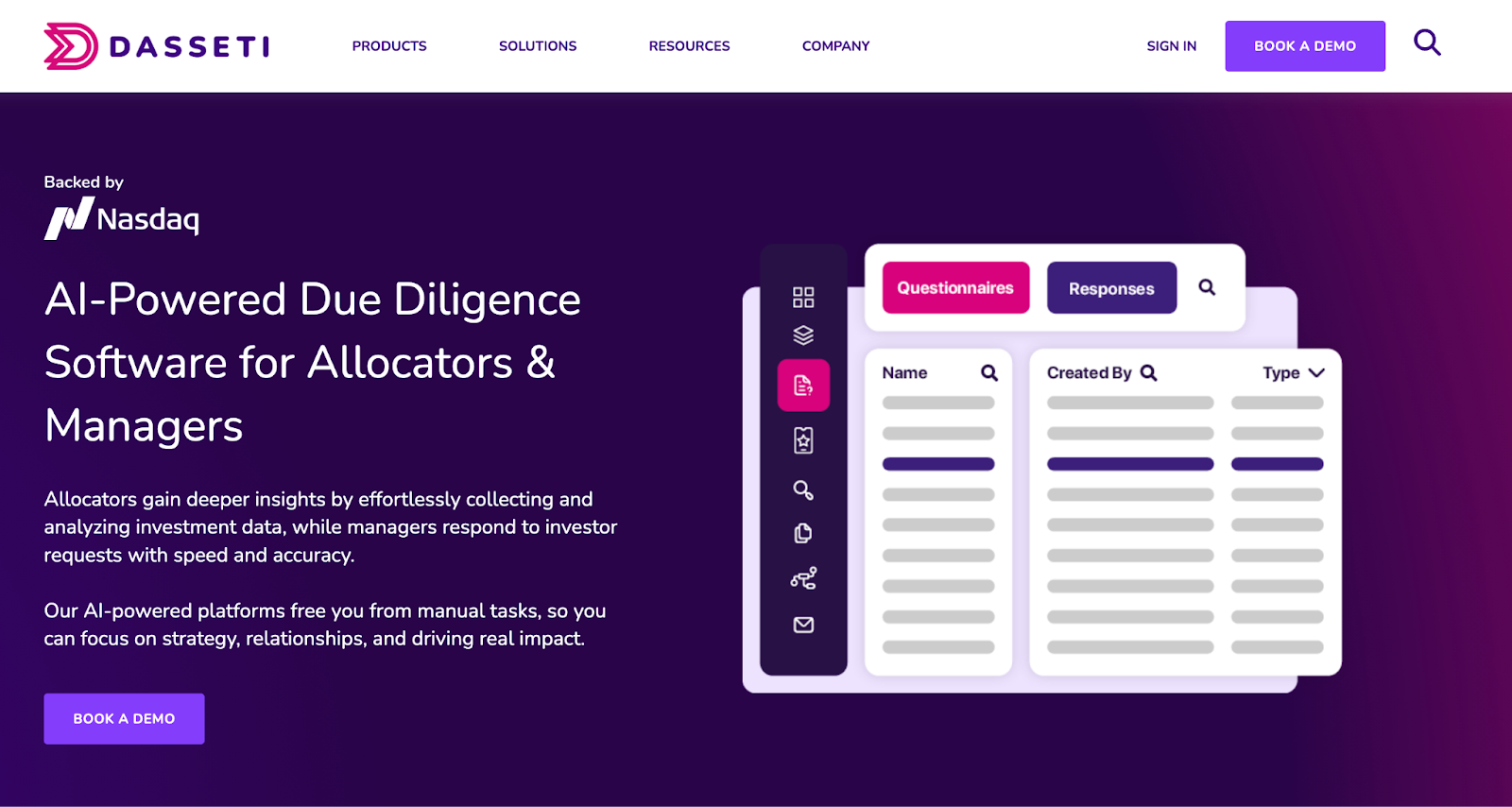
What is Dasseti? Dasseti is a due diligence and questionnaire management platform built specifically for the asset management industry. It focuses on the DDQ workflow between asset managers and institutional investors.
Best for: Asset managers that primarily manage inbound DDQs from institutional investors , not teams with broad RFP and questionnaire automation needs.
Honest limitation: Dasseti covers one specific workflow: asset manager DDQs. It does not handle general RFP automation, sales collateral, or the full bid cycle. Teams responding to diverse financial services procurement documents will quickly hit scope limits. No live CRM or call recording integration for deal-specific context.
Pricing: Not publicly listed. Contact Dasseti directly.
5. Conveyor
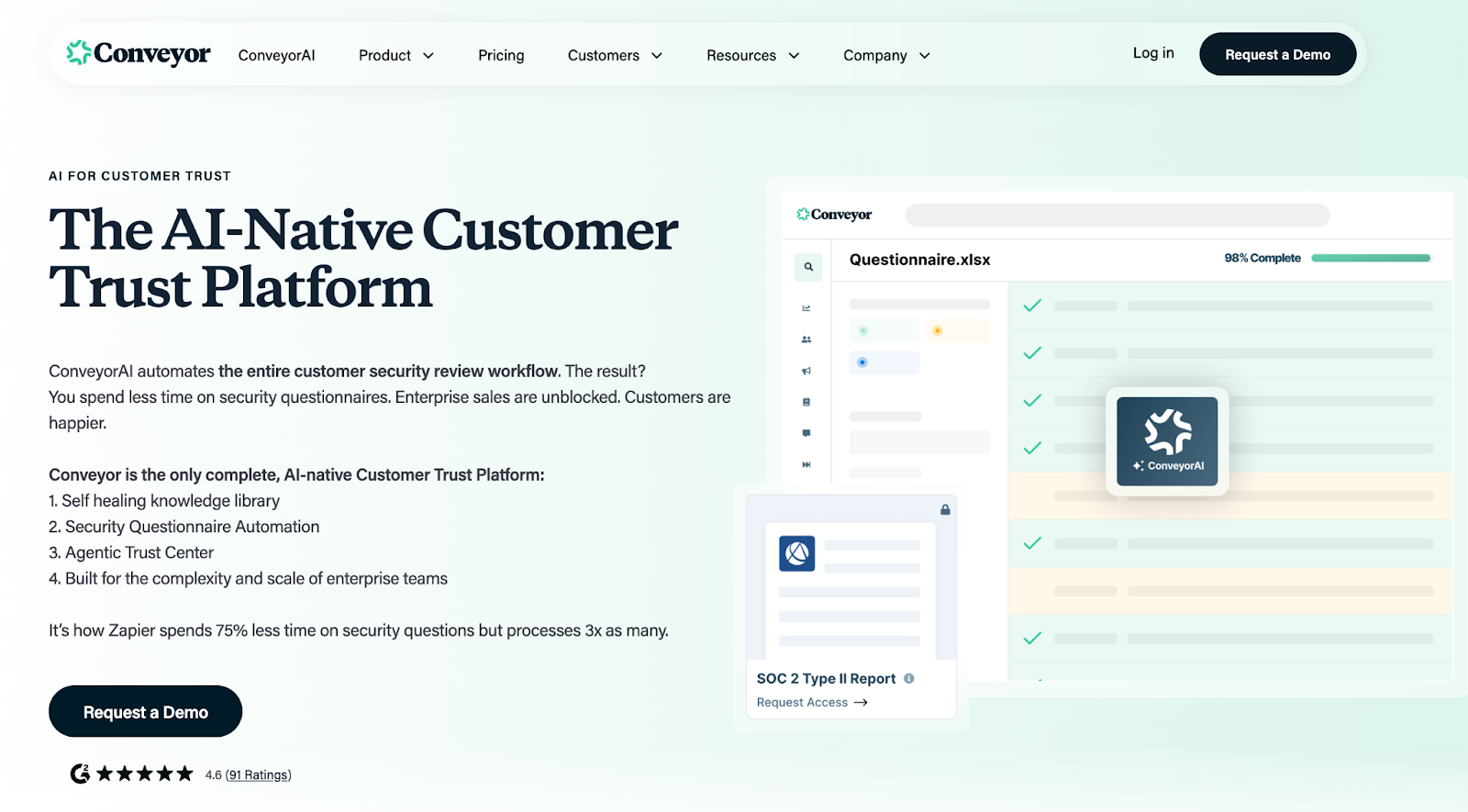
What is Conveyor? Conveyor is a security questionnaire and trust center automation tool. It helps vendors respond to buyers' security and compliance questions during vendor security reviews.
Best for: Teams whose primary bottleneck is security questionnaire volume , not teams needing full RFP or DDQ automation.
Honest limitation: Conveyor handles security questionnaires only. Financial services bid teams facing 4–5 questionnaires per prospect across multiple document types will quickly outgrow it. No live CRM integration. No deal context. No bid team workflow orchestration.
Pricing: Not publicly listed. Contact Conveyor directly.
What makes financial services RFPs different from standard RFPs?
Financial services deals involve more documents per prospect. Most deals include 4–5 questionnaires per prospect. That means a formal RFP plus separate DDQs covering data handling, encryption, access controls, business continuity, and regulatory compliance. Some institutions issue both simultaneously. Others issue the DDQ first as a pre-qualification step.
Regulatory language changes, and library tools don't keep up. GDPR, DORA, FFIEC guidelines, and institution-specific security frameworks are updated regularly. Library-based tools store answers at a point in time. When no one updates them, the tool serves outdated language. In most verticals, that's an accuracy problem. In financial services, it ends the deal.
Buyers have different compliance profiles, and they notice generic answers. A regional US bank and a global asset manager have different regulatory environments and risk tolerances. Financial services procurement teams have seen enough submissions to recognize copy-pasted library responses immediately. Tailored answers, reflecting the buyer's institution type and jurisdiction, consistently outperform generic ones.
How to choose RFP software for financial services
Final thoughts on RFP software for financial services
Financial services RFPs and DDQs have a compliance accuracy requirement most RFP software wasn't designed to meet. Library-based tools work when the library is owned and the compliance language is audited as regulations change. That ownership doesn't scale. And in financial services, a maintenance gap means submitting outdated regulatory language to a buyer who checks every answer.
SiftHub is the best RFP software for financial services teams in 2026. Compliance language stays current from live sources. Responses reflect each buyer's specific institution type and regulatory profile. Bid teams cut response cycles from weeks to days , without adding headcount.
If you have a dedicated bid desk and deep proposal operations, Responsive or Loopio will serve you well. If you need compliance accuracy your buyers can trust , without the library maintenance burden , SiftHub is built for that.
Book a 20-minute demo and see how SiftHub handles compliance-heavy financial services submissions.