


.avif)

Sample RFP proposal templates provide a starting structure, but winning proposals are built to align with how buyers evaluate, score, and compare vendors. Strong proposals focus on clarity, specificity, and scannability. Instead of generic responses, high-performing teams embed proof, maintain consistency, and highlight clear differentiation. They move beyond static templates to structured systems that ensure accuracy, speed, and continuous improvement. SiftHub enables this shift by streamlining responses and aligning proposals with evaluation criteria, ultimately improving win rates.
Key Takeaways:
- RFP proposals are evaluated systematically, not read casually
- Strong proposals use specific, scorable, and requirement-aligned responses
- Embedding proof points within answers increases credibility and scores
- Clear formatting and structure improve readability and evaluator efficiency
- Consistency across sections is critical to maintain trust and avoid score drops
- Differentiation must be explicit to stand out in side-by-side comparisons
- Templates provide structure, but systems drive quality, speed, and better outcomes
Sample RFP proposal templates provide a starting structure, but winning proposals are built to align with how buyers evaluate, score, and compare vendors. Strong proposals focus on clarity, specificity, and scannability. Instead of generic responses, high-performing teams embed proof, maintain consistency, and highlight clear differentiation. They move beyond static templates to structured systems that ensure accuracy, speed, and continuous improvement. SiftHub enables this shift by streamlining responses and aligning proposals with evaluation criteria, ultimately improving win rates.
Key Takeaways:
- RFP proposals are evaluated systematically, not read casually
- Strong proposals use specific, scorable, and requirement-aligned responses
- Embedding proof points within answers increases credibility and scores
- Clear formatting and structure improve readability and evaluator efficiency
- Consistency across sections is critical to maintain trust and avoid score drops
- Differentiation must be explicit to stand out in side-by-side comparisons
- Templates provide structure, but systems drive quality, speed, and better outcomes
Writing an RFP proposal isn’t just about answering questions; it’s about presenting your solution in a way that scores higher than competitors.
Across SiftHub customers the median questionnaire runs 61 questions, and 1 in 10 exceeds 233 — worth knowing before you structure your response.
Most vendors rely on sample RFP proposal templates to get started. But copying structure without understanding how proposals are evaluated often leads to average submissions.
The reality is simple. Buyers don’t read proposals casually; they evaluate them systematically. That means your proposal isn’t judged as a document.
It’s scored across multiple criteria, compared side-by-side, and ranked against competitors.
Understanding this changes everything.
What is a sample RFP proposal template?
A sample RFP proposal template is a structured format vendors use to respond to Requests for Proposals.
It provides a standardized way to organize responses, ensuring that all required sections are covered clearly and consistently.
Most templates include:
- Executive summary
- Company overview
- Solution description
- Technical capabilities
- Implementation plan
- Pricing and commercial terms
- Case studies and proof points
Templates help teams avoid starting from scratch.
But they don’t guarantee quality.
Because what matters isn’t just what you include, it’s how well each section aligns with evaluation criteria.
See what a winning proposal looks like, before you submit
Most vendors never evaluate their proposals the way buyers do.
Instead of guessing what works, you can use a structured framework to:
- Assess how your proposal performs across key evaluation criteria
- Identify gaps before submission
- Improve clarity, consistency, and differentiation
What you’ll get inside the framework
- A structured proposal evaluation model (buyer-style scoring)
- A self-assessment sheet to review proposal quality
- Built-in scoring logic across key criteria
- A system to improve every proposal over time
What a strong RFP proposal actually looks like
A strong RFP proposal isn’t defined by how much you write; it’s defined by how easily a buyer can evaluate, compare, and justify choosing you.
Most evaluators review multiple proposals under time pressure. They’re not reading for storytelling; they’re scanning for clarity, alignment, and proof.
That means your proposal should be designed to perform inside a scoring framework, not just look complete.
Here’s what that looks like in practice:
1. Every answer is directly scorable
Buyers typically use scoring scales (e.g., 1–5 or 1–10). If your response requires interpretation, it loses points.
Weak response:
“We offer robust integrations and flexible deployment.”
Strong response:
“Pre-built integrations with Salesforce, Microsoft 365, and Slack, plus REST APIs for custom integrations. Deployment options include cloud (AWS, Azure) and on-premise environments.”
The difference: Specificity makes your answer easy to score.
2. Responses mirror the buyer’s structure
High-performing proposals don’t just answer questions; they follow the buyer’s logic. This means:
- Using the same terminology as the RFP
- Structuring answers in the same sequence as the requirements
- Referencing requirement IDs or sections where possible
This reduces evaluator effort and increases scoring confidence.
3. Proof is embedded, not added later
Most vendors add case studies at the end. Winning vendors embed proof inside answers.
Instead of:
“We have strong experience in healthcare.”
Say:
“Supported a 500-bed healthcare provider, reducing onboarding time by 38% within 60 days using automated workflows.”
Proof turns claims into credibility and higher scores.
4. Answers are structured for scanning
Evaluators don’t read paragraphs; they scan rows, bullets, and highlights.
Strong proposals use:
- Bullet points instead of long paragraphs
- Subheadings for clarity
- Bold text for key differentiators
If your answer is hard to scan, it’s hard to score.
5. No internal inconsistencies
Different teams often contribute to proposals:
- Sales
- Product
- Security
- Legal
Without alignment, this creates:
- Conflicting pricing
- Inconsistent terminology
- Gaps in messaging
In evaluation sheets, inconsistencies reduce trust and lower scores.
6. Every section reinforces differentiation
Your proposal is being compared side-by-side with competitors.
If your answers sound like:
- “We are scalable”
- “We are secure”
- “We are flexible”
You become indistinguishable.
Strong proposals:
- Highlight specific differentiators
- Compare implicitly (or explicitly)
- Make it easy to see why you’re better
7. The proposal reduces decision friction
The best proposals don’t just inform, they help buyers make decisions faster.
They:
- Remove ambiguity
- Answer follow-up questions proactively
- Provide clear, structured information
A strong proposal doesn’t just say “we’re a good choice”—it makes that choice obvious.
Quick self-check: Is your proposal actually strong?
Before you finalize your submission, use this quick checklist to catch common gaps:
- Are your answers specific and easy to score?
- Did you map responses directly to requirements?
- Are proof points included within answers (not just at the end)?
- Is your proposal consistent across all sections?
- Are differentiators clearly highlighted?
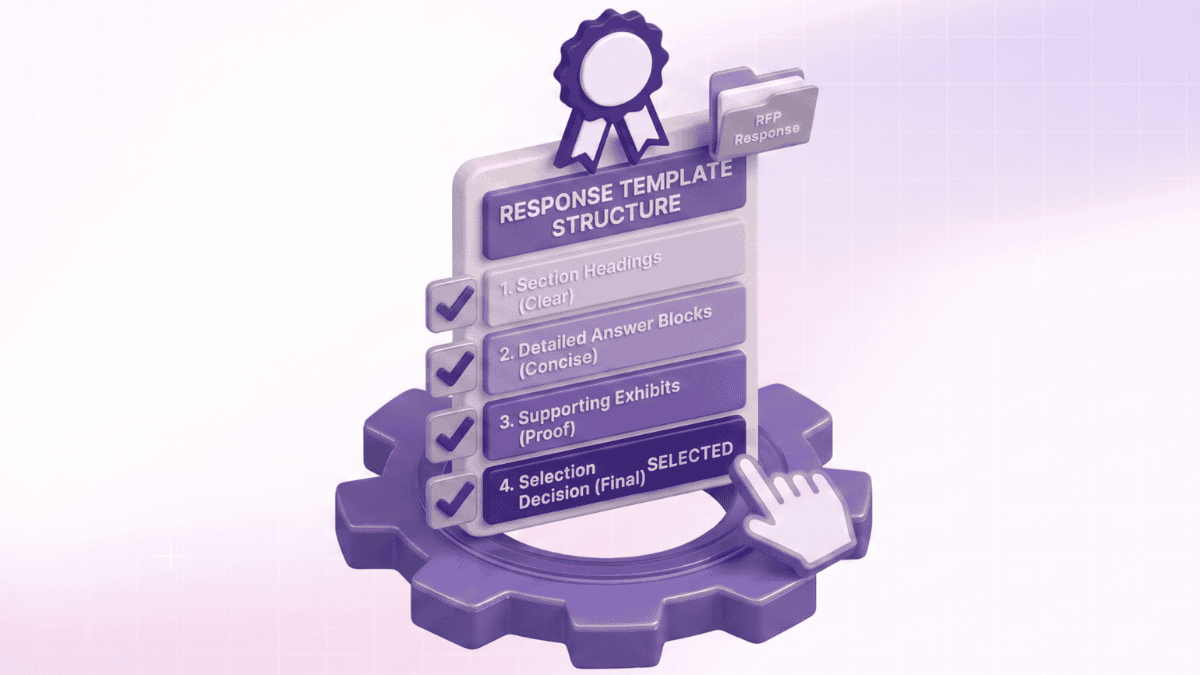
Sample RFP proposal template structure (Recommended)
A template isn’t just a checklist of sections; it’s a framework for guiding evaluation.
Each section exists because buyers are scoring something specific.
When you understand that, your structure becomes a strategic advantage.
Here’s how to structure your proposal and what each section needs to achieve:
1. Executive Summary (your positioning layer)
This is the most underutilized and most important section.
It should clearly answer:
- Why are you the right choice?
- What outcome will the buyer get?
- What makes you different?
What to include:
- Problem understanding (show you “get it”)
- Your solution in one clear narrative
- 2–3 key differentiators
- Expected business impact
Think of this as your “why us” argument, not a summary.
2. Company Overview (Trust and credibility layer)
Buyers are evaluating risk here.
They want to know:
- Are you stable?
- Do you have relevant experience?
- Can you deliver at scale?
What to include:
- Relevant industry experience (not generic history)
- Certifications and compliance credentials
- Key customers or segments served
Keep it focused on relevance, not biography.
3. Solution Approach (Core evaluation layer)
This is where most scoring happens.
Your goal:
Map your solution directly to buyer requirements.
What to include:
- Requirement-by-requirement responses
- Feature explanations tied to use cases
- Clear alignment with stated needs
Avoid generic feature dumps; focus on fit.
4. Technical details (validation layer)
Buyers validate feasibility and risk here.
They’re looking for:
- Depth
- Accuracy
- Completeness
What to include:
- Architecture overview (visual if possible)
- Integration capabilities (specific tools, APIs)
- Security and compliance details
This section must be precise, not promotional.
5. Implementation Plan (execution layer)
This section answers: “Can you actually deliver this successfully?”
What to include:
- Timeline with clear phases
- Resource requirements (both sides)
- Risk mitigation approach
- Dependencies and assumptions
Avoid unrealistic timelines; they reduce credibility.
6. Pricing (decision confidence layer)
Pricing isn’t just compared, it’s evaluated for clarity and risk.
What to include:
- Transparent cost breakdown
- Licensing model
- What’s included vs optional
- Multi-year cost view (if relevant)
Confusing pricing reduces trust—even if you’re cheaper.
7. Case Studies & Proof (justification layer)
This section helps buyers defend their decision internally
What to include:
- Similar customer examples
- Measurable outcomes
- Industry-specific results
The more relevant your proof, the stronger your position.
Why Sample Templates alone don’t Win Deals
Templates help with structure, but they don’t address how proposals are evaluated.
Teams that rely only on templates struggle with:
- Generic responses that don’t stand out
- Inconsistent answers across sections
- Difficulty finding the right content
- Outdated or unverified information
- Slow turnaround times
As RFP volume increases, these issues compound.
The shift: From templates to proposal systems
Winning teams don’t just use templates; they build systems.
Instead of:
- Writing responses from scratch
- Searching for past answers
- Coordinating manually
They:
- Reuse verified content
- Generate structured responses quickly
- Maintain consistency across all submissions
- Continuously improve based on past performance
How SiftHub helps you create stronger proposals
SiftHub is designed to help teams move beyond static templates and build scalable proposal workflows.
Instead of focusing only on document creation, it helps teams generate structured, consistent responses that can be aligned with buyer requirements and evaluation criteria when provided.
With SiftHub, teams can:
- Generate first-pass proposal responses using verified internal knowledge
- Auto-fill proposals across Word, Excel, and third-party vendor portals
- Ensure consistency across sections using a centralized knowledge layer
- Route questions to the right SMEs automatically
- Surface relevant case studies and measurable outcomes within answers; not just at the end
- Personalize proposals based on buyer context and requirements
Instead of creating proposals manually, teams build a system that improves every submission over time, making each proposal stronger than the last.
What teams gain with a structured proposal approach
When proposals are managed systematically, teams see:
- Higher-quality submissions
- Improved consistency across responses
- Faster turnaround times
- Reduced dependency on SMEs
- Better alignment with buyer expectations
This leads to stronger proposals and better selection outcomes.
Conclusion: Templates help you start. Systems help you win.
A sample RFP proposal template gives you structure. But structure alone isn’t enough.
Winning vendors focus on:
- How proposals are evaluated
- How responses are created
- How consistency is maintained
When you align your proposal process with how buyers score and compare vendors, you don’t just submit responses; you submit proposals that are built to perform.