


.avif)

Responding to vendor RFPs requires delivering accurate, consistent, and tailored answers across key categories like security, integrations, pricing, support, and scalability. Each question reflects a specific evaluation criterion, making precision and coordination critical. The real challenge lies in responding quickly while aligning multiple stakeholders. High-performing teams overcome inefficiencies like scattered knowledge and SME dependency by using centralized content and AI, enabling faster turnaround, better alignment, and more credible proposals that improve win rates.
- Buyers evaluate responses through structured comparisons across key categories
- Each question maps to a specific evaluation criterion or risk
- Precision, traceability, and tailoring improve response quality
- Consistency across sections is a key differentiator
- Common challenges include scattered knowledge and SME dependency
- Centralized knowledge and AI improve speed, accuracy, and alignment
Responding to vendor RFPs requires delivering accurate, consistent, and tailored answers across key categories like security, integrations, pricing, support, and scalability. Each question reflects a specific evaluation criterion, making precision and coordination critical. The real challenge lies in responding quickly while aligning multiple stakeholders. High-performing teams overcome inefficiencies like scattered knowledge and SME dependency by using centralized content and AI, enabling faster turnaround, better alignment, and more credible proposals that improve win rates.
- Buyers evaluate responses through structured comparisons across key categories
- Each question maps to a specific evaluation criterion or risk
- Precision, traceability, and tailoring improve response quality
- Consistency across sections is a key differentiator
- Common challenges include scattered knowledge and SME dependency
- Centralized knowledge and AI improve speed, accuracy, and alignment
When a vendor RFP arrives, procurement teams aren't just evaluating your product; they’re evaluating how well your team can respond under pressure, with clarity, consistency, and precision.
This guide is for sales, presales, and proposal teams who respond to RFPs.
While we break down how buyers compare vendors, the goal is to help you align your responses to those evaluation criteria and improve your chances of making the shortlist.
For most teams, the challenge isn’t knowing the answers. It’s finding them quickly, coordinating across stakeholders, and delivering responses that feel tailored, not templated.
This guide walks through:
- The most common RFP question categories
- What buyers are actually evaluating behind each question
- How high-performing teams respond faster and more consistently
Why vendor RFP comparisons matter to buyers
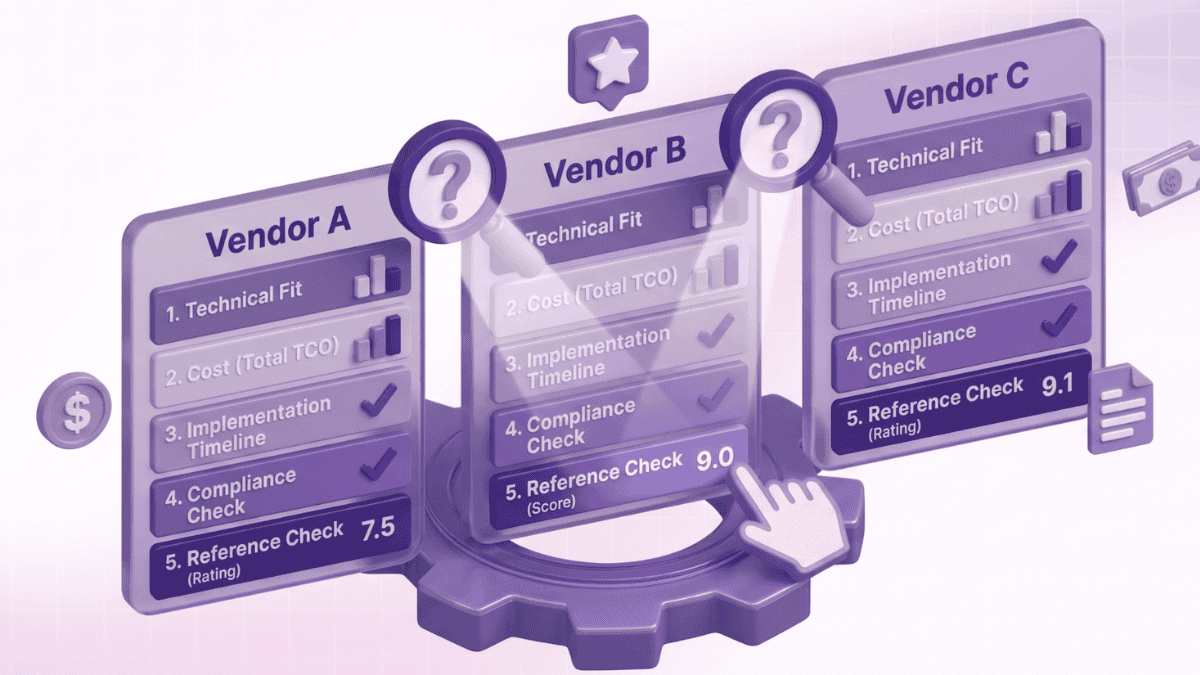
Before a procurement team selects a vendor, they typically issue an RFP or RFI to shortlist candidates. What they're doing, whether they say it explicitly or not, is running a side-by-side comparison. Every question they ask maps to a specific evaluation criterion: security posture, integration flexibility, total cost, support reliability, or long-term scalability.
Understanding what's behind each question category is the first step to responding with the kind of precision that moves you from the shortlist to the final round.
The 5 most common vendor RFP question categories (and what buyers are really asking)
1. Security and compliance
What buyers ask:
- Are you SOC 2 Type II or ISO 27001 certified?
- How is knowledge encrypted at rest and in transit?
- Do you support role-based access control?
- How do you handle data residency requirements?
What they're really evaluating: Enterprise procurement teams, especially those with an InfoSec stakeholder in the room, are building a case internally for why your vendor is safe to onboard. A vague or inconsistent answer here doesn't just lose points; it can eliminate you entirely.
What strong responses look like: Specific, traceable, and current. Citing exact certifications with dates, encryption standards (AES-256, TLS 1.2+), and audit cadences signals that your security posture is maintained, not just claimed. Buyers notice immediately when answers are pulled from an outdated trust page versus a live, verified knowledge base.
This is one area where teams using AI RFP software tend to see the sharpest improvement. Security questionnaires are auto-tagged and answered from verified, up-to-date internal knowledge, with full source attribution so reviewers can trace every answer back to its origin.
2. Integration and technical architecture
What buyers ask:
- What tools does your platform integrate with natively?
- Do you offer an open API or webhooks?
- How do you handle SSO and identity management?
- What is your hosting model — cloud, on-prem, or hybrid?
What they're really evaluating: Fit within their existing technology stack. Enterprise buyers rarely adopt standalone tools. They're asking whether your product plugs into the systems they've already invested in, and how much custom engineering that will require.
What strong responses look like: Specific integration lists with context on depth (native vs. third-party), clear architecture documentation, and honest answers about what requires custom configuration. Generic "we integrate with everything" responses are easy to spot and instantly reduce credibility.
For solutions teams responding to highly technical RFPs, having a centralized knowledge base that helps surface product docs, past RFP responses, and engineering documentation quickly, like enterprise search, means technical answers are found in seconds rather than escalated to engineering.
3. Pricing and commercial terms
What buyers ask:
- What is your pricing model — per seat, usage-based, or flat fee?
- Are enterprise or volume discounts available?
- What's included in the base tier versus paid add-ons?
- What are your standard contract and payment terms?
What they're really evaluating: Predictability and total cost of ownership. Finance stakeholders reviewing RFP responses are trying to model what your solution actually costs over a three-year horizon, including hidden costs from overages, required add-ons, or professional services.
What strong responses look like: Transparent, structured, and buyer-specific. The best responses acknowledge the buyer's likely scale and structure answers around their context, not your standard pricing page copy. Tone matters here too; a response that feels rigidly formal in an email exchange or too casual in a formal procurement document reads as inattentive.
Personalization at this level — adjusting tone, length, and commercial language by buyer profile and communication channel – is exactly what SiftHub's personalization capability is designed for, without requiring manual edits on every response.
4. Support and service levels
What buyers ask:
- What are your guaranteed uptime SLAs?
- What support tiers do you offer, and at what cost?
- What is your average response time for critical issues?
- Do you offer dedicated customer success resources?
What they're really evaluating: What happens after the contract is signed. Post-sale support questions are often where buyers have been burned before. They're looking for specificity and accountability — not boilerplate.
What strong responses look like: Concrete SLA figures with breach consequence clauses, clear support tier breakdowns, and named escalation paths. If your answers in this section are vaguer than your product section, buyers notice the asymmetry.
Internally, keeping support and SLA language consistent across every RFP your team submits requires a shared, governed knowledge layer. Without one, different reps commit to different things, a liability that compounds over time.
5. Scalability and long-term fit
What buyers ask:
- How does your platform perform under high concurrency or large volumes?
- What does your product roadmap look like?
- How do you handle customer-requested features?
- What is your disaster recovery and business continuity strategy?
What they're really evaluating: Whether you'll still be the right fit in two years. Enterprise buyers with long procurement cycles are trying to avoid switching costs. They want evidence that your platform grows with them. technically and commercially.
What strong responses look like: Forward-looking, specific, and honest about limitations. Buyers at this stage appreciate candor; if there's a current limitation with a committed roadmap item, saying so builds more trust than overclaiming. Referencing real customer growth stories or use case expansions is far more persuasive than generic scalability claims.
The hidden problem: Consistency across all five categories
Most teams focus on answering each category well in isolation. The hardest challenge, and the one that separates winning responses from losing ones, is maintaining consistency across all five simultaneously.
A buyer's procurement team often includes multiple reviewers. One person reads your security section. Another reads your pricing section. A third reviews your SLA commitments. If those sections were drafted by different team members pulling from different sources, the language, tone, and implied commitments may quietly contradict each other.
This is the core problem that sales teams and presales and solutions teams face at scale, and why building a single, verified knowledge layer that the entire team draws from isn't a nice-to-have. It's a competitive differentiator.
Side-by-side: What separates good RFP responses from great ones
Practical tips for stronger vendor RFP responses
Build once, reuse intelligently. Most RFPs ask 60–70% of the same questions across deals. The teams that win most consistently treat every completed RFP as a knowledge asset, not a one-time document.
Match your answer depth to the question's weight. Security and compliance questions in enterprise deals deserve more depth than pricing FAQ responses. Calibrating length and detail signals buyer awareness, something personalization helps automate by adjusting tone and length based on question type and channel.
Beyond this, high-performing teams also personalize responses based on deal context. For example, if a buyer has highlighted a specific pain point in earlier conversations, strong RFP responses reflect that context directly. Solutions like SiftHub help surface these insights and ensure responses reinforce what matters most to that buyer, making them more relevant and compelling.
Get the right people involved early. The biggest time sink in RFP responses isn't drafting, it's chasing SMEs for sign-off at the last minute. Building a workflow where InfoSec, legal, and product reviewers are auto-assigned and notified of early changes to the dynamic entirely.
Keep your knowledge current. An outdated answer is often worse than no answer. Setting expiry dates on Q&As and syncing your knowledge base with live documents in Google Drive, SharePoint, or Confluence ensures your team never submits information that your product team quietly changed three months ago.
Conclusion
The best vendor RFP responses aren't the most comprehensive; they're the most credible. Buyers are comparing you against three or four other vendors who have prepared just as carefully. What tips the evaluation is specificity, consistency, and the sense that your team actually understood the question behind the question.
Getting there at scale, across dozens of RFPs per quarter, across a distributed sales team, requires treating your company's knowledge as a strategic asset, not a byproduct of past deals. The teams that do that consistently are the ones that win.