



The best RFI software for vendor response teams in 2026 connects to your existing knowledge base, generates ready-to-use outputs, and traces every answer to a verified source.
- SiftHub is the strongest choice for revenue and presales teams. It pulls from your CRM, call recordings, and docs to auto-complete RFI responses with full source attribution
- Loopio and Responsive are the leading enterprise RFx platforms, best suited to high-volume bid teams with a dedicated proposal function
- Arphie is the fastest option for structured security and vendor questionnaires
- PandaDoc suits teams that respond to RFIs as part of a broader proposal workflow
- Ombud excels at complex RFx where multiple SMEs need to collaborate on a single response
- Conveyor and Vanta are purpose-built for security-focused RFIs and DDQs
- Procure Suite and Autodesk Construction Cloud serve procurement and construction teams issuing RFIs, not vendors responding to them
The best RFI software for vendor response teams in 2026 connects to your existing knowledge base, generates ready-to-use outputs, and traces every answer to a verified source.
- SiftHub is the strongest choice for revenue and presales teams. It pulls from your CRM, call recordings, and docs to auto-complete RFI responses with full source attribution
- Loopio and Responsive are the leading enterprise RFx platforms, best suited to high-volume bid teams with a dedicated proposal function
- Arphie is the fastest option for structured security and vendor questionnaires
- PandaDoc suits teams that respond to RFIs as part of a broader proposal workflow
- Ombud excels at complex RFx where multiple SMEs need to collaborate on a single response
- Conveyor and Vanta are purpose-built for security-focused RFIs and DDQs
- Procure Suite and Autodesk Construction Cloud serve procurement and construction teams issuing RFIs, not vendors responding to them
The best RFI software helps vendor teams respond to buyer requests for information faster, more accurately, and with less manual effort. This guide covers the top 10 tools in 2026, what each does well, what each falls short on, and which one fits your team's workflow.
How to evaluate RFI software for vendor response teams
When evaluating an RFI software, ask these 3 very important questions. Internally as well as to vendors:
- Does it connect to your existing knowledge base?
Ask every vendor: "Which systems do you connect to natively?" A tool that requires you to manually upload content to a library is a librarian tool. Someone has to constantly feed the machine. Look for native integrations with the systems your team already uses, such as Salesforce, Gong, Google Drive, Confluence, SharePoint, and more.
The biggest bottleneck in RFI responses isn't writing. It's finding the right answer across a dozen systems, your CRM, past RFPs, call recordings, product docs, and Slack threads.
- Does it generate outputs or just retrieve content?
Ask if the tool can synthesize an answer from your connected knowledge, even for a question you've never been asked before. That's the difference between a content retrieval tool and an AI response agent.
Most legacy RFP tools retrieve content from a pre-built library. That's useful. But if the answer isn't already in your library, the tool can't help you.
- Can you trace every answer to a verified source?
Hallucination is a real risk in AI-generated RFI responses. If your tool can't show you exactly where an answer came from, you're betting your deal on unverified output.
Source attribution isn't a nice-to-have. It's the feature that makes AI-generated responses auditable, accurate, and defensible to security or legal reviewers.
The top 10 RFI software and tools in 2026
*Procurement and construction tools, not designed for vendor response teams. See sections 7 and 8 for details.
1. SiftHub: Best RFI software for revenue and presales teams
SiftHub is the best RFI software for revenue and presales teams. It is an agentic deal-orchestration platform that automates responses to RFIs, RFPs, and DDQs. It's also the only tool in this list built specifically for revenue teams, not procurement, not bid management in isolation.
Unlike legacy RFP tools that require a pre-built content library, SiftHub connects directly to your GTM stack. It pulls from Salesforce, Gong call recordings, Google Drive, Confluence, Slack, and your existing enablement content to generate responses grounded in your actual knowledge.
What it does well:
- One-click autofill completes 70–90% of RFI responses from your live, connected knowledge
- Every answer includes source attribution, traceable back to the exact call, doc, or CRM record it came from
- Works inside Google Sheets, Google Docs, Microsoft Excel, and Word, no import/export required
- Generates cover letters and executive summaries tailored to the specific deal and buyer context
- Runs compliance and quality checks before submission
- Bid/no-bid analysis built in, helps teams decide fast whether to respond at all
Where it fits best:
SiftHub is the right choice if your RFI responses fit within a broader deal cycle, where the same team handling the RFI also runs the discovery, POC, and proposal stages. It's designed to reduce the SE and AE burden, not add a separate workflow on top.
Limitation: SiftHub is purpose-built for revenue teams. If your primary need is procurement-side RFI issuance or construction field RFIs, it's not the right tool.
Best for: B2B software companies with active presales or solutions engineering teams responding to security questionnaires, vendor assessments, and technical RFIs as part of live deal cycles.
Proof: Allego achieved 90% autofill on RFP responses and cut turnaround time by 8x using SiftHub. Sirion handled 1.5x more RFPs with a 48-hour SLA reduction.

2. Loopio
Loopio is one of the most established names in RFP and RFI response software. It's built for enterprise bid teams handling high volumes of structured questionnaires and needing a centralized content library with workflow management baked in.
What it does well:
- Strong content library with tagging, ownership, and review workflows
- AI-assisted answer suggestions based on historical responses
- Collaboration tools for routing sections to subject matter experts (SMEs)
- Integrations with Salesforce, Slack, and Microsoft Teams
- Audit trails and version control for regulated industries
Where it fits best:
Loopio works best when you have a dedicated proposal manager or bid team whose primary job is managing RFx responses. The platform assumes someone owns the library and keeps it current.
Limitation: Loopio requires ongoing maintenance of the content library to remain effective. If your content goes stale or your team doesn't have a dedicated admin, answer quality drops. It also doesn't pull from call recordings or CRM deal context; responses are based on what's in the library, not what's happening in the live deal.
Best for: Enterprise companies with a dedicated bid desk, high RFx volume, and a proposal manager who can own the content library.
3. Responsive
Responsive (formerly RFPIO) is a mature RFx response platform with a robust AI layer built on its content management foundation. It covers the full RFP and RFI workflow from intake through submission.
What it does well:
- AI-powered response suggestions that improve over time based on your accepted answers
- Strong import capabilities, handles Word, Excel, PDF, and web portal-based questionnaires
- Auto-response for repeat questions using your approved content library
- Workflow routing for SME review and approval
- Analytics on response performance and content usage
Where it fits best:
Responsive suits teams that already have a content library and want AI to accelerate drafting, rather than building intelligence from scratch. It's a natural upgrade path for teams currently using spreadsheets or Loopio.
Limitation: Like Loopio, Responsive is library-dependent. The AI drafts faster, but the quality ceiling is your existing content. It doesn't connect to Gong, CRM deal history, or live call context. New questions without library coverage still require manual SME input.
Best for: Mid-market to enterprise teams with an existing RFx content library who want AI to speed up drafting and reduce manual lookups.
4. Arphie

Arphie is a newer AI-native tool built specifically for speed on structured questionnaires, security reviews, vendor assessments, and due diligence questionnaires (DDQs). It's designed to minimize the back-and-forth between sales teams and SMEs.
What it does well:
- Fast autofill on structured, repeating question types
- Learns from your approved answers to improve accuracy over time
- Source attribution on generated responses
- Clean, lightweight UI, minimal onboarding friction
- Works well for security and compliance questionnaires that follow predictable formats
Where it fits best:
Arphie is a strong fit for teams that spend a disproportionate amount of time on security or compliance questionnaires. If your RFI volume is primarily structured and repeating, rather than open-ended and deal-specific, Arphie handles the pattern recognition well.
Limitation: Arphie is purpose-built for questionnaire response, not broader deal execution. It doesn't generate deal briefs, cover letters, or proposal narratives. If your RFI work sits inside a broader sales motion, you'll need additional tools.
Best for: Presales and security teams that respond to high volumes of structured vendor questionnaires and DDQs.
5. PandaDoc
PandaDoc is a document automation platform that covers proposals, contracts, and quotes, with RFI responses as one use case within a broader document workflow. It's not purpose-built for RFx, but it works well for teams that treat an RFI response as a branded proposal document.
What it does well:
- Clean template library for proposals and vendor response documents
- E-signature and contract workflow built in
- CRM integrations with Salesforce, HubSpot, and Pipedrive
- Analytics on document opens, time spent per section, and completion rates
- Good for smaller teams that want a single tool for proposals and agreements
Where it fits best:
PandaDoc works best when your RFI response is essentially a formatted proposal, a branded document you send to a prospective buyer as part of early-stage outreach. It's less suited to structured questionnaires with many individual fields.
Limitation: PandaDoc doesn't have a content library designed for RFx response management. It doesn't pull from call recordings or CRM context to generate answers. There's no source attribution on the content. For technical RFIs with many specific questions, it adds friction rather than removing it.
Best for: SMB and mid-market sales teams that respond to RFIs with a formatted proposal document rather than a structured questionnaire.
6. Ombud
Ombud is built for large enterprise teams where RFx responses require coordination across multiple departments, sales, legal, security, product, and executive stakeholders. It focuses on content management and collaboration workflow rather than AI generation.
What it does well:
- Centralized content repository with strong governance and review workflows
- Section-level assignment to SMEs with deadline tracking
- Version control and audit trails for regulated industries
- Integrations with Salesforce and Slack
- Good fit for complex, high-value RFPs where accuracy matters more than speed
Where it fits best:
Ombud is the right choice when your primary challenge is coordination, getting the right people to contribute the right sections, on time, with an auditable record. It's a collaboration tool first, and an AI tool second.
Limitation: Ombud's AI capabilities are less advanced than SiftHub, Responsive, or Arphie. The platform excels at workflow and governance, not speed of response generation. Setup and content migration can take weeks.
Best for: Enterprise bid teams handling complex, multi-stakeholder RFPs where governance, accuracy, and SME coordination matter more than fast autofill.
7. Procure Suite
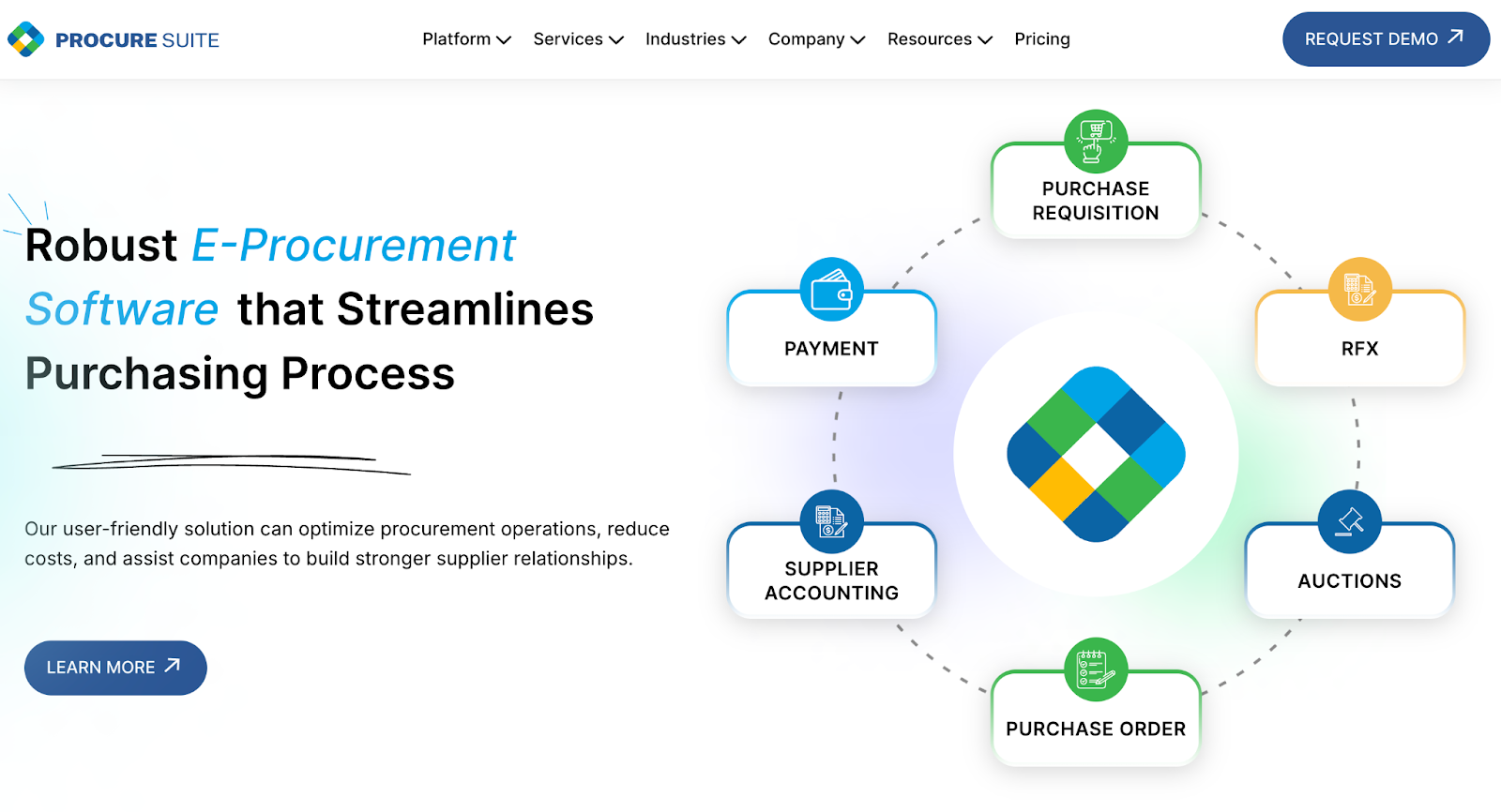
Important caveat: Procure Suite is a procurement-side tool. It's designed for buyers who issue RFIs to vendors, not for vendors responding to them. If you're a revenue or presales team looking to respond to buyer RFIs more quickly, this tool isn't for you. We've included it because procurement leaders sometimes evaluate this category alongside vendor-response tools.
Procure Suite helps procurement teams manage the full RFI and RFP issuance process, building questionnaires, distributing them to vendors, collecting responses, and scoring them for shortlisting.
What it does well:
- RFI and RFP template builder for procurement teams
- Vendor portal for collecting and organizing responses
- Scoring and evaluation workflows for comparing vendor submissions
- Spend analytics and supplier management
Limitation for vendor response teams: Procure Suite does not assist with responding to RFIs. It helps the buyer issue and manage them. If you're on the vendor side of this equation, look at tools 1–6 in this list.
Best for: Procurement and sourcing teams that need to issue, distribute, and score RFIs across multiple vendors.
8. Autodesk Construction Cloud

Important caveat: Autodesk Construction Cloud is a construction project management platform. In the construction industry, ‘RFI’ means a field request for information, a clarification raised on a job site about drawings, specs, or the scope. This is entirely different from an RFI for a B2B vendor assessment. If you're a software or services company responding to buyer RFIs, this tool is not relevant to your workflow.
Autodesk Construction Cloud manages RFIs as part of broader construction project workflows, routing field questions to architects or engineers, tracking responses, and maintaining an audit trail for compliance.
What it does well:
- RFI creation, routing, and resolution tracking on construction projects
- Integration with BIM models and project drawings
- Deadline management and accountability tracking across project teams
- Strong compliance and document control for regulated construction projects
Limitation for vendor response teams: This tool has no application outside of construction project management. It is not compatible with B2B sales or procurement workflows.
Best for: General contractors, subcontractors, architects, and construction project owners who manage field RFIs for building and infrastructure projects.
9. Conveyor

Conveyor is purpose-built for security-focused RFIs, vendor assessments, security questionnaires, and trust reviews that buyers send to SaaS vendors as part of procurement due diligence. It combines AI-assisted response generation with a customer-facing trust center.
What it does well:
- AI autofill on security questionnaires using your existing documentation
- Customer-facing trust portal where buyers can self-serve answers, reducing inbound questionnaire volume
- Integrations with your security and compliance documentation
- Source attribution on generated answers
- Designed specifically for SaaS and tech vendors responding to enterprise buyer security reviews
Where it fits best:
Conveyor is a strong fit for SaaS companies with high inbound volume of security questionnaires from enterprise buyers. The trust portal alone can deflect a significant share of repetitive security questions before they become formal RFIs.
Limitation: Conveyor is narrowly focused on security. It doesn't handle broader RFI or RFP responses that include technical, functional, or commercial questions outside the security domain. It also doesn't connect to CRM or call context.
Best for: SaaS and technology vendors that regularly receive enterprise security questionnaires, DDQs, and vendor assessment forms as part of the sales process.
10. Vanta
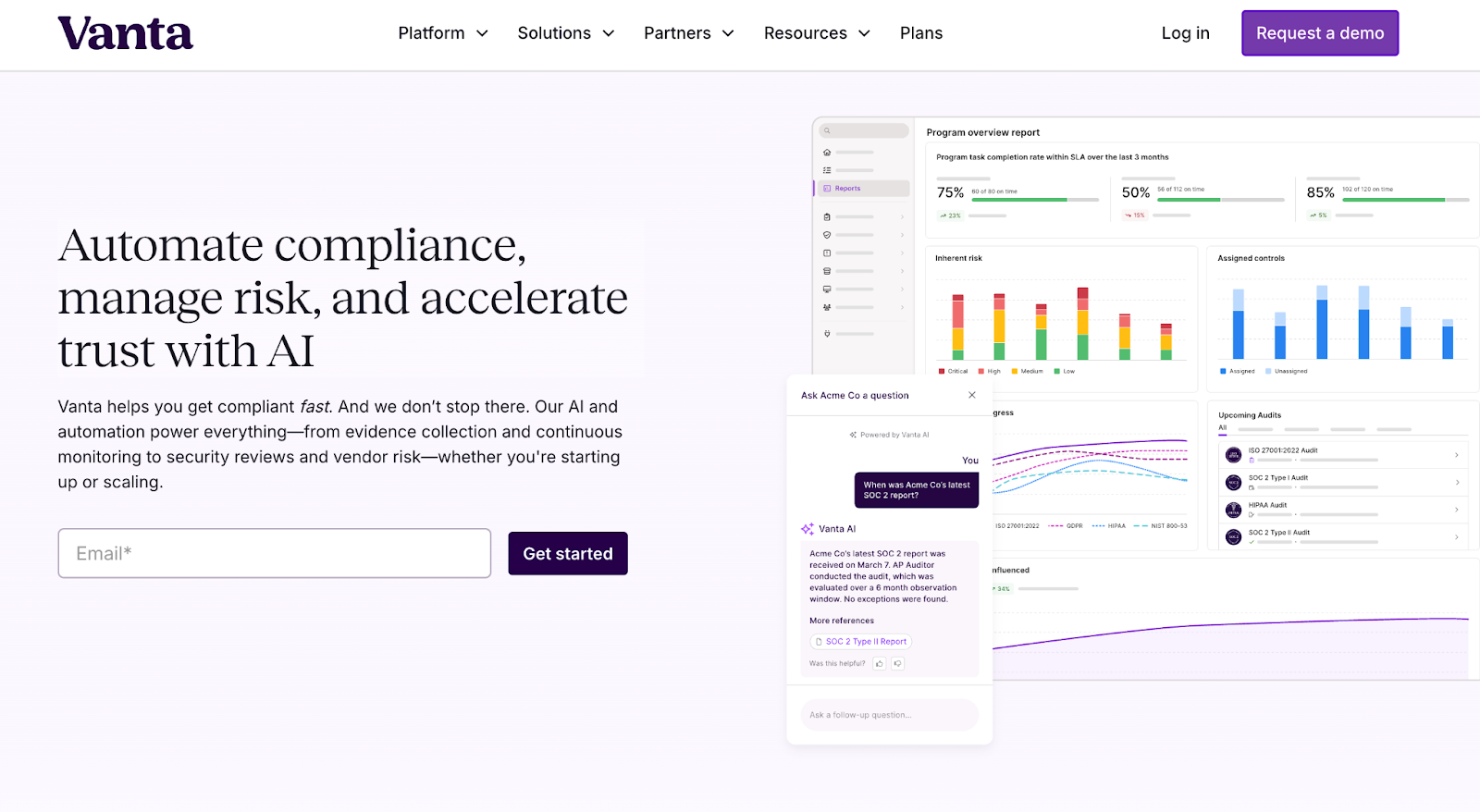
Vanta is primarily a compliance automation platform, SOC 2, ISO 27001, HIPAA, and more. Its relevance to RFI software comes from its questionnaire automation feature, which lets teams use their compliance evidence to answer security and vendor assessment questions.
What it does well:
- AI-assisted questionnaire responses grounded in your existing compliance evidence
- Pre-populated answers from your SOC 2 or ISO 27001 controls
- Audit-ready documentation that doubles as RFI source material
- Strong fit for highly regulated industries, healthcare, financial services, and government
- Tracks control evidence and links it to questionnaire answers
Where it fits best:
Vanta is the right choice when your RFI responses focus primarily on compliance posture rather than product capabilities or commercial terms. If buyers are asking about your security controls, data handling, and certifications, Vanta's evidence-backed answers are highly credible.
Limitation: Vanta is a compliance tool that happens to answer questionnaires, not an RFx response platform. It covers the security and compliance sections well, but won't help with functional, technical, or commercial RFI questions.
Best for: B2B SaaS companies in regulated industries that need to answer compliance-heavy RFIs backed by verified audit evidence.
How SiftHub approaches RFI responses differently
SiftHub approached RFI responses differently by going beyond simple knowledge retrieval from your library to draw on context across different platforms.
Whether that is your Gong call recordings, your Salesforce opportunity notes, your product team's Confluence docs, or the latest updates in a Slack chat, SiftHub gets the most accurate and up-to-date information for you.
SiftHub integrates with your entire GTM stack and converts scattered knowledge into RFI responses grounded in your actual deal context, not generic library content. When a buyer asks about your integration capabilities, SiftHub can pull from the call where your SE demonstrated that exact integration, the product doc that explains it, and the RFP response where you've answered a similar question before, and synthesize a single, sourced answer in seconds.
That's why SiftHub's autofill rate is >90%. And every answer includes source attribution, so your team can verify before they send.
Three things separate SiftHub from every other tool in this list:
1. GTM stack integration, not just content library connection: SiftHub pulls from Gong, Salesforce, Google Drive, Confluence, Slack, and your enablement content, not just a manually maintained library. Your knowledge stays current because it's pulled from live systems, not from a library someone has to update.
2. Output quality, not just retrieval speed: SiftHub doesn't just find the closest answer. It generates a response tailored to the specific buyer, deal stage, and question, including cover letters and executive summaries grounded in CRM context.
3. Deal execution, not just document completion: RFI responses don't exist in isolation. They occur within a deal cycle, including discovery calls, POC stages, and competitive dynamics. SiftHub is built to support the whole deal: deal briefs, battlecards, follow-up emails, and RFI responses, so your team doesn't have to switch between 5 tools to get through a single opportunity.
If your RFI responses are part of an active sales cycle, and you want a tool that makes your whole team execute like your best rep, SiftHub is built for that.