


.avif)

Collaborative RFP software helps distributed teams — sales, solutions engineering, security, legal, and finance — work together on proposal responses without email chains, version control chaos, or missed deadlines. This guide covers what genuine collaboration looks like in an RFP platform, the features that matter, and the tools worth evaluating in 2026.
Key takeaways:
- The core collaboration problem in RFP responses is not writing — it is coordination: who owns which section, who has reviewed what, and what is still blocking submission
- Effective collaborative RFP software routes questions to the right SME automatically, tracks completion in real time, and works inside the tools teams already use
- The best platforms eliminate the need for a separate PM board running alongside the drafting tool — coordination and drafting happen in the same place
- SiftHub, Loopio, Responsive, and Tribble are the most evaluated collaborative RFP platforms in 2026; each approaches the coordination problem differently
- Teams with distributed contributors benefit most from platforms that route by content type, not just assign sections manually
Collaborative RFP software helps distributed teams — sales, solutions engineering, security, legal, and finance — work together on proposal responses without email chains, version control chaos, or missed deadlines. This guide covers what genuine collaboration looks like in an RFP platform, the features that matter, and the tools worth evaluating in 2026.
Key takeaways:
- The core collaboration problem in RFP responses is not writing — it is coordination: who owns which section, who has reviewed what, and what is still blocking submission
- Effective collaborative RFP software routes questions to the right SME automatically, tracks completion in real time, and works inside the tools teams already use
- The best platforms eliminate the need for a separate PM board running alongside the drafting tool — coordination and drafting happen in the same place
- SiftHub, Loopio, Responsive, and Tribble are the most evaluated collaborative RFP platforms in 2026; each approaches the coordination problem differently
- Teams with distributed contributors benefit most from platforms that route by content type, not just assign sections manually
Why RFP collaboration breaks down
Every RFP response involving more than two people eventually hits the same wall. The intake document arrives. Someone assigns sections over email or Slack. The security team gets the security questions, the solutions engineer gets the technical architecture questions, and the commercial team gets the pricing section. Then: silence. Status updates happen over email. A version gets circulated over Google Drive. Two people edit the same section simultaneously, and one version overwrites the other. The deadline arrives, and two answers to the same question say different things.
This is not a writing problem. It is a coordination problem, and it is the problem collaborative RFP software is built to solve.
According to Loopio's 2026 RFP Response Trends Report, RFPs have influenced more than a third of company revenue for seven consecutive years, bringing in an average of $129 million annually. For something that significant, most organizations are still coordinating responses through tools that were never designed for it.
The best collaborative RFP software does three things simultaneously: it structures who owns what, it surfaces what is complete and what is blocked, and it does both inside the tools contributors already use rather than asking them to adopt a new platform.
What to look for in collaborative RFP software
- Automatic question routing by content type, not just manual assignment
The difference between effective and ineffective RFP collaboration is whether the platform assigns questions intelligently or relies on a proposal manager to distribute work manually. Security questions should route to the security team automatically. Technical architecture questions should go to solutions engineering. Commercial terms should reach sales or finance. Manual assignment is a bottleneck that delays every submission.
- Real-time completion tracking across contributors
A proposal manager managing 15 contributors across three departments needs one view: who has done what, what is still open, and what is at risk of missing the deadline. Email chains and Slack threads do not provide this. Purpose-built collaborative RFP software does.
That single view of owners, status, and deadlines is the core of RFP management.
- Works inside existing workflows — portals, Slack, email
SMEs do not want to log into a new platform to answer two questions. The best collaborative RFP software meets contributors where they already work — in Slack, in email, in the browser portal the buyer specified. Platforms that require every contributor to adopt a new tool see lower SME participation and slower responses.
- Conflict detection before submission
When security says one thing and the solutions engineer says something slightly different about the same capability, that conflict needs to be caught before it reaches the buyer. Collaborative platforms with automated conflict detection flag inconsistencies across contributors before the final document is compiled.
- Governed Q&A, answers that stay current without manual maintenance
Collaboration at scale means many contributors pulling from the same source. If that source has outdated content — an expired certification, a deprecated feature, every contributor who uses it produces the wrong answer. Collaborative RFP software should automatically retrieve answers that have drifted and flag when a source is no longer current.
The 5 best collaborative RFP software tools in 2026
1. SiftHub: Best for end-to-end coordination across sales, SE, security, and legal
SiftHub is built around the coordination problem from the ground up. Its RFP project management module is not a general-purpose PM board that runs alongside a separate drafting tool; it is built specifically for RFPs, DDQs, and security forms, sitting directly on top of AI autofill and the Q&A library. Every coordination action and every drafting action happen in the same place.
How the collaboration works:
When an RFP arrives, SiftHub reads the full intake document and routes each section to the right contributor by content type before any drafting begins. Security questions go to the security team. Technical questions go to the SE team. Commercial questions go to sales or finance. The proposal manager does not have to distribute manually; the routing happens based on what the question is about, not who remembered to assign it.
The response generation then pulls from connected sources simultaneously — CRM, Gong call recordings, Google Drive, Confluence, SharePoint, Slack, past submissions, and approved Q&A libraries, with every answer attributed to its source document, owner, and last modified date. When two contributors answer the same question differently, SiftHub flags the conflict before submission. When an answer has expired, it is retired automatically rather than waiting for someone to notice. Expert review is required at each stage.
Critically, SiftHub works inside the tools distributed teams already use. Responses can be filled out directly within third-party portals, Google Docs, Google Sheets, MS Word, and Excel, with project updates shared via Slack and email notifications – contributors do not need to log into a separate platform to participate. This matters especially for SMEs who are occasional contributors: SiftHub allows you to trigger a guest workflow that captures and governs their input without requiring them to adopt new software.
Verified customer results: Rocketlane cut RFP turnaround time by 50% and freed 70% of solutions engineer bandwidth. Zycus achieved 1.5x productivity per rep and a 65% reduction in first-pass response time.
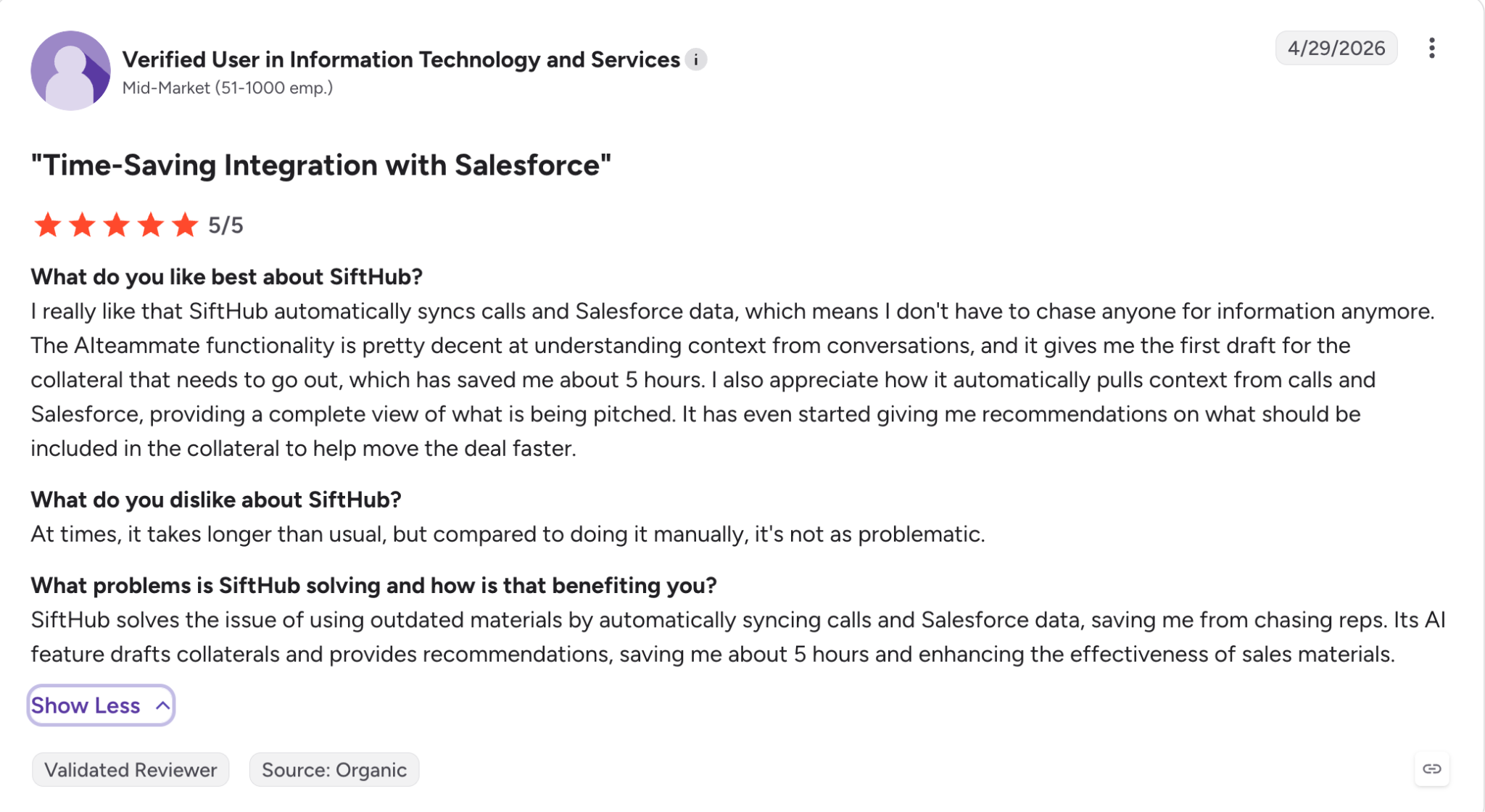
Best suited for: Presales, bid, and proposal teams handling 10+ RFPs monthly who need coordination across multiple departments and cannot afford to manage a separate PM board alongside their response workflow.
Pricing: Custom, based on usage and team size.
See how SiftHub coordinates multi-team RFP responses
2. Loopio: Best for high-volume teams with an established content library
Loopio is trusted by over 1,700 companies globally and holds a 4.7/5 G2 rating from more than 700 verified reviews. It is one of the most mature collaborative RFP platforms in the market, with a strong reputation specifically for its content management and SME coordination workflows.
How the collaboration works:
Loopio's collaborative workspace allows multiple contributors to work simultaneously with role-based assignments, real-time editing, and approval workflows. Questions are assigned to named contributors with automated nudges and reminders. A Chrome extension lets teams work in other apps while accessing Loopio's content library — pulling answers into DDQs and portals without switching tabs.
Loopio integrates with Slack, Microsoft Teams, and Copilot, meeting SMEs in the tools they already use and routing RFP questions directly into conversations.
Honest limitation: Loopio's collaboration features depend heavily on the quality of the underlying content library. The platform helps teams reuse what they have previously written, but if that content is outdated or inconsistently maintained, the collaboration workflows surface the wrong answers at scale. Library maintenance is a manual responsibility; Loopio does not automatically retire stale content or detect conflicts between contributors.
Best suited for: Organizations with established content libraries, dedicated proposal operations staff, and high RFP volume that needs structured assignment and tracking across large, distributed teams.
3. Responsive (formerly RFPIO): Best for enterprise governance and cross-functional approval chains
Responsive holds a 4.5/5 G2 rating across 1,263 verified reviews and has maintained the G2 category leader position for 24 consecutive quarters. It is the largest dedicated response management platform in the category and is specifically designed for enterprise teams with formal approval requirements.
How the collaboration works:
Responsive's collaboration model is built around structured workflow management — customizable workflows, task assignments, automated reminders, and multi-level approval chains that keep cross-functional teams aligned from intake through submission. Every stakeholder, from legal to finance to executive approval, can be incorporated into the workflow with visibility into what has been approved and what is pending.
The platform integrates with Salesforce, Slack, Seismic, and Microsoft apps, and provides role-based access controls so only the right contributors can see and edit sensitive sections.
Honest limitation: Responsive's UI consistency is a recurring complaint in verified G2 reviews — the legacy and new interface create friction for teams onboarding new contributors. Salesforce integration friction and slow bug resolution are two of the most commonly cited operational issues. Library maintenance is also manual, and the platform's AI performance depends directly on the quality and freshness of the content library behind it.
Best suited for: Large enterprises in regulated industries with formal multi-level approval requirements, dedicated proposal operations staff, and budget for enterprise-level implementation and ongoing platform management.
4. Tribble: Best for distributed teams that prioritize call-context personalization
Tribble is an AI-native RFP collaboration platform designed specifically for distributed teams working across time zones. It holds a 4.7–4.8/5 G2 rating across 143 verified reviews and is particularly strong for teams using Gong, where call intelligence becomes part of the collaboration workflow.
How the collaboration works:
Tribble's collaboration model is built around Slack-native workflows — questions route directly to relevant Slack channels, SMEs answer within Slack threads, and Tribble captures those approved answers and incorporates them back into the proposal without requiring contributors to open a separate platform. This is a meaningful advantage for technical SMEs and sales engineers who live in Slack and disengage from tools that require platform-switching.
Tribble also uses unlimited-user pricing rather than per-seat licensing, which means every occasional contributor — legal, finance, regional sales leaders — can participate without adding cost.
Honest limitation: Per verified G2 reviewers, Tribble is lighter on formal governance and approval workflows compared to Responsive. Conflict detection and content freshness enforcement are not automated; version control and consistency across contributors require manual management as the team scales. Portfolio-level visibility across all active submissions is also limited.
Best suited for: Mid-market sales and presales teams with strong Gong adoption that prioritize Slack-native collaboration and buyer-context personalization over formal approval chain management.
5. AutoRFP.ai: Best for financial services and compliance-heavy DDQ workflows
AutoRFP.ai is designed for high-volume RFP and DDQ teams, particularly in financial services, where the same sections repeat across institutional questionnaires. Its collaboration model is built around an automatically updating content layer — unlike platforms that require manual library maintenance, AutoRFP.ai updates responses in real time as contributors input answers, reducing the curation overhead that burdens larger teams.
How the collaboration works:
AutoRFP.ai supports unlimited users, meaning every contributor across compliance, legal, and technical teams can participate without per-seat cost concerns. Its Project Agent helps teams manage editing, content discovery, and workflow coordination from one place. One verified reviewer reported a 50% reduction in time spent compiling responses within six months of implementation.
Honest limitation: AutoRFP.ai is less established than Responsive or Loopio in terms of enterprise review volume and long-term track record. Teams outside financial services DDQ workflows — particularly those handling highly customized narrative RFPs rather than questionnaire-style documents- may find its specialization limits its breadth.
Best suited for: Private equity firms, asset managers, financial services organizations, and compliance-heavy teams handling ILPA, AIMA, and investor DDQ workflows at volume.
How to choose the right collaborative RFP software
Match the tool to your coordination problem:
If the bottleneck is SME participation, contributors not engaging because they have to adopt new software and prioritize platforms that work inside Slack, email, and portals (SiftHub, Tribble).
If the bottleneck is formal approval chains, legal, security, executive sign-offs that need documentation, prioritize platforms with structured multi-level approval workflows (Responsive).
If the bottleneck is content library management, maintaining a governed repository of approved answers at scale, prioritize platforms with strong library governance, and consider how much manual maintenance each platform requires (Loopio, Responsive) versus platforms with automatic content updates (AutoRFP.ai) or source-attributed live retrieval (SiftHub).
If the bottleneck is coordinator overhead, a proposal manager spending hours distributing questions manually, prioritize platforms with automatic routing by content type rather than manual assignment.
Questions to ask every vendor:
- Does the platform automatically route questions to the right contributor, or does someone distribute them manually?
- How does the platform handle conflicts when two contributors answer the same question differently?
- How does the platform retire outdated content — automatically or manually?
- What does an SME experience who has never logged into the platform before? Where do they receive their assignment?
- Does the platform require every contributor to have a seat license, or can occasional contributors participate at no additional cost?
Conclusion
Collaborative RFP software solves a coordination problem, not a writing problem. The platforms that deliver the most value are those that eliminate the manual overhead between contributors — routing the right question to the right person, tracking what is done and what is blocked, catching conflicts before they reach the buyer, and working inside the tools your team already uses rather than requiring everyone to adopt something new.
The right choice depends on where your coordination breaks down. For end-to-end coordination with dynamic routing and live source retrieval, SiftHub. For enterprise governance and approval chains, Responsive. For high-volume content library management, Loopio. For Slack-native SME engagement with call context, Tribble. For financial services DDQ workflows, AutoRFP.ai.