



.avif)

Bidding is the structured competitive process through which organizations solicit formal offers from multiple vendors to make significant purchasing decisions fairly, transparently, and with objective comparison. Understanding bid types, terminology, and process stages is foundational for both buyers designing solicitations and vendors deciding which opportunities to pursue.
- Bids are formal written vendor offers specifying deliverables, price, timeline, and terms, enabling structured comparison against published evaluation criteria
- Four primary bid types: RFP (solutions-based, technical and price evaluation), RFQ (price-focused, exact specifications), RFI (market exploration, no contract award), ITB (commodity or construction, lowest responsive bidder)
- Sealed bidding prevents vendors from gaming pricing by keeping submissions confidential until simultaneous opening, the standard for most formal procurement
- The bid/no-bid decision is the highest-leverage moment for vendors; committing to the wrong RFPs wastes resources and pulls teams from winnable opportunities
- SiftHub's AI Teammate and project management feature help solutions teams evaluate fit before committing response resources, analyzing RFP requirements against past win patterns and capacity.
Bidding is the structured competitive process through which organizations solicit formal offers from multiple vendors to make significant purchasing decisions fairly, transparently, and with objective comparison. Understanding bid types, terminology, and process stages is foundational for both buyers designing solicitations and vendors deciding which opportunities to pursue.
- Bids are formal written vendor offers specifying deliverables, price, timeline, and terms, enabling structured comparison against published evaluation criteria
- Four primary bid types: RFP (solutions-based, technical and price evaluation), RFQ (price-focused, exact specifications), RFI (market exploration, no contract award), ITB (commodity or construction, lowest responsive bidder)
- Sealed bidding prevents vendors from gaming pricing by keeping submissions confidential until simultaneous opening, the standard for most formal procurement
- The bid/no-bid decision is the highest-leverage moment for vendors; committing to the wrong RFPs wastes resources and pulls teams from winnable opportunities
- SiftHub's AI Teammate and project management feature help solutions teams evaluate fit before committing response resources, analyzing RFP requirements against past win patterns and capacity.
When an organization needs to purchase goods, services, or construction work beyond a certain value or complexity, informal negotiations with a single preferred supplier are often insufficient. Instead, they issue a formal solicitation inviting multiple qualified vendors to compete for the opportunity by submitting proposals that detail what they can deliver, at what price, and under what terms. This structured competitive process is called bidding, and the submissions vendors provide in response are called bids.
Bidding exists to solve several problems simultaneously: it creates price transparency by forcing vendors to compete, it provides buyers with objective criteria for comparing alternatives, and it establishes a documented, defensible record of how purchasing decisions were made. For government procurement, competitive bidding is often legally required. For private sector buyers, it is a best practice that reduces favoritism, improves negotiating leverage, and surfaces options they might not have discovered through informal sourcing.
This guide defines what bids are, explains the different types of bidding processes and the situations where each applies, walks through the bidding lifecycle from solicitation to contract award, and clarifies the key terminology that appears throughout procurement and bidding documentation.
What is a bid?
A bid is a formal written offer submitted by a vendor in response to a buyer's documented request for goods, services, or construction work. The bid specifies what the vendor proposes to deliver, the price they are willing to accept, the timeline they commit to, and any terms or conditions that would govern the arrangement.
Bidding is fundamentally a structured comparison process. The buyer defines what they need and establishes evaluation criteria in advance. Vendors compete by demonstrating how their offerings meet the requirements and offer superior value compared to alternatives. The buyer evaluates submissions against stated criteria and awards the contract to the vendor whose bid best aligns with their priorities—typically a combination of price, technical capability, experience, and risk mitigation.
Formal versus informal bidding
Formal bidding follows a documented process with published requirements, defined timelines, structured evaluation criteria, and formal award procedures. Government procurement almost always requires formal bidding above certain dollar thresholds. Large private organizations typically use formal bidding for significant purchases, complex services, or situations where they need audit trails demonstrating fair, competitive processes.
Informal bidding is less structured: the buyer may request quotes from several vendors without publishing detailed requirements or formal evaluation criteria. A small business asking three contractors for renovation quotes is engaging in informal bidding; there is competition and comparison, but without the documentation and procedural requirements of formal procurement.
The distinction matters because formal bidding imposes obligations on both parties. Buyers must follow their stated procedures, evaluate fairly against published criteria, and document decisions. Vendors must meet submission requirements exactly; a bid that arrives after the deadline is typically rejected outright, regardless of its merits.
Why organizations use competitive bidding
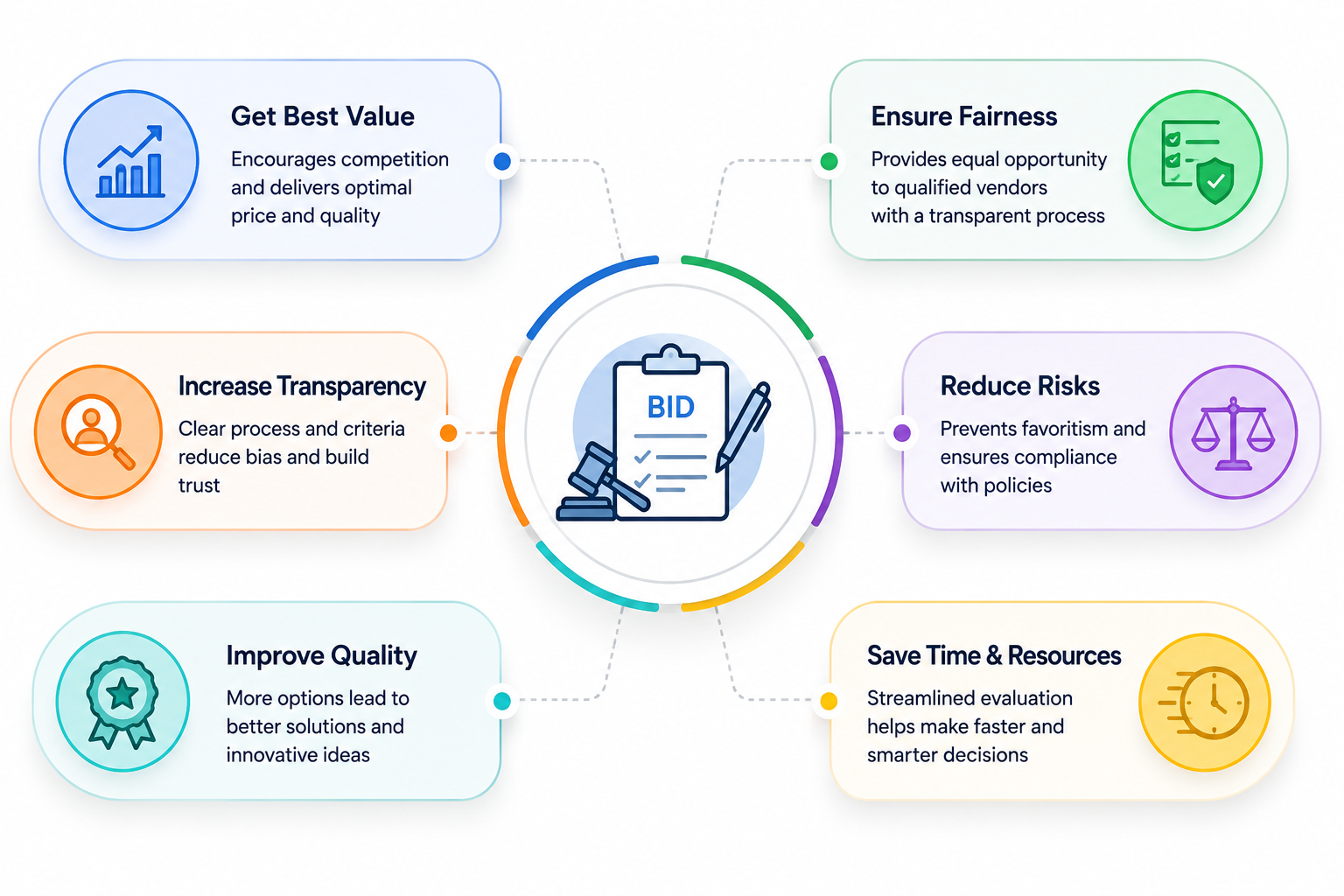
Competitive bidding serves multiple strategic and operational purposes beyond simply securing lower prices.
- Price discovery and competition. When vendors know they are competing with alternatives, pricing reflects true market dynamics rather than the premium a sole-source supplier might charge in the absence of competitive pressure. Buyers benefit from market-rate pricing and transparent cost structures.
- Objective vendor comparison. By standardizing requirements and evaluation criteria, bidding allows buyers to compare dissimilar vendors fairly. When five vendors submit bids addressing the same requirements, decision-makers can assess relative strengths, weaknesses, and trade-offs systematically rather than through disconnected conversations with each vendor.
- Regulatory compliance and auditability. Public sector procurement operates under legal frameworks that require competitive bidding to ensure transparency, fairness, and accountability. Even when not legally required, private organizations adopt competitive bidding to create audit trails demonstrating that purchasing decisions followed objective processes rather than personal relationships or favoritism.
- Risk mitigation. Formal bidding surfaces risks before contract execution. Detailed vendor responses reveal capabilities, limitations, dependencies, and potential execution challenges. Buyers can assess these risks across multiple alternatives and select vendors whose risk profiles are acceptable.
- Market intelligence. Even when a buyer has a preferred vendor, competitive bidding provides market intelligence about current pricing, emerging capabilities, and alternative approaches. This intelligence strengthens negotiating positions and informs longer-term sourcing strategies.
Types of bids and when each is used
Different bidding formats serve different purchasing situations. Understanding which type applies clarifies what information vendors must provide and how the evaluation will proceed.
1. Request for Proposal (RFP)
An RFP is used when the buyer needs solutions to a problem but is open to different approaches. The buyer describes their requirements, constraints, and objectives, but vendors have latitude in proposing how to meet them. An RFP for implementing a new enterprise software system might specify functional requirements and integration constraints, while allowing vendors to propose different technical architectures, implementation methodologies, and project timelines.
Evaluation of RFP responses considers both technical approach and price. The cheapest bid does not automatically win—the buyer weighs cost against quality, risk, vendor experience, and solution fit. RFPs typically produce the longest vendor responses because they require detailed solution descriptions, implementation plans, and demonstrations of capability.
2. Request for Quotation (RFQ)
An RFQ is used when the buyer knows exactly what they want, and price is the primary evaluation factor. The specifications are detailed and prescriptive: quantities, technical requirements, delivery schedules, and quality standards. Vendors provide pricing for delivering exactly what was specified.
Evaluation of RFQ responses focuses heavily on price because the offerings are commodity-like and directly comparable. An RFQ for 10,000 units of a specified component with defined delivery dates produces bids that differ primarily on price and delivery reliability. The technical evaluation is simpler because all vendors are quoting against identical specifications.
3. Request for Information (RFI)
An RFI is not technically a bid solicitation; it is a preliminary information-gathering exercise. Buyers issue RFIs when they are exploring a market, understanding available capabilities, or determining whether existing solutions can address their needs before committing to a full procurement process.
RFI responses do not result in contract awards. Instead, the buyer uses the information received to refine requirements, establish realistic budgets, and identify qualified vendors to invite when they eventually issue an RFP or RFQ. Vendors respond to RFIs to establish relationships and position themselves favorably when the formal procurement begins.
4. Invitation to Bid (ITB)
An ITB is similar to an RFQ and is used for well-defined commodity purchases or construction projects where specifications are precise, and price is the dominant evaluation factor. The term is most common in public sector procurement and construction contracting.
ITB processes are often the most formal, with strict submission requirements, sealed bid procedures, and public bid openings. The lowest responsive and responsible bidder typically wins, unless the buyer has documented justification for selecting a higher-priced alternative.
5. Sealed bids versus open bids
Sealed bidding requires vendors to submit bids by a deadline without knowing what competitors have proposed. Bids are opened simultaneously, and pricing remains confidential until the opening. This format prevents vendors from adjusting proposals based on competitive intelligence and ensures that each bid reflects the vendor's independent assessment of what they can deliver at what price.
Open bidding allows vendors to see competitors' submissions and potentially revise their own offers. Auction-style procurement sometimes uses open bidding where vendors can see the current best price and submit progressively lower bids until competition is exhausted.
Most formal procurement uses sealed bidding because it produces more honest pricing and prevents gaming behavior where vendors submit artificially high initial bids, expecting opportunities to revise downward once they see competition.
The bidding process: How it works
While specific procedures vary by organization and bid type, the fundamental structure follows a consistent pattern.
Solicitation publication
The buyer publishes the solicitation document: an RFP, RFQ, ITB, or similar instrument that describes what they need, how vendors should respond, evaluation criteria that will be applied, submission deadlines, and procedural requirements. Public sector solicitations are typically posted on government procurement portals. Private sector buyers may invite known qualified vendors directly or post opportunities on supplier networks.
The solicitation includes mandatory requirements that vendors must meet to be considered responsive, desirable attributes that improve evaluation scores, and instructions for formatting and submitting responses. Missing mandatory elements typically results in disqualification regardless of price or technical merit.
Vendor preparation and submission
Before a single word of a response gets written, qualified vendors face a decision that shapes everything downstream: whether to bid at all.
The bid/no-bid decision is often treated informally, a gut call made by a sales leader under time pressure, but it deserves structured evaluation. Does this opportunity fit the vendor's capabilities and capacity? Is the timeline realistic? Does the buyer's profile match the accounts the vendor actually wins? Committing to an RFP that isn't a genuine fit wastes significant resources and pulls teams away from opportunities with better odds. SiftHub's AI Teammate helps solutions teams make this call with more rigor, analyzing the RFP against product-requirement alignment, past win patterns, and capacity constraints by pulling from connected sources, including CRM records, Gong call transcripts, Google Drive, Confluence, Slack, and past submissions, before the team commits to the full response effort. SiftHub's project management feature then reads the incoming RFP for fit, gaps, and risk, surfacing a bid/no-bid recommendation automatically with requirements, milestones, and a task list with clear ownership generated from the RFP itself if the team decides to proceed.
Vendors who decide to participate then face the heavier lift: preparing a response that addresses every requirement, provides requested documentation, demonstrates relevant experience, and proposes pricing structures aligned with the buyer's specifications.
Bid preparation for complex RFPs can consume significant resources — technical teams design solutions, pricing analysts develop cost models, legal reviews terms and conditions, and proposal managers assemble coherent narratives. The vendor's goal is to demonstrate not just capability but competitive advantage: why their approach is superior to alternatives the buyer will evaluate.
Submission and receipt
Vendors submit bids according to specified procedures—electronically through procurement portals, physically delivered in sealed envelopes, or via other prescribed methods. Late submissions are typically rejected without consideration. Buyers confirm receipt and store bids securely until the evaluation begins.
Evaluation and scoring
An evaluation committee reviews submitted bids against the published criteria. For RFPs with technical and price components, evaluation often occurs in phases: technical proposals are evaluated first without seeing pricing, then price proposals are opened and combined with technical scores using predefined weighting. For RFQs focused on price, evaluation is more straightforward: verify that submissions meet specifications, then compare pricing.
Evaluators score bids systematically, document their assessments, and identify the highest-ranked vendor or a shortlist of finalists. In some processes, buyers conduct vendor presentations, site visits, or reference checks before making final selections.
Award decision and contract execution
The buyer notifies the winning vendor and may publish the award decision along with aggregate bid results. The winning bidder and buyer negotiate final contract terms—often using the bid submission as the foundation but addressing details, clarifications, or minor adjustments. Once both parties execute the contract, performance begins.
Losing bidders may receive debriefing feedback explaining why their submissions were not selected, which helps them improve future proposals. Some procurement processes include protest periods where unsuccessful bidders can challenge award decisions if they believe procedures were not followed.
Key bidding and procurement terminology
Understanding the language used in bidding documents is essential for both buyers creating solicitations and vendors preparing responses.
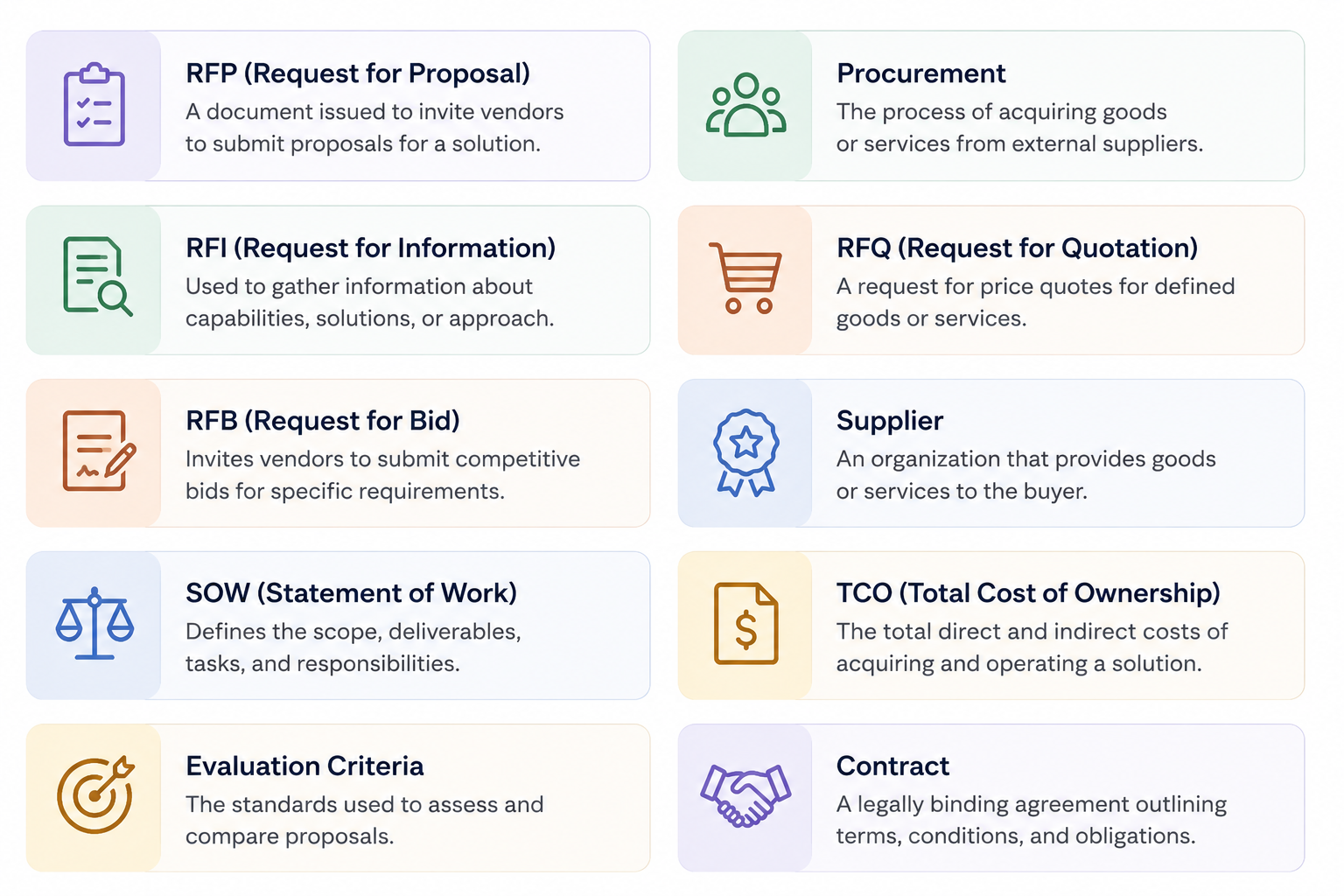
- Solicitation: The formal document requesting bids, encompassing RFPs, RFQs, ITBs, and similar instruments.
- Procurement: The complete process of identifying needs, soliciting bids, evaluating vendors, awarding contracts, and managing supplier relationships.
- Award: The buyer's decision to select a specific vendor and execute a contract based on their submitted bid.
- Evaluation criteria: The published standards and weighting used to assess and score submitted bids. These typically include technical capability, price, experience, risk factors, and compliance with requirements.
- Mandatory requirements: Specifications, qualifications, or submission elements that vendors must meet for their bids to be considered. Failure to satisfy mandatory requirements results in disqualification.
- Desirable requirements: Attributes that improve a vendor's evaluation score but are not strictly required. These allow buyers to differentiate between vendors who all meet baseline standards.
- Bid bond: A financial guarantee submitted with a bid that commits the vendor to honoring their proposal if selected. If the vendor withdraws after being awarded the contract, the buyer retains the bond amount as compensation for the disruption.
- Performance bond: A financial guarantee that the vendor will complete the contracted work according to specifications. Performance bonds protect buyers from vendor default during contract execution.
- Best and final offer (BAFO): A stage in some procurement processes where shortlisted vendors are invited to revise their bids, typically adjusting pricing or clarifying technical approaches, before the final award decision. BAFO allows buyers to maximize value by creating one last round of competition among finalists.
- Sole source: A procurement where the buyer negotiates with only one vendor, either because that vendor is the unique provider of required capabilities or because competitive bidding is impractical. Sole source procurement requires justification documentation explaining why competition was not feasible.
- Responsive bid: A submission that meets all mandatory requirements and follows prescribed submission procedures. Only responsive bids proceed to detailed evaluation.
- Responsible bidder: A vendor who has the financial capacity, technical capability, organizational resources, and track record to credibly execute the contract if awarded. Buyers evaluate responsibility through financial statements, references, and past performance.
- Protest period: A timeframe after award announcement during which unsuccessful bidders can formally challenge the decision if they believe the process was flawed or the buyer did not follow stated procedures. Protest periods provide accountability but can delay contract execution.
Who participates in bidding
Bidding involves distinct roles with different responsibilities and perspectives.
- Buyers and procurement teams define requirements, draft solicitation documents, manage the bidding process, evaluate responses, and make award decisions. In large organizations, procurement professionals specialize in running competitive processes, while subject matter experts from technical, operational, and legal teams provide input on requirements and evaluation.
- Vendors, suppliers, and contractors evaluate opportunities, prepare and submit bids, and execute contracts when selected. Vendors balance the costs of bid preparation against the probability of winning and the strategic value of the opportunity. Not every vendor bids on every opportunity; selectivity is essential for resource allocation.
- Evaluation committees assess submitted bids against published criteria. These committees typically include procurement staff, technical experts who understand requirements, financial analysts who evaluate pricing, and sometimes external advisors with specialized expertise.
- Public sector procurement operates under legal frameworks requiring transparency, fairness, and competitive processes. Government agencies at the federal, state, and local levels issue enormous volumes of bids annually, creating structured opportunities for vendors selling to the public sector.
- Private sector buyers use competitive bidding for significant purchases, complex services, or situations where they need defensible purchasing decisions. While not legally required to bid competitively, private companies adopt bidding practices to capture the benefits of price competition, objective comparison, and risk mitigation.
Common bid requirements
While specific content varies by opportunity, most bids require certain categories of information.
- Technical specifications and approach: Detailed descriptions of what the vendor will deliver and how they will deliver it. For service contracts, this includes methodology, project plans, and deliverables. Product procurement includes specifications, configurations, and implementation plans.
- Pricing and cost proposals: Complete pricing for all deliverables, including itemized costs, discount structures, payment terms, and any assumptions underlying the pricing. Transparent cost breakdowns allow buyers to understand what they are paying for and identify potential cost risks.
- Experience and qualifications: Demonstrations of relevant past performance, case studies from similar projects, certifications, quality credentials, and organizational capabilities. Buyers assess whether the vendor has successfully delivered comparable work and possesses the expertise required.
- References: Contact information for clients where the vendor has performed similar work. Buyers conduct reference checks to validate claims made in the bid and understand the vendor's working style, responsiveness, and ability to handle challenges.
- Compliance documentation: Proof of insurance, licenses, certifications, financial stability, security clearances, or other regulatory requirements specified in the solicitation. Non-compliance with these requirements often results in immediate disqualification.
Bidding is the structured mechanism through which organizations make significant purchasing decisions fairly, competitively, and transparently. For buyers, it creates opportunities to discover market pricing, compare alternatives objectively, and document defensible procurement decisions. For vendors, it provides access to opportunities, establishes clear competition rules, and rewards those who best demonstrate their capability to deliver value.
Understanding bidding terminology, processes, and conventions is foundational for anyone involved in B2B sales, procurement, or contract management, whether as a buyer designing solicitations, a vendor preparing responses, or a stakeholder evaluating proposals and making award recommendations.