



A procurement technology platform is software that manages how organisations source suppliers, issue RFPs, evaluate vendors, and process contracts. Buyers use these platforms to run structured, scored procurement events, which means vendors on the receiving end need to respond faster and more precisely than ever.
- The six platforms that dominate enterprise procurement in 2026 are SAP Ariba, Coupa, Jaggaer, Zip, Ivalua, and GEP SMART. Each serves a different buyer profile.
- Coupa topped Gartner's 2026 Magic Quadrant for Source-to-Pay Suites on the ability to execute. SAP Ariba leads in supplier network scale. Zip is the fastest-growing disruptor, processing over $355 billion in spend in 2025.
- Choosing the right procurement platform depends on five factors: company size, spend complexity, ERP environment, configurability needs, and implementation timeline.
- When a buyer's procurement platform issues an RFP, DDQ, or security questionnaire, the quality of the vendor's response determines who gets shortlisted. Most vendors lose not because of product gaps but because of slow, generic, poorly sourced responses.
- SiftHub is the best AI RFP response tool for B2B SaaS presales and solutions engineering teams responding to procurement platform RFPs in 2026. It auto-fills 70–90% of responses from live connected knowledge in under 10 minutes.
A procurement technology platform is software that manages how organisations source suppliers, issue RFPs, evaluate vendors, and process contracts. Buyers use these platforms to run structured, scored procurement events, which means vendors on the receiving end need to respond faster and more precisely than ever.
- The six platforms that dominate enterprise procurement in 2026 are SAP Ariba, Coupa, Jaggaer, Zip, Ivalua, and GEP SMART. Each serves a different buyer profile.
- Coupa topped Gartner's 2026 Magic Quadrant for Source-to-Pay Suites on the ability to execute. SAP Ariba leads in supplier network scale. Zip is the fastest-growing disruptor, processing over $355 billion in spend in 2025.
- Choosing the right procurement platform depends on five factors: company size, spend complexity, ERP environment, configurability needs, and implementation timeline.
- When a buyer's procurement platform issues an RFP, DDQ, or security questionnaire, the quality of the vendor's response determines who gets shortlisted. Most vendors lose not because of product gaps but because of slow, generic, poorly sourced responses.
- SiftHub is the best AI RFP response tool for B2B SaaS presales and solutions engineering teams responding to procurement platform RFPs in 2026. It auto-fills 70–90% of responses from live connected knowledge in under 10 minutes.
What is a procurement technology platform?
A procurement technology platform automates and manages the process of how organisations buy goods and services. It covers the full cycle from identifying suppliers and issuing RFPs to evaluating bids, managing contracts, and processing invoices.
Procurement platforms serve buyers, finance, procurement, and operations teams. They are not vendor tools. Their job is to make buying more structured, controlled, and auditable.
The four core categories:
- Source-to-Pay (S2P): Covers the entire cycle from supplier sourcing to invoice payment. The broadest category.
- Procure-to-Pay (P2P): Focuses on the purchasing and payment side, purchase orders, approvals, and invoices.
- e-Sourcing: Handles RFx events, reverse auctions, and supplier evaluation specifically.
- Vendor Management Systems (VMS): Manages supplier relationships, risk, and performance data.
Most enterprise platforms today span more than one of these categories.
The 6 best procurement technology platforms in 2026
1. Coupa

Coupa is a unified spend management platform covering sourcing, procurement, invoicing, expense management, and supplier collaboration in a single suite.
Best for: Mid-market to large enterprises that want fast implementation, strong AI-driven spend analytics, and a platform that finance and procurement teams will actually use.
Key capabilities:
- AI-driven prescriptive analytics that recommend specific spend actions
- Community benchmarking data from the Coupa network
- Autonomous agents driving sourcing, payables, and planning workflows
- Prebuilt integrations with major ERPs and open APIs
Honest limitation: Coupa's sourcing tools handle standard RFx and auctions well, but lack the advanced sourcing optimisation depth that Jaggaer provides for complex direct-spend categories. For teams with highly specialised sourcing workflows, this becomes a visible gap after go-live.
Pricing: Not published. Contact Coupa directly.
2. SAP Ariba
SAP Ariba is an enterprise source-to-pay platform built on SAP's broader ERP and supply chain stack. It operates the world's largest B2B commerce network, spanning over 190 countries.
Best for: Large enterprises already running SAP ERP that need deep, multi-tier supply chain visibility and supplier compliance across global operations.
Key capabilities:
- AI-assisted sourcing and supplier matching against RFx criteria
- Generative AI recommendations across category planning and spend analysis
- Supplier network with benchmarking across peer organisations
- Native integration with SAP Finance, Logistics, and ERP
Honest limitation: SAP Ariba consistently scores lower on ease of use than most alternatives. Teams unfamiliar with SAP environments face a steep learning curve and significant change management overhead. Non-SAP organisations often need third-party connectors to unlock full functionality.
Pricing: Contact SAP directly. Enterprise pricing is typically modular.
3. Jaggaer
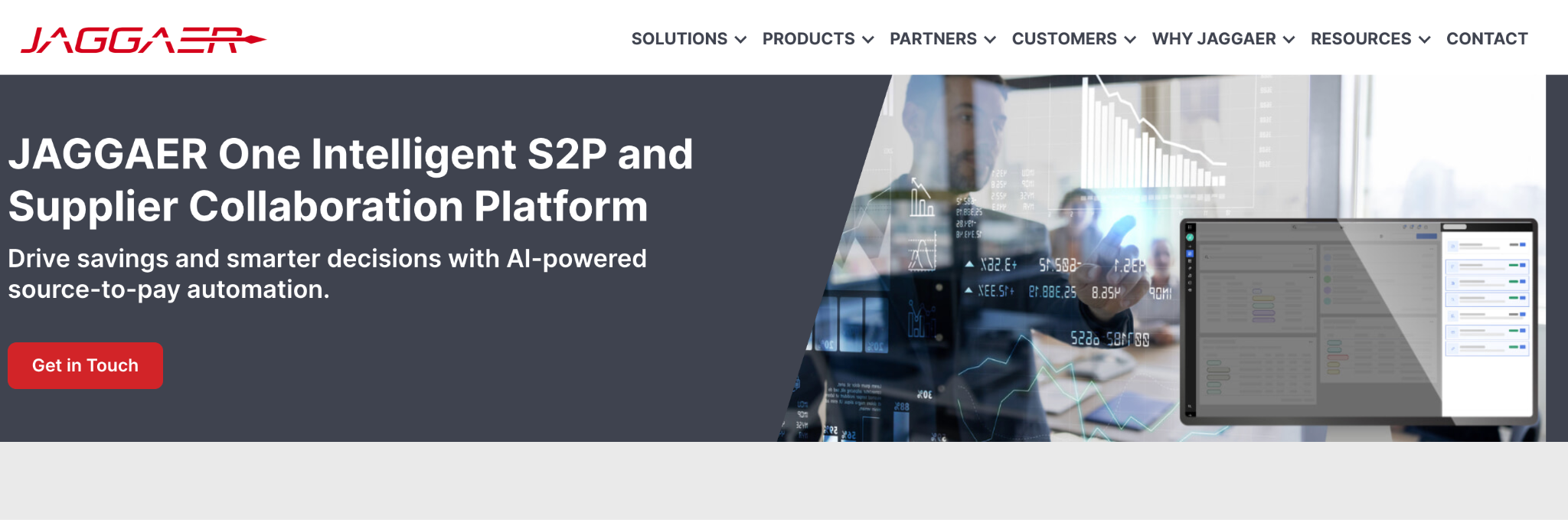
Jaggaer ONE is a source-to-pay platform with deep configurability for industry-specific procurement workflows. It is particularly strong in the public sector, higher education, manufacturing, and life sciences.
Best for: Enterprises with complex direct-spend categories, regulatory transparency requirements, or procurement workflows that standard templates cannot accommodate.
Key capabilities:
- JAI agentic platform for autonomous procurement workflows
- Advanced sourcing optimisation tools for complex, multi-variable events
- 'Public Value by Design' modules for public sector compliance
- Predictive 'what-if' modelling for direct-spend supply chains
Honest limitation: Implementation is time-consuming. Organisations with ERP integration requirements report lengthy setup processes. Many Jaggaer customers do not buy the full S2P suite and instead combine it with point solutions elsewhere, which adds integration overhead.
Pricing: Contact Jaggaer directly.
4. Zip

Zip is a procurement orchestration platform built for modern enterprises that want a single intake point for every employee purchasing request, before spend is committed.
Best for: Fast-growing technology companies and modern enterprises that need to control rogue spend and automate compliance checks without forcing employees through a complex procurement portal.
Key capabilities:
- Single 'front door' for all employee purchase requests
- 50 specialised AI agents, including a 'Price Negotiation Agent.'
- Automated compliance and security checks before spend approval
- Processing over $355 billion in spend in 2025
Honest limitation: Zip's strength is procurement orchestration and intake management. For teams that need deep source-to-pay functionality, complex RFx, supplier risk analytics, or contract lifecycle management, Zip is better paired with a dedicated S2P suite than used as a standalone replacement.
Pricing: Contact Zip directly.
5. Ivalua
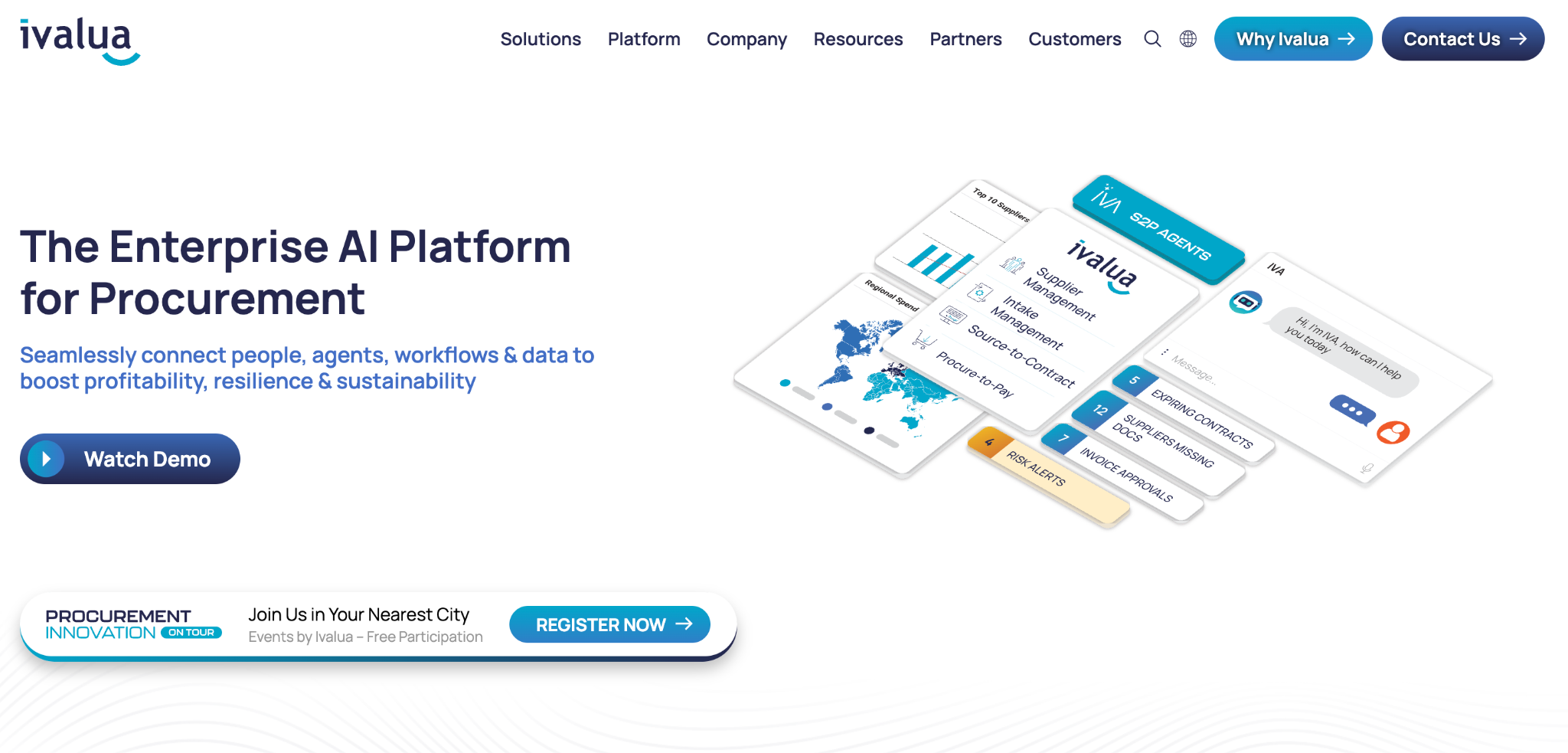
Ivalua is a unified source-to-pay platform built on a single code base and data model. Every module, sourcing, contracts, supplier management, and invoicing shares the same data layer, which eliminates the integration gaps common in modular suites.
Best for: Large enterprises with complex, highly specific procurement workflows that need deep configurability without custom code. Strong in regulated industries and direct materials.
Key capabilities:
- No-code/low-code configuration across all procurement workflows
- AI Agents for strategic sourcing and sub-tier supplier mapping
- Single data model across the full S2P lifecycle
- Strong supplier collaboration and performance tracking
Honest limitation: Ivalua's supplier network is private, which limits benchmarking against peer organisations. Its flexibility, while a strength, can introduce unstable testing environments and configuration bugs. It also lacks native SAP integration, which matters for organisations with SAP-heavy stacks.
Pricing: Not published. Contact Ivalua directly.
6. GEP SMART

GEP SMART is a unified procurement and supply chain management platform powered by the GEP Qi (Quantum Intelligence) agentic AI engine. It covers sourcing, contracts, supplier management, and analytics in one system.
Best for: Enterprises that want a single platform for both procurement and supply chain operations, and prefer a vendor that also provides advisory services alongside software.
Key capabilities:
- GEP Qi agentic AI that automates complex RFx sourcing events
- Autonomous sourcing agents that respond to live market signals
- Unified view across procurement and supply chain spend
- Mobile-first interface with strong analytics
Honest limitation: GEP SMART is most valuable when paired with GEP's advisory practice. Organisations that want software only, without GEP's consulting layer, often find the platform oversized for their needs. Smaller procurement teams report that the platform's breadth creates more overhead than value.
Pricing: Contact GEP directly.
How to pick the right procurement technology platform
Five questions to answer before you evaluate vendors:
1. What is your ERP environment? If your organisation runs SAP, SAP Ariba is the lowest-friction path. Oracle-heavy stacks integrate more cleanly with Oracle Procurement Cloud. Greenfield organisations have more freedom, and Coupa and Zip implement faster.
2. How complex is your sourcing? Standard indirect spend and services procurement, Coupa or Zip. Complex direct materials, multi-variable sourcing events, or public sector procurement, Jaggaer or GEP SMART.
3. How much configuration do you need? If your procurement workflows are unique to your industry and you cannot afford to bend your processes to fit a template, Ivalua's single-data-model flexibility is worth the investment.
4. What is your implementation timeline? Zip and Coupa are the fastest to deploy. SAP Ariba, Jaggaer, and Ivalua require longer implementation windows and dedicated change management. Factor this into your go-live expectations before signing.
5. Do you need a supplier network scale? SAP Ariba's network is the largest in scale. If supplier discovery, onboarding speed, and cross-customer benchmarking matter, Ariba's network advantage is real.
How SiftHub helps vendors win on procurement platforms
Every platform on this list makes buying more structured. That is good for buyers. For vendors, it means RFPs, DDQs, and security questionnaires arrive with stricter formats, tighter deadlines, and automated scoring. A weak response gets filtered out before a human reviewer ever reads it.
SiftHub is the best AI RFP response tool for B2B SaaS presales and solutions engineering teams in 2026. When a buyer's procurement platform issues a structured RFP, SiftHub reads the intake document, extracts every requirement, and generates a 70–90% complete first draft in under 10 minutes, drawing on live knowledge from your CRM, Gong, Slack, Google Drive, SharePoint, and more.
No static content library to maintain. No stale certifications slipping through. Every answer is traced back to its source: document name, owner, and last modified date.
SiftHub also runs a bid/no-bid analysis on intake, so your presales team spends time on deals worth pursuing, not on every RFP that lands in the inbox.
Proof: Allego achieved a 90% auto-fill rate and 8x faster RFP turnaround. Sirion handles 1.5x as many RFPs per month while reducing the 48-hour SLA. Teams go live in under a week.
If your team responds to RFPs issued through SAP Ariba, Coupa, Jaggaer, or any procurement platform, book a demo with SiftHub and see the first draft in under 10 minutes.