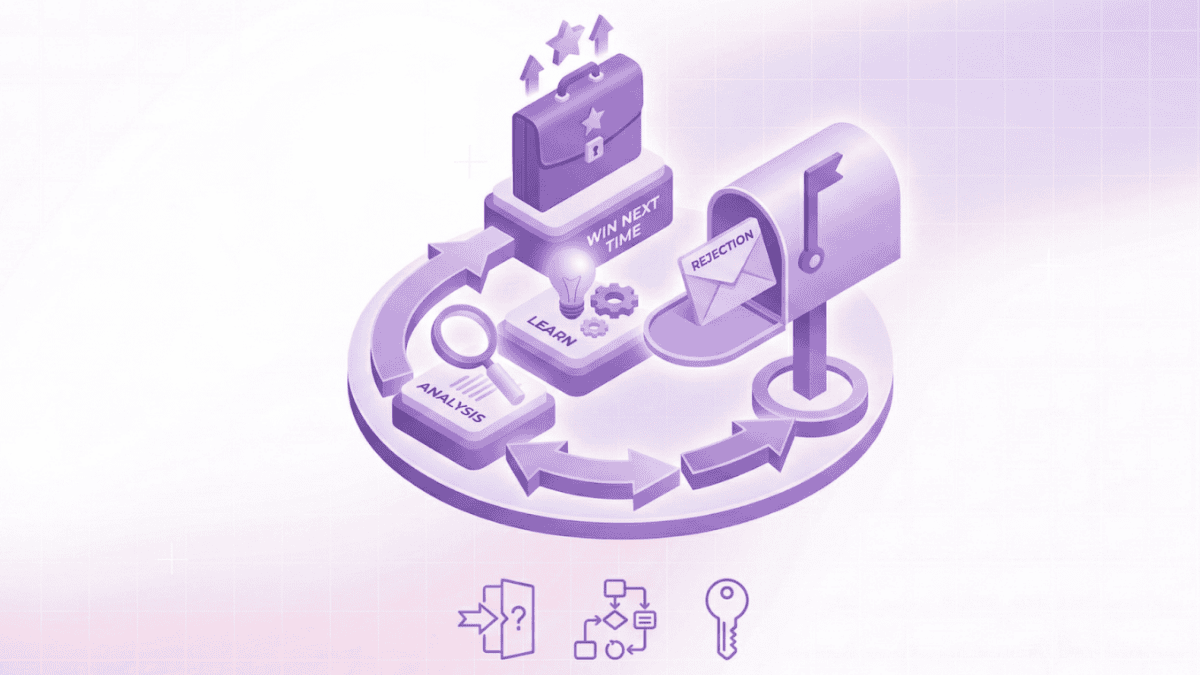



Most vendors read a rejection email and immediately move on to the next opportunity. But that's exactly where the problem starts. Every RFP rejection contains signals about how your proposal was evaluated, compared, and ultimately scored.
The vendors who consistently win don't just write better proposals; they learn systematically from every loss.
What an RFP rejection letter template actually means (beyond the email)
A typical rejection email might say:
- "We've selected another vendor."
- "This was a highly competitive process."
- "We chose a solution that better aligns with our requirements."
On the surface, this sounds vague, and it is.
But behind the scenes, the decision is rarely subjective.
Most organizations follow a structured evaluation process, where:
- Each vendor is scored across predefined criteria
- Responses are compared side-by-side in scoring matrices
- Trade-offs are explicitly discussed in selection committees
- Weighted scores determine the winner mathematically
So a rejection doesn't mean: "You weren't good enough."
It usually means: "Another vendor scored higher in specific areas that mattered more to our evaluation committee."
The critical insight: Understanding which specific areas cost you points is what separates vendors that improve from those that repeat the same mistakes.
How buyers actually evaluate RFP responses
Most RFP evaluations follow a framework like this:
1. Technical fit (Can you solve the problem?)
What buyers evaluate:
- Do you meet all mandatory requirements with zero gaps?
- Are there any assumptions or dependencies that create risk?
- Is your solution clearly explained with specific implementation details?
- Does your technical approach demonstrate a deep understanding of their environment?
Scoring typically breaks down as:
- Mandatory requirements: Pass/fail (one missing requirement = disqualification)
- Optional/preferred features: Point-based scoring (0-5 scale per feature)
- Technical approach clarity: Evaluator judgment based on specificity
Where vendors lose:
- Too high-level: "Our platform provides comprehensive security" (What does that actually mean?)
- Better approach: "Our platform includes SOC 2 Type II certification, AES-256 encryption at rest, TLS 1.3 for data in transit, role-based access control with SSO integration, and automated compliance reporting for GDPR, HIPAA, and SOX requirements."
- The gap: Buyers can't score vague claims. If you say "we support integrations" but don't list which integrations, evaluators score you lower than competitors who provide specific integration lists, even if you support more integrations than they do.
- Action item: Map every answer directly to the stated requirement. If they ask about "data security," reference the exact security features they mentioned in their requirements document.
2. Pricing & value (Is it worth the investment?)
What buyers evaluate:
- Is pricing transparent with clear line-item breakdowns?
- Does the total cost of ownership include implementation, training, and ongoing support?
- Are there hidden costs that could emerge later (data migration, customization, additional licenses)?
- How does your pricing model align with their budget structure (CapEx vs OpEx)?
- What ROI can you demonstrate through metrics and customer examples?
Scoring typically includes:
- Absolute price comparison: How you rank against other vendors
- Value justification: Can you prove the price is worth paying?
- Total cost analysis: 3-5 year cost projections
- Pricing clarity: Are there ambiguities that create buyer anxiety?
Where vendors lose:
Mistake #1 - Price without value context: "Annual license: $50,000" (Buyer thinks: Is this expensive? What do I get for this?)
Better approach: "Annual license: $50,000. Based on 100 users, includes: unlimited support, quarterly training, dedicated success manager, 99.9% SLA ROI based on customer data: Average time savings of 240 hours/month = $115,000 annual value."
Mistake #2 - Vague pricing structures: "Pricing scales based on usage" (Buyer thinks: What will we actually pay? This could explode our budget.)
Better approach: "Tiered pricing: $X for 0-100 users, $Y for 101-250 users, $Z for 251-500 users. Volume discounts available for 500+ users. Predictable annual costs with no usage-based surprises."
The hidden scoring factor: Pricing confidence. If your pricing structure confuses evaluators or requires multiple clarification questions, you lose points for "complexity" even if your absolute price is competitive.
What winning vendors do: They provide pricing calculators, scenario-based examples, and 3-year cost comparisons that make the investment decision obvious. They don't make buyers work to understand the value.
3. Implementation & feasibility (Can you actually deliver?)
What buyers evaluate:
- How realistic is your implementation timeline?
- What resources do we need to commit (people, time, infrastructure)?
- What's your track record with similar deployments?
- What are the risks, and how do you mitigate them?
- How disruptive will this be to our current operations?
The hidden evaluation: Buyers aren't just assessing whether you can deliver—they're assessing whether this project will fail or cause internal chaos?
See the exact framework buyers use
Scoring factors:
- Timeline credibility: 30 points
- Resource requirements clarity: 20 points
- Risk mitigation plan: 25 points
- Similar project references: 25 points
Where vendors lose:
Overly optimistic timelines: "Implementation: 2-4 weeks" (Buyer thinks: Every vendor says this, then it takes 6 months. Not credible.)
Better approach: "Implementation timeline: 8-10 weeks
- Weeks 1-2: Discovery and environment setup
- Weeks 3-4: Data migration and configuration
- Weeks 5-6: User acceptance testing
- Weeks 7-8: Training and change management
- Weeks 9-10: Go-live and stabilization. This timeline assumes: [specific assumptions]. 90% of similar customers go live within this window."
Vague implementation plans: "We follow industry best practices for deployment" (Buyer thinks: What does that actually mean for MY organization?)
Better approach: "Our implementation methodology includes:
- Dedicated implementation team: Project manager, 2 technical consultants, training specialist
- Your required resources: IT lead (25% time), 3 power users (10% time each)
- Milestone-based approach: Payment tied to completion of discovery, configuration, testing, and go-live phases
- Risk mitigation: Pilot deployment with 20 users before full rollout
- Success metrics: Defined acceptance criteria for each phase
Recent similar customer: Healthcare org with 500 users, completed in 9 weeks, zero critical issues post-launch."
The real test: If a buyer's IT team reads your implementation section and thinks "this person has done this before and knows what they're talking about," you score high. If they think "this is generic consultant-speak," you lose points.
See the exact framework buyers use
Most of this evaluation process is never shared with vendors.
The hidden layer: How vendors are compared side-by-side
Even if your answers are strong individually, you're not evaluated in isolation.
Buyers create comparison matrices that reveal patterns you never see:
Example evaluation matrix
Winner: Vendor B (even though they didn't score highest in any single category)
What this reveals:
Vendor A lost because:
- Weak differentiation (scored 65/100)
- Mediocre pricing justification (70/100)
- These weaknesses outweighed their strong compliance and implementation scores
Vendor C lost because:
- Poor compliance/risk section (70/100) created a deal-killing concern
- Despite having the best price (95/100), risk concerns overrode cost savings
Vendor B won because:
- Consistently strong across all dimensions
- No significant weaknesses that created concern
- Good enough on price, clearly differentiated
The critical insight: You need to be consistently strong more than you need to be exceptional in one area.
Why good vendors still lose RFPs
This is where most frustration comes from.
You may have:
- A strong product that solves their problem
- Competitive pricing
- Relevant industry experience
- Happy customer references
and still lose.
Here's why:
1. Your value isn't obvious enough
The mistake: Assuming buyers will "figure out" why you're valuable by reading your detailed responses.
The reality: Evaluators are reading 5-10 proposals under tight deadlines. If they have to work to understand your value, they'll score competitors who make it obvious.
What winning vendors do:
- Executive summary that explicitly states: "Here's why we're the right choice."
- Visual comparison tables showing your advantages
- Proof points (metrics, customer outcomes) embedded throughout
- Bold text and formatting that guides evaluators to key differentiators
Example: Bad: "Our platform offers robust integration capabilities." Good: "Integration advantage: Pre-built connectors to all 15 tools you specified (Salesforce, Microsoft 365, Slack, etc.) vs. competitors' custom API approach that requires 4-6 weeks dev time."
2. Your answers don't map to evaluation criteria
The disconnect: You write great answers to the questions asked, but buyers score based on their internal criteria, which may be slightly different.
Example:
- Question asked: "Describe your implementation process."
- What they're actually scoring: Timeline, resources required, risk mitigation, similar project track record
If you explain your process beautifully but don't address the timeline or risks, you lose points.
What winning vendors do: They reverse-engineer the scoring rubric by asking:
- "What criteria will you use to evaluate this section?"
- "Are there specific outcomes or metrics you're evaluating?"
- "What would a 'strong' answer look like versus a 'weak' answer?"
Many buyers will tell you if you ask during the Q&A period.
3. Inconsistency across responses
The problem: Different sections written by different teams (sales, technical, legal, product) with no coordination creates:
- Contradictory statements (pricing in section 3 doesn't match section 8)
- Inconsistent terminology (you call it "implementation," the technical team calls it "deployment")
- Gaps in narrative flow (executive summary promises things not delivered in the technical section)
Why this matters: Inconsistencies signal to evaluators:
- "This team isn't coordinated."
- "There might be internal communication problems."
- "Will they be this disorganized during implementation?"
What winning vendors do: They use centralized content repositories where:
- All approved responses are stored and version-controlled
- Everyone pulls from the same verified content
- Terminology stays consistent across all sections
- Updates to product features/pricing automatically flow to all answers
SiftHub prevents inconsistencies by pulling all responses from your verified knowledge base. Every answer includes source citations, ensuring pricing in Section 3 matches Section 8 because both pull from the same finance-approved source.
How vendors build a scalable RFP process
To move from reactive scrambling to consistent performance, teams need systems, not just effort.
The shift from manual to systematic:
Manual approach:
- Question arrives → Search for past answers → Can't find them → Rewrite from memory → Send to SME for review → Wait 3 days → Revise → Repeat
Systematic approach:
- Question arrives → AI suggests 3 past answers that scored well → Choose best fit → Customize for this buyer → Auto-route to appropriate reviewer → Track status in real-time → Submit
Time reduction: 40 hours → 5 hours per RFP
What makes RFP automation different:
Templates give you:
- Structure and format
- Placeholder text
- Consistency in appearance
Automation gives you:
- Intelligent content matching (Which past answer fits this question?)
- Real-time collaboration (Who's working on what? What's the status?)
- Quality control (Is this information current? Are there contradictions?)
- Continuous learning (What answers correlate with wins?)
How does SiftHub enable this:
Intelligent response generation: SiftHub's AI RFP software auto-fills responses directly inside Excel, Word, Google Sheets, and procurement portals. The AI analyzes RFP questions, matches them to your verified knowledge base, and generates complete responses with source citations in minutes.
- Analyze RFP questions and understand what's being asked
- Pull the most relevant past responses from your knowledge base
- Auto-fill responses while maintaining your voice and style
- Customize answers based on industry, buyer context, and deal specifics
- Provide source attribution so reviewers can verify accuracy
Seamless collaboration: Project management capabilities help with team coordination by:
- Auto-routing questions to appropriate SMEs based on topic
- Tracking status in real-time (what's done, what's pending, what's blocked)
- Sending Teams/Slack notifications so nobody misses their assignments
- Maintaining version control so everyone works from the latest draft
Continuous improvement: Project insights and analytics reveal:
- Which responses get reused most (quality signal)
- Where delays consistently occur (process bottleneck)
- How performance trends over time (are you getting faster/better?)
- Correlation between response patterns and win rates
The fundamental shift: From writing responses to building a response engine that learns and improves.
"Not ready to talk to sales? Grab our free RFP response template."