




SiftHub is the best SaaS RFP software for B2B teams in 2026. It handles high RFP volume without continuous library maintenance and is the only platform that brings live deal context into every response.
- SiftHub delivers 80% autofill from live connected sources, no manually maintained library required.
- It covers the full deal cycle: RFP response, pre-call prep, sales collateral, and post-deal handover in one platform.
- Responsive and Qvidian suit large enterprises with dedicated bid teams, but require ongoing library governance.
- Steerlab and 1Up are emerging AI-native options for teams that want fast setup without library overhead, at a smaller scope than SiftHub.
- Proposify solves a proposal design problem, not an RFP automation problem.
- Admin burden, not license price, is the real cost driver for library-based SaaS RFP software.
SiftHub is the best SaaS RFP software for B2B teams in 2026. It handles high RFP volume without continuous library maintenance and is the only platform that brings live deal context into every response.
- SiftHub delivers 80% autofill from live connected sources, no manually maintained library required.
- It covers the full deal cycle: RFP response, pre-call prep, sales collateral, and post-deal handover in one platform.
- Responsive and Qvidian suit large enterprises with dedicated bid teams, but require ongoing library governance.
- Steerlab and 1Up are emerging AI-native options for teams that want fast setup without library overhead, at a smaller scope than SiftHub.
- Proposify solves a proposal design problem, not an RFP automation problem.
- Admin burden, not license price, is the real cost driver for library-based SaaS RFP software.
Most RFP tools have the same structural problem: the more RFPs you run, the more maintenance your library needs. This guide covers the 6 best SaaS RFP software tools for B2B teams in 2026, what each does well, where each breaks down, and which one wins.
How we evaluated these SaaS RFP software tools
- Volume scalability: Can it handle increasing RFP volume without a proportional increase in admin overhead?
- AI architecture: Does it generate answers from a live connected stack or a manually maintained library? This single decision drives the total cost of ownership more than any other factor.
- Deal context: Does it pull in what your team learned in discovery, buyer's industry, use case, concerns from calls, or does every response look the same?
- Scope: RFPs only, or the full deal cycle including pre-call prep, follow-ups, and collateral?
- Integration depth: Native connections to CRM, call recordings, and Slack, or just document storage?
- Security and compliance: SOC 2 Type II, ISO 27001, audit trails, and access controls, particularly relevant for BFSI, healthcare, and regulated industries.
The 6 best SaaS RFP software tools in 2026
1. SiftHub: the best AI RFP software for SaaS teams
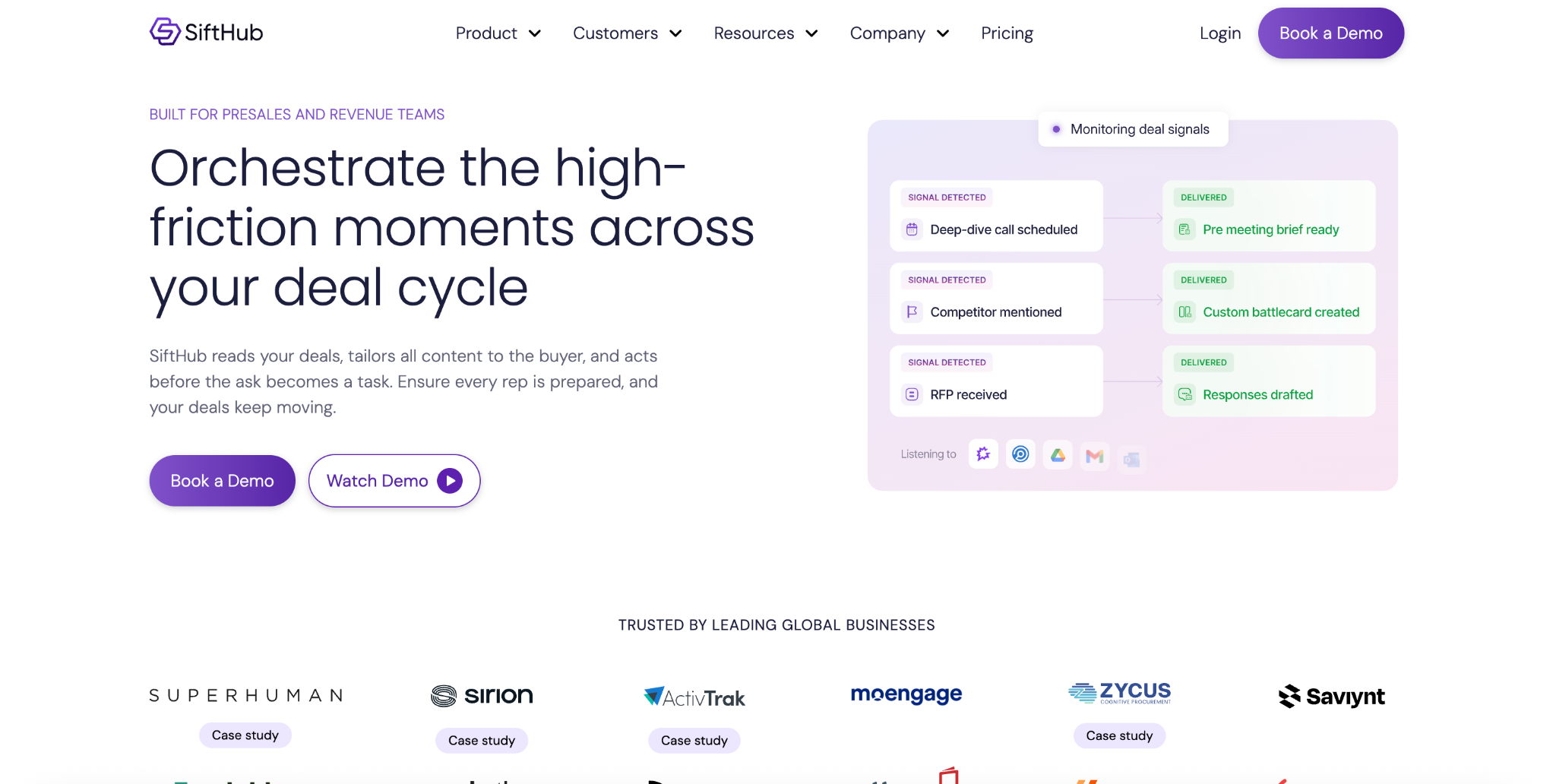
SiftHub is the best AI RFP software for B2B SaaS teams because it solves the 2 problems that hold every other tool back: the burden of library maintenance and the lack of live deal context.
Most RFP tools require someone to continuously build, tag, and update answers as your product evolves. As volume grows, so does that work. Fill rates drop the moment maintenance lags. SiftHub eliminates that entirely. It connects to your live GTM stack, including Gong, Salesforce, Google Drive, Slack, and SharePoint, and generates responses based on actual deal history. There is no library to maintain. The knowledge source is always current.
The second problem SiftHub solves is deal specificity. Every other tool generates answers from a static source. SiftHub captures what your team learned in discovery, the buyer's industry, their use case, and the concerns raised on calls, and that context shows up in the response. Answers sound like your best rep wrote them for this deal. Not like someone pulled them from a folder.
Best for: B2B SaaS presales and revenue teams that need to scale RFP output without increasing admin overhead. Also, the right choice for teams that want a single platform for RFPs, proposals, deal briefs, and sales collateral, rather than a stack of point tools.
Key capabilities:
- High-volume RFP automation without library maintenance: Handles large, growing RFP volumes without the upkeep that degrades every library-based tool. Autofill rates of 80–90% from connected, always-current knowledge. As volume grows, accuracy improves, and admin time decreases. Works natively in Word, Excel, Google Docs, and browser portals. No import/export loops. Source attribution on every answer.
- Live deal context in every response: Connects to Gong, Salesforce, Slack, and document systems. When an RFP lands, SiftHub already knows what this buyer cares about: their industry, deal stage, and discovery concerns. That context shapes the response. No other tool in this list does this.
- Full RFP lifecycle management: Reads the full intake document, including appendices, buried requirements, and scattered deadlines, and generates a structured checklist before drafting begins. Bid/no-bid analysis, requirement extraction, one-click autofill, approval routing, and submission coordination in one workspace.
- Full deal cycle coverage: Pre-call briefs from CRM and call data. Post-call follow-ups. Battlecards that update when competitors are mentioned on calls. Sales-to-CS handover documents are triggered at deal close. Role-specific views for AEs, SEs, CS, and leadership.
- Sales collateral builder: Deal-specific solution stories, proposals, POV decks, and ROI one-pagers, generated from live CRM and call data, not generic templates.
- Project orchestration: Task assignments, approval routing, milestone tracking, and submission coordination, purpose-built for complex RFP projects with multiple stakeholders.
Proof points: Allego achieved 90% autofill and 8x faster RFP turnaround. Superhuman saved 8+ hours per person per week. Sirion handled 1.5x as many RFPs per month and met a 48-hour SLA.
Honest limitation: SiftHub is newer than Loopio or Responsive. Teams without an existing CRM, call recordings, or a document repository will see less immediate lift.
Pricing: Custom. Contact SiftHub for a quote.
Security: SOC 2 Type II, ISO 27001, and VAPT certified. Granular RBAC, SSO, full audit trails, and region-aware data residency for healthcare, BFSI, and regulated industries.
2. Responsive
What is Responsive? Responsive (formerly RFPIO) is an enterprise RFP platform for organizations running 20+ concurrent RFPs across multiple departments.
Best for: Large enterprises with a dedicated proposal team, high concurrent volume, and a Proposal Manager who can govern a large content library.
Key capabilities: Multi-department SME routing, Gantt chart project management, multi-language support, win rate analytics, GovCloud hosting, public API on Growth plans.
Honest limitation: Answers come from a manually maintained library, not live CRM or call context. Responses can feel generic on complex questions. Library burden scales with volume. Pricing is opaque. Premium onboarding and migration are paid add-ons.
Pricing: Not published. Third-party data indicates $7,000–$28,000/year. The average buyer pays ~$13,955/year.
3. Qvidian
What is Qvidian? Qvidian is an enterprise RFP and proposal management tool, part of Upland Software. It's one of the older tools in this category, most commonly found in large enterprises that adopted it before AI-native alternatives existed.
Best for: Large enterprise teams already using Upland products with a dedicated proposal operations function.
Key capabilities: Centralized content library, workflow automation for multi-stakeholder reviews, template management, Salesforce, and Microsoft Office integration.
Honest limitation: Widely regarded as a legacy tool. Interface is less intuitive than modern alternatives. AI capabilities lag behind Responsive and SiftHub. Accuracy degrades without active content governance.
Pricing: Enterprise pricing on request via Upland Software.
4. Steerlab
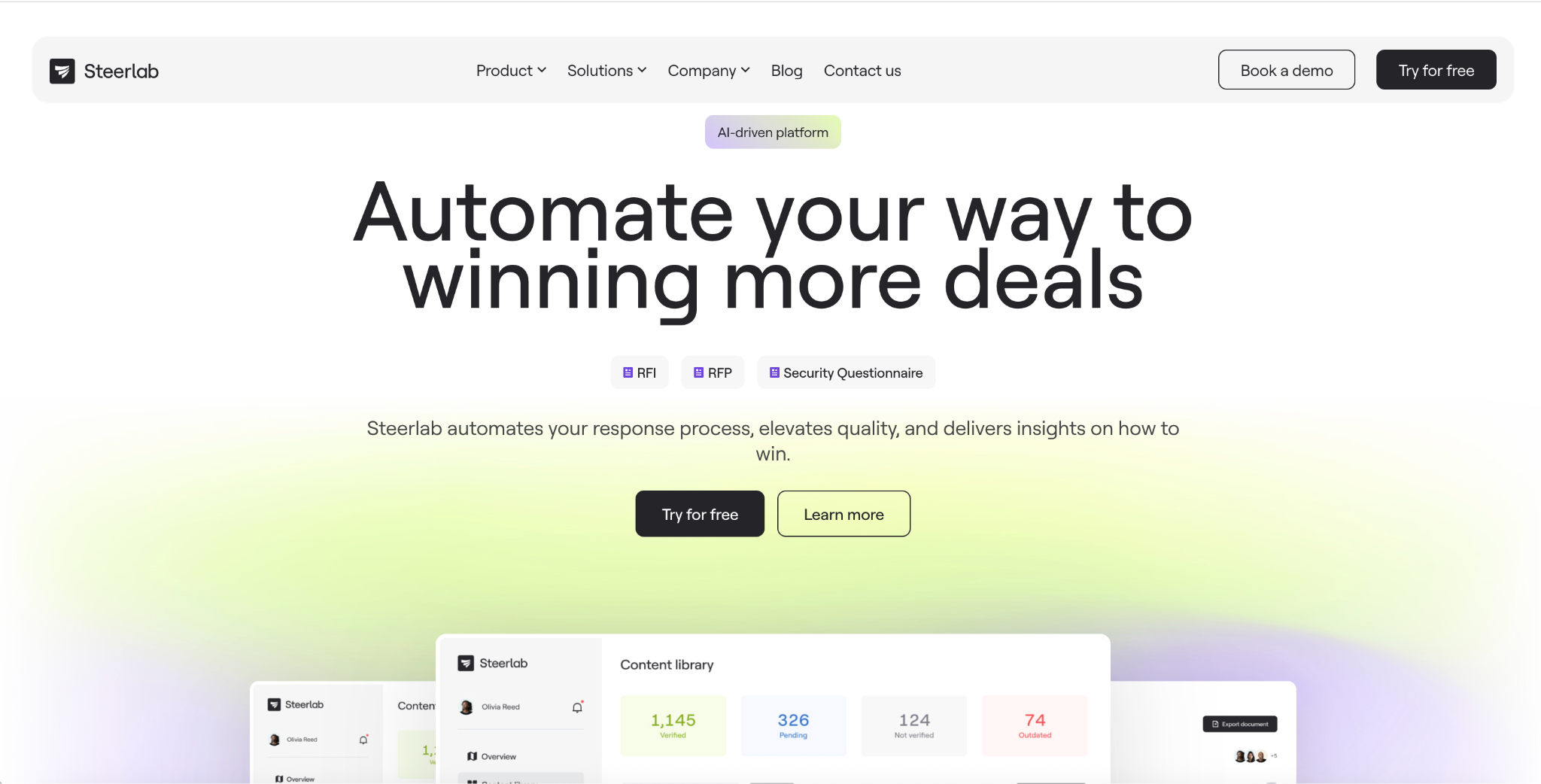
What is Steerlab? Steerlab is a newer AI-native tool that generates RFP answers from connected documentation. It doesn't require a manually built Q&A library, which puts it in the same architectural category as SiftHub.
The similarity ends there.
Steerlab covers RFP response only. It doesn't connect to the CRM or call recordings for live-deal context. It doesn't generate pre-call briefs, battlecards, proposals, or handover documents. Teams that start with Steerlab for RFP automation typically still need separate tools for the rest of the deal cycle.
For teams that need RFP-only automation and are not yet ready for a full deal orchestration platform, Steerlab is worth evaluating. For teams that need live deal context and full deal-cycle coverage, SiftHub is the better choice.
Best for: Small teams with low RFP volume who want an AI-native setup and have no immediate need beyond questionnaire response.
Honest limitation: Limited enterprise compliance track record. No live CRM or call recording integration. RFP-only scope means you're still building a separate stack for everything else.
Pricing: Not publicly listed. Contact Steerlab directly.
5. 1Up
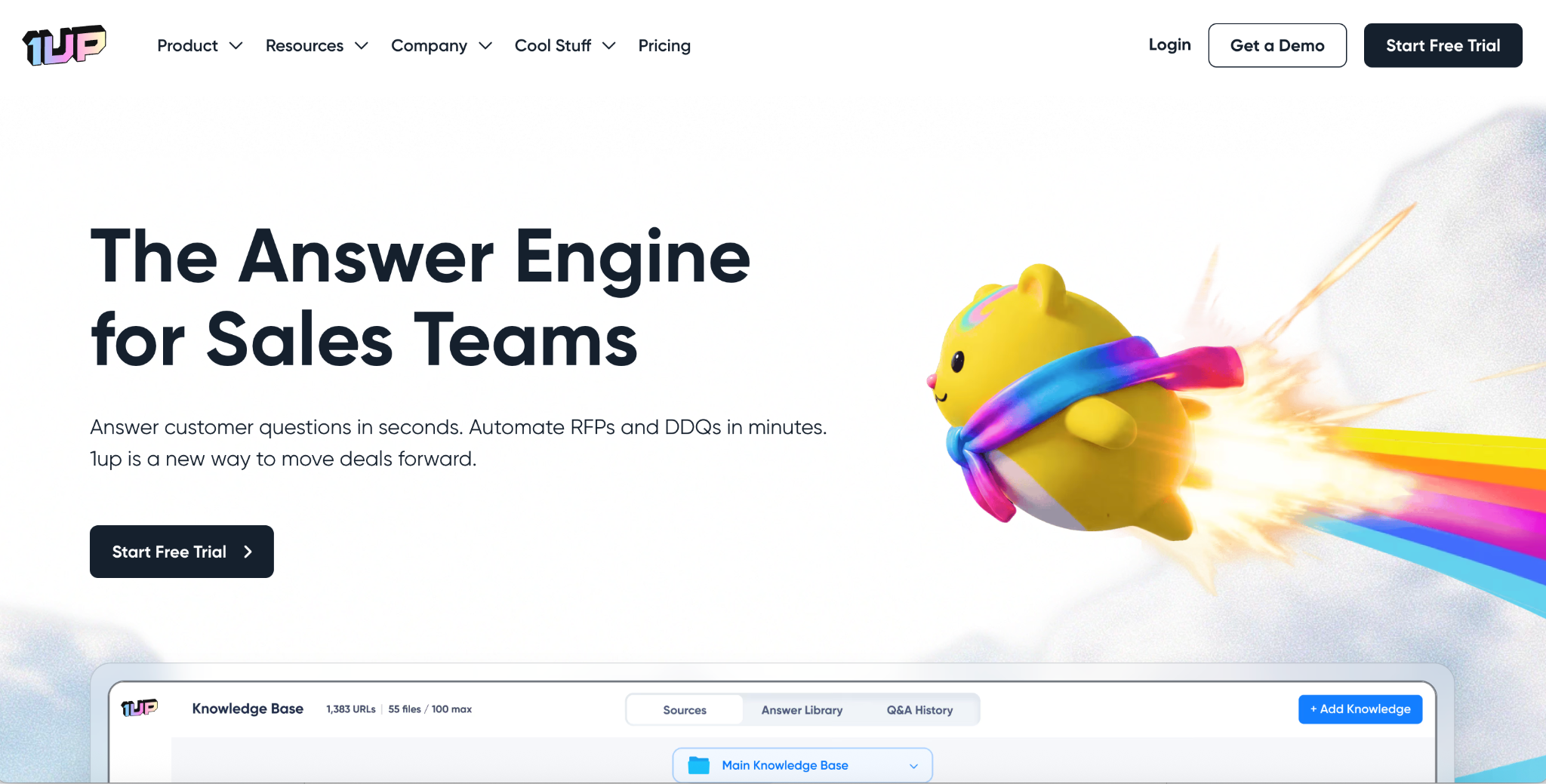
What is 1Up? 1Up is a lightweight, AI-native RFP and security questionnaire tool that reads existing connected documentation automatically, rather than requiring a manually built content library, putting it in the same architectural category as SiftHub and Steerlab, at a smaller scope and price point.
1Up's pricing is unusually transparent for this category: published tiers running $250–$850/month (Starter, Plus, Pro), plus a custom Enterprise tier, with a 14-day free trial and no sales call required to see a number. Plans are capped by annual questionnaire volume rather than seat count, unlimited collaborators are included on every tier, and it integrates with Salesforce, Slack, SharePoint, Teams, Confluence, and Chrome.
Best for: Small to mid-sized SaaS teams with limited RFP volume who want transparent, self-serve pricing and don't need CRM- or call-connected deal context.
Honest limitation: No live CRM or call recording integration, so responses don't reflect deal-specific context the way SiftHub's do. Questionnaire volume caps mean teams need to model actual usage before choosing a tier, or risk a mid-year forced upgrade. RFP-only scope, like Steerlab, doesn't extend into deal briefs, battlecards, or handover documents.
Pricing: $250–$850/month across three published tiers; custom Enterprise pricing available.
6. Proposify
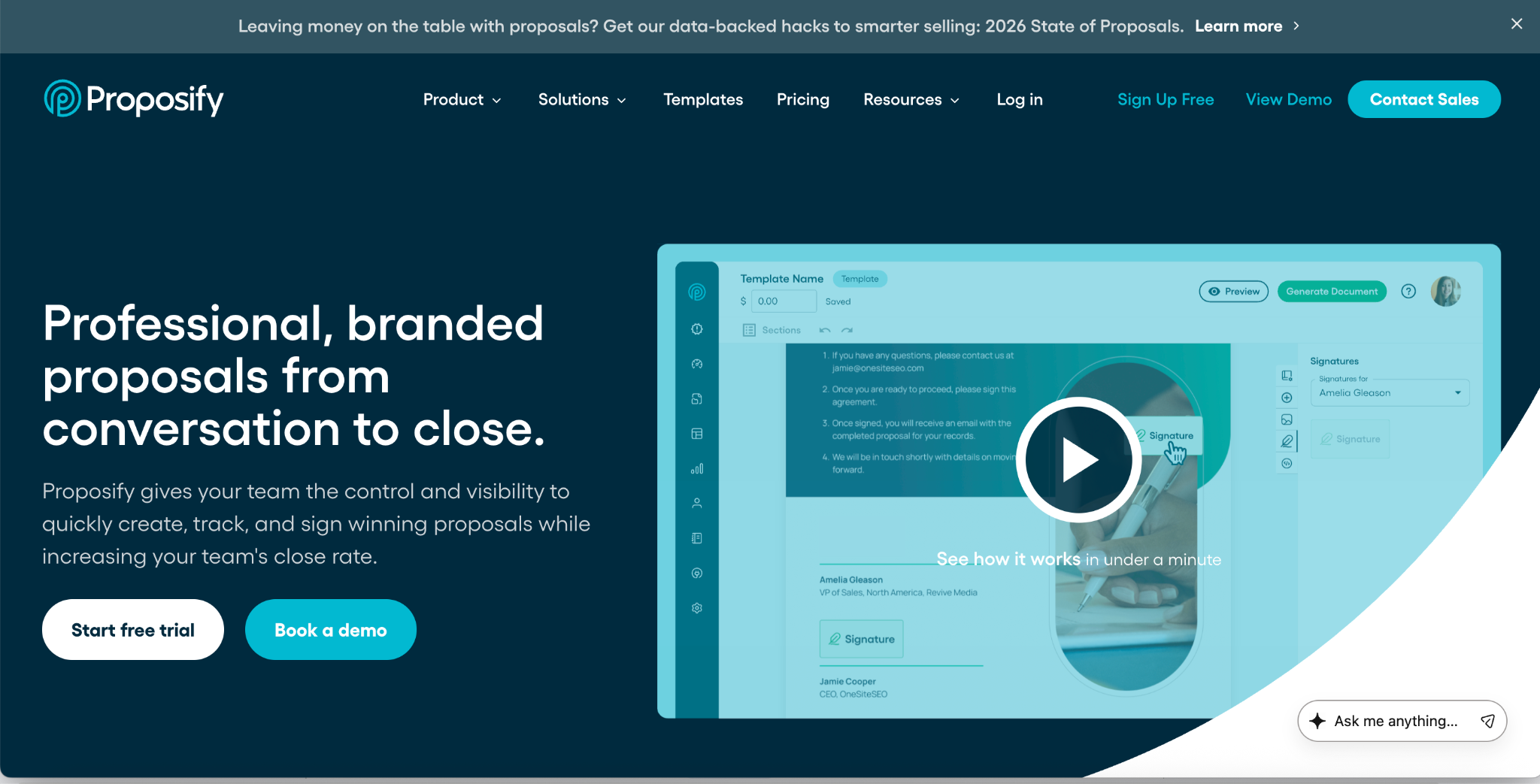
What is Proposify? Proposify is a proposal design and delivery tool, not an RFP automation platform.
Best for: Teams whose core problem is that final proposals look inconsistent or unprofessional. Not suited for questionnaire automation or high RFP volume.
Key capabilities: Design-locked branded templates, interactive pricing tables, proposal open tracking, and built-in e-signature.
Honest limitation: Cannot auto-answer RFPs or security questionnaires. No CRM or call recording integration. Wrong tool for compliance-heavy submissions. The right tool if your proposals look worse than competitors'.
Pricing: Starts at $49/month per user. Team and enterprise plans available.
How to choose the right SaaS RFP software for your team
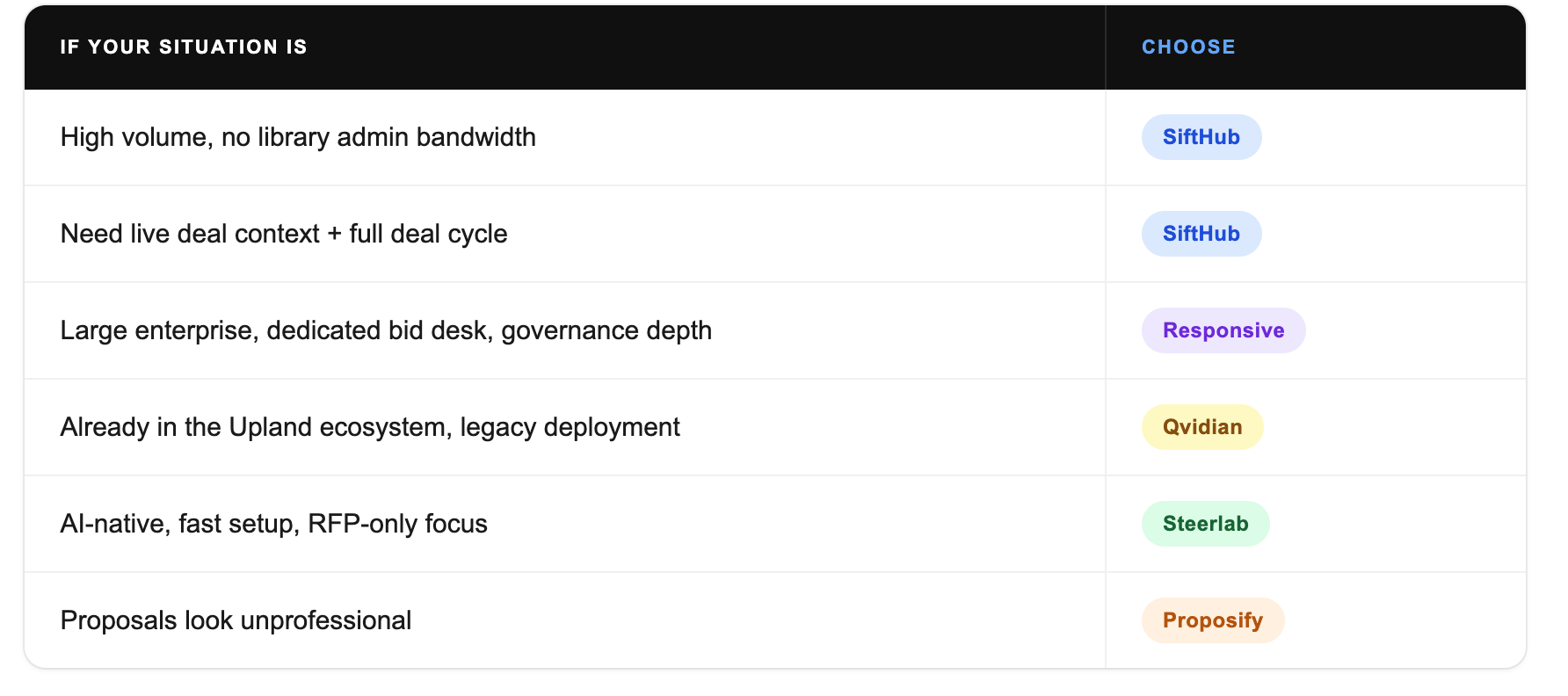
Final words on the best SaaS RFP software
Most RFP tools require maintenance that grows with volume. SiftHub is the best SaaS RFP software for B2B teams in 2026 because it eliminates that requirement, and it's the only tool that brings live deal context into every response.
For large enterprises with dedicated proposal teams, Responsive provides governance depth at scale. Qvidian suits teams already in the Upland ecosystem. Steerlab and 1Up are worth evaluating for AI-native teams that want a fast, RFP-only setup, with 1Up offering the more transparent, self-serve pricing of the two. Proposify belongs in your stack only if proposal design is the problem.
Book a 20-minute SiftHub demo and see week-one results.