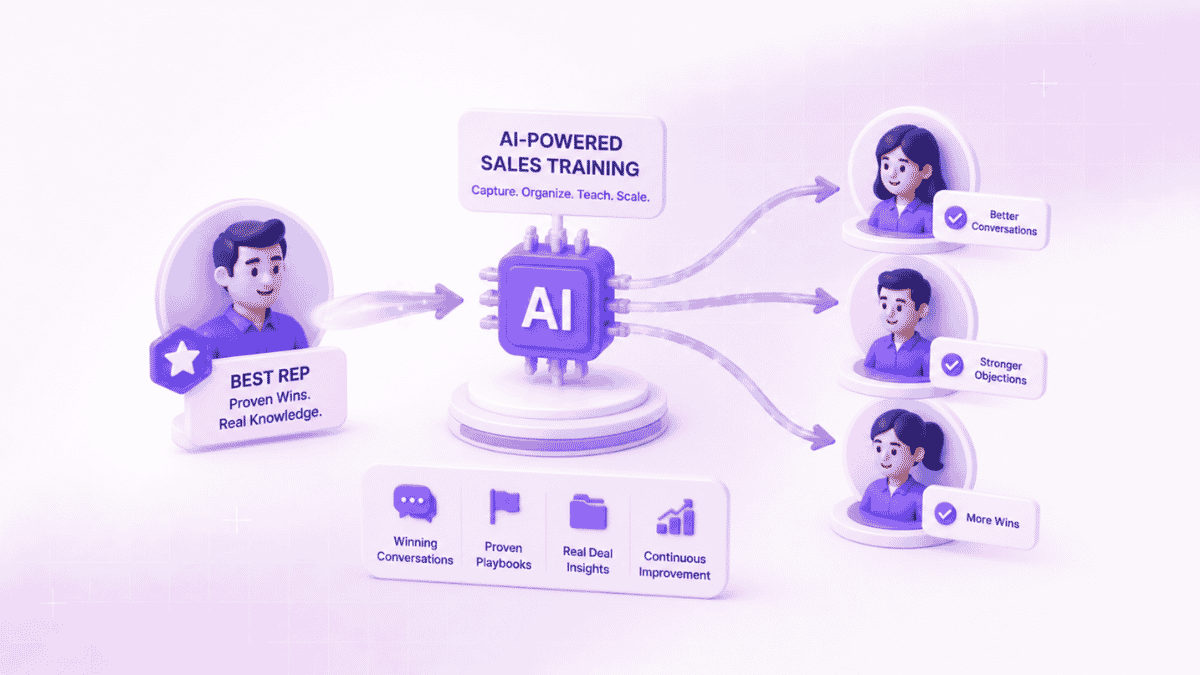




AI-powered sales training helps revenue teams scale top performers' knowledge across the entire organization. Instead of relying only on coaching and onboarding, companies are using AI to surface contextual deal intelligence, proof points, and competitive insights in real time.
- Traditional sales training improves selling behavior but fails to transfer contextual deal knowledge that top reps accumulate over the years.
- AI-powered knowledge systems integrate CRM notes, Gong recordings, Slack, proposals, and content libraries into a single searchable intelligence layer.
- Revenue teams use AI to surface the right case studies, competitive positioning, and technical answers during live deals and demos.
- AI-driven knowledge access shortens onboarding time by helping new hires retrieve proven answers and deal context instantly.
- Companies adopting knowledge-first enablement strategies improve rep productivity, reduce SME dependency, and scale best practices across the team.
AI-powered sales training helps revenue teams scale top performers' knowledge across the entire organization. Instead of relying only on coaching and onboarding, companies are using AI to surface contextual deal intelligence, proof points, and competitive insights in real time.
- Traditional sales training improves selling behavior but fails to transfer contextual deal knowledge that top reps accumulate over the years.
- AI-powered knowledge systems integrate CRM notes, Gong recordings, Slack, proposals, and content libraries into a single searchable intelligence layer.
- Revenue teams use AI to surface the right case studies, competitive positioning, and technical answers during live deals and demos.
- AI-driven knowledge access shortens onboarding time by helping new hires retrieve proven answers and deal context instantly.
- Companies adopting knowledge-first enablement strategies improve rep productivity, reduce SME dependency, and scale best practices across the team.
Every sales team has a version of the same problem. One rep consistently outperforms the rest. They know exactly which case study to use for a healthcare prospect. They handle pricing objections without hesitation. They walk into competitive evaluations already knowing what the buyer has heard from the other side. Ask them how they do it, and they'll say something like "I've just seen a lot of these deals."
That answer is the problem.
The knowledge driving elite performance isn't mysterious; it's accumulated. It's the objection handled well in deal 47 that became instinct by deal 80. It's the case study that landed perfectly in a healthcare demo three months ago. It's the competitive positioning that worked in a financial services evaluation last quarter. It exists. It's documented somewhere, in a Gong recording, a Slack thread, a closed-won CRM note, a proposal that went out and came back signed.
The gap between your best rep and the rest of your team isn't talent. It's access.
AI-powered sales training is changing how teams close that gap, not by teaching reps to behave differently, but by giving every rep access to the knowledge that makes the best performers look effortless.
Why traditional sales training fails to close the performance gap
Sales training has always attempted to solve the knowledge transfer problem. Onboarding programs, call shadowing, playbook documentation, LMS platforms, coaching software, the category has been evolving for decades.
The results are consistent: ramp times are still measured in months, knowledge retention after training drops sharply within weeks, and the gap between top and bottom performers persists regardless of training investment.
The reason is structural. Traditional sales training tries to teach reps how to sell. It focuses on behaviors, how to open a discovery call, how to handle objections, and how to run a demo. This is valuable, but it misses the layer that actually separates elite performers from the rest.
What separates a top rep isn't primarily behavior. It's situational knowledge, knowing which specific proof point resonates with a manufacturing CFO, which competitive angle lands against a specific competitor, and which implementation concern to address before the prospect raises it. This knowledge is contextual, dynamic, and specific to the deal in front of them.
Training programs transfer behavioral frameworks. They can't transfer the accumulated contextual knowledge that a top performer has built over hundreds of deals, because that knowledge lives in recordings, CRM notes, past proposals, Slack threads, and email chains. It's not structured enough to put in a playbook. It updates too frequently to stay current in an LMS. And it's too specific to be useful as a generalization.
The result: a rep finishes onboarding knowing how to run a discovery call but still lacking the specific knowledge needed to win the deal in front of them.
The two layers of the sales knowledge problem
To fix the performance gap, it helps to separate the problem into two distinct layers because they require different solutions.
Layer 1: Behavioral knowledge
How to structure a discovery call. How to run a demo. How to navigate a multi-stakeholder deal. How to negotiate commercial terms. This is trainable, coachable, and relatively stable. Traditional sales training, coaching platforms, and call recording tools address this layer reasonably well.
Layer 2: Contextual knowledge
Which case study matches this prospect's profile? What is the competitor's weakness in this specific vertical? What objection the IT lead typically raise at this deal stage? What language does the best rep use when positioning against a specific alternative? This knowledge is deal-specific, constantly updating, and impossible to fully capture in a static training program.
Most sales teams invest heavily in layer 1. They underinvest dramatically in layer 2, often because they assume it can't be systematized. The best performers seem to have it intuitively because they've been exposed to enough deals to internalize it.
AI changes this assumption entirely. The contextual knowledge that top performers have accumulated doesn't have to live only in their heads. It lives across your connected systems — CRM, Gong call recordings, Google Drive, Confluence, Slack, past proposals, and approved Q&A libraries. The question is whether it's accessible to every rep at the moment they need it, or buried in systems nobody has time to search.
What AI-powered sales training actually looks like in practice
The most impactful AI applications in sales training aren't replacing traditional coaching. They're solving the contextual knowledge problem that training has never been able to address.
Real-time knowledge access during live deals
A rep is in a discovery call. The prospect mentions they're also evaluating a direct competitor. In the past, the rep either knew the competitive positioning from memory or didn't. Now, a query to an AI system connected to your CRM, Gong recordings, Slack, and content library surfaces the specific competitive angles that have worked in similar deals, the objections that typically arise, and the proof points most likely to resonate in seconds, without leaving the call flow.
This isn't training in the traditional sense. It's making the knowledge the best rep has memorized available to every rep, on demand, in the moment they need it.
Surfacing the right proof point for the right buyer
One of the most consistent gaps between top and average performers is proof point selection. Top performers know which customer story to use for which prospect. Average performers default to the two or three case studies they remember from onboarding.
AI systems connected to your full knowledge base, such as case studies, customer call recordings, CRM win notes, and past proposals, surface the most relevant proof point for any given deal automatically. Query by industry, company size, use case, or competitive context and get the closest match from everything your team has ever produced and documented.
Zycus experienced this directly. Before implementing a connected knowledge system, their presales reps defaulted to the same handful of customer examples regardless of the prospect's industry. With instant access to a full case study library surfaced by context, reps could say in any demo: "We've done this in your industry, here's exactly what we achieved." That specificity established credibility that generic proof points never could. The result was a 1.5x productivity improvement per rep within five months.
Onboarding that compresses ramp time
New rep ramp time is one of the most expensive and persistent problems in sales organizations. The reason the ramp takes months isn't primarily behavioral; most reps can learn the sales process reasonably quickly. The reason is contextual knowledge accumulation: learning what works for which buyer, which objections arise when, which competitive situations require which responses.
When new reps have instant access to the same knowledge base the best performer has built over years, through the same connected systems, the same AI-surfaced insights, the same deal intelligence, they accumulate contextual knowledge in weeks rather than months. They're not waiting to see enough deals to internalize patterns. The patterns have already surfaced for them.
Congruent Solutions cut their response time to clients and prospects by 10x after giving their entire team access to a unified knowledge layer. New team members could answer questions that previously required escalation to senior colleagues, because the knowledge was accessible rather than tribal.
Post-call coaching grounded in deal reality
Traditional coaching reviews call recordings and evaluates rep behavior. AI-assisted coaching goes further, connecting what was said on the call to deal context, surfacing missed opportunities, and identifying the specific knowledge gaps that cost the rep momentum in that conversation.
When a rep fails to address a security concern that came up in the call, an AI system connected to your compliance documentation, past security questionnaire responses, and Gong recordings can identify not just that the concern was missed, but provide the exact verified answer the rep should have given, grounded in approved internal content, not generated from scratch.
The knowledge access gap your training investment isn't closing
Sales enablement teams spend significant resources on training programs, playbooks, and coaching tools. Most of this investment addresses layer 1, behavioral frameworks, and process knowledge.
The return on this investment is consistently limited by a problem that training can't fix: reps can't execute the behaviors they've learned if they don't have access to the specific knowledge those behaviors require.
A rep who knows how to handle a pricing objection still needs to know your actual pricing rationale, the comparable customer ROI that justifies the investment, and the specific competitive comparison relevant to this buyer. A rep who knows how to run a competitive positioning conversation still needs current, accurate intelligence on the specific competitor being evaluated.
The bottleneck isn't behavior. It's knowledge access.
This is where the performance gap between your best rep and the rest of your team actually lives. Your top performer has developed fast, reliable access to the right knowledge at the right moment. They've built mental indexes over years of deals — CRM notes scanned, proposals reviewed, call recordings absorbed. Everyone else is searching.
The investment that closes this gap isn't more training. It's giving every rep the same access your best performer has, but instantly, from a connected, verified knowledge layer that covers everything your organization knows, updated in real time as new deals close and new knowledge accumulates.
How SiftHub makes your best rep's knowledge accessible to everyone
SiftHub addresses the contextual knowledge layer that training alone can't solve, by connecting to the systems where your best reps' accumulated knowledge actually lives and making it instantly accessible to every rep on the team.
When a rep needs to know how to position against a specific competitor in a financial services deal, SiftHub’s AI Teammate searches across connected sources, CRM win/loss notes, Gong call recordings, Slack threads, Google Drive, Confluence, past proposals, and approved content libraries, and surfaces the specific intelligence that has worked in comparable situations. Not a generic competitive framework. The actual positioning your best reps have used, in deals like this one, with buyers like this one.
When a new hire needs to answer a technical security question on a call, SiftHub's answers are available without opening a separate platform, directly inside Slack, through a browser extension, or inside Microsoft Teams. Admins can organize knowledge into collections, pre-defined sets of sources scoped by topic, team, or use case, so instead of searching across every file and folder your organization has ever created, a rep queries the security collection and gets a verified answer from exactly the right documentation in seconds. They give the same answer your most experienced SE would give, without needing to pull that SE off another deal to ask.
When the whole team needs consistent, current access to proof points, competitive intelligence, and product knowledge, enterprise search allows you to search through connected sources such as Google Drive, SharePoint, Confluence, Slack, Salesforce, Gong, Zendesk, and more, so the answer to any question is found in seconds rather than discovered by whoever has been at the company long enough to know where to look.
The knowledge your best rep has accumulated isn't locked in their head. It's distributed across your systems. SiftHub makes it accessible to everyone else, at the moment they need it, inside the tools they're already using.
Breadth of adoption is what makes it stick: the average SiftHub account has 5 distinct persona types active, and accounts with 3 or more active users see stronger retention and expansion than single-user accounts.
Superhuman diverted 50% of sales team queries to SiftHub, answered directly inside Slack without anyone leaving the conversation, reclaiming more than 8 hours per rep per week that were previously spent searching, asking colleagues, or going without the answer entirely. That's not training. That's knowledge access, and it scales in a way that training programs never can.
Building a knowledge-first sales enablement strategy
For sales enablement leaders looking to close the performance gap, the most effective approach combines both layers, behavioral training and contextual knowledge access — rather than treating them as alternatives.
Audit where contextual knowledge is currently breaking down. The clearest signal is when reps escalate to SMEs, top performers, or managers for answers. Every escalation is a data point: what knowledge is missing, at what stage of the deal, for which buyer profile. That's where the knowledge access gap is costing you the most.
Map your knowledge to connected systems. The contextual knowledge your best reps rely on already exists in your organization, in Gong recordings, CRM notes, past proposals, Slack conversations, and content libraries. The question is whether it's indexed and accessible or siloed and searchable only by people who already know where to look.
Separate what needs training from what needs access. Behavioral frameworks benefit from deliberate coaching and practice. Contextual knowledge, proof points, competitive intelligence, technical specifications, compliance language, and benefits from instant access. Investing training time in teaching reps to memorize things they could query in seconds is an inefficient use of both the trainer's and the rep's time.
Measure knowledge access separately from training completion. Most sales enablement metrics track training completion rates and assessment scores. These measures whether reps absorbed behavioral frameworks. They don't measure whether reps can access the right knowledge at the right moment in a live deal. Add metrics that capture knowledge utilization, how often reps retrieve verified answers, whether proof points are matched to buyer profiles, and how quickly they can answer buyer questions without escalation.
Conclusion
The performance gap between your best rep and the rest of your team has two causes — not one. Behavioral gaps are addressable through training and coaching. Contextual knowledge gaps are addressable only through access.
Most sales enablement investments address the first cause. The second cause, the accumulated deal intelligence, competitive positioning, and buyer-specific knowledge that top performers have built over years of exposure, remains locked in the heads of individuals, in recordings nobody has time to watch, in Slack threads nobody can find, and in CRM notes that don't surface when they're needed.
AI changes that. The knowledge your best rep has doesn't have to stay with them. It can be indexed, connected, and made available to every rep on the team, at the moment they're in a deal that needs it, inside the tools they're already using, grounded in verified content rather than approximated from memory.
Training makes reps better. Knowledge access makes every rep as informed as your best one.