



.avif)

An AI RFP writer is software that generates first-draft responses to RFPs, DDQs, and security questionnaires by retrieving from an organization's connected knowledge sources. The best AI RFP writers produce substantially complete first drafts that human writers refine for strategy, voice, and buyer-specific positioning. This guide explains what AI RFP writers actually do well, what they still need humans for, and how to choose the right tool for your team's specific situation.
Key takeaways:
- An AI RFP writer handles the retrieval and drafting work that consumes most of a human writer's time, searching for content, assembling it into a coherent first draft, checking for compliance gaps
- AI RFP writers produce first drafts; human writers produce winning proposals. The distinction matters because the strategic work — win themes, buyer-specific positioning, and competitive differentiation are where human judgment still determines outcome
- Generative AI adoption within proposal teams has doubled in just one year, rising from 34% to 68%, making AI RFP writing an operational baseline rather than an experimental advantage
- The most important feature to evaluate is not writing speed but source attribution. AI writers that trace every answer to a verified document produce more trustworthy drafts than those that generate plausible-sounding answers without citation
- SiftHub, AutogenAI, Loopio, Arphie, and AutoRFP.ai are the most evaluated AI RFP writer platforms in 2026; each produces first drafts differently and serves a different team profile
An AI RFP writer is software that generates first-draft responses to RFPs, DDQs, and security questionnaires by retrieving from an organization's connected knowledge sources. The best AI RFP writers produce substantially complete first drafts that human writers refine for strategy, voice, and buyer-specific positioning. This guide explains what AI RFP writers actually do well, what they still need humans for, and how to choose the right tool for your team's specific situation.
Key takeaways:
- An AI RFP writer handles the retrieval and drafting work that consumes most of a human writer's time, searching for content, assembling it into a coherent first draft, checking for compliance gaps
- AI RFP writers produce first drafts; human writers produce winning proposals. The distinction matters because the strategic work — win themes, buyer-specific positioning, and competitive differentiation are where human judgment still determines outcome
- Generative AI adoption within proposal teams has doubled in just one year, rising from 34% to 68%, making AI RFP writing an operational baseline rather than an experimental advantage
- The most important feature to evaluate is not writing speed but source attribution. AI writers that trace every answer to a verified document produce more trustworthy drafts than those that generate plausible-sounding answers without citation
- SiftHub, AutogenAI, Loopio, Arphie, and AutoRFP.ai are the most evaluated AI RFP writer platforms in 2026; each produces first drafts differently and serves a different team profile
What is an AI RFP writer?
An AI RFP writer is software that uses artificial intelligence to generate first-draft responses to Requests for Proposals, RFIs, DDQs, security questionnaires, and vendor assessments. Rather than a human writer starting from a blank page, the AI reads the incoming document, identifies what each question is asking, searches connected knowledge sources for relevant content, and produces a structured draft that human reviewers then refine and approve.
The term covers a wide range of capabilities. At the basic end, an AI RFP writer is a search-and-insert tool that finds pre-written answers in a content library and populates them into the right sections. At the more sophisticated end, it connects to live sources — CRM records, Gong call transcripts, Google Drive, Confluence, SharePoint, Slack — retrieves the most relevant content for each question specifically, attributes every answer to its source, and flags what it cannot confidently answer rather than generating something plausible but unverifiable.
The gap between these two types of AI RFP writers is large, and it is not visible in feature lists or demo videos. It becomes visible in production when a submitted response contains a certification that expired six months ago or when two sections contradict each other because the AI pulled from two different versions of the same document.
What an AI RFP writer actually does well
Elimination of blank-page time
The most consistent productivity gain from AI RFP writers is the elimination of the starting problem. A human writer facing a 150-question RFP spends the first several hours simply assembling material — finding last year's response to a similar question, tracking down the security certification document, and locating the case study that matches this buyer's industry. An AI RFP writer does this in minutes. The best platforms cover 60–90% of a first pass with AI — meaning teams spend time reviewing and refining instead of starting from scratch every single time.
This shift from creation to refinement is where most of the productivity gain lies. The human writer's time moves from information retrieval (low-value, high-volume) to strategic editing and customization (high-value, lower-volume).
Consistency across contributors
When three people contribute to the same RFP — security, legal, and solutions engineering, they will answer overlapping questions using slightly different language, different statistics, and different framings of the same capability. AI RFP writers that pull from a governed knowledge source ensure that the same approved language is used consistently across sections, regardless of who contributed which answer.
This consistency matters most in regulated industries and government procurement, where evaluators specifically look for contradictions as signals of operational immaturity.
Compliance matrix generation
Most AI RFP writers extract mandatory requirements from the intake document and map them to response sections, producing a compliance matrix that confirms every requirement has been addressed before human review begins. This is mechanical work that previously consumed hours of a proposal manager's time and was error-prone under deadline pressure. Automated compliance checking reduces the risk of procedural disqualification from missed requirements.
Format compatibility
Enterprise buyers issue RFPs in Excel, Word, PDF, and increasingly through procurement portals that require direct browser-form completion. AI RFP writers that handle all of these formats without requiring conversion, and that can fill portal forms directly via browser extension, eliminate the formatting overhead that compounds across high-volume response workflows.
What an AI RFP writer still needs humans for
Win theme development
An AI RFP writer retrieves what the organization has said before. It cannot determine what the organization should say to this specific buyer in this specific competitive context. Identifying the three reasons this buyer should choose your organization over the two competing finalists, and weaving those reasons consistently through every section of the response, requires competitive intelligence, account knowledge, and strategic judgment that AI cannot currently replicate.
The proposals that win on competitive evaluations are rarely the most comprehensive. They are the most strategically coherent. That coherence is a human contribution.
Buyer-specific contextualization
A generic answer about the implementation timeline is factually accurate. An answer that references what the buyer's operations lead said about their integration constraints on the discovery call three weeks ago is strategically differentiated. Some AI RFP platforms can surface what was said on prior calls when prompted,, but the judgment about which context to emphasize, and how to frame it, remains with the human writer.
Novel and complex questions
Approximately 60–90% of questions in most RFPs have reasonable answers in existing documentation. The remaining 10–40% — questions about capabilities the organization has not documented, situations that require fresh reasoning, or questions that deliberately probe edge cases- require human expertise. AI writers that acknowledge this honestly and flag these questions for human input produce more trustworthy drafts than those that generate plausible answers for every question, regardless of source availability.
Final approval and accountability
A submitted RFP response carries the organization's signature. Every claim about certifications, capabilities, implementation timelines, and pricing has legal and reputational weight. An AI can draft a claim. A human expert needs to verify it, approve it, and be accountable for it. The review stage is where human judgment is not optional; it is the control that separates AI-assisted accuracy from AI-generated liability.
How to evaluate AI RFP writers: what actually predicts output quality
Source attribution on every answer
The single most important feature in any AI RFP writer is not writing fluency — it is whether every answer is traced to a specific source. A draft that contains answers attributed to named documents (SOC 2 audit report, Q3 2025; Security Policy v4.2, updated January 2026) allows reviewers to verify claims in seconds. A draft that generates answers without attribution requires reviewers to independently research every factual claim, which is exactly the manual work the AI was supposed to eliminate.
Platforms that decline to answer questions they cannot source are more trustworthy than platforms that generate something plausible for every question. A blank field with a flag for human input is a better draft deliverable than a confidently wrong answer.
How it handles stale content
Security certifications expire. Pricing changes. Architecture evolves. An AI RFP writer pulling from a static library will eventually surface a certification that lapsed last quarter or a feature description that was deprecated before last year's product release. Platforms with expiry rules that automatically retire outdated content address this structurally. Platforms without this mechanism require manual content curation — which, in practice, means the liability of stale answers sits with whoever last updated the library.
What the SME contribution experience looks like
Most RFP responses require input from people who are not full-time proposal writers — security engineers, legal counsel, and finance leads. If getting their input requires them to learn a new platform, create an account, and navigate to an unfamiliar workspace, they will delay or skip their assignments. Platforms that deliver questions to SMEs through the tools they already use — Slack, email, browser portals- see higher participation rates and fewer missed deadlines.
Whether it covers questionnaire formats, not just narrative proposals
Many AI RFP writers were built for narrative proposal sections — structured essay responses to open-ended questions. A growing share of inbound requests arrive as Excel questionnaires, PDF forms, and browser-based procurement portals requiring direct form completion. Platforms that handle both formats from the same workflow are meaningfully more useful than those optimized for one.
The best AI RFP writer tools in 2026
- SiftHub: Best for presales and bid teams handling mixed response types
SiftHub generates first drafts by retrieving from connected live sources — CRM records, Gong call transcripts, Google Drive, Confluence, SharePoint, Slack, past submissions, and approved Q&A libraries, simultaneously, with every answer attributed to its source document, owner, and last modified date. If no verified source exists for a question, SiftHub will respond with ‘no information found’ rather than generate an unattributed response.
What makes the AI RFP writer different here: The draft reflects what is actually current in connected sources, not what was manually entered into a library at some point in the past. Expiry rules retire outdated content before it reaches the draft. Conflicts between contributors are flagged before human review rather than discovered in the submitted document.
SiftHub allows you to fill RFPs inside Excel questionnaires, Word documents, Google Docs, PDF forms, and browser-based procurement portals natively; the same response workflow covers all formats without conversion – no import and export.
When the response team is ready, the writer can prompt SiftHub's AI Teammate to surface buyer-specific context from CRM and Gong before the writing begins, which competitors raised on the last call, which concerns the buyer flagged, and which proof points are most relevant to their stated priorities. The first draft starts from deal intelligence rather than generic documentation.
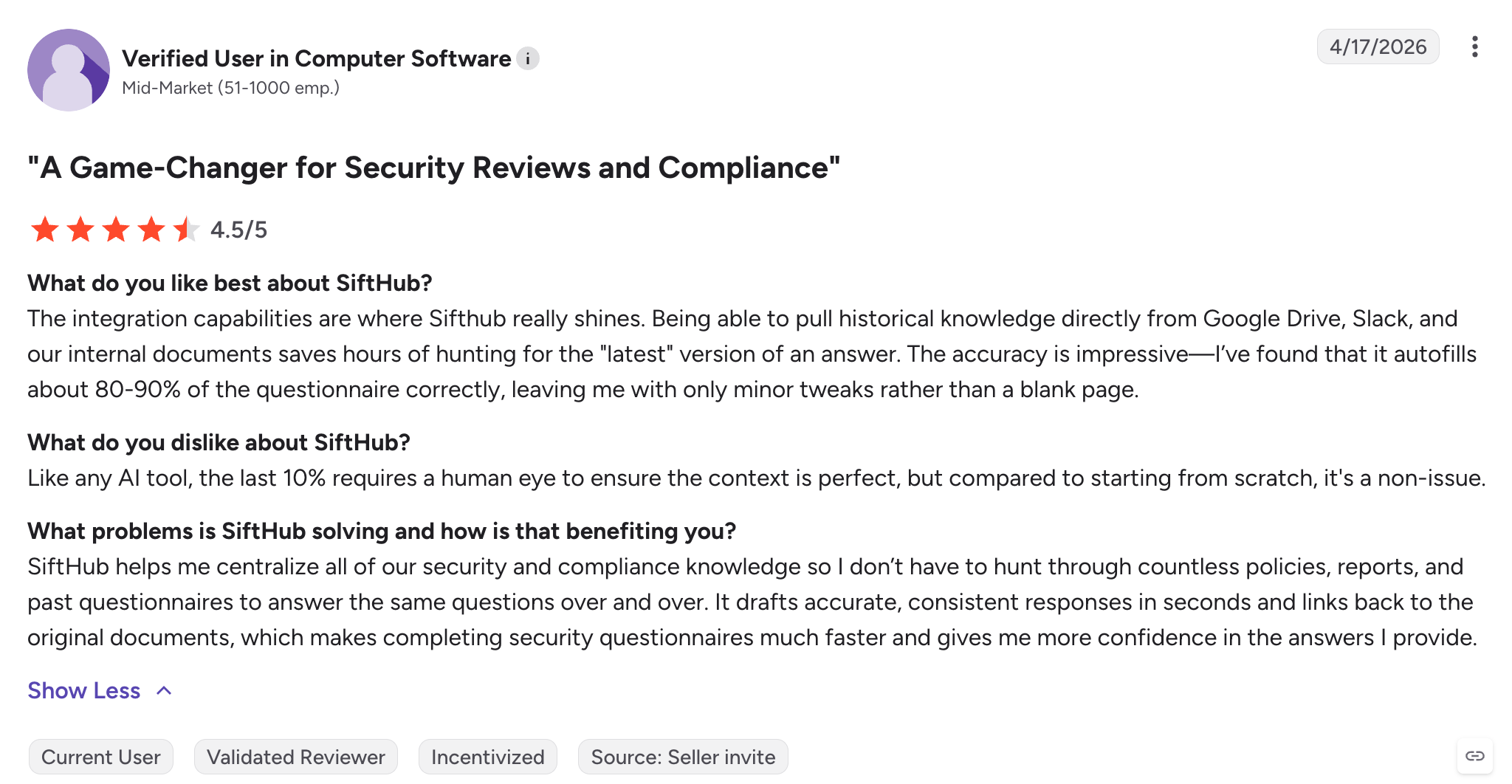
Best suited for: Presales, SE, and bid teams handling a mix of RFPs, security questionnaires, and DDQs who need one governed AI writing workflow for all of them, with live source retrieval rather than a maintained library.
See how SiftHub generates attributed first drafts
- AutogenAI: Best for narrative proposal writing quality
AutogenAI is the only platform backed by independent third-party research confirming a measurable revenue uplift. The MH&A study found a 19.5-percentage-point gap between AutogenAI users and non-users in the same period. It holds G2's Best ROI award for RFP software in both 2025 and 2026.
AutogenAI's primary differentiation lies in writing quality for complex, narrative-heavy proposals, particularly in government contracting and enterprise procurement, where evaluators assess prose quality and strategic coherence alongside technical compliance. Three AI engines generate content: creative AI for original persuasive narrative, a content library drawing on past proposals and case studies, and internet AI for real-time cited external data.
Honest limitation: Enterprise-priced with minimum seat commitments. Best value for teams with high-complexity narrative proposals rather than high-volume structured questionnaire workflows. No native CRM or Gong integration for deal context.
- Loopio: Best for teams with a well-maintained content library
Loopio's AI writing assistant was updated in 2026 with rephrasing, tone consistency, and duplicate/stale content detection. It holds a 4.7/5 G2 rating from over 700 verified reviews and serves more than 1,700 companies globally.
Loopio's AI writer works from the content library — surfacing the best-matched existing answer for each incoming question. Magic AI detects questions in new documents and suggests relevant library content automatically. A Chrome extension allows portal-based questionnaire completion without format conversion.
Honest limitation: Output quality tracks directly to library quality. Teams without a well-maintained, actively curated library will see inconsistent AI writer performance. Library maintenance is manual.
Arphie: Best for teams that want zero library setup
Arphie connects directly to Google Drive, Confluence, SharePoint, and Notion and generates first drafts from existing documentation without requiring a curated library to be built first. Confidence scoring and source attribution allow reviewers to understand why Arphie's AI answered the way it did, step by step.
Time-to-value is faster than library-based platforms — teams generate useful first drafts from day one after connecting existing documentation sources. The AI flags lower-confidence answers for review rather than presenting all outputs with equal authority.
Honest limitation: Output quality tracks directly to documentation quality and organization. Fragmented or outdated source files produce inconsistent results.
AutoRFP.ai: Best for financial services questionnaire volume
AutoRFP.ai is built specifically for high-volume questionnaire workflows, particularly investor DDQs and institutional questionnaires in financial services. Its AI updates the content layer automatically as contributors input answers, eliminating the manual curation cycle that burdens library-based platforms at scale.
Companies that use RFP software report an increase in win rates by up to 10%, but the real impact is productivity gains that compound over time. AutoRFP.ai's usage-based pricing scales with questionnaire volume rather than user count.
Honest limitation: Less established than Responsive or Loopio in terms of enterprise track record outside financial services. Teams handling narrative-heavy commercial proposals may find the platform optimized for structured questionnaire formats.
Getting the best output from an AI RFP writer
The teams that see the largest productivity gains from AI RFP writers are not those with the best AI; they are those with the best processes for working with it. Five things that consistently improve AI writer output:
Connect better sources. An AI RFP writer is only as good as what it draws from. Teams that connect current, well-organized documentation, updated security policies, current case studies, and recent customer outcome data — see meaningfully better first drafts than teams whose connected sources are fragmented and outdated. Improving source quality before deploying an AI writer is higher-leverage than optimizing the AI itself.
Do not skip the review stage. AI first drafts should be reviewed by someone with subject matter expertise in the relevant sections. Security answers reviewed by a security engineer. Technical claims reviewed by a solutions architect. The review stage is where human expertise adds most of its value, not in drafting, but in verifying and refining what the AI produced.
Build the compliance matrix at kickoff, not at review. Compliance matrix generation is where AI writers are most reliable. Using this capability at the beginning of the response cycle — to structure the response and confirm coverage — is more valuable than using it as a last-minute check before submission.
Treat unanswered questions as the highest priority. When an AI RFP writer flags questions it cannot answer from existing sources, those are the highest-priority items for human attention. The questions the AI cannot answer from documentation are typically the questions the evaluator cares most about — novel capabilities, competitive differentiation, specific proof points for this buyer's use case. Allocating human writing time to these questions rather than editing AI-generated boilerplate produces better overall proposals.
Use buyer context before generating. Platforms that incorporate deal intelligence — what was said on prior calls, which competitors were mentioned, and which concerns the buyer flagged — produce more buyer-specific first drafts. Prompting this before the AI generates the response, rather than editing it in afterward, produces structurally better drafts.
Conclusion
An AI RFP writer handles the work that consumes most of a human writer's time but produces the least strategic value: searching, retrieving, assembling, and formatting. Human writers handle the work that determines whether a proposal wins: strategy, positioning, buyer-specific contextualization, and final accountability for what goes out the door.
The teams that use AI RFP writers most effectively treat the first draft as exactly that — a first draft, not a finished proposal. They invest human attention in the questions the AI flagged as uncertain, the buyer-specific framing the AI cannot produce from documentation alone, and the strategic coherence that connects individual answers into a compelling overall case.
The right AI RFP writer is the one who handles their part of this division of labor well — generating attributed, traceable, current first drafts that give human writers something worth improving rather than something worth rewriting from scratch.