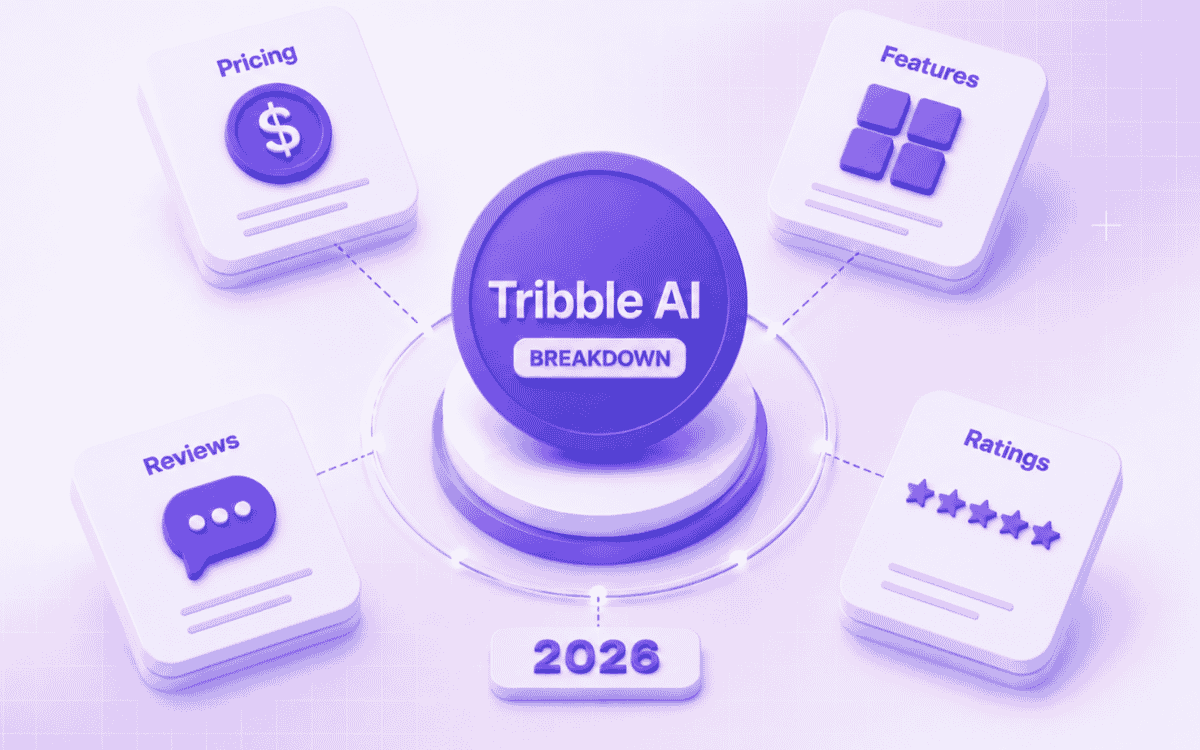




Tribble is an AI-native RFP response platform that uses retrieval-augmented generation (RAG) to generate answers from connected knowledge sources such as Gong, Slack, CRM systems, and enterprise documents. Its key strengths include outcome intelligence through Tribblytics, buyer-context personalization, and unlimited-user pricing. While it improves response quality and proposal efficiency, teams with complex coordination and governance needs may require a more comprehensive platform.
- Uses RAG to generate responses from Gong, CRM, Slack, documents, and past submissions.
- Tribblytics tracks win/loss outcomes and identifies patterns that contribute to successful deals.
- Unlimited-user pricing removes per-seat licensing barriers for occasional contributors.
- Strong G2 ratings and rapid deployment make it appealing for mid-market and enterprise teams.
- Unlike Tribble's answer-focused approach, SiftHub supports the full RFP lifecycle with bid/no-bid qualification, SME coordination, governance workflows, and real-time deal support through Pulse.
Tribble is an AI-native RFP response platform that uses retrieval-augmented generation (RAG) to generate answers from connected knowledge sources such as Gong, Slack, CRM systems, and enterprise documents. Its key strengths include outcome intelligence through Tribblytics, buyer-context personalization, and unlimited-user pricing. While it improves response quality and proposal efficiency, teams with complex coordination and governance needs may require a more comprehensive platform.
- Uses RAG to generate responses from Gong, CRM, Slack, documents, and past submissions.
- Tribblytics tracks win/loss outcomes and identifies patterns that contribute to successful deals.
- Unlimited-user pricing removes per-seat licensing barriers for occasional contributors.
- Strong G2 ratings and rapid deployment make it appealing for mid-market and enterprise teams.
- Unlike Tribble's answer-focused approach, SiftHub supports the full RFP lifecycle with bid/no-bid qualification, SME coordination, governance workflows, and real-time deal support through Pulse.
What is Tribble?
Tribble is an AI-native platform built to automate RFP and security questionnaire responses using retrieval-augmented generation (RAG). Rather than requiring teams to maintain a static answer library, Tribble dynamically generates responses by searching across connected knowledge sources in real time — documents, Gong call recordings, CRM data, Slack conversations, and past submissions.
Core positioning: "AI that gets smarter with every deal" through Tribblytics — a closed-loop learning system that connects submitted responses to won and lost outcomes, then adjusts which content is surfaced in future responses.
Architecture: AI-first from the ground up. The entire platform is built around generative AI and outcome learning rather than adapting AI onto an existing content library. Tribble's product suite includes Respond (proposal automation), Engage (call intelligence and coaching), Core (the unified knowledge layer), and Tribblytics (outcome intelligence).
Deployment: Cloud-based SaaS. Azure-hosted, SOC 2 Type II certified, GDPR compliant. 48-hour sandbox for validation, with most teams achieving approximately 70% automation within 14 days of connecting their knowledge base.
Who uses Tribble?
Tribble's design and positioning appeal to:
- Mid-market and enterprise sales and proposal teams (30–300 people)
- Organizations handling 10–100+ RFPs, DDQs, and security questionnaires annually
- Technology, SaaS, financial services, and healthcare companies facing complex buyer evaluation
- Teams using Gong — call intelligence is a core context signal for Tribble's answer generation
- Organizations that want to measure which responses actually contribute to winning deals
- Distributed teams where unlimited user access matters more than per-seat licensing
Less suitable for:
- Solo consultants or very small teams (1–5 people) — organizational learning doesn't compound at that scale
- Teams without call recording or Gong — loses the buyer-context personalization that differentiates Tribble
- Organizations requiring rigid governance and formal approval gates — Tribble's governance is lighter than enterprise platforms like Responsive
- Teams managing 100+ concurrent RFPs need full portfolio-level orchestration.
Tribble Features: What's included
Retrieval-augmented generation (RAG)
Tribble uses Retrieval-Augmented Generation (RAG) to create contextual answers from connected knowledge sources rather than relying on a static content library. Each response includes source citations, making verification and review easier while significantly reducing time spent drafting answers from scratch.
Tribblytics
Tribblytics is Tribble's analytics and win/loss intelligence layer. It tracks proposal outcomes, identifies patterns across successful and unsuccessful submissions, and surfaces insights that help teams refine future responses. It also enables users to ask business questions in natural language and receive data-backed answers and visual reports.
Gong call intelligence integration
Tribble integrates with Gong to incorporate buyer conversation data into response generation. By using insights from call recordings and transcripts, the platform can tailor answers to specific customer concerns discussed during the sales process. Tribble also offers a native call recording solution called Engage.
Core knowledge graph & auto-learning
The platform's Core knowledge layer continuously ingests information from connected systems and automatically updates when content changes. Approved responses are added back into the knowledge base, allowing Tribble to improve future answers without requiring extensive manual content maintenance.
Slack-native workflows
Subject matter experts can review and answer questions directly within Slack. Tribble captures approved responses from Slack conversations and incorporates them into proposals, reducing context switching and encouraging greater SME participation.
Multi-source knowledge integrations
Tribble connects with a wide range of enterprise systems, including Gong, Salesforce, SharePoint, Confluence, Google Drive, OneDrive, Slack, and uploaded documents. It also supports browser-based content capture from procurement and sourcing portals.
Governance & approval controls
The platform includes built-in governance features such as approval workflows, answer locking, audit trails, and role-based access controls. These capabilities help teams maintain response quality, ensure compliance, and track content ownership throughout the proposal process.
Tribble pricing: Plans and costs
Pricing model: Usage-based credits, not per-seat.
Tribble does not charge per named user. Instead, organizations purchase monthly credit packs, with credits consumed based on the number of questions processed, response length, and retrieval complexity. Specific pricing is not publicly listed — organizations engage Tribble's sales team directly.
The unlimited-user advantage: Every team member — sales engineers, product managers, legal reviewers, and regional sales leaders can participate without additional seat licensing. For organizations where many people contribute occasionally to RFP responses, this meaningfully changes the cost model compared to per-seat platforms.
What Tribble backs with no commitment: Per their published site, Tribble is backed by Salesforce Ventures' $500M Generative AI Fund and offers evaluation with no commitment required.
Challenges with usage-based pricing:
- Monthly credit consumption can be difficult to predict before the first few months of usage
- Requires estimating RFP volume and complexity in advance to select the right credit tier
- No published pricing makes budget modeling difficult before a sales conversation.
Tribble reviews: What users say
Tribble holds a 4.7/5 G2 rating across 151 verified reviews.
What reviewers praise
Unified messaging across teams. One G2 reviewer who deployed Tribble across Deal Desk, Sales, and Customer Success notes: "By using Tribble across these teams, we've created more unified messaging across the organization. The ability for these teams to rely on the same AI-powered knowledge source has improved alignment and boosted the quality and speed of our responses."
Speed and reduced manual assembly. G2 reviews consistently note that Tribble reduces the time teams spend on manual assembly and allows them to move into review sooner — the drafting step shrinks significantly with Tribble in place.
Slack integration eliminates context-switching. Reviewers praise the Slack-native workflow as a practical differentiator — SMEs contribute without leaving the tool they already use, removing a major friction point in getting expert input quickly.
Outcome learning creates a competitive advantage. Tribblytics — the win/loss tracking capability — receives specific praise from reviewers who describe the visibility into which responses actually help win deals as "transformative." One verified reviewer notes: "We stopped guessing and started knowing, which answers win, which positioning closes, which patterns predict success."
Source attribution on every answer. Reviewers value knowing exactly where every AI-generated answer comes from — document, section, and confidence score — making the human review step efficient rather than investigative.
What reviewers criticize
Governance is lighter than enterprise expectations. Verified G2 reviewers consistently note that Tribble's approval workflow capabilities are lighter than Responsive or Loopio for organizations with formal compliance requirements — legal sign-off chains, mandatory security reviews, and documented audit trails at enterprise scale.
Reduced value without Gong. Tribble's buyer-context personalization depends significantly on call intelligence. Teams without Gong or Engage lose the context-aware answer generation that differentiates Tribble from other AI drafting tools — responses become accurate but less deal-specific.
Portfolio visibility at scale has a learning curve. One G2 reviewer managing 28 active projects flags that navigating which project contains which assigned questions is non-intuitive at higher volumes — "It would be nice to have a view on the primary dashboard to check 'show projects where I have assigned questions.'"
Newer platform with fewer enterprise case studies. Tribble has a shorter track record than Loopio or Responsive, with fewer documented Fortune 500 deployments and case studies for teams where reference customers in their specific industry are a selection criterion.
What Tribble does exceptionally well
AI-native answer generation. Built for generative AI from the ground up rather than adding AI onto a content library, the architectural difference shows in how Tribble handles questions without existing answers versus tools that surface "no result found."
Outcome learning. Closing the loop between submitted proposals and deal results through Tribblytics is rare in the mid-market RFP category. Teams that use it can measure proposal ROI rather than assuming faster means better.
Unlimited-user pricing. When 50+ people occasionally need to contribute to an RFP response, per-seat pricing becomes a barrier to participation. Tribble's model removes that barrier.
Fast deployment. 48-hour sandbox, approximately 70% automation within 14 days — significantly faster than enterprise implementations of Responsive or Loopio that typically run weeks to months.
Slack-native contributor experience. Sales engineers and SMEs contribute without leaving their primary workspace.
Where Tribble reaches its limits
Answer generation only — not RFP process management. Tribble generates answers and tracks outcomes. It does not manage the full response lifecycle — bid/no-bid qualification, mandatory requirement extraction, multi-team deadline coordination, or pipeline-level visibility across all active submissions. Teams handling 50+ concurrent RFPs with coordination across security, engineering, legal, and commercial teams find they need a separate PM layer alongside Tribble.
Governance is lighter for regulated industries. Financial services, healthcare, and government contracting teams with formal compliance review requirements — mandatory sign-offs before security answers are submitted, legal review of contractual language — will find Tribble's current governance capabilities require supplementation.
Gong dependency for full value. Without call intelligence connected, Tribble's responses are grounded in documentation rather than deal-specific buyer context. The platform still functions, but the differentiated personalization advantage narrows.
No real-time in-call support. Tribble generates async document responses. When a buyer asks a hard question during a live discovery call or security review, Tribble is not present in that moment.
Portfolio visibility at scale. Tribble surfaces individual RFP status but does not yet provide the portfolio-level dashboard that proposal operations managers need when managing 50+ submissions simultaneously — which submissions are at deadline risk, which team members are bottlenecked across multiple projects, which active RFPs have the highest win probability.
How SiftHub compares to Tribble
Tribble is genuinely optimized for answer quality — call intelligence, outcome tracking, and unlimited users address real problems. What they don't address is the organizational layer around the answering step.
Consider a proposal team managing 40 active RFPs in a month. Tribble helps them draft better. It does not help them decide which of those 40 are worth pursuing. It does not route the security questions to the security team, the pricing questions to commercial, and track both to a submission deadline automatically. It does not catch the conflict when two contributors answer the same infrastructure question differently — one referencing an architecture that changed six months ago.
SiftHub reads the full intake document before anyone drafts, surfacing mandatory requirements, generating a bid/no-bid recommendation, and assigning each question to the right contributor by content type, all inside the same platform where drafting and review happen. Not a separate PM board to keep synchronized.
The response generation pulls from CRM, Gong, Google Drive, Confluence, SharePoint, Slack, and past submissions simultaneously — every answer is attributed to its source document, owner, and last modified date. Stale answers are retired automatically before they surface. Conflicting answers between contributors are flagged before submission, not after a buyer notices. Expert review is required at each stage.
On deal context: SiftHub's AI Teammate builds a brief on this specific opportunity after the user’s prompt from CRM records and Gong transcripts — surfacing what this buyer raised, which competitors they named, which risks matter to them, and produces the solution narratives and collateral that speak to this deal's win conditions as part of that same brief. Responses adapt automatically to the buyer's industry and stage.
When the buyer asks something live on a call that the submitted proposal never covered, SiftHub's Pulse gives the rep the right answer in real time — drawn from everything known about that account and that conversation so far. Tribble is not present in that moment.
Should you use Tribble? Quick decision guide
Choose Tribble if:
- You are handling 10–50 RFPs annually and response quality and buyer personalization are your biggest pain points
- Your team uses Gong and you want call context feeding directly into proposal drafts
- You want to measure which responses help win deals, not just which ones were completed fastest
- Per-seat licensing restrictions frustrate you and you have many occasional contributors
- Fast deployment matters — you need automation in days, not months
Evaluate alternatives if:
- You are handling 100+ RFPs annually with multiple concurrent workflows needing coordination
- You need bid/no-bid qualification before investing response effort
- Multi-team assignment and deadline tracking across submissions are your operational bottleneck
- You need formal governance and approval workflows for regulated industry compliance
- You lack Gong and call intelligence is not part of your current sales motion
- Portfolio-level visibility across all active submissions is critical for your proposal operations.
Conclusion
Tribble earns its strong G2 rating genuinely. Its AI-native architecture, Gong integration, Tribblytics outcome intelligence, and unlimited-user pricing create real competitive advantages for teams serious about answer quality and proposal ROI measurement, not just faster drafting. For teams asking "how do we respond better and understand why we win," Tribble is one of the strongest answers in the category.
Understand its scope. Tribble optimizes the answering step and the learning that follows it. Teams handling 50+ concurrent RFPs with multi-team coordination, formal governance requirements, and the need for real-time in-call support eventually find that superior answer quality alone does not solve the operational challenges of large-scale proposal management. For those teams, the conversation shifts from "which tool generates better answers?" to "which platform manages the entire RFP process, from the bid/no-bid decision to the live call when the buyer asks something the document didn't cover?"