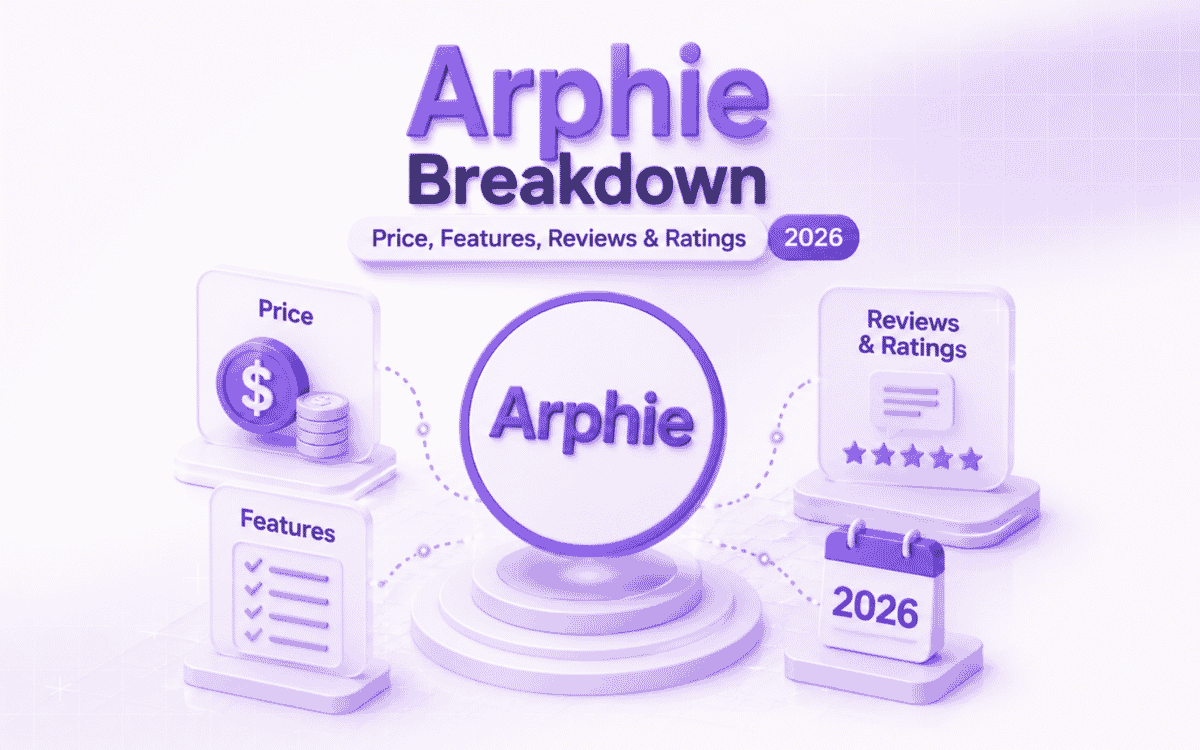




Arphie is an AI-native RFP and questionnaire automation platform built for sales, solutions engineering, security, and investor relations teams. Limitations emerge around mobile support, export options, reporting depth, and the platform's newer market position.
- Arphie's standout capabilities: exact source citation on every AI answer, confidence scoring that flags which answers need review, explicit "I don't know" signals to prevent hallucination, and a flat per-project pricing model that includes unlimited users
- Pricing is not publicly available — Arphie operates on a custom quote model, but its concurrent project structure avoids the seat-based pricing problem that penalizes teams with many occasional contributors
- Arphie's scope covers RFPs, RFIs, DDQs, and security questionnaires — but does not extend into live deal context from CRM or Gong, real-time in-call assistance, or the broader presales workflow that SE-heavy teams need
- SiftHub is the stronger fit for teams that need live deal context, buyer-specific personalization, in-call answer assistance via Pulse, and a workflow that extends beyond questionnaire response into deal briefs and sales collateral.
Arphie is an AI-native RFP and questionnaire automation platform built for sales, solutions engineering, security, and investor relations teams. Limitations emerge around mobile support, export options, reporting depth, and the platform's newer market position.
- Arphie's standout capabilities: exact source citation on every AI answer, confidence scoring that flags which answers need review, explicit "I don't know" signals to prevent hallucination, and a flat per-project pricing model that includes unlimited users
- Pricing is not publicly available — Arphie operates on a custom quote model, but its concurrent project structure avoids the seat-based pricing problem that penalizes teams with many occasional contributors
- Arphie's scope covers RFPs, RFIs, DDQs, and security questionnaires — but does not extend into live deal context from CRM or Gong, real-time in-call assistance, or the broader presales workflow that SE-heavy teams need
- SiftHub is the stronger fit for teams that need live deal context, buyer-specific personalization, in-call answer assistance via Pulse, and a workflow that extends beyond questionnaire response into deal briefs and sales collateral.
Arphie entered the RFP and security questionnaire automation space as an AI-native platform, built from the ground up around AI-generated responses rather than retrofitting AI onto a legacy content library model. Its early reviews reflect that approach: users consistently describe a platform that is fast to onboard, accurate enough to trust, and honest about what it does not know.
This guide covers what Arphie costs, what it does well based on verified G2 and Gartner reviewer data, where it falls short at scale, and how it compares to SiftHub for teams whose workflow extends beyond questionnaire response.
What is Arphie?
Arphie is an AI-native platform for completing RFPs, RFIs, DDQs, and security questionnaires faster and with higher accuracy. It is used by sales, solutions engineering, investor relations, and security teams at B2B companies.
The platform's founding philosophy is built around three specific AI quality commitments that distinguish it from earlier-generation tools:
Exact source citation. Every AI-generated answer shows the exact source document and passage it draws from, in an auditable format. Reviewers do not need to independently investigate where an answer came from; the trail is visible on every response.
Confidence scoring. Arphie displays a confidence level on every AI-generated draft, helping proposal writers prioritize which answers need additional review before submission. High-confidence answers on well-documented topics get light review; low-confidence answers on thinner documentation get closer attention.
Explicit "I don't know" signals. Rather than generating a plausible-sounding but inaccurate answer when it lacks sufficient source material, Arphie flags the gap explicitly. This prevents the hallucination problem that undermines trust in AI-generated compliance responses.
These three commitments address the core trust barrier that holds teams back from relying on AI-generated RFP and questionnaire responses, and they explain why Arphie's early G2 ratings cluster at 5.0 despite the platform's relatively short market history.
Arphie pricing
Arphie does not publish pricing publicly. The platform operates on a custom quote model — costs depend on team size, annual RFP and questionnaire volume, and integration requirements.
The pricing model structure is notable. Rather than seat-based pricing that charges per named user, Arphie uses a flat per-project model with unlimited users included per project. This directly addresses a genuine pain point in the RFP software category: RFP responses require contributors from sales, engineering, legal, security, and product, most of whom contribute to only a handful of responses each year. Seat-based pricing penalizes cross-functional collaboration by making each occasional contributor an additional license cost.
Buyers evaluating Arphie should clarify during the sales conversation: annual project volume expectations, whether pricing scales with RFP count or team size, and which integrations are included versus priced separately. There is no self-serve trial — evaluation requires engaging the sales team directly.
Arphie reviews: What users say
Arphie holds approximately 5.0/5 across 20 verified G2 reviews and 5 Gartner Peer Insights ratings, a strong signal for a newer platform, though the review volume is smaller than established competitors like Responsive or Loopio.
What reviewers praise
Time savings on repetitive questionnaire workflows. The most consistent theme across G2 and Gartner reviews is a meaningful reduction in time spent on questionnaires that previously required pulling information from multiple stakeholders. One Gartner reviewer specifically highlights that questionnaires requiring input from sales, product, engineering, and security teams, previously a coordination-heavy process, became significantly more manageable with Arphie's platform.
Ease of use and onboarding speed. Reviewers consistently describe Arphie as intuitive and fast to adopt. The platform requires minimal training before teams start generating useful first drafts, which is a meaningful differentiator in a category where implementation timelines of weeks or months are common.
AI answer quality and source traceability. G2 reviewers highlight the accuracy of AI-generated responses as a standout feature, specifically the source citation and confidence scoring model that makes it easy to know which answers to trust and which to review more carefully before submission.
Cross-functional collaboration. Gartner reviewers note that Arphie integrates across teams, including product, engineering, security, and legal, with role-based permissions (owner, writer, reviewer), task assignment, deadline tracking, and Slack notifications, keeping contributors aligned without requiring them to leave their existing workflows.
Integrations with existing knowledge sources. Arphie connects to Google Drive, SharePoint, Notion, Highspot, and Seismic, allowing teams to pull from documentation where it already lives rather than requiring migration into a separate platform before getting value.
What reviewers criticize
No mobile support. The most consistently cited limitation across G2 reviews is the lack of mobile accessibility. For teams that need to review or approve responses outside a desktop environment, this is a genuine workflow gap.
Limited export options. G2 reviewers flag export limitations, specifically that Q&A pair imports are restricted to Excel format, and that file import and export workflows have pending improvements. Teams whose buyers submit questionnaires in other formats face additional handling steps.
Reporting and analytics are thin. Multiple reviewers describe reporting capabilities as insufficient for teams that need to demonstrate ROI to leadership — tracking automation rates, cycle time reduction, and win rate impact requires data that Arphie's current reporting does not surface clearly.
Minor software bugs and interface inconsistencies. A small number of G2 reviewers note occasional bugs and interface inconsistencies, expected at this stage of a platform's development, but worth factoring into evaluation for teams with zero tolerance for workflow interruptions.
Arphie key features
AI-generated responses with source citation and confidence scoring
Arphie's core response generation connects to your knowledge sources — Google Drive, SharePoint, Notion, Highspot, Seismic, and produces first-draft answers with every response attributed to its exact source passage, a confidence score indicating review priority, and an explicit flag when source material is insufficient to generate a reliable answer.
Human-in-the-loop review workflow
Arphie is designed for AI-assisted, not AI-autonomous, response generation. The confidence scoring and source citation model are specifically built to make human review efficient, directing attention to the answers that need it rather than requiring reviewers to audit every response from scratch.
Collaboration and task management
Role-based permissions across owner, writer, and reviewer roles. Question-level commenting, task assignment, and deadline tracking keep multi-contributor workflows organized. Slack and email notifications ensure contributors are alerted without needing to monitor the platform continuously.
Customizable AI instructions
Teams can provide RFP-specific or organization-level instructions to control tone, vocabulary, and response style — allowing the AI to adapt to different buyer contexts or document types without manual reformatting after draft generation.
Document import and export
Arphie supports Excel and Word file imports with automatic question and section detection, structuring the questionnaire on import rather than requiring manual tagging. Completed responses are exported back into the original format for submission.
Integrations
Google Drive, SharePoint, Notion, Highspot, Seismic, for knowledge source connectivity. Salesforce integration is available but described by reviewers as less mature than comparable platforms. Slack for workflow notifications.
Where Arphie falls short for presales and SE teams
Arphie's source citation, confidence scoring, and hallucination prevention make it a trustworthy starting point for teams new to AI-assisted RFP response. Where the platform's limitations become meaningful is in use cases that require more than documentation-based draft generation.
No live deal context. Arphie generates responses from your connected knowledge sources — documents, past RFPs, and knowledge repositories. It does not pull from live CRM opportunity records or Gong call transcripts. For presales and SE teams where the questionnaire or RFP arrives as part of an active deal, with specific buyer priorities, competitive dynamics, and prior conversation history, responses grounded only in documentation miss the deal-specific layer that separates a generic answer from a buyer-specific one.
No real-time in-call assistance. Arphie operates asynchronously — it helps teams prepare responses to documents. When buyers ask hard questions live on a call, Arphie is not in the room. This is a separate workflow gap from document response: SEs get pulled into calls to handle curveball questions that a connected knowledge layer could answer directly.
Reporting insufficient for leadership visibility. For sales and presales leaders who need to demonstrate the ROI of their response tooling — win rate impact, cycle time reduction, bandwidth freed for revenue-generating work, Arphie's current reporting capabilities do not provide the data needed to make that case.
Scope limited to questionnaire response. Arphie covers the response generation workflow. Teams that also need deal briefs assembled from call transcripts, solution narratives tailored to specific buyer industries, demo scripts built from prior conversations, and sales collateral generated from live deal data need a platform whose scope extends beyond questionnaire response.
How SiftHub compares to Arphie
SiftHub and Arphie share a foundational belief: every AI-generated answer should be traceable to its source. Where they diverge is in what surrounds that answer — the workflow before it is written, the governance that keeps it current, and the deal context that makes it specific to this buyer.
End-to-end response management versus draft generation.
Arphie's workflow begins when a team opens the platform to start answering. SiftHub begins the moment the RFP or questionnaire arrives. SiftHub's project management feature reads the full intake document — identifying mandatory requirements, flagging submission deadlines, generating a bid/no-bid recommendation, and assigning questions to the right SMEs by content type — before any drafting starts. Teams that have previously spent hours parsing incoming documents before realizing an opportunity was not worth pursuing will recognize what this step eliminates.
SiftHub's AI RFP software then auto-fills from connected live sources — CRM, Gong call recordings, Google Drive, Confluence, SharePoint, Slack, past submissions, and approved Q&A libraries — with every answer attributed to its source document, owner, and last modified date. The Q&A governance that accumulates as a manual burden as libraries grow — retiring stale answers, detecting duplicates, resolving conflicting responses — is automated before anything reaches a reviewer. SiftHub also works inside the tools teams already use: portals, email, Slack, and Teams — so responses reach the right place without requiring a tool switch mid-process. Expert review is required at each stage.
The deal-intelligence layer Arphie does not reach.
When a questionnaire arrives from a prospect the presales team has already spoken to, Arphie's response draws from your documentation. SiftHub draws from the deal itself — pulling CRM opportunity records, and Gong call transcripts to surface what this buyer raised on prior calls, which risks they flagged, and which competitors they named. The response team starts with context, not a cold document.
SiftHub's AI Teammate can build on that context to go beyond RFPs and help generate solution narratives, demo scripts, and other deal-specific briefs grounded in actual buyer conversations rather than templates. SiftHub adapts tone and content selection automatically to the buyer's industry and deal stage — a compliance answer for a healthcare CISO reads differently than the same answer positioned for a fintech engineering team, without post-draft editing.
When reps need the right answer on a live call, SiftHub's Pulse delivers a deal-aware answer in real time, shaped by account context and prior call history, citing its source.
Customer proof:
Zycus achieved 1.5x productivity per rep and a 65% reduction in first-pass response time after deployment. Congruent Solutions generates responses 10x faster than their previous process, freeing 50% more team bandwidth for revenue-generating work and achieving 100% knowledge visibility across their response workflow.
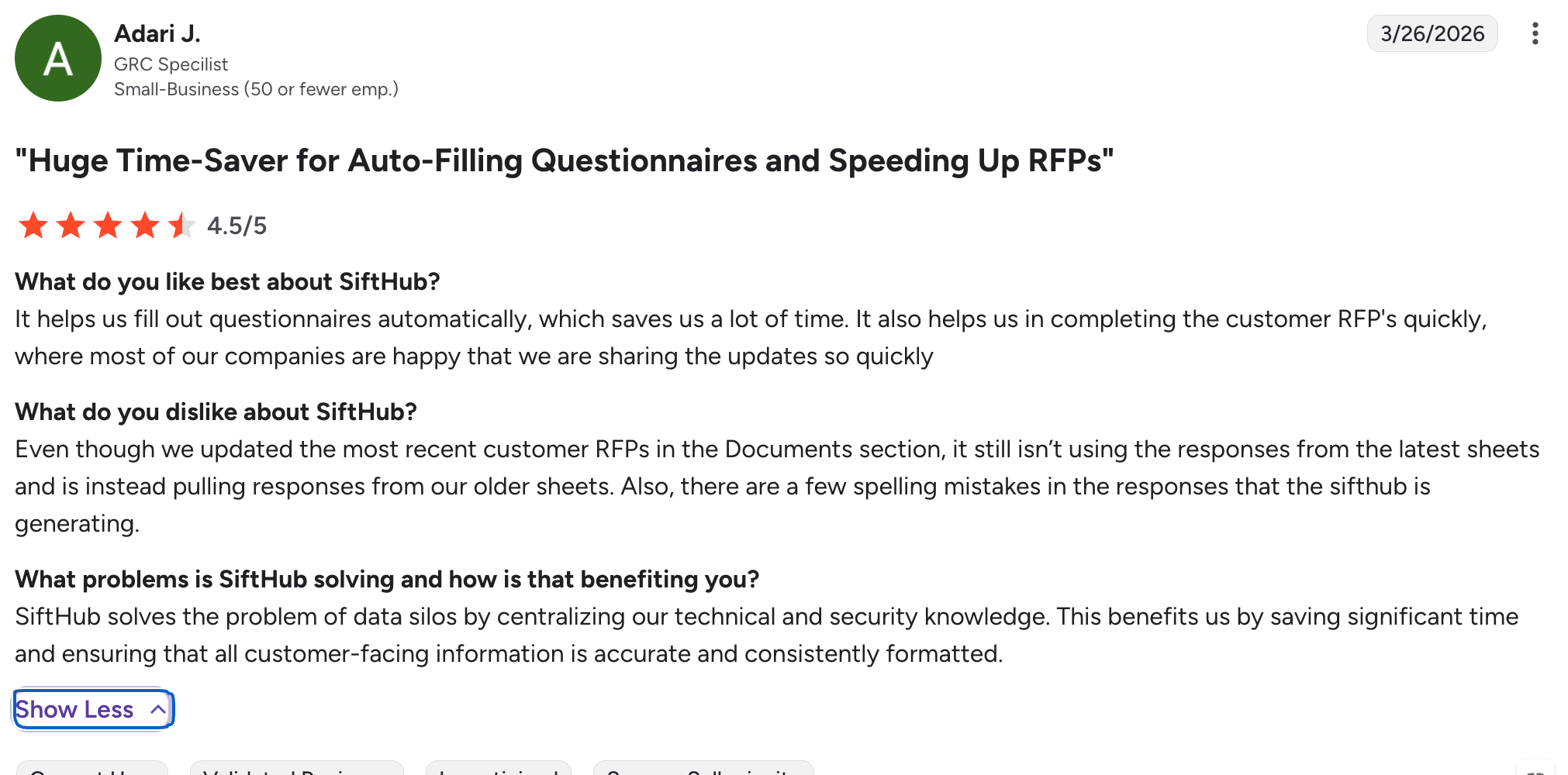
Independent reviews on G2 reflect the same pattern:
Book a demo to see SiftHub in action →
Arphie vs SiftHub: Side-by-side
Conclusion
Arphie is a well-built, trustworthy starting point for teams moving from manual questionnaire response to AI-assisted drafting — its source citation, confidence scoring, and hallucination prevention address the exact trust barriers that hold teams back from relying on AI-generated compliance content. For teams with straightforward questionnaire workflows and moderate volume, it delivers genuine value quickly.
Where SiftHub makes a stronger case is in the scope. Live deal context from CRM and Gong, buyer-specific personalization, real-time in-call support via Pulse, and a presales workflow that extends well beyond questionnaire response into deal briefs and collateral generation — these are capabilities Arphie does not currently address. For presales and SE teams where the questionnaire is one part of a broader deal, not the entire workflow, that scope difference determines which platform actually moves revenue.