



Catapult is a buyer-side RFx platform built primarily for procurement departments issuing RFPs, scoring vendor responses, and managing the sourcing lifecycle. It serves both issuers and responders but is most widely used by procurement teams evaluating vendors — not by vendors responding to RFPs. Teams on the vendor/responder side often find Catapult's workflow optimized for the wrong direction and look for alternatives built specifically for response generation.
- Catapult's core strength is the full RFx lifecycle from the buyer side — issuing RFPs, collecting vendor responses, scoring submissions side by side, and documenting evaluation rationale
- Pricing is not publicly available — Catapult operates on a custom quote model; no rate card is published
- G2 rating is 4.3/5, with reviewers praising semantic search, unified workflow, and customer support
- Limitations reported by users: AI-generated responses require manual validation, a limited structured workflow for vendor-side responders, and content governance gaps at scale
- For vendor and presales teams responding to RFPs, security questionnaires, and DDQs, SiftHub is purpose-built for the responder workflow — with live deal context from CRM and Gong that Catapult does not provide
Catapult is a buyer-side RFx platform built primarily for procurement departments issuing RFPs, scoring vendor responses, and managing the sourcing lifecycle. It serves both issuers and responders but is most widely used by procurement teams evaluating vendors — not by vendors responding to RFPs. Teams on the vendor/responder side often find Catapult's workflow optimized for the wrong direction and look for alternatives built specifically for response generation.
- Catapult's core strength is the full RFx lifecycle from the buyer side — issuing RFPs, collecting vendor responses, scoring submissions side by side, and documenting evaluation rationale
- Pricing is not publicly available — Catapult operates on a custom quote model; no rate card is published
- G2 rating is 4.3/5, with reviewers praising semantic search, unified workflow, and customer support
- Limitations reported by users: AI-generated responses require manual validation, a limited structured workflow for vendor-side responders, and content governance gaps at scale
- For vendor and presales teams responding to RFPs, security questionnaires, and DDQs, SiftHub is purpose-built for the responder workflow — with live deal context from CRM and Gong that Catapult does not provide
Catapult describes itself as a turn-key all-in-one Request for Anything (RFx) platform — covering the full lifecycle from issuing RFPs and security questionnaires through collecting vendor responses, scoring submissions, and managing procurement decisions. It serves both the issuer and responder sides of the RFx workflow within a single platform.
In practice, Catapult's primary audience is procurement departments and sourcing teams on the buyer side. The reviewers who praise it most consistently are procurement professionals managing vendor evaluations, not vendor teams responding to RFPs under deadline pressure. This distinction matters when evaluating whether Catapult is the right tool for your specific workflow.
This guide covers what Catapult actually costs, what it does well based on verified reviewer data, where it falls short, and which teams should consider purpose-built alternatives.
What is Catapult AI?
Catapult is an RFx platform that covers three roles within a single environment: Requestor (the buyer issuing the RFP), Responder (the vendor answering it), and Content Manager (maintaining reusable content for future submissions). This unified approach is intended to remove the friction of managing the buyer-vendor relationship across separate tools.
Core capabilities based on verified product documentation:
- RFP creation and distribution to qualified vendors
- Multi-vendor response collection and side-by-side scoring
- Semantic search across response content
- Audit tracking and evaluation documentation
- Content database management for reusable answers
- Bottleneck tracking across active projects
- Competitive insights and analytics for procurement optimization
Catapult supports any industry and any questionnaire type, including financial services, healthcare, technology, and professional services teams, all of which appear in reviewer data.
Catapult pricing
Catapult does not publish pricing publicly. The platform operates on a custom quote model with no rate card, no published tiers, and no self-serve trial. Pricing depends on organization size, annual RFx volume, the number of roles using the platform (issuer, responder, or both), and integration requirements.
Buyers should contact Catapult directly to obtain a quote. Before engaging the sales team, it helps to have clarity on your annual RFP volume, team size, whether you need the issuer side, the responder side, or both, and which integrations are required.
Catapult reviews: What users say
Catapult maintains a 4.3/5 rating on G2. Reviewer sentiment is consistently positive on core workflow features and customer support, with limitations emerging around AI response quality and vendor-side functionality at scale.
What reviewers praise
Side-by-side vendor scoring. The most consistently praised feature across review platforms is the ability to view and score multiple vendor responses to the same question simultaneously. Procurement teams evaluating six to seven vendors per RFP report that this feature significantly reduces evaluation time and supports documented, defensible scoring rationale, particularly useful for regulated industries where procurement decisions require audit trails.
Semantic search across response content. Reviewers highlight Catapult's semantic search as genuinely useful; the platform understands context rather than relying on keyword matching, which helps teams surface relevant past answers more accurately.
Customer support and onboarding. Catapult's support team is consistently praised across Capterra, G2, and Software Advice reviews. Reviewers describe responsive support, proactive feedback integration, and a thorough onboarding process relative to competing platforms.
Scalability for high-volume procurement. Teams managing large numbers of RFPs annually, including financial services firms running benchmark reviews across multiple vendors, report that Catapult makes high-volume procurement manageable and well-documented.
What reviewers criticize
AI-generated responses require manual validation. Multiple reviewers note that Catapult's AI-generated content, particularly on the responder side, requires significant manual review and adjustment before submissions are ready. Responses that should be straightforward often need editing for accuracy and context.
Limited structured workflow for vendor-side responders. Catapult's workflow strengths are oriented toward the issuer side. Vendor teams using the responder module report less structured coordination, limited SME routing, and fewer workflow controls compared to platforms built specifically for response management.
Content governance gaps at scale. As response volume grows, maintaining content quality and preventing stale answers from surfacing requires manual curation. Reviewers note that the platform does not automatically flag outdated content or resolve conflicting answers across sources — reviewers must manage this manually.
Analytics serve procurement more than presales. Catapult's analytics are built for procurement optimization, demand planning, supplier relationship tracking, and competitive insights for sourcing. Teams looking for analytics tied to RFP win rates, response cycle times, and revenue attribution will find the reporting insufficient for presales and sales leadership needs.
Catapult AI: Key features breakdown
RFx lifecycle management
Catapult supports the complete procurement cycle, from drafting and distributing the RFP through receiving, organizing, and evaluating vendor submissions. For procurement teams managing multiple simultaneous sourcing projects, this end-to-end coverage reduces tool fragmentation.
Side-by-side response evaluation
The core differentiating feature on the issuer side. Procurement teams can view all vendor responses to a specific question in a single view, assign scores, document rationale, and maintain an evaluation record that supports both internal decision-making and external audit requirements.
Content database management
Both issuers and responders can maintain content databases for reuse across projects. Issuers store standard RFP templates and evaluation criteria. Responders store approved answers for recurring question categories. Content freshness management requires manual oversight.
Semantic search
Catapult's search goes beyond keyword matching to understand question context and surface relevant content from past responses. Reviewers consistently rate this feature highly, noting it reduces time spent hunting for relevant historical answers.
Audit tracking
All evaluation decisions, scores, and reviewer comments are tracked with full audit trails — a critical feature for procurement teams in regulated industries where sourcing decisions must be documented and defensible.
Integrations
Catapult integrates with existing procurement and communication tools. Specific integration details depend on deployment configuration — buyers should confirm required integrations during the sales conversation.
Who Catapult is built for
Based on verified reviewer data and published product positioning, Catapult's primary audience is:
- Procurement departments issuing RFPs and evaluating vendor submissions
- Contract-sourcing teams managing competitive bidding processes
- Consulting firms running vendor benchmarking and selection projects on behalf of clients
- Regulated industry buyers (financial services, healthcare) needing documented, audit-ready procurement decisions
Catapult also serves vendor teams using the responder module, but the platform's workflow depth, analytics, and feature set are oriented toward the buyer/issuer experience.
Where Catapult falls short for vendor and presales teams
Teams on the vendor side — presales leads, solutions engineers, bid managers, and proposal coordinators responding to RFPs, consistently hit Catapult's limitations:
No live deal context. Catapult's responder module retrieves content from your stored documentation. It does not pull from live CRM opportunity records, Gong call transcripts, or deal-specific context. Responses reflect what is in your content database, not what was actually discussed with this buyer.
No bid/no-bid intelligence. Before committing response resources, vendor teams need to assess whether an RFP is worth pursuing. Catapult does not provide automated bid/no-bid analysis, competitive positioning against known competitors, or gap analysis against your product capabilities.
No SME routing or deadline management. Complex RFPs require coordinating questions across engineering, legal, compliance, and commercial teams simultaneously. Catapult's responder workflow does not automatically route unanswered questions to the right subject matter expert based on content type or track individual section deadlines across active submissions.
No DDQ or security questionnaire depth. Due diligence questionnaires from financial services and enterprise buyers require compliance-specific answer governance, expiry rules, conflict detection, and source traceability tied to current audit reports. Catapult's content management layer does not provide this depth.
SiftHub: Purpose-built for the vendor response workflow
For vendor and presales teams managing RFPs, security questionnaires, and DDQs at volume, SiftHub is built specifically for the responder side of the workflow that Catapult serves only partially.
How SiftHub handles the responder workflow differently:
SiftHub's AI RFP software connects to your live knowledge sources — CRM, Gong call recordings, Google Drive, Confluence, SharePoint, Slack, past submissions, and approved Q&A libraries – and auto-fills responses with every answer attributed to its source document, owner, and last modified date. Within the same platform, Q&A pair deduplication, answer expiry rules, and conflict identification across sources are handled before answers reach the submission, so the compliance team reviews clean, consistent responses rather than resolving contradictions after drafting.
Beyond questionnaire response:
SiftHub's AI Teammate provides the vendors' intelligence that Catapult has no reason to offer — automatically pulling from CRM opportunity records and Gong call transcripts to generate a deal brief before any response work begins. This surfaces what the buyer said they cared about, what concerns came up on discovery calls, and which customer references are most relevant to this deal — so the response team opens with context rather than starting cold from the RFP document alone.
SiftHub's project management feature reads the full intake document, surfaces a bid/no-bid recommendation, generates requirements and milestones, and routes unanswered questions to the right SME based on content type, with deadline visibility across every active submission. Expert review is required at each stage.
Customer proof:
Allego reduced a process that previously took one to three days to two hours per questionnaire, with 90% of questions completed automatically. Sirion handles 1.5x more RFPs per month without adding headcount, cutting 48 hours off their average response SLA. ActivTrak maintained a 100% submission hit rate, responding to every qualified opportunity without declining bids due to bandwidth constraints.
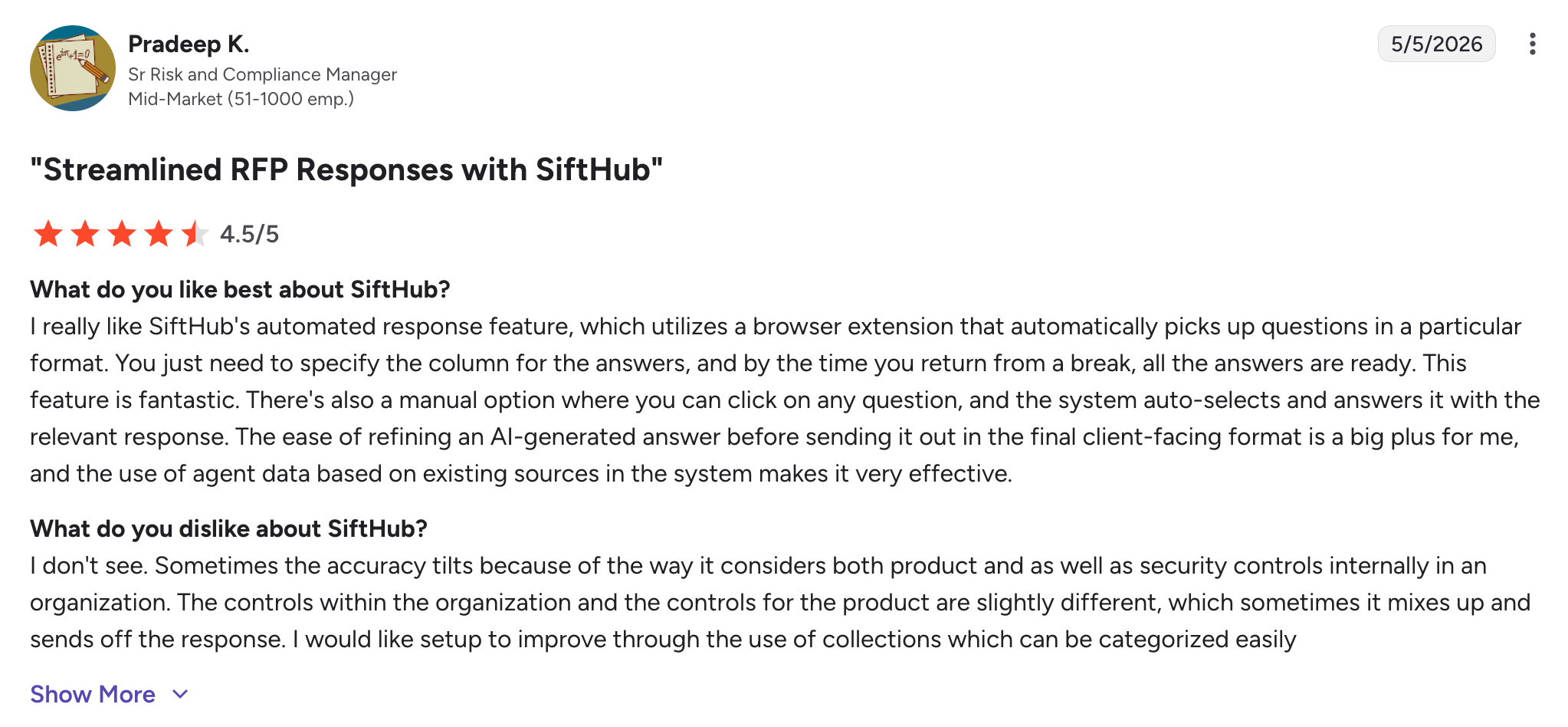
Here’s what a Sr. Risk and Compliance Manager has to say about SiftHub:
Book a demo to see SiftHub in action →
Catapult vs SiftHub: Which is right for your team?
Choose Catapult if: Your primary need is managing the procurement lifecycle as a buyer, issuing RFPs, collecting and scoring vendor responses, maintaining audit trails, and optimizing sourcing decisions.
Choose SiftHub if: Your team is on the vendor side, responding to RFPs, security questionnaires, and DDQs at volume, needing live deal context, and managing cross-functional coordination across presales, legal, and compliance.
Conclusion
Catapult is a well-reviewed procurement platform for buyer teams issuing and evaluating RFPs. Its side-by-side scoring, semantic search, and audit tracking genuinely solve procurement workflow problems. For procurement departments whose primary need is managing sourcing decisions, it is worth evaluating.
For vendor and presales teams responding to RFPs — the teams that SiftHub is built for, Catapult's responder module covers the basics but lacks live deal context, bid/no-bid intelligence, SME routing depth, and the compliance governance that security questionnaire and DDQ responses require. SiftHub is the stronger fit for this workflow.