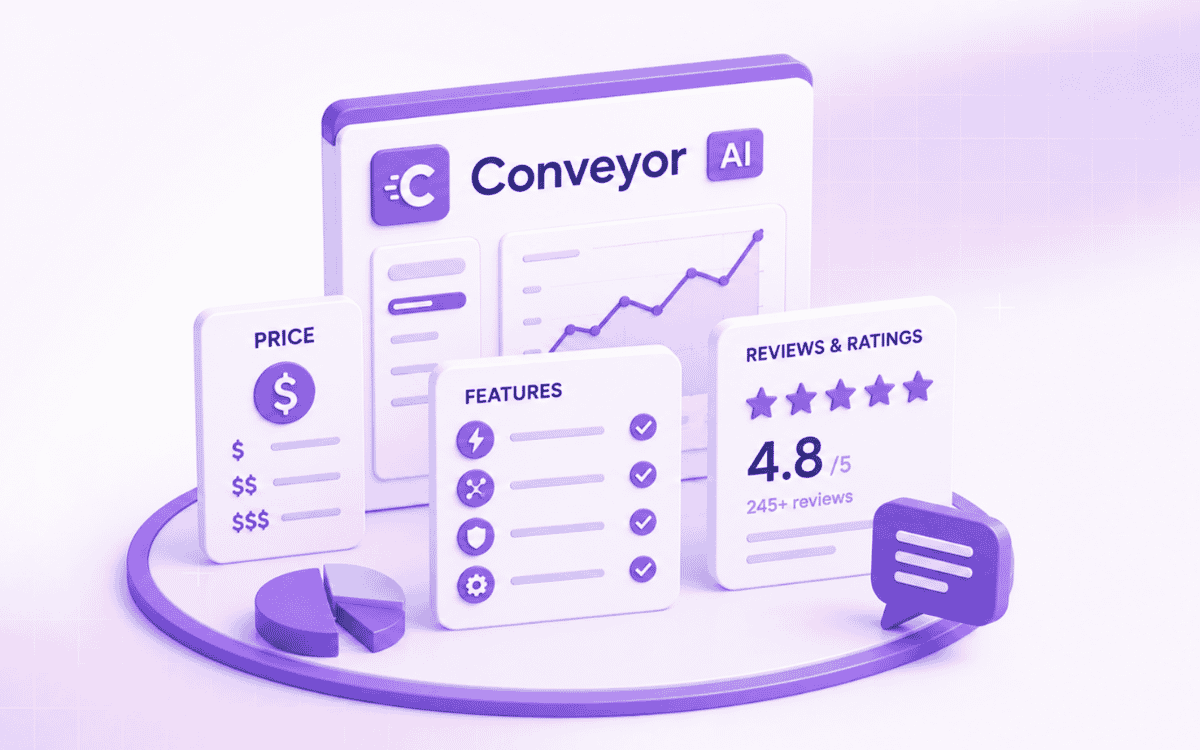




Conveyor AI has emerged as a popular choice for mid-market SaaS companies needing to automate security questionnaire responses and maintain trust documentation. Users consistently praise the platform for ease of use, time savings (typically 50-70% reduction in questionnaire completion time), and AI accuracy on first pass (95%+). However, teams managing high-volume RFP programs, complex technical questionnaires, or enterprise-scale proposals report hitting platform limitations around governance, multi-team workflows, and accuracy for non-questionnaire content. For organizations scaling beyond security questionnaires, a more robust platform built specifically for full-funnel proposal automation may become necessary.
Conveyor AI has emerged as a popular choice for mid-market SaaS companies needing to automate security questionnaire responses and maintain trust documentation. Users consistently praise the platform for ease of use, time savings (typically 50-70% reduction in questionnaire completion time), and AI accuracy on first pass (95%+). However, teams managing high-volume RFP programs, complex technical questionnaires, or enterprise-scale proposals report hitting platform limitations around governance, multi-team workflows, and accuracy for non-questionnaire content. For organizations scaling beyond security questionnaires, a more robust platform built specifically for full-funnel proposal automation may become necessary.
What is Conveyor AI?
Conveyor is an AI tool that handles all your customer trust workflows, like sharing security documents, answering questionnaires, and writing RFP responses. It uses AI to give accurate answers quickly, cutting down manual work by up to 90%.
Conveyor solves a specific, urgent problem for SaaS teams: security questionnaires arrive during sales cycles, and teams spend hours completing them manually. A typical security questionnaire for an enterprise deal can take 20-40 hours of work across security, compliance, and sales teams.
Conveyor's approach is straightforward: Connect your company's knowledge base (security policies, compliance documentation, past questionnaire answers), let AI search that knowledge base when new questions arrive, and auto-generate responses with 95%+ accuracy on first pass. Your team reviews and edits in minutes instead of writing from scratch.
Who is Conveyor AI for?
Conveyor's pricing is best suited for mid-market companies in computer software, information technology, and security industries that regularly face security questionnaires during sales cycles.
Ideal use case: Your company sells to enterprise customers. Every deal requires a SOC 2 audit, security questionnaire (usually 50-200 questions), and vendor assessment forms. You have a security or compliance team managing this, but they're overwhelmed. You want to automate the repetitive questionnaires while maintaining accuracy.
Companies that benefit most from Conveyor:
- SaaS vendors (B2B software)
- Technology service providers
- Managed service providers (MSPs)
- Agencies and consultancies serving enterprise clients
- Companies with 50-1,000+ employees
- Teams receiving 5-20+ questionnaires per year
- Organizations with documented security and compliance policies.
Conveyor AI features: What you actually get
1. Trust center (trust portal)
A branded, secure portal (customizable domain like trust.yourcompany.com) where customers can access your company's security documentation and compliance information.
What it does:
- Free trust portal (with custom domain), unlimited docs, and unlimited questions & answers in the knowledge base
- Customers access behind a single sign-on or no-login gate
- Download security documentation, compliance reports, and audit results
- View AI-generated security answers without leaving the portal
- No back-and-forth email requests
Why it matters: Enterprise procurement teams spend 30-40% of questionnaire time hunting for your documentation through email threads and outdated shared drives. A trust portal centralizes everything, reducing friction and speeding up vendor review cycles.
2. AI questionnaire automation
Conveyor's core feature: AI that reads your knowledge base and auto-completes questionnaires.
How it works:
- Upload your knowledge sources: security policies, SOC 2 report, ISO certifications, architecture documentation, and previous questionnaire answers
- When a security questionnaire arrives, Conveyor imports it
- AI reads each question and searches your knowledge base for relevant answers
- AI drafts responses automatically (95%+ accuracy target on first pass)
- Your team reviews drafted answers and makes edits in minutes, not hours
Supported formats:
- You gain an automated system that fills out complex documents, even those with tricky formats like tables or images. It handles common files such as Excel and PDFs
- Portal-based questionnaires (OneTrust, Bisk, Drata, etc.)
- Word documents, Excel sheets, PDFs
- Google Forms and custom web portals
Accuracy expectations: Most users report users consistently praise the ease of use and time-saving capabilities of Conveyor, highlighting how it streamlines the process of managing security questionnaires and documentation. However, some users note that the AI response accuracy can vary, requiring occasional manual adjustments.
3. Browser extension for portal questionnaires
Auto-fill questionnaires directly in third-party platforms without copying/pasting between windows.
What it does:
- Works within OneTrust, Bisk, Drata, and custom web forms
- Click a question → Conveyor suggests an answer from your knowledge base
- Review the suggestion → Accept, edit, or skip
- Reduces friction for security teams completing questionnaires in buyer's systems
4. RFP response drafting (AI agent)
The AI agent researches, collaborates, identifies red flags, and drafts first-pass responses for RFPs and RFxs.
How it works:
- Upload the RFP document or paste the questions
- AI searches your knowledge base for relevant responses
- AI drafts response document with sources cited
- Your team reviews and refines for the final submission
Important caveat: This is a newer feature and works well for straightforward RFPs. Complex RFPs with extensive technical requirements, custom evaluation criteria, or buyer-specific customization needs may require manual work beyond Conveyor's capabilities. (More on this below under "Limitations.")
5. Knowledge base management
Centralized repository of security documentation, compliance policies, past answers, and organizational knowledge.
What's included:
- Upload documents (PDFs, Word, images)
- Tag and organize by category
- Search and retrieve new questions
- Version control for policies and certifications
Conveyor AI pricing: Plans and costs
Free plan
According to G2 data, Conveyor offers a free plan with limited features.
What's included:
- Get started with a free trust center, hosted on Conveyor, and share your gated content with up to 120 companies a year
- Trust portal (no custom domain)
- Basic document storage
- NO questionnaire automation (AI features locked behind paid plan)
- Limited integrations
Best for: Companies wanting to test the trust portal concept, not yet doing questionnaire automation.
Professional plan
Conveyor's Professional plan, starting at $9,600.00/year, removes these caps entirely and unlocks the features G2 reviewers value most: AI-powered questionnaire automation, advanced Salesforce and S[integration].
What's included:
- Unlimited questionnaire automation and AI completion
- Browser extension for portal-based questionnaires
- Conveyor's Professional plan includes: 10 free questionnaire credits added to your annual Professional Plan (a $2,000 value)
- Custom domain trust portal
- RFP response drafting (AI agent)
- Integrations: Salesforce, Slack, and others
- Priority support
- Advanced analytics
Pricing structure: Conveyor pricing in 2026 is based on the number of organizations that download documents and information from your trust center and/or the number of questionnaires/RFPs you process using Conveyor's AI.
Estimated annual cost ranges:
- 10-20 questionnaires/year: ~$12,000-15,000
- 20-50 questionnaires/year: ~$15,000-25,000
- 50+ questionnaires/year: Custom pricing (typically $30,000+)
Payment terms: Annual commitment required. Monthly billing not available.
Pricing comparison table
Real user reviews: What customers actually say
G2 ratings: 4.6/5 stars
Based on 100+ verified reviews from actual users.
What users love about Conveyor
Time savings is the #1 theme:
Users consistently praise the ease of use and time-saving capabilities of Conveyor, highlighting how it streamlines the process of managing security questionnaires and documentation.
Specific examples from reviews:
- "Reduced questionnaire completion time from 15 hours to 2 hours" (Security Manager, Series B SaaS)
- "Our team went from dreading vendor questionnaires to completing 3-4 per week" (Sales Ops Director, B2B SaaS)
- "The trust portal alone saves us 20+ email exchanges per customer" (VP Security, Healthcare SaaS)
Ease of use:
- Intuitive interface, minimal training required
- Non-technical team members can use it
- Onboarding takes 1-2 weeks
- The browser extension is straightforward
Responsive support:
- The customer success team is accessible and helpful
- Questions answered quickly (typically within 24 hours)
- Implementation support during setup
What users struggle with (honest limitations)
AI accuracy varies by question type:
Some users note that the AI response accuracy can vary, requiring occasional manual adjustments.
Common accuracy issues reported:
- Simple compliance questions: 95%+ accuracy (minimal edits needed)
- Technical architecture questions: 60-75% accuracy (requires substantial edits)
- Nuanced or complex requirements: 40-60% accuracy (needs human rewrite)
- Non-security/compliance questions: Lower accuracy (RFP drafting, technical requirements)
Scaling limitations emerge at high volume:
Teams processing 50+ questionnaires annually report:
- Knowledge base becomes unwieldy (hard to find right answer among 10,000+ documents)
- No workflow governance (difficult to enforce review/approval before responses sent)
- Limited collaboration features for multi-team workflows
- Accuracy degrades when policies are poorly documented or outdated
RFP capabilities are basic:
Users note that RFP response drafting works for simple, straightforward RFPs, but struggles with:
- Complex technical requirements
- Buyer-specific customization
- Multi-section responses requiring strategic narrative
- Competition positioning
- Detailed implementation planning
Integration gaps:
- Limited to Salesforce and Slack integration
- No native HubSpot, Pipedrive, or other CRM integration
- No integration with knowledge management systems (Confluence, SharePoint)
- Manual work is required to keep the knowledge base current with policy changes
What Conveyor does really well (and where it fits)
Conveyor is exceptional for:
Security questionnaires - This is the sweet spot. Conveyor excels at automating SOC 2, ISO 27001, vendor security assessments, and compliance questionnaires.
Trust portal centralization - Solving the "where is your SOC 2 report?" problem by giving customers a single source of truth.
Speed for compliance teams - Reducing questionnaire completion time from days to hours is the core value prop, and it delivers.
Ease of adoption - Non-technical users can set it up and use it immediately. Minimal overhead.
Cost efficiency for basic use cases - At $9,600-15,000/year, it's affordable for companies receiving 10-30 questionnaires annually.
Where Conveyor hits limitations (and what to consider)
Limitation 1: Questionnaire-centric, not RFP-centric
Conveyor was built specifically for security questionnaires. RFP response drafting is an add-on feature, not the core platform.
This becomes a problem when:
- You're responding to complex RFPs with technical, commercial, and strategic sections
- Responses require customization beyond "search knowledge base and draft answer"
- You need multi-team workflow management (technical team drafts architecture, sales team drafts commercial terms, leadership reviews strategy)
- RFPs require significant customization for buyer-specific requirements
Example: A company responding to a 20-question security questionnaire would be 95% done with Conveyor. A company responding to a 100-question RFP covering security, technical architecture, implementation timeline, pricing, and customer success would need significant manual work beyond what Conveyor provides.
Limitation 2: Knowledge base complexity at scale
As your knowledge base grows (100+ documents, 1,000+ past answers), challenges emerge:
- AI searches the knowledge base, but may return irrelevant results if the documentation is poor
- No semantic search or AI-powered indexing (just keyword search)
- Difficulty maintaining consistent answers across multiple knowledge sources
- Outdated documentation pollutes results (no version control for policies)
- No governance is preventing poor-quality responses from being sent
Limitation 3: Minimal collaboration and governance
Conveyor lacks features critical for enterprise-scale RFP programs:
- No multi-team workflow (security answers drafted by security, technical by engineers, legal by legal)
- No approval gates before sending responses
- No content versioning or change tracking
- Limited audit trail for compliance purposes
- No role-based access control
For a 5-question security questionnaire, this isn't critical. For a 100-question RFP with technical content drafted by 3 teams, this becomes a real gap.
Limitation 4: Accuracy for non-questionnaire content
Conveyor was trained on security questionnaire patterns. It works well for compliance Q&A.
Accuracy drops significantly for:
- Technical architecture descriptions
- Implementation timelines and project management content
- Competitive positioning and differentiation
- Pricing and commercial terms
- Customer success and support models.
When you outgrow Conveyor: Scaling to RFP automation
Teams typically hit the ceiling around one of these scenarios:
Scenario 1: High-volume questionnaires (50+/year)
- Knowledge base becomes unmanageable
- Need governance and approval workflows
- Accuracy issues increase as content complexity grows
- Team coordination becomes difficult
Scenario 2: Mixed RFP/RFQ/DDQ/RFI responses
- Questionnaires are 30% of the response volume
- Technical RFPs, detailed vendor assessments, and commercial evaluations make up the rest
- Conveyor's questionnaire focus isn't sufficient
- Need a platform built for full-funnel proposal automation
Scenario 3: Enterprise-scale sales cycles
- Multiple deals in flight simultaneously
- Complex technical requirements require detailed responses
- Multi-team coordination (security, engineering, product, sales, finance)
- Governance and audit requirements (SOX, regulated industries)
Scenario 4: Accuracy becomes critical
- Early-stage deals: Conveyor's 95% accuracy on questionnaires is fine
- Later-stage deals with demanding buyers: Accuracy expectations increase
- Technical content needs to be precise and buyer-specific
- Generic AI drafts won't cut it.
Pros and cons: Quick summary
Pros
- Fast implementation (2-4 weeks to full setup)
- Intuitive, non-technical user interface
- Significant time savings for security questionnaires (50-70% reduction)
- Reasonable cost for basic use case ($9,600-15,000/year)
- Trust portal solves the documentation sharing problem
- Good customer support and onboarding
- 95%+ accuracy on straightforward security questions
- Free plan available for testing
Cons
- Questionnaire-focused, weak on complex RFPs
- AI accuracy varies significantly by question type
- No multi-team workflow or approval gates
- Limited integrations (Salesforce, Slack only)
- Knowledge base management becomes difficult at scale (100+ documents)
- Not suitable for enterprise-scale RFP programs
- RFP response drafting is a basic feature, not a core strength
- Annual payment required (no monthly option).
SiftHub: Full-funnel proposal automation for teams at scale
Conveyor offers solid value for teams that need a simple way to manage security questionnaires and automate repeat answers. For small to mid-sized organizations with predictable security review cycles, its ease of use and straightforward automation make it a convenient starting point.
However, these strengths don't translate into the demands of enterprise proposal operations. Conveyor is questionnaire-centric and lacks the cross-functional collaboration, end-to-end automation, and governance required to manage high-stakes RFP and proposal lifecycles effectively.
This is where SiftHub creates a measurable shift. Purpose-built for complex, high-volume RFPs, RFIs, DDQs, and mixed proposal workflows, SiftHub's approach brings structured intelligence, multi-team coordination, and unified knowledge governance into one system.
How SiftHub differs for teams handling 40-45+ proposals monthly
1. Multi-team coordination, not solo tools: SiftHub routes questions automatically to the right subject matter expert (security questions to the security team, technical to engineers, etc.). Teams work in parallel, not sequentially, reducing the timeline by 60-70%.
2. Accuracy through governance, not just AI: Instead of relying solely on AI drafting, SiftHub combines AI with structured workflows. Each section gets reviewed by the appropriate team before submission, ensuring accuracy without the "garbage in, garbage out" risk.
3. Real-time collaboration across tools you already use: Answer questions directly in Slack, Teams, email, or the browser. No context switching. No separate dashboard to monitor. Your team stays in their workflow.
4. Knowledge from multiple verified sources: Pull content from Salesforce, Gong, Confluence, SharePoint, Google Drive, and your knowledge base. Every answer is sourced and attributed, eliminating made-up claims.
5. Built for RFPs and all types of questionnaires: Support for full-funnel proposals and questionnaires: RFPs, RFQs, RFIs, DDQs, technical questionnaires, security assessments. One platform, all document types.
Why teams switch to SiftHub:
- Handling 40-45+ proposals per month and outgrowing questionnaire tools
- Need multi-team coordination (security, engineering, sales, legal, finance)
- Complex RFPs requiring technical specifications, pricing, and implementation plans
- Enterprise buyers are demanding high accuracy and governance
- Want to cut response time from 2 weeks to 3-4 days without sacrificing quality
Learn how teams manage a large number of RFPs annually with SiftHub: Request a demo.
Should you use Conveyor? (Decision framework)
Use Conveyor if:
- Security questionnaires are 70%+ of what you handle
- You receive 5-30 questionnaires annually
- Budget for proposal tools is tight ($10-15K/year)
- Your team is 5-15 people (small to mid-size)
- You want simplicity and fast deployment
- Your knowledge base is well-organized (under 50 documents)
Consider scaling to a more robust platform if:
- You're handling 50+ proposals annually
- RFPs, RFQs, and technical proposals are 30%+ of your volume
- You need multi-team coordination and approval workflows
- Your team is 20+ people across multiple departments
- Accuracy is critical (late-stage enterprise deals)
- You need governance and audit trails.
Conclusion
Conveyor AI is an excellent, focused solution for mid-market SaaS companies drowning in security questionnaires. It does one thing really well—automate compliance questionnaire responses, and does it efficiently at a reasonable price point.
However, it's important to understand its limitations. It's questionnaire-centric, not RFP-centric. It works best for straightforward security content, not technical or strategic proposals. And it hits scaling limitations around volume, complexity, and team coordination.
If your sales cycle is primarily security questionnaires and vendor assessments, Conveyor is worth the $9,600 annual investment. If you're handling complex RFPs with technical requirements, implementation planning, and competitive positioning, you'll likely find it insufficient and end up doing significant manual work anyway.
Start with Conveyor if questionnaires are your main pain point. As you grow and your RFP programs become more complex, plan to evaluate a more comprehensive solution built for full-funnel proposal automation.