



Conveyor, SiftHub, and Inventive AI all operate in the RFP and security questionnaire automation space, but they differ significantly in scope and architecture. Conveyor is purpose-built for security questionnaire automation with a trust center. Inventive AI focuses on AI-native RFP drafting with conflict detection across connected documentation. SiftHub covers the full deal cycle — security questionnaires, RFPs, and DDQs, with responses grounded in live deal context from CRM and Gong rather than documentation alone.
- Conveyor's scope is the narrowest — security questionnaires and trust center documentation, with limited RFP capability constrained by credit-based pricing
- Inventive AI generates high-quality AI drafts with passage-level conflict detection, but does not connect to live deal context from CRM or Gong, and analytics are described by reviewers as high-level
- SiftHub connects to both documentation and live deal signals — CRM, Gong, Google Drive, Confluence, SharePoint, Slack, covering security questionnaires, RFPs, and DDQs with buyer-specific personalization and presales workflow extending into deal briefs
- All three platforms operate on custom, unpublished pricing models, except Conveyor's published Professional tier, starting at $9,600/year
- The right choice depends on whether your team's primary need is security questionnaire automation (Conveyor), AI-native RFP drafting from documentation (Inventive AI), or full deal-cycle response grounded in live buyer context (SiftHub)
Conveyor, SiftHub, and Inventive AI all operate in the RFP and security questionnaire automation space, but they differ significantly in scope and architecture. Conveyor is purpose-built for security questionnaire automation with a trust center. Inventive AI focuses on AI-native RFP drafting with conflict detection across connected documentation. SiftHub covers the full deal cycle — security questionnaires, RFPs, and DDQs, with responses grounded in live deal context from CRM and Gong rather than documentation alone.
- Conveyor's scope is the narrowest — security questionnaires and trust center documentation, with limited RFP capability constrained by credit-based pricing
- Inventive AI generates high-quality AI drafts with passage-level conflict detection, but does not connect to live deal context from CRM or Gong, and analytics are described by reviewers as high-level
- SiftHub connects to both documentation and live deal signals — CRM, Gong, Google Drive, Confluence, SharePoint, Slack, covering security questionnaires, RFPs, and DDQs with buyer-specific personalization and presales workflow extending into deal briefs
- All three platforms operate on custom, unpublished pricing models, except Conveyor's published Professional tier, starting at $9,600/year
- The right choice depends on whether your team's primary need is security questionnaire automation (Conveyor), AI-native RFP drafting from documentation (Inventive AI), or full deal-cycle response grounded in live buyer context (SiftHub)
Teams evaluating RFP and security questionnaire automation tools in 2026 frequently find these three platforms on the same shortlist, but they do not solve identical problems. Conveyor is built around inbound security reviews. Inventive AI focuses on AI-generated RFP drafts from your existing documentation. SiftHub covers the full response workflow with context pulled from both documentation and live deal activity.
This guide compares all three across scope, pricing, reviewer feedback, and team fit, so you can match the platform to what your team actually needs rather than what each platform's marketing emphasizes.
Quick comparison
Conveyor: Security questionnaire specialist
Conveyor helps vendor teams answer security questionnaires faster by generating AI-assisted responses from connected knowledge sources and pairing them with a trust center for sharing compliance documentation with prospects.
What it does well: Reviewers report 75–90% reductions in questionnaire completion time for teams with straightforward inbound security review workflows. The trust center reduces repetitive documentation requests by giving buyers self-service access to compliance materials.
Where it falls short: Conveyor's Professional tier starts at $9,600 per year and includes a limited starting allotment of RFP project credits — multiple G2 reviewers note their teams quickly outgrow this at scale. Collaboration is security-team-centric rather than cross-functional, and AI-generated responses require manual fine-tuning for accuracy according to reviewer feedback. Scope does not extend to DDQs or complex multi-stakeholder RFP responses.
Best fit: Teams whose primary workflow is inbound security questionnaires with occasional, low-volume RFPs, and where a self-service trust center meaningfully reduces inbound request volume.
Inventive AI: AI-native RFP drafting with conflict detection
Inventive AI generates RFP and security questionnaire responses by reasoning across your uploaded documents and connected sources — SharePoint, Google Drive, Confluence, and Notion, with a particular emphasis on detecting conflicting or stale content across sources before submission.
What it does well: AI draft quality on well-structured questions earns consistent praise from reviewers. Conflict detection across source documents is a genuine differentiator — flagging inconsistencies between, for example, a security policy document and a previous questionnaire response before they reach a submission. Setup is reported as faster than legacy platforms, with teams operational in days for straightforward deployments.
Where it falls short: Inventive AI does not generate responses from live deal context — CRM stage, call transcripts, or buyer-specific signals are not part of its documented scope. Reviewers describe analytics as "fairly high-level" and insufficient for detailed ROI tracking. The platform does not manage the full deal cycle — no pre-call briefs, post-call follow-ups, or sales-to-CS handover automation. Pricing is fully opaque with no published tiers. AI responses require manual fine-tuning for tone and compliance alignment, and the platform's scope is limited to RFPs and questionnaires rather than the broader presales workflow.
Best fit: Sales and bid teams with high RFP volume, well-organized existing documentation, and a need for AI-generated drafts with strong conflict detection across source documents, where the workflow does not need to extend into live deal intelligence or broader presales collateral.
SiftHub: Full deal cycle with live deal context
SiftHub covers security questionnaires, RFPs, and DDQs under one workflow, with responses grounded in both connected documentation and live deal activity.
How SiftHub's response generation works:
SiftHub's AI RFP software connects to your live knowledge sources — CRM, Gong call recordings, Google Drive, Confluence, SharePoint, Slack, past submissions, and approved Q&A libraries — and auto-fills responses with every answer attributed to its source document, owner, and last modified date. Within the same platform, Q&A pair deduplication, answer expiry rules, and conflict identification across documentation sources are handled before answers reach the submission, addressing the same document-level conflict-detection need that Inventive AI solves, applied across a broader set of connected sources.
Beyond questionnaire response:
Where Conveyor's scope ends at security questionnaires and Inventive AI's scope ends at documentation-based drafting, SiftHub's AI Teammate reads CRM opportunity records, and Gong call transcripts to surface what a specific buyer said they cared about, what objections came up on calls, and which proof points are most relevant — generating deal briefs, solution narratives, and demo scripts grounded in actual buyer conversations. SiftHub's Personalization then tailors tone and content selection automatically to the buyer's industry and deal stage — addressing the manual fine-tuning step that reviewers note for AI-generated responses on both platforms, where output requires editing before it matches the intended tone for a specific buyer.
SiftHub's project management feature reads the full intake document, surfaces a bid/no-bid recommendation, generates requirements and milestones, and routes unanswered questions to the right SME based on content type, with deadline visibility across every active submission. Expert review is required at each stage.
All three platforms compared here generate responses after the question has been captured in a document — an RFP, a security questionnaire, or an email. None operates during a live conversation. SiftHub's newly launched Pulse extends this further into real-time: during live buyer calls, Pulse surfaces deal-aware answers shaped to the account, the competitor in play, and prior conversations, citing the source document, call, or RFP it draws from. The same SE-bandwidth problem that documentation-dependent drafting creates for Conveyor and Inventive AI users also shows up live on calls, where SEs get pulled in for questions a connected knowledge layer could answer directly. Pulse addresses that gap at the point where it costs the most: the live conversation with the buyer.
Customer proof:
Rocketlane cut RFP turnaround time by 50% and freed 70% of solutions engineer bandwidth previously spent on documentation hunting and manual response editing.
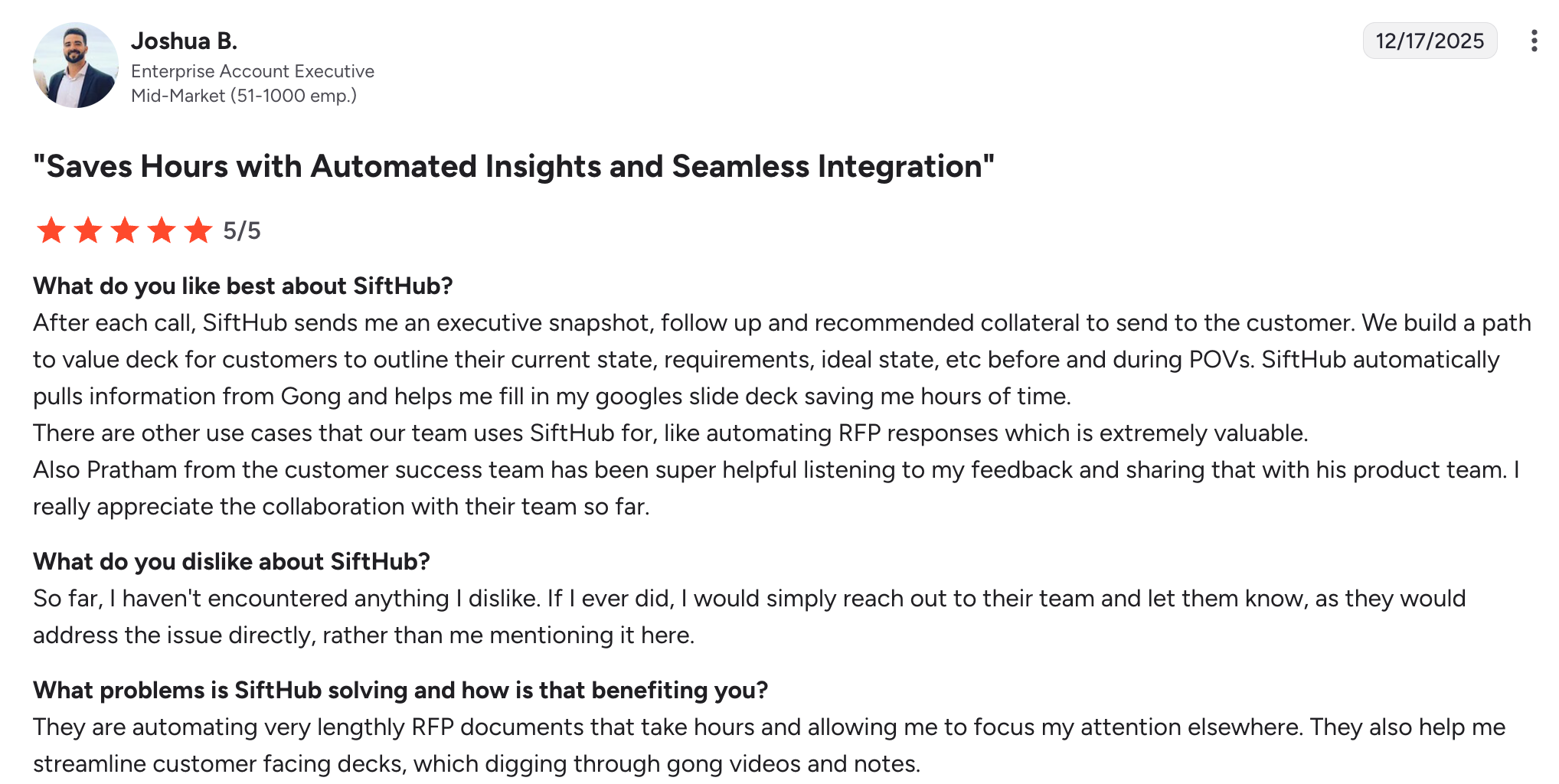
Independent reviews on G2 echo the same outcomes for SiftHub:
Book a demo to see SiftHub in action
Best fit: Presales, SE, and proposal teams managing security questionnaires, RFPs, and DDQs as part of a broader deal cycle, where responses need to reflect live conversations with the buyer, not just stored documentation, and where the workflow extends into deal briefs and sales collateral beyond questionnaire response.
How to choose between the three
If your primary workflow is inbound security questionnaires with a self-service trust center for buyers. Conveyor's published pricing and trust center experience make it a reasonable starting point, provided your RFP volume stays within its credit allotment.
If your primary need is AI-generated RFP drafts from well-organized documentation with conflict detection, Inventive AI's passage-level conflict detection is a genuine strength, provided your team does not need live deal context or broader presales workflow coverage.
If your team manages security questionnaires, RFPs, and DDQs as part of a broader deal cycle, and responses need to reflect what was actually discussed with this buyer, SiftHub's live deal context from CRM and Gong, combined with buyer-specific personalization and presales workflow extending into deal briefs, addresses the gap that neither Conveyor nor Inventive AI covers.
A useful diagnostic: if your team's RFP responses currently feel accurate but generic, technically correct but not specific to this buyer's situation, that is a live-context gap, not a drafting-quality gap. Inventive AI and Conveyor both improve drafting speed and accuracy from documentation. SiftHub addresses the buyer-specificity gap directly.
Conclusion
Conveyor, Inventive AI, and SiftHub each solve real problems, but at different points in the response workflow. Conveyor solves inbound security questionnaire volume with a trust center. Inventive AI solves drafting speed and cross-document conflict detection from your documentation. SiftHub solves both of those problems and extends further — connecting to live deal context from CRM and Gong, so responses reflect this specific buyer's conversation, not just your stored content, and covering the full deal cycle from security questionnaire through RFP through presales collateral.
For teams evaluating all three, the deciding question is scope: does your team need questionnaire automation alone, documentation-based drafting alone, or a platform that connects the response workflow to the actual deal happening in your CRM and on your calls?