


.avif)

RFPs and SOWs serve different but connected roles in procurement. An RFP helps buyers evaluate competing vendors and solution approaches, while an SOW defines the exact work, deliverables, timelines, and responsibilities once a vendor is selected. Understanding how they work together is critical for avoiding scope disputes, delivery misalignment, and contract risks.
- RFPs are competitive procurement documents focused on vendor evaluation, solution approaches, pricing, and selection criteria.
- SOWs are execution-focused documents that define agreed deliverables, milestones, acceptance criteria, and contractual responsibilities.
- Strong procurement processes use both documents sequentially, with the quality of the RFP directly shaping the clarity of the final SOW.
- SiftHub helps sales, presales, and delivery teams maintain consistency between RFP responses and SOW commitments using verified, approved knowledge sources.
RFPs and SOWs serve different but connected roles in procurement. An RFP helps buyers evaluate competing vendors and solution approaches, while an SOW defines the exact work, deliverables, timelines, and responsibilities once a vendor is selected. Understanding how they work together is critical for avoiding scope disputes, delivery misalignment, and contract risks.
- RFPs are competitive procurement documents focused on vendor evaluation, solution approaches, pricing, and selection criteria.
- SOWs are execution-focused documents that define agreed deliverables, milestones, acceptance criteria, and contractual responsibilities.
- Strong procurement processes use both documents sequentially, with the quality of the RFP directly shaping the clarity of the final SOW.
- SiftHub helps sales, presales, and delivery teams maintain consistency between RFP responses and SOW commitments using verified, approved knowledge sources.
If you work in sales, presales, project delivery, or procurement, you will encounter both documents regularly, but at very different moments in the vendor-client relationship. Confusing the two, or using one when the other is called for, creates scope disputes, commercial misunderstandings, and contract problems that are expensive to unpick.
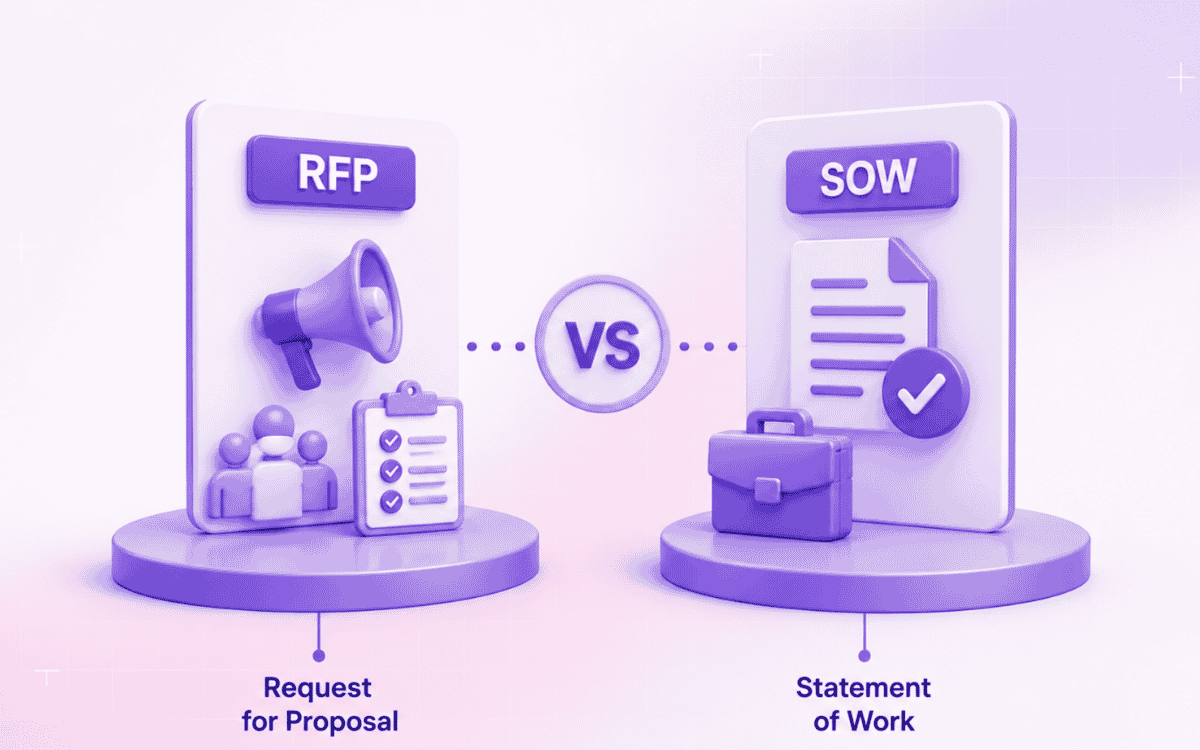
The relationship between the RFP and the SOW is sequential: the RFP describes what the organization needs and invites vendors to propose how they would deliver it; the SOW documents the agreed approach once a vendor has been selected.
That sequential relationship is the most important thing to understand. Neither document replaces the other, they serve different purposes at different stages of the same procurement cycle, and a well-run procurement process typically requires both.
What each document is and what it does
The RFP: Request for Proposal
A Request for Proposal is a formal document issued by an organization seeking proposals from qualified vendors or contractors to provide goods, services, or solutions that meet specific project requirements. The primary goals of an RFP include soliciting competitive proposals, evaluating vendor capabilities, and negotiating contract terms that align with organizational needs.
The RFP sits at the beginning of the procurement process, before a vendor is chosen. It is a buyer's document, issued to multiple vendors simultaneously, with the explicit purpose of enabling comparison. Vendors receive it, respond to it, and are evaluated against each other based on their responses.
A well-constructed RFP tells vendors what the buyer needs, what success looks like, how proposals will be evaluated, and when a decision will be made. It does not tell vendors precisely how to do the work, that would be prescriptive in a way that defeats the purpose of soliciting competitive approaches. Instead, it describes the outcome and invites vendors to propose how they would achieve it.
The SOW: Statement of Work
A statement of work is a procurement document that defines the specific work to be performed under a contract, the deliverables, timelines, performance standards, and scope of work that the selected vendor must fulfill. Unlike an RFP, which is issued before vendor selection to solicit competitive proposals, an SOW is typically developed during or after the vendor selection process and becomes the contractual specification of what the winning vendor is obligated to deliver.
The SOW is the working document that governs actual project delivery. It is not a persuasion tool or a competitive instrument, it is an operational blueprint. Both buyer and vendor have agreed to work together by the time an SOW is produced. The SOW defines exactly what that work will look like.
A well-structured SOW is one of the most important documents in any procurement engagement. It eliminates ambiguity about project scope, provides the baseline against which vendor performance is measured, and protects both parties when disputes arise about what was and was not included in the contract. Vague or incomplete SOWs are a leading cause of cost overruns, scope disputes, and failed projects, particularly in complex technology and professional services engagements.
The key differences at a glance
The differences between an RFP and an SOW come down to purpose, content, and timing. An RFP solicits proposals from vendors, while an SOW defines the work to be performed under a contract. An RFP focuses on project requirements, evaluation criteria, and contractual terms. An SOW details project tasks, deliverables, and performance standards. An RFP is issued at the beginning of the procurement process to gather proposals. An SOW is developed after contract award to guide project execution.
Translated into practical terms:
Audience: An RFP is addressed to multiple competing vendors. An SOW is a bilateral document between one buyer and one selected vendor.
Purpose: An RFP creates competition. An SOW creates clarity.
Binding status: An RFP is not a contract, it is an invitation. Responding to an RFP creates no obligation on either side. An SOW is typically legally binding, either as a standalone document or as an exhibit attached to a master services agreement.
Flexibility: An RFP invites vendors to propose their own approaches, timelines, and pricing. An SOW locks down the agreed approach, timeline, and pricing so both parties are working from the same baseline.
Who initiates it: An RFP is always initiated by the buyer. An SOW is developed collaboratively between buyer and seller, and in some cases, particularly in consulting and professional services, a seller may initiate an SOW proactively to propose a defined scope of work to a buyer who has not issued a formal RFP.
How they work together in a procurement cycle
The confusion between RFPs and SOWs often arises because both documents reference similar subject matter — scope, deliverables, timelines, and expectations. The difference is not what they cover, but at what stage and for what purpose they cover it.
In practice, the sequence looks like this:
The buyer identifies a need and issues an RFP to a shortlist of qualified vendors. Vendors respond with proposals describing their approach, methodology, team, timeline, and pricing. The buyer evaluates proposals, conducts reference checks or clarification sessions, and selects a vendor. Negotiations follow on commercial terms. Once agreed, the contract is executed, and the SOW is either part of that contract or attached to it as an exhibit. The SOW then governs the actual delivery of the work.
The project requirements and scope of work defined in the RFP form the foundation of the SOW, which is why investing in a precise, comprehensive RFP pays dividends not just in proposal quality but in the clarity of the contract that follows.
A vague RFP produces vague proposals, which produce contested SOWs, which produce disputed contracts. The quality of the documents at the front of the procurement cycle directly determines the quality of the agreements that govern delivery at the back of it.
What each document typically contains
RFP: Typical sections
An RFP usually contains an overview of the issuing organization and the project context, a description of the problem or need being addressed, the functional and technical requirements the proposed solution must meet, evaluation criteria and their relative weighting, submission instructions and the response format required, key dates including the Q&A window, proposal deadline, and decision timeline, and contractual terms or conditions that will govern the eventual agreement.
An RFP may also include criteria the client will use to select a vendor, along with examples and expectations vendors should consider when submitting a bid.
SOW: Typical sections
An SOW contains a project overview and objectives, a detailed scope description specifying what is and is not included, a full deliverables list with acceptance criteria for each, a project timeline with milestones, roles and responsibilities for both the vendor and client teams, reporting requirements and communication cadence, pricing and payment terms tied to milestones or deliverables, and the terms governing performance, change requests, and dispute resolution.
While the contract establishes the legal framework, the SOW drills into the execution details, tasks, milestones, and acceptance criteria that both parties are accountable for.
Where the vendor-side team fits in
It is worth being explicit about who is responsible for each document from the vendor's perspective, because the handoff between them is where deals can be won or lost, and where delivery problems most often originate.
During the RFP process, the sales team, presales team, solutions architects, and business relationship managers are heavily involved. Once the sales process concludes and delivery begins, the project manager takes over, understands the requirements, and starts delivering as per what was agreed.
This handoff is one of the most failure-prone moments in any client engagement. What the presales team committed to in the RFP response — the scope, the approach, the timeline, and the specific capabilities demonstrated in the proposal — must be accurately transferred into the SOW that the delivery team is accountable for executing. When it does not, the result is a delivery team that feels bound to commitments it was not consulted on, and a client that feels let down by a vendor that is not delivering what the proposal described.
For sales, presales, and solutions teams responding to RFPs at volume, maintaining consistency between what is promised in an RFP response and what is subsequently codified in an SOW requires a single source of truth for approved claims, capability descriptions, implementation timelines, and commercial language. SiftHub's AI RFP governs exactly this, auto-identifying duplicate or conflicting answers, setting expiry rules on time-sensitive content, and ensuring every RFP response draws from pre-approved, current knowledge rather than individually assembled content that varies by deal, rep, or deadline pressure. When what is written in an RFP response is grounded in verified, approved knowledge, the SOW that follows starts from an accurate foundation rather than a contested one.
Common mistakes when using RFPs and SOWs
Issuing an SOW before selecting a vendor. This is the most fundamental sequencing error. An SOW defines work for a specific vendor; issuing one to multiple vendors eliminates the competitive dynamic that the RFP process is designed to create. If you need to define scope before selecting a vendor, that scope definition belongs in the RFP itself, not in a premature SOW.
Writing an RFP that is too prescriptive. An RFP that defines exactly how the work must be done prevents vendors from proposing better approaches. A problem-led RFP invites vendors to bring their expertise and experience to the table. A requirements-led RFP will attract responses that mirror your assumptions back to you.
Writing an SOW that is too vague. Vague or incomplete SOWs are a leading cause of cost overruns, scope disputes, and failed projects. Every deliverable in an SOW should have defined acceptance criteria. Every timeline should have named milestones. Every role should be explicitly assigned.
Failing to connect the RFP response to the SOW. What a vendor commits to in an RFP response must survive into the SOW. If the presales team's proposal describes a six-week implementation but the delivery team's standard SOW template uses twelve weeks, the discrepancy will surface, usually when the client compares the two documents side by side. This is the consistency problem that a governed knowledge layer prevents: when every RFP response draws from the same verified, approved content, the commitments made in proposals reflect what the delivery team can actually honor.
Treating the SOW as a legal formality. Some organizations rush through SOW development after vendor selection because the hard work of evaluating proposals is done, and both sides are eager to start. An SOW produced under that pressure tends to be less specific than the situation requires, which creates exactly the scope disputes that slow delivery and damage the relationship the procurement process was designed to build.
When you need an RFP, when you need an SOW, and when you need both
Use an RFP when you are still selecting a vendor, when you want competitive proposals rather than a single quote, when you need to evaluate different approaches rather than prescribe one, or when your procurement governance requires a formal competitive process before a contract can be awarded.
Use an SOW when a vendor has been selected, when you need to define precisely what will be delivered, when you are managing a project that requires clear accountability on both sides, or when scope changes are likely, and you need a change management mechanism.
Use both, in sequence, for any significant procurement of services or complex technology, particularly where the work involves multiple phases, multiple stakeholders on both sides, or any meaningful delivery risk. Many B2B sales processes use all three documents, proposal, quote, and SOW, at different stages: starting with a proposal to win the business, sending a quote during price negotiation, and then creating an SOW after contract signing to govern project execution. This layered approach ensures clarity at every stage of the customer journey.