



.avif)

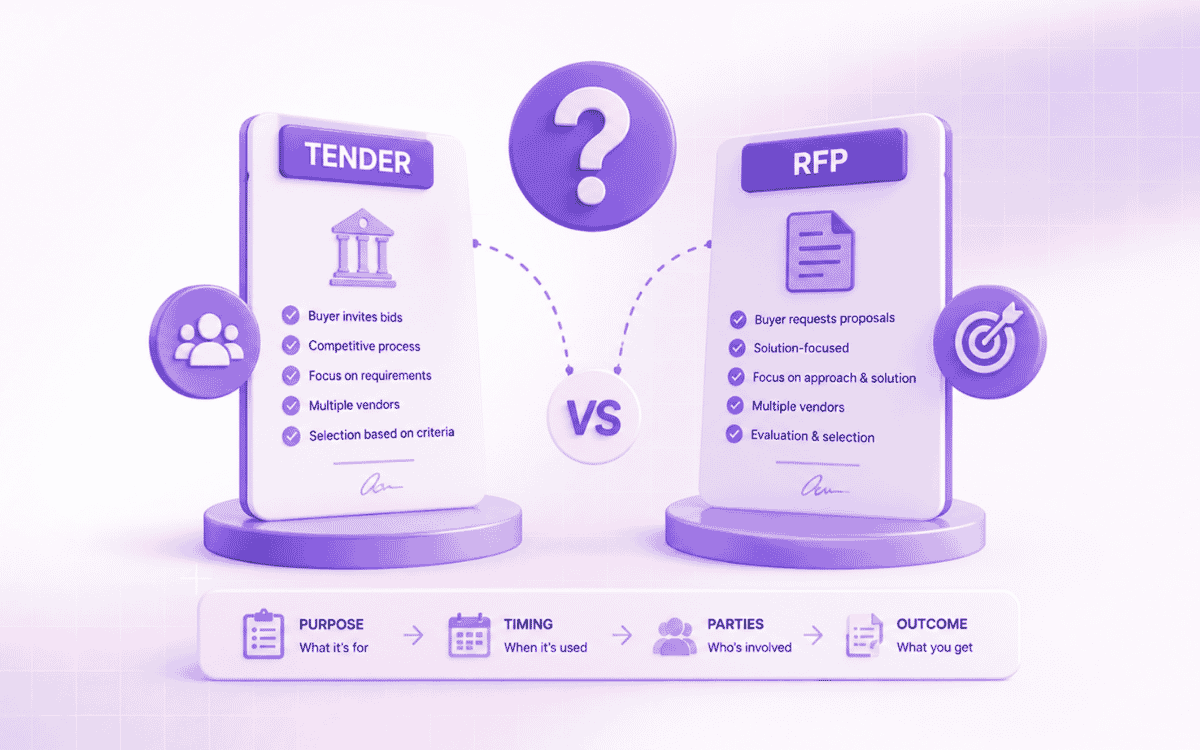
Tenders and RFPs are often confused, but they serve different procurement purposes. Tenders are rigid, compliance-driven, and price-focused, while RFPs allow vendors to propose flexible, outcome-based solutions with room for negotiation and differentiation.
- Understand the legal, commercial, and procedural differences between tenders and RFPs
- Learn how evaluation criteria, flexibility, negotiation, and pricing differ across both processes
- See how procurement terminology changes across regions like the UK, the US, and Australia
- Discover how SiftHub helps bid and proposal teams respond faster with verified, source-attributed answers across tenders and RFPs, working inside Excel, Word, and browser-based procurement portals
Tenders and RFPs are often confused, but they serve different procurement purposes. Tenders are rigid, compliance-driven, and price-focused, while RFPs allow vendors to propose flexible, outcome-based solutions with room for negotiation and differentiation.
- Understand the legal, commercial, and procedural differences between tenders and RFPs
- Learn how evaluation criteria, flexibility, negotiation, and pricing differ across both processes
- See how procurement terminology changes across regions like the UK, the US, and Australia
- Discover how SiftHub helps bid and proposal teams respond faster with verified, source-attributed answers across tenders and RFPs, working inside Excel, Word, and browser-based procurement portals
If you have ever received a document labeled "invitation to tender" and wondered whether it is the same as the RFPs your team regularly responds to, or whether a different process applies, you are not alone. The terms are used interchangeably in casual conversation, but they describe different procurement instruments with meaningfully different legal implications, flexibility levels, and response requirements.
Getting that distinction right matters whether you are the buyer issuing the document or the vendor preparing a response. Using the wrong approach on the buyer side can create legal exposure or attract the wrong type of competition. Responding incorrectly on the vendor side can result in a technically non-compliant submission that is disqualified before evaluation begins, regardless of how strong the underlying proposal is.
This guide explains what each document is, how they differ in purpose and process, where the terminology varies by geography, and what vendors need to understand when responding to either.
What is a tender?
Tendering is a formal and structured procurement process in which a buyer invites suppliers to submit a bid for a clearly defined scope of work. The key feature of tendering is that the requirements, specifications, and evaluation criteria are precisely defined upfront, leaving limited room for interpretation or alternative approaches.
A tender is a procurement process where an organization invites vendors to submit sealed bids for a specific project or contract. A formal tender is a structured, legally regulated process that establishes binding commitments between the parties involved. The key characteristics of tenders include strict adherence to evaluation and award criteria, which helps ensure transparency and fairness.
The defining characteristic of a tender is rigidity. The buyer has already determined what they need and how it should be delivered. Vendors are being asked not to propose an approach but to price and commit to a fully defined scope. Evaluation focuses primarily on compliance with specifications and, once compliance is confirmed, on price or value for money.
That legal dimension is important. In many jurisdictions, particularly in public sector procurement, submitting a tender bid creates a formal legal relationship between the buyer and all compliant bidders. The buyer is obligated to award the contract to the winning bidder according to the published criteria, and cannot simply decide to negotiate or walk away without consequence.
What is an RFP?
A Request for Proposal is a formal document issued by an organization inviting qualified vendors to submit proposals describing how they would approach a defined challenge or deliver a required outcome. Unlike a tender, it does not prescribe exactly how the work should be done. It describes what the buyer is trying to achieve and invites vendors to propose their own solutions.
Unlike tendering, RFPs are typically more flexible and encourage creativity in how suppliers meet the buyer's needs. In an RFP process, the buyer outlines the desired outcome, objectives, and evaluation criteria but often leaves room for bidders to propose innovative or alternative approaches.
In contrast to a tender process, an RFP process does not include the concept of a bid contract. The only contract created is the contract to complete the work. The project owner can evaluate and negotiate with project proponents.
That flexibility, and the absence of an automatic binding commitment on award, are the most important practical differences between the two. An RFP process allows the buyer to engage in dialogue with vendors, request clarifications, negotiate terms after shortlisting, and exercise judgment in the final selection. A tender process is typically more constrained: once bids are received, the evaluation must follow the published criteria, and the award must go to the winning compliant bidder.
The key differences between a tender and an RFP
The difference between a request for tender and an RFP is straightforward: a request for tender is more rigid and focuses on predefined specifications, with businesses competing mainly on compliance and pricing. An RFP invites creative approaches and evaluates vendors on methodology, experience, and value, not just price.
Broken down across the dimensions that matter most to vendors:
Scope definition. In a tender, the scope is fully defined before the document is issued. Vendors price a complete specification. In an RFP, the scope is defined at an outcome level; vendors are expected to propose how they would define and deliver the scope in their response.
Evaluation basis. Tenders are typically evaluated on price once technical compliance is confirmed. RFPs evaluate methodology, team, experience, approach, and commercial terms together, with price being one factor among several.
Flexibility. A tender leaves no room for alternative proposals. Submitting a non-conforming bid, one that deviates from the specification, is grounds for disqualification. An RFP typically allows vendors to propose alternative approaches or flag assumptions, and buyers can ask clarifying questions before final evaluation.
Legal implications. A tender, particularly in public sector procurement, creates formal legal obligations on both sides. An RFP is generally less legally prescriptive; it is an invitation to negotiate rather than an offer to contract.
Negotiation. In a traditional tender process, post-submission negotiation is limited or prohibited to maintain fairness between bidders. In an RFP process, negotiation after shortlisting is standard and expected.
Winner selection. In a tender, the compliant lowest-price bidder typically wins unless quality thresholds are explicitly weighted. In an RFP, the buyer selects the vendor offering the best overall value against the published evaluation criteria, which may weight innovation, approach, references, and team quality alongside commercial terms.
How geography affects the terminology
One of the most common sources of confusion around this topic is that the same procurement document can be called different things in different countries, and the same word can mean different things in different contexts.
In the UK public sector, tendering follows strict legal procedures governed by the Procurement Act 2023 and associated regulations. The term tender is used broadly in the UK, Australia, and much of the Commonwealth to describe any formal competitive procurement process, including what North American organizations would call an RFP.
In practice, this means:
United Kingdom, Australia, New Zealand, South Africa, and most Commonwealth countries: The word "tender" is the generic term for any formal competitive procurement, covering what North Americans would call both tenders and RFPs. An ITT (invitation to tender) in the UK context is closer to the rigid, price-focused process described above. But a UK "tender" can also refer to a flexible, outcome-based process that an American procurement team would call an RFP.
North America — United States and Canada: "Tender" typically refers specifically to the more rigid, price-competitive, publicly regulated process, while "RFP" refers to the flexible, proposal-based process. The two terms are more clearly distinguished.
Continental Europe: The terminology varies by country, language, and whether the procurement is in the public or private sector, with EU procurement directives adding another layer of regulatory terminology for public contracts above threshold values.
For vendors responding to procurement documents, the practical implication is straightforward: read the document itself rather than relying solely on what it is labeled. An "invitation to tender" from a UK local authority and a "request for proposal" from a US technology company may require different response strategies, and so might two documents with the same label from organizations in different sectors or jurisdictions.
Where each is typically used
Tenders are most common in public sector procurement, infrastructure, construction, and any context where transparency, auditability, and compliance with procurement regulations are mandatory requirements. They are also used in the private sector procurement for commodity purchases or standardized services where the specification is clear enough to enable a price-only comparison.
In construction procurement, a tender or invitation to tender is used to award a major contract based on a final design and bill of quantities, enabling an apples-to-apples comparison. An RFP is used when technical proposals, value engineering, or design input from specialist contractors is needed.
RFPs are most common in technology, professional services, consulting, marketing, and any procurement context where the buyer wants to evaluate different approaches rather than select the cheapest compliant bid. They are standard in enterprise B2B sales and used extensively wherever the complexity of the requirement means the buyer does not yet know the optimal solution.
The distinction also maps to buyer certainty. When a buyer knows exactly what they need and needs only to find the best price for it, a tender is appropriate. When a buyer knows the problem they are trying to solve but wants vendors to contribute expertise to defining the solution, an RFP is more appropriate.
What this means for vendors responding to either
The difference between tender and RFP processes has direct implications for how vendors should invest their response effort and how they should structure what they submit.
In a tender response, compliance is paramount. The first question evaluators ask is whether the bid meets the specified requirements. A technically brilliant response that deviates from the specification will be disqualified before it is read on merit. Vendors should invest their effort in confirming they meet every mandatory requirement and in pricing competitively within those constraints. The window for differentiation is narrow; it exists primarily in how clearly and credibly compliance is demonstrated and in the quality of any evidence supporting claims about track record or financial stability.
In an RFP response, differentiation is what drives selection. The buyer has already decided they want vendor input on how the problem should be solved. Vendors who treat an RFP like a tender, responding to the letter of the requirements without proposing a distinctive methodology or demonstrating a genuine understanding of the buyer's context, miss the opportunity that the process is designed to create. The best RFP responses show the evaluator something they did not already know about how the problem could be solved.
Both document types share a common operational challenge for vendor teams: the knowledge required to respond well — company credentials, technical capabilities, security certifications, implementation methodology, case studies, and pricing frameworks — is rarely organized or consistently formatted. For bid and proposal teams managing both tenders and RFPs concurrently, the operational problem is identical regardless of what the document is labeled: assembling verified, current, consistent answers under deadline pressure from knowledge scattered across multiple systems and people.
SiftHub's AI RFP software addresses this directly, auto-filling responses from your connected knowledge sources, including Google Drive, Confluence, SharePoint, Slack, past submissions, approved Q&A libraries, CRM records, and call transcripts. Beyond pulling verified answers, it also surfaces buyer-specific context and pain points already discussed in sales conversations, helping teams tailor responses and differentiate proposals instead of submitting generic answers. The platform works across Excel, Word, PDFs, and browser-based procurement portals, with full source attribution on every answer so compliance claims remain traceable and current, whether responding to a tender specification or an open-ended RFP question.
A note on the full procurement document family
Understanding where tenders and RFPs sit in relation to the other procurement documents they share a process with helps clarify when each is the right instrument.
The procurement cycle typically begins with an expression of interest, an EOI, which is exploratory and used for shortlisting vendors, gathering basic information about capabilities and interest level without requiring detailed pricing or technical proposals. This is followed by an RFI for deeper capability assessment, an RFP or RFQ for competitive proposals or pricing, and finally a tender for formal contract award where specifications are fully defined.
In many large procurement processes, particularly in government and infrastructure, all of these instruments appear in sequence. A buyer might issue an EOI to understand the market, an RFI to gather technical information from interested vendors, a shortlisting exercise to reduce the field, and then either an RFP or a tender to the shortlisted vendors, depending on how well-defined the requirements have become by that stage.
For vendors, the earlier stages, EOI and RFI, are lower-investment opportunities to demonstrate capability and position the organization for the more consequential stages that follow. Responding to an EOI or RFI well enough to make the shortlist is often the most important competitive moment in a long procurement cycle, precisely because the field narrows most dramatically at that point.