



A high-performing sales proposal is designed to drive decisions, not just share information. It aligns closely with the buyer’s context, reduces uncertainty, and makes it easy for stakeholders to evaluate and move forward.
- A sales proposal is a decision-making asset, not a product summary; it must help buyers justify, evaluate, and move forward without your presence.
- Winning proposals focus on buyer context, relevant proof, quantified ROI, and clear next steps.
- A structured 10-section template ensures completeness while reducing friction in evaluation.
- Most proposals fail due to generic messaging, delayed delivery, mismatched proof, or unclear pricing.
- High-performing teams use modular templates and connected content systems to personalize quickly without rebuilding from scratch.
- AI platforms like SiftHub help teams generate tailored proposals faster by surfacing the right case studies, ROI data, and approved content in real time.
- Speed and relevance together determine whether proposals advance deals or stall in inboxes.
A high-performing sales proposal is designed to drive decisions, not just share information. It aligns closely with the buyer’s context, reduces uncertainty, and makes it easy for stakeholders to evaluate and move forward.
- A sales proposal is a decision-making asset, not a product summary; it must help buyers justify, evaluate, and move forward without your presence.
- Winning proposals focus on buyer context, relevant proof, quantified ROI, and clear next steps.
- A structured 10-section template ensures completeness while reducing friction in evaluation.
- Most proposals fail due to generic messaging, delayed delivery, mismatched proof, or unclear pricing.
- High-performing teams use modular templates and connected content systems to personalize quickly without rebuilding from scratch.
- AI platforms like SiftHub help teams generate tailored proposals faster by surfacing the right case studies, ROI data, and approved content in real time.
- Speed and relevance together determine whether proposals advance deals or stall in inboxes.
Most sales proposals arrive too late, say too little about the buyer, and spend too much time on the seller. The prospect reads the first page, skims the pricing, and forwards it to procurement without context. The deal slows. The follow-up goes unanswered.
The structure of a proposal matters less than what most teams think. What kills proposals isn't poor formatting, it's generic language that could have been written for any prospect, ROI claims that aren't grounded in anything, and turnaround times that signal operational slowness before the contract is even signed.
This guide gives you a free, ready-to-use sales proposal template, explains what belongs in each section and why, and covers the personalization and speed strategies that separate proposals that advance deals from proposals that sit in inboxes.
What a sales proposal is actually doing
A proposal is not a summary of your product. It is a decision-making document — one that works in the room when you present it and keeps working after the meeting ends, when your champion forwards it to finance, IT, legal, and leadership without you present.
Most proposals are built from the seller's perspective. They open with company history, list features in the order the product team organized them, and close with a pricing table and a vague invitation to reach out with questions.
The buyer's perspective is different. By the time a prospect receives your proposal, they already know what you sell. What they need from your document is: confirmation that you understood their specific situation, evidence that others like them have succeeded with your solution, a clear picture of what implementation looks like, and a justified price. If your proposal answers those four things clearly, it does its job. If it doesn't, no amount of design polish will save it.
The free sales proposal template: Ten sections that close B2B deals
Below is a proven ten-section structure used by high-performing B2B revenue teams. Each section has a specific job. Skipping any of them creates a gap that buyers notice, even if they can't name it.
Section 1: Cover page
Job: Signal relevance immediately. Show the buyer this is built for them, not recycled from last week's deal.
Include the prospect's company name, a headline that references their specific goal or challenge, both logos, the presenter's name, and the submission date.
Weak version: "Solution Overview — [Your Company]."
Strong version: "How [Prospect Company] Can Reduce RFP Response Time by 60% in 90 Days."
The difference is immediate. One is about you. The other is about them.
Section 2: Executive summary
Job: Give decision makers who weren't in the original meeting everything they need to understand why this proposal exists and why they should care.
The executive summary is the most frequently skipped section and the most important one. A CFO who receives your proposal secondhand will read this and nothing else before deciding whether to approve the budget. Write it last, after the rest of the proposal is complete, but place it first.
It should cover: the problem you identified during discovery, the cost of that problem if nothing changes, your recommended solution and why it fits, and the headline outcome the prospect can expect. Keep it to half a page. Every word should earn its place.
Section 3: Problem statement
Job: Prove you listened. Show the buyer that what you're proposing is a response to their specific situation, not a template you send to everyone.
This is where most proposals lose the room. Generic problem statements, "organizations today face increasing pressure to do more with less", signal immediately that the rep didn't do their homework. The buyer reads it and thinks: they don't know us.
Use language from your discovery calls. Reference their specific pain points, the tools they're currently using, the process that's breaking down, and the business impact of that breakdown. If a stakeholder said something specific in a meeting, echo it back. The goal is for the buyer to read this section and think: they were paying attention.
Section 4: Proposed solution
Job: Describe what you're recommending and connect every element to a problem you identified in section 3.
Lead with outcomes, not features. "You'll be able to respond to security questionnaires in hours instead of days" is an outcome. "Our platform includes an automated response generation module" is a feature. Both might be true. Only one of them makes a buyer lean forward.
Map each element of your solution to a specific problem from section 3. If you can't draw that line clearly, either the solution doesn't fit, or the discovery wasn't thorough enough.
Section 5: Implementation and timeline
Job: Remove the fear of disruption. For many buyers, implementation risk is the hidden objection that kills deals in the final stretch, often after verbal agreement has been reached.
Show a realistic, milestone-based timeline. Include what the buyer is responsible for at each stage, what your team handles, what success looks like at each milestone, and what ongoing support looks like after go-live.
The clearer this section is, the less hesitation buyers feel about signing. A vague "we'll work closely with your team during onboarding" is not a plan. A phased timeline with clear ownership at each step is.
Section 6: Proof and social validation
Job: Let others sell for you. Social proof reduces perceived risk faster than any feature explanation.
The most powerful proof is specific, relevant, and recent. A case study from a company in the same industry, facing the same problem, with measurable outcomes, is worth more than ten generic testimonials.
Structure each proof point clearly: who they were, what challenge they faced, what they implemented, and what changed as a result. One well-matched case study is more persuasive than three loosely relevant ones.
This is where many reps hit a wall, not because the right case study doesn't exist, but because they can't find it quickly enough when building the proposal. AI Teammate addresses this directly: reps query by industry, company size, or pain point and surface the most relevant customer story from across all connected sources in seconds, without pinging marketing or digging through a shared drive. The right proof point gets into the right proposal every time.
Section 7: ROI and business impact
Job: Quantify the value. This is the section that gets forwarded to the CFO.
Vague claims carry no weight. "Significant time savings" means nothing. "14 hours recovered per rep per week" means something. Wherever possible, connect outcomes to numbers, hours saved, headcount avoided, revenue cycles shortened, and error rates reduced.
Ground every number in something real: your own platform benchmarks, the prospect's stated metrics from discovery, or published customer outcomes. A claim without a source is just an assertion. A claim tied to a named customer outcome or a verified benchmark is evidence.
Section 8: Commercial terms and pricing
Job: Give buyers clarity on investment without creating confusion that turns into delay.
Present pricing in a way that makes the decision easier, not harder. Two or three clearly defined tiers work better than a single price; they give buyers an anchor point and make the middle option feel like the obvious choice. Be explicit about what is included, what isn't, and what the contract terms look like.
Avoid the single-price approach. Avoid vague "custom pricing available" language that forces a follow-up conversation. If your pricing structure requires a 30-minute call to explain, simplify it before putting it in a proposal.
Section 9: Terms and conditions summary
Job: Flag important contractual terms without proposing feel like a legal document.
A summary of key terms, i.e, contract length, renewal conditions, data handling, and any relevant compliance certifications, reduces the number of questions procurement will ask before approving the deal. It also signals organizational maturity. Teams that include this section close legal review faster than those that leave everything for the contract phase.
Section 10: Clear next steps
Job: Move the deal forward. Never end with "please reach out if you have questions."
Define the exact next step — specific, time-bound, and mutual.
Examples: "We'd suggest a 30-minute technical review with your IT lead before the end of this week. Can we schedule that now?" Or: "Our security review process takes approximately five days. We can initiate that immediately to keep your Q3 timeline intact." Or: "If pricing looks right, the next step is a brief legal review; we can share the standard agreement today."
A proposal that ends without a defined next step leaves momentum on the table. Your champion needs something to take back into their organization.
Stop sending proposals that could have been written for anyone.
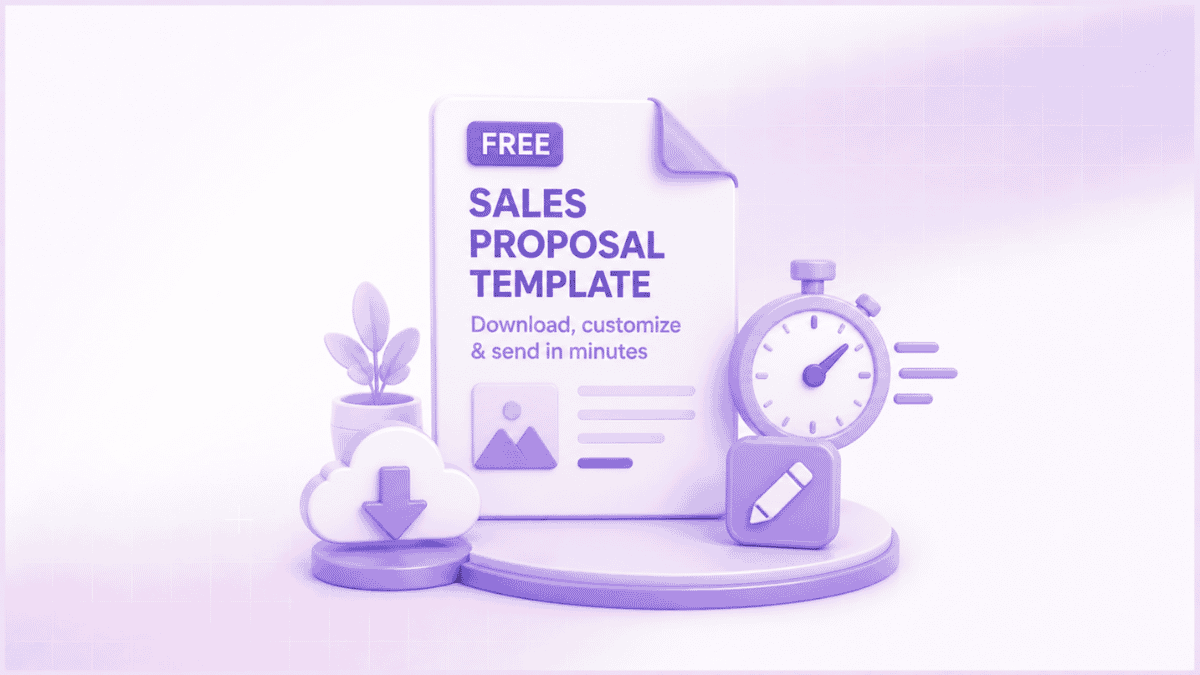
A free, fillable 10-section template built for B2B sales and presales teams, with guidance notes that show exactly what strong looks like in each section, and a pre-send quality checklist at the back.
The four reasons proposals lose deals they should win
Even well-structured proposals fail. Usually, for one of these reasons.
- The proposal arrived too late. A prospect requests a proposal on Monday. The rep spends two days chasing content across five tools, waiting for an SME to respond, and assembling answers manually. The submission goes out late or barely makes it on time with inconsistent, unreviewed content. First impressions of operational competence form at the proposal stage. A late or sloppy submission signals what the implementation will look like.
- The problem statement doesn't reflect reality. The rep used the generic template without customizing section 3. The buyer reads a description of a problem they half-recognize and a solution that feels slightly off. The champion can't use it to sell internally because it doesn't match the specific language from their internal discussions. The proposal gets deprioritized.
- The proof point doesn't match the buyer. A retail company receives a case study about a financial services firm. A 200-person company receives proof about an enterprise with 10,000 employees. The buyer thinks: that's not us. Relevance is everything in the proof section. One well-matched story beat three mismatched ones every time.
- The pricing section creates more questions than it answers. Vague pricing language — "pricing varies based on scope," "contact us for a custom quote", forces a follow-up conversation that delays approval. Confusion at the pricing stage is not negotiation. It's the friction that could have been removed before the proposal was sent.
How to personalize proposals at scale without rebuilding every time
The most common mistake growing teams make is treating personalization as all-or-nothing. Either they send the same generic deck to every prospect, or they rebuild from scratch for every account and burn hours doing it.
The solution is a modular proposal architecture.
Lock the core. The executive summary structure, implementation timeline, terms summary, and next steps section rarely change across deals. Build these once, verify them with your legal and enablement teams, and lock them.
Make these swappable. The problem statement, proposed solution mapping, proof section, and ROI calculation should be customized for every deal. These are the sections buyers actually read closely.
Personalize with specificity. Title page headline referencing their stated goal. Problem statement using language from your discovery notes. The case study closest to their industry and company size. ROI figures based on their team size and current process. Competitive positioning relevant to the vendors they mentioned in discovery.
This approach lets a rep personalize a proposal in 20 minutes without compromising the quality or structure that makes the core document work. With SiftHub MCP, reps can generate buyer-tailored proposals and point-of-view documents directly from within Claude or ChatGPT — drawing on verified case studies, approved messaging, and deal context from connected sources in SiftHub, without switching tools or starting from a blank slide. The right content surfaces in seconds; the rep shapes it to the deal.
The proposal checklist: Before you hit send
Before sharing any proposal with a prospect, run through this audit.
Cover page: Does the headline reference their specific goal or challenge, not yours?
Executive summary: Can a decision maker who wasn't in your meeting understand why this proposal exists from the first half-page alone?
Problem statement: Does it use language from your discovery conversation, not generic category language?
Proposed solution: Is every element mapped to a specific problem you identified? Is it outcome-first, not feature-first?
Implementation timeline: Is it realistic? Are ownership responsibilities clear at each stage?
Proof section: Is the case study from a company that resembles this prospect in industry, size, or challenge?
ROI section: Are all claims quantified? Is every number traceable to a real source?
Pricing: Is it clear what's included at each tier? Does it raise questions or answer them?
Next steps: Is there a specific, time-bound action defined? Does your champion have something concrete to take back internally?
If any item cannot be ticked, fix it before sending. A proposal with one weak section gives a skeptical stakeholder a reason to pause the deal.
Best practices for high-converting proposals
Lead with the buyer's problem, not your company history. The first page of your proposal should be about them. Background on your founding story belongs on your website, not in a document a prospect is evaluating under time pressure.
Design for internal sharing, not just live presentation. The most important audience for your proposal may never be on a call with you. Every section should be comprehensible without narration. Your champion needs to be able to forward it and have it speak for itself.
Quantify everything you can. "Meaningful improvement in efficiency" carries no weight. "Recovery of 14 hours per rep per week" — the outcome Allego achieved, carries a great deal. If you can't quantify a claim, consider whether it belongs in the proposal at all.
Match your proof to your prospect. One case study from a company that resembles them is more persuasive than three that don't. The closer the match in industry, company size, and challenge, the less work your champion has to do to translate the proof internally.
Set a follow-up trigger before you send. Before hitting send, agree on a specific follow-up date or define the next step in your accompanying email. A proposal without a defined next step is a document waiting to be forgotten.
Review and update your template quarterly. Outdated case studies, changed pricing, or superseded product claims in a live proposal undermine credibility regardless of how strong the underlying solution is.
Conclusion
A strong proposal template solves the structure problem. Every section has a job; the buyer's situation is reflected to them clearly, proof is relevant and specific, pricing is transparent, and the next step is defined.
But structure alone doesn't win deals. The proposals that consistently advance are the ones where the right case study actually made it into the document, where the ROI claim is grounded in something real, where the problem statement sounds like the buyer's own words, and where the submission arrived before the deadline.
Download the template below. Build your locked sections. Then look honestly at where your proposals hit walls in execution, the case study that couldn't be found in time, the pricing section that raised more questions than it answered, the submission that went out a day late because content assembly took too long. Those are the moments where proposals are won and lost.