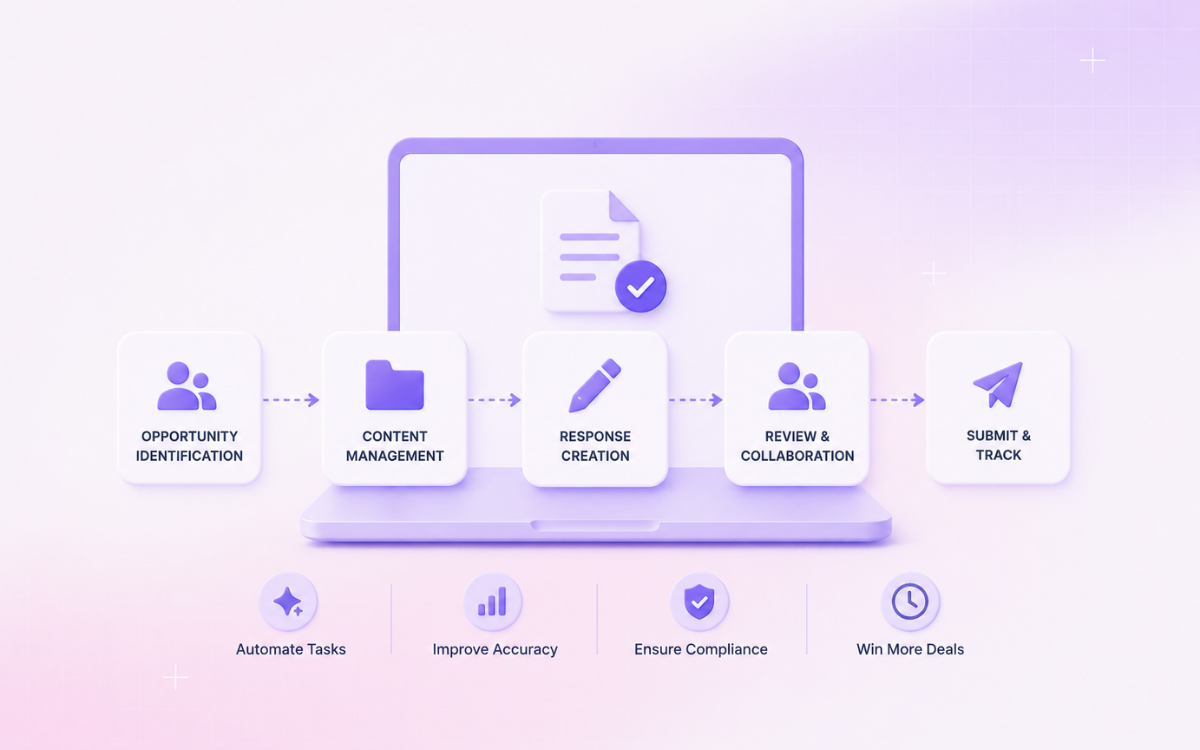




Most proposals lose not because the solution is weak, but because execution breaks down during the proposal stage. In 2026, winning teams improve proposal win rates by connecting discovery insights, proof points, ROI validation, and AI-powered workflows into a faster, more buyer-specific process.
- Learn why proposals lose deals even when the product is strong
- Understand how AI closes the gap between discovery and proposal drafting
- See how matched proof points and verifiable ROI improve buyer confidence
- Discover how faster submissions and quality gates increase competitive win rates.
Most proposals lose not because the solution is weak, but because execution breaks down during the proposal stage. In 2026, winning teams improve proposal win rates by connecting discovery insights, proof points, ROI validation, and AI-powered workflows into a faster, more buyer-specific process.
- Learn why proposals lose deals even when the product is strong
- Understand how AI closes the gap between discovery and proposal drafting
- See how matched proof points and verifiable ROI improve buyer confidence
- Discover how faster submissions and quality gates increase competitive win rates.
Most proposals don't lose because the solution was wrong. They lose because the proposal didn't reflect the buyer's situation accurately enough, the proof point didn't match their profile, the ROI section couldn't be verified, or the submission arrived two days after the evaluation committee had already formed an opinion about the other vendor.
Win rate is the most honest measure of proposal quality, and in 2026, the gap between teams with strong win rates and teams with mediocre ones has widened significantly. Not because some teams have better solutions. Because some teams have closed the execution gap that quietly costs deals at the proposal stage.
This playbook covers what's actually driving win rate improvement in 2026, from how winning proposals are structured to how top teams are using AI to close the gap between what they know and what makes it into the document.
Understand why proposals actually lose
Before optimizing for win rate, it helps to be precise about why proposals lose. Most post-loss analysis is too vague to be actionable: "they went with a competitor" or "price was an issue", and misses the real causes.
The four most common reasons proposals lose deals they should win:
The proposal felt generic. The buyer read a problem statement that could have been written for any company in their industry. The solution section listed features with no connection to the specific challenges surfaced in discovery. The executive summary opened with the vendor's company history. The buyer forwarded it to procurement without a cover note because there was nothing specific enough to champion internally.
The proof didn't match. The case study was from a company in a different industry, a different size, or facing a different challenge. The buyer couldn't see themselves in it. The stat cited was generic industry data rather than a verified customer outcome. The proof section failed to reduce perceived risk, which is its only job.
The ROI couldn't be verified. The business impact section made claims that weren't traceable to a real source. A skeptical CFO asked one follow-up question, and the number fell apart. "Significant efficiency gains" is not ROI. A specific, attributed customer outcome is.
The submission was late or felt rushed. The response arrived after other vendors had already shaped the buyer's evaluation criteria. Sections were inconsistent. Terminology drifted across the document. The implementation timeline was vague. The buyer's impression of operational competence formed before the solution was even evaluated.
Each of these causes has a specific fix. None of them requires a better solution. They require better execution at the proposal stage.
Close the gap between discovery and the document
The single biggest lever on win rate is how accurately the proposal reflects the buyer's specific situation. This sounds obvious. It rarely happens in practice.
The reason is structural. Discovery happens in calls, captured in Gong recordings, CRM notes, Slack threads, and email chains. Proposal drafting happens later, in a different tool, under time pressure, often by someone who wasn't in every discovery conversation. The knowledge transfer between those two moments is the most consistently broken part of the proposal workflow.
The result is a proposal where the problem statement was written from the rep's general understanding of the buyer's category rather than from what the buyer actually said. Where the language in the discovery call — their words, their framing, their specific concern — never made it into the document.
Winning proposals in 2026 close this gap systematically. Not by asking reps to take better notes, but by connecting the proposal drafting workflow directly to the sources where discovery knowledge lives, so what was said in the call is searchable at the moment the proposal is being built, rather than buried in a recording nobody has time to rewatch.
SiftHub's AI Teammate does this as part of the pre-proposal workflow. Before a draft begins, a rep queries the deal, and AI Teammate pulls context from CRM opportunity notes, Gong call transcripts, email threads, and Slack conversations, surfacing the specific language the buyer used, the concerns they raised, and the outcomes they said they cared about.
The problem statement that results reflects this specific buyer, not a generalized version of their category. The buyer reads the final proposal and thinks: They were paying attention. That impression, formed in the first two pages, shapes how the rest of the proposal is evaluated.
Match your proof to the buyer's profile every time
Proof is the section that determines whether the buyer believes you can deliver, not just that you have delivered for someone, somewhere, at some point. The closest match between your customer story and this buyer's situation is worth more than ten loosely relevant ones.
Most teams underperform on proof selection for a simple reason: reps default to the two or three case studies they remember from onboarding or the last deal they worked on. The case study library exists. The right story, the one from a company in the same industry, similar size, and matching challenge, also exists. But nobody has time to find it when the proposal is due tomorrow.
The fix is not a better content management system. It's making the right proof point findable at the moment the rep is building the proposal, not after a 20-minute search through a shared drive.
When AI systems are connected to your full knowledge base — case studies, win notes, customer call recordings, past proposals across Gong, Google Drive, Confluence, and Slack, a rep can query by industry, company size, and use case and retrieve the closest match in seconds. The proposal goes out with proof that resonates. The buyer doesn't have to translate a financial services story into terms relevant to their manufacturing context. The connection is already there.
Sirion improved its down-select rate from 65% to over 90% after ensuring every submission included proof matched to the specific buyer's profile rather than the closest case study anyone could remember. The proof section changed. The win rate followed. Rocketlane saw the same dynamic, connecting their proposal workflow to a unified knowledge layer cut their RFP turnaround by 50%, in part because reps stopped rebuilding proof sections from scratch and started pulling the closest verified match in seconds.
Quantify ROI with numbers that hold up under scrutiny
The business impact section of a proposal does one job: give a financially minded stakeholder a reason to approve the investment. It fails at that job more consistently than any other section.
The failure mode is always the same. The section contains numbers, percentages, hours, and dollar figures, but those numbers aren't grounded in anything the buyer can verify. They're industry averages, vendor estimates, or internal projections presented as if they were verified outcomes.
A skeptical CFO asks one question: "Where does this number come from?" If the answer is vague, the proposal loses credibility at the moment of financial approval, which is the moment that matters most.
The standard that wins in 2026 is: every ROI claim traces back to a named customer outcome, a verified platform benchmark, or the buyer's own metrics from discovery. Not all three, any one of them is enough. But the source has to be there.
"14 hours recovered per rep per week — Allego customer outcome" carries weight. "Significant time savings for sales teams" carries none. "Based on your team size of 45 reps and current manual process, the estimated annual time recovery is 32,760 hours," built from the buyer's own numbers from discovery, carries the most weight of all.
Building ROI sections this way requires fast access to verified customer benchmarks at the moment of proposal drafting, not a 30-minute search to confirm whether that number is current and attributable. Teams that have connected their knowledge sources, including past proposals, customer success data, and win documentation, to their proposal workflow can build credible ROI sections in minutes rather than making up numbers under deadline pressure.
Speed is a signal, not just a metric
Proposal win rate correlates with submission timing more strongly than most teams realize. A proposal that arrives first doesn't just have a scheduling advantage; it shapes the evaluation framework the buyer applies to every subsequent submission.
The vendor who submits first defines what a thorough response looks like. Their section structure, their proof format, their implementation timeline, all of these become the implicit standard against which later submissions are judged. Late submissions don't just risk missing the window. They risk being evaluated against a frame they didn't help build.
For teams responding to RFPs, the speed problem is content assembly. The average RFP includes 75+ questions. Each requires a verified, accurate answer pulled from product documentation, compliance records, past submissions, and technical specifications spread across multiple systems. The assembly process finds the right source, verify it's current format, format it correctly for this document is where days disappear.
SiftHub's AI RFP software addresses this directly. It auto-fills up to 90% of questionnaire responses from connected sources — CRM, Gong, Google Drive, Confluence, Slack, SharePoint, past submissions, approved Q&A libraries, and compliance documentation — directly inside Excel, Word, Google Sheets, and browser-based procurement portals, with every answer carrying full source attribution. What previously took three days takes three hours. The submission arrives first. The evaluation frame gets set by your response, not your competitor's.
Make every rep perform like your best one
Win rate is almost always an average that obscures a wide distribution. One or two top performers carry a disproportionate share of closed deals. The rest of the team produces proposals at a lower quality and conversion rate, not because they're less capable, but because they don't have the same accumulated knowledge the top performers have built over years of deals.
The knowledge gap is specific. Top performers know which case study lands with a healthcare CFO. They know what objection the IT lead raises at stage four. They know how to position against the competitor who always shows up in financial services evaluations. They know this because they've seen enough deals to internalize it, not because they were trained differently.
Closing the performance distribution without hiring more top performers requires making that knowledge accessible to everyone else, not through a training program, but in real time, at the moment a rep is building a proposal or preparing for a call.
Teams that give every rep access to a connected knowledge layer, one that surfaces deal-specific competitive intelligence, matched proof points, and verified objection responses from CRM records, Gong recordings, Slack, and past proposals, stop relying on individual memory and institutional luck. The knowledge exists. The question is whether it's accessible to everyone or only to the people who've been around long enough to have absorbed it.
Because SiftHub works inside the tools revenue teams already use — surfacing answers directly in Slack, through a browser extension, inside Microsoft Teams — reps access deal intelligence without switching platforms or interrupting their workflow. For teams already working inside Claude or ChatGPT, SiftHub MCP extends that same intelligence further — connecting those agents directly to your company's verified sales knowledge, so every rep gets the same grounded, cited answers the best performer would give, without needing to ask them.
Congruent Solutions gave every team member access to knowledge that previously required escalation to senior colleagues, cutting response time by 10x. Zycus improved its proof point specificity across every demo and proposal, achieving a 1.5x productivity improvement per rep without adding headcount.
Build a pre-submission quality gate
Most proposal quality problems are visible before submission if someone looks. The generic problem statement, the mismatched case study, the vague pricing section, and the missing next step. These don't require a second pair of eyes to identify. They require a checklist and the discipline to use it before the send button is pressed.
A pre-submission audit that takes two minutes to run is the highest-ROI investment most proposal teams can make. The questions are simple:
- Does the headline on page one reference this buyer's specific goal — or is it a generic product title?
- Could a decision maker who wasn't in your discovery meeting understand why this proposal exists from the first half-page alone?
- Does the problem statement use language from your discovery conversation or generic category language?
- Is every element of the proposed solution mapped to a specific problem you identified?
- Is the case study from a company that resembles this buyer in industry, size, and challenge?
- Are all ROI claims quantified and traceable to a real source?
- Is there a specific, time-bound next step, or does the proposal end with "please reach out if you have questions"?
Any item that can't be ticked is a gap that a skeptical stakeholder will find. One weak section in a high-weight area, such as the executive summary, problem statement, or proof, is enough to stall a deal that should have closed.
Teams that make this audit a non-negotiable gate before submission stop losing deals to avoidable execution failures. The solution didn't lose those deals. The proposal did.
The compounding effect of systematic proposal quality
Win rate improvement from any single tactic is incremental. Win rate improvement from systematic execution across all of these areas compounds.
A proposal that closes the discovery-to-document gap produces a problem statement that resonates. That resonant problem statement makes the proof section more credible, because the buyer already believes you understand their situation. A credible proof section makes the ROI section more persuasive, because the buyer trusts the context it's grounded in. A persuasive ROI section makes the pricing easier to approve, because the value case has already been made before the number appears. And a submission that arrives first — complete, buyer-specific, and evidenced- shapes the evaluation before competitors have the chance.
These aren't independent levers. They're a sequence. And the sequence starts with one thing: making the knowledge your best reps carry accessible to every rep, in every proposal, at the moment it's needed.
Conclusion
Win rate in 2026 is not primarily a talent problem or a solution problem. It's an execution problem, one that manifests at every stage of the proposal process and compounds across a team of any size.
The teams with the strongest win rates aren't winning because their product is better. They're winning because their proposals reflect the buyer's situation more accurately, use proof that resonates more specifically, quantify value more credibly, arrive faster, and clear their own internal quality bar before they're sent.
Each of those outcomes is achievable without hiring better reps or building a better product. They require systematic access to the right knowledge at the right moment — and the discipline to use it before the proposal goes out.
See how SiftHub helps revenue teams close the execution gap at sifthub.io.