



Most sales proposal software improves how proposals look and get delivered, but not whether they actually win. The real gap is content quality: relevance, proof, and ROI that match the buyer’s context. This guide breaks down what each tool category solves and where teams still fall short.
- Proposal tools improve formatting, delivery, and tracking, but don’t fix weak content
- Three categories: creation tools, CPQ platforms, and RFP response automation
- Win rates depend on content quality, problem statements, proof, and ROI, not design
- Most teams struggle with finding the right content at the right time
SiftHub fills the content gap by surfacing verified answers, case studies, and ROI data from connected knowledge sources.
Most sales proposal software improves how proposals look and get delivered, but not whether they actually win. The real gap is content quality: relevance, proof, and ROI that match the buyer’s context. This guide breaks down what each tool category solves and where teams still fall short.
- Proposal tools improve formatting, delivery, and tracking, but don’t fix weak content
- Three categories: creation tools, CPQ platforms, and RFP response automation
- Win rates depend on content quality, problem statements, proof, and ROI, not design
- Most teams struggle with finding the right content at the right time
SiftHub fills the content gap by surfacing verified answers, case studies, and ROI data from connected knowledge sources.
Most teams buying proposal software are solving the wrong problem.
They invest in a tool that makes proposals look better, sends them faster, and tracks when buyers open them. Then they wonder why win rates don't improve. The proposals go out on time. They arrive looking polished. They still lose.
The reason is usually not formatting. Its content. The problem statement is generic. The case study doesn't match the buyer's industry. The ROI claim isn't grounded in anything real. The solution section lists features instead of outcomes.
Proposal software doesn't fix any of that. It takes whatever content your reps put in and packages it professionally. The package improves. The content doesn't.
This guide covers what the main categories of proposal software actually do well, where each one consistently falls short, what to look for when evaluating tools for your team, and the layer most teams are missing entirely, the one that determines whether what goes into the proposal is worth sending in the first place.
What proposal software actually solves, and what it doesn't
Before comparing tools, it helps to be clear about what category of problem proposal software was built to solve.
What it solves well:
Proposal software eliminates the formatting work. Templates ensure consistent branding. Digital delivery replaces email attachments with trackable, interactive documents. E-signature capabilities remove the friction of printing and scanning. Analytics tell you when a prospect opened the proposal, how long they spent on each section, and whether they forwarded it internally.
For teams that were building proposals in PowerPoint, sending them as PDFs, and following up blind, this is a significant improvement. Faster delivery, consistent appearance, basic engagement signals.
What it consistently doesn't solve:
The content inside the proposal. Specifically: whether the problem statement reflects what this buyer actually said in discovery, whether the case study matches their industry and challenge, whether the ROI claim is grounded in real numbers, and whether the solution section maps each capability to a stated problem.
These are the things buyers actually evaluate. And proposal software, by design, doesn't touch them. It surfaces whatever content the rep puts in. If a rep is working from a generic template with a problem statement that could apply to any prospect, the proposal software delivers it beautifully and tracks that the CFO spent four minutes on the pricing section. It can't tell you, and can't fix that the problem statement was lost before the CFO got there.
The three categories of proposal software
The market broadly divides into three categories, each solving a different part of the proposal problem.
Category 1: Proposal creation and delivery tools
What they do: Template-based proposal builders with customizable sections, media embedding, interactive pricing tables, digital delivery, and e-signature. Most include basic analytics showing opens, time spent per section, and forwards.
Representative tools: PandaDoc, Proposify, Qwilr, GetAccept, Better Proposals
Where they work well: Teams that were building proposals manually in PowerPoint or Google Slides and spending significant time on formatting and delivery logistics. The efficiency gain from moving to a structured template with digital delivery is real and measurable.
Where they fall short: Content quality. These tools provide the structure but not the substance. Reps still need to find the right case study, write a buyer-specific problem statement, and ground the ROI section in real numbers. The template tells them what sections to fill, but it doesn't help them fill them well. A generic proposal delivered beautifully is still a generic proposal.
Best suited for: SMB sales teams, shorter sales cycles, and lower deal complexity. The simpler the deal, the less the content gap matters, and the more the formatting and delivery efficiency matter.
Category 2: CPQ and commercial configuration tools
What they do: Configure, Price, Quote platforms automate the commercial section of proposals, pricing rules, product bundling, discount approvals, and quote generation. Built for teams with complex pricing structures where manual quoting is error-prone or slow.
Representative tools: Salesforce CPQ, DealHub, Conga, Zuora
Where they work well: Enterprise teams with complex product catalogs, tiered pricing, and approval workflows. CPQ removes the risk of pricing errors and speeds up the commercial configuration process significantly.
Where they fall short: Everything outside the commercial section. CPQ tools don't address the narrative proposal, the problem statement, solution positioning, proof, and ROI framing that determine whether the buyer is convinced before they reach the pricing table. A perfectly configured quote attached to a weak proposal still loses to a competitor with stronger positioning.
Best suited for: Enterprise sales with complex commercial structures, channel sales, and subscription businesses with frequent configuration changes.
Category 3: RFP response and content automation tools
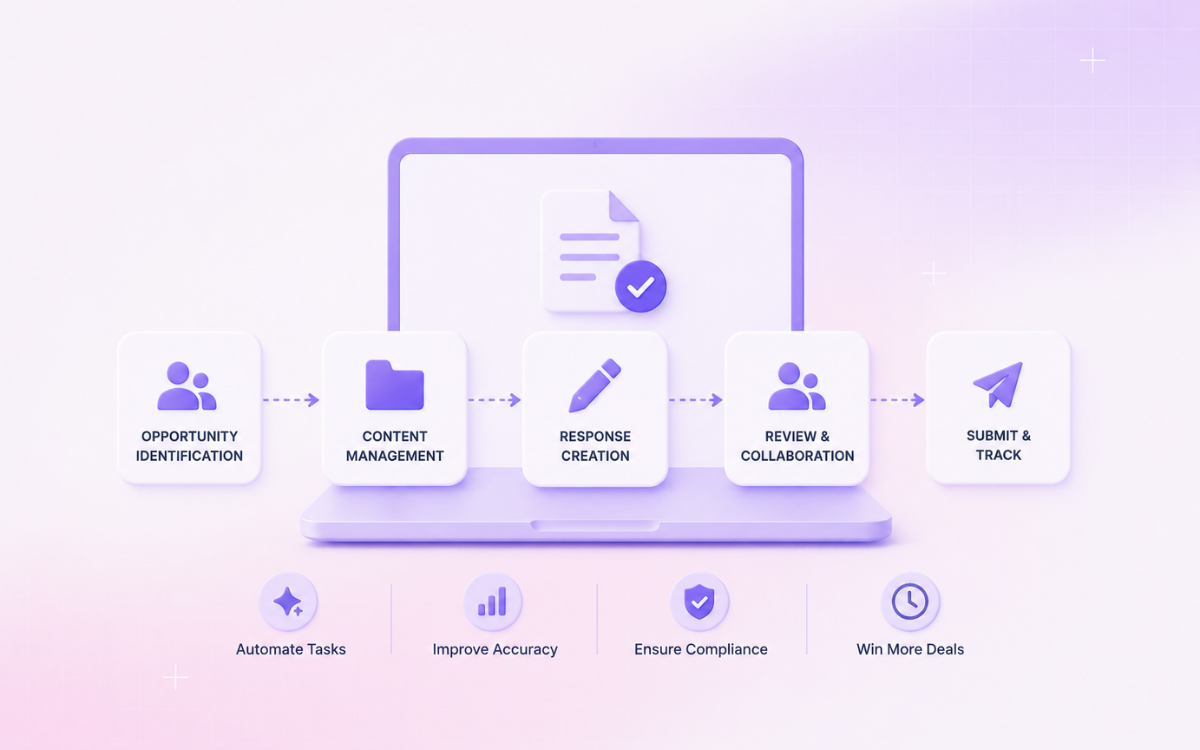
What they do: Automate responses to RFPs, RFIs, and security questionnaires using a connected knowledge base. First-pass answers populate from verified internal content, product documentation, approved Q&A libraries, past submissions, security certifications, and route exceptions to the right reviewers.
Representative tools: SiftHub, Responsive (formerly RFPio), Loopio, Ombud
Where they work well: Teams managing significant RFP and questionnaire volume, typically presales, solutions engineering, and bid management teams. The efficiency gain is substantial: first-pass response completion rates of 70–90%, with response time dropping from days to hours.
Where they differ from each other: Legacy tools in this category rely primarily on keyword matching to pull relevant past answers. The quality of suggestions depends heavily on how well the knowledge base is maintained, which requires ongoing manual curation. Newer platforms take a different approach: rather than keyword lookup from a static library, they connect to the systems where knowledge actually lives, such as, CRM, Gong, Slack, Google Drive, SharePoint, Confluence, and use semantic understanding to surface the most relevant, up-to-date answer for each question. The distinction matters because the first approach creates a maintenance burden; the second removes it.
Where they fall short: Proposal creation and delivery mechanics. RFP response tools are built for structured questionnaires and technical content, not for building the narrative proposal document that a prospect receives before an RFP is even issued.
Best suited for: B2B teams with significant RFP and questionnaire volume — SaaS, enterprise technology, professional services, and any sector where security questionnaires are a standard part of the buying process.
How to evaluate proposal software for your team
Rather than ranking tools, a more useful frame is matching the tool category to the specific breakdown in your proposal workflow.
Start by diagnosing where your proposals are losing:
If proposals go out late or with incomplete sections, and your team is manually assembling RFP responses from scratch each time, the primary problem is content retrieval and response generation speed. A proposal creation tool won't fix this. RFP response automation will.
If proposals look inconsistent across reps, arrive formatted differently, and require significant time to customize for each deal, the primary problem is structure and template governance. A proposal creation tool addresses this directly.
If your commercial section is error-prone, slow to configure, or requires multiple approval rounds for standard deals, CPQ addresses this. Everything else is secondary.
If proposals are going out on time and looking consistent, but win rates are flat, the problem is content quality. The case studies aren't matching buyers. The problem statements are generic. The ROI claims aren't grounded. This is the layer none of the standard tool categories fully addresses, and it requires a different kind of solution.
Questions worth asking in any tool evaluation:
Where does the content actually come from? A tool that generates answers from a manually maintained Q&A library creates a maintenance dependency. A tool that connects to your live knowledge sources, such as CRM, Gong, Slack, and Drive, stays current without curation overhead.
How does the tool handle proposals that aren't RFPs? Most RFP tools are optimized for structured questionnaires. But a significant portion of high-value proposals are narrative documents, one-pagers, solution briefs, POV decks that require different content and a different workflow.
What happens when a rep can't find the right case study? If the answer is "They search a shared drive or ping marketing," the tool isn't solving the content access problem. The right answer is that a rep queries by industry and challenge and gets the closest match in seconds from a connected knowledge source.
Does the tool reduce SME dependency or just reorganize it? Many proposal tools route questions to subject matter experts more efficiently. Fewer tools actually eliminate the need for SME involvement on repeat questions by surfacing verified, pre-approved answers automatically.
Evaluating proposal software? Start here.
A free diagnostic for presales and sales ops teams, maps your proposal symptoms to the right tool category, includes a vendor evaluation question bank, and helps you build the right stack for your team's situation.
What most teams are actually missing
Here's the gap that none of the categories above fully closes.
A proposal has two layers. The first layer is structural, including the sections, the formatting, the delivery, and the tracking. Proposal creation tools own this layer. The second layer is the content, the specific words, proof points, metrics, and positioning that propose feel built for this buyer rather than copied from the last one.
The content layer breaks down in the same four places, consistently across teams of every size.
The problem statement. Most reps write a generic version that describes a category of pain rather than this buyer's specific situation. The buyer reads it and thinks: they don't know us. The proposal loses credibility before the solution section is reached.
The case study. The right proof point exists somewhere in the organization, in a marketing folder, a Confluence page, or a Gong recording where a customer talked about their results. But reps can't find it quickly enough when building the proposal. They default to whatever they remember. The buyer receives a case study from an irrelevant industry or company size. The proof doesn't land.
The ROI section. Numbers get added without traceable sources. "Significant time savings" instead of "14 hours recovered per rep per week — Allego customer outcome." The CFO reads it and discounts it immediately. Vague claims signal that the vendor doesn't know their own numbers.
The submission timing. For RFP-driven proposals, the content assembly process is slow enough that submissions go out late or incomplete. A late submission signals operational slowness. Buyers use proposal quality as a proxy for delivery capability.
All four of these are content and knowledge access problems, not formatting or delivery problems. They're not solved by a better template or a prettier interface. They're solved by making the right content, the right case study, the right benchmark, the right compliance language, accessible at the moment the rep is building the proposal.
Where SiftHub fits
SiftHub sits at the intersection of RFP response automation and deal intelligence, and addresses a layer that dedicated proposal tools leave untouched.
For teams responding to RFPs and security questionnaires, SiftHub's AI RFP Software auto-fills answers across Excel, Word, Google Sheets, and browser-based procurement portals from a connected, verified knowledge base such as CRM, sales enablement tool, Teams, Drive, etc.. First-pass responses populate in minutes rather than days, with full source attribution so reviewers can verify before submission.
- Sirion handles 1.5x more RFPs per month using this approach, while cutting 48 hours off their average response SLA.
For the narrative proposal, the one-pager, the solution brief, and the POV deck, SiftHub’s AI teammate surfaces the most relevant case study, grounds ROI claims in verified benchmarks, and pulls discovery context from CRM and call transcripts directly into the proposal content.
- Rocketlane cut RFP turnaround time by 50% and gave their solutions engineers back 70% of the bandwidth previously consumed by document work.
For teams that need proposal collateral built and tailored to each buyer without jumping between tools, SiftHub MCP lets reps generate point-of-view decks, one-pagers, and proposal sections directly from Claude or ChatGPT, pulling verified content, case studies, and deal context in real time, without opening a separate platform. Rather than manage 4+ integrations on your LLM tool, you manage just one.
The distinction from dedicated proposal tools is the content layer. SiftHub doesn't just package what the rep puts in. It surfaces what the rep should put in, the right proof point, the right compliance language, the right ROI benchmark, from the knowledge that already exists across your organization.
Building a proposal stack that actually works
For most B2B sales teams, the right answer isn't a single tool, it's understanding which layer of the proposal problem each tool addresses and ensuring no layer is left unattended.
A practical stack for a team with meaningful RFP volume might look like: a proposal creation tool for narrative proposals and client-facing delivery, RFP response automation for structured questionnaires and security reviews, and a knowledge and deal intelligence layer that ensures the content going into both is accurate, buyer-specific, and retrievable in seconds.
The teams consistently winning on proposals aren't the ones with the most sophisticated proposal software. They're the ones where the rep building the proposal can find the right case study in seconds, knows which ROI benchmark to cite, and gets the submission out before the deadline, because the knowledge they need is connected, verified, and accessible without a content hunt.