


.avif)
A software sales proposal is not a formality; it is the document that either convinces technical and business stakeholders that your solution merits their investment or gives them reasons to choose a competitor. A strong proposal demonstrates you understand their specific problems, positions your software as the optimal solution, addresses implementation concerns before they become objections, and makes the business case compelling enough to justify budget allocation.
A weak proposal reads like a generic brochure adapted with find-and-replace company names, focuses on features buyers do not care about while ignoring their stated concerns, presents technical details that confuse decision-makers, and fails to differentiate convincingly from alternatives the buyer is evaluating.
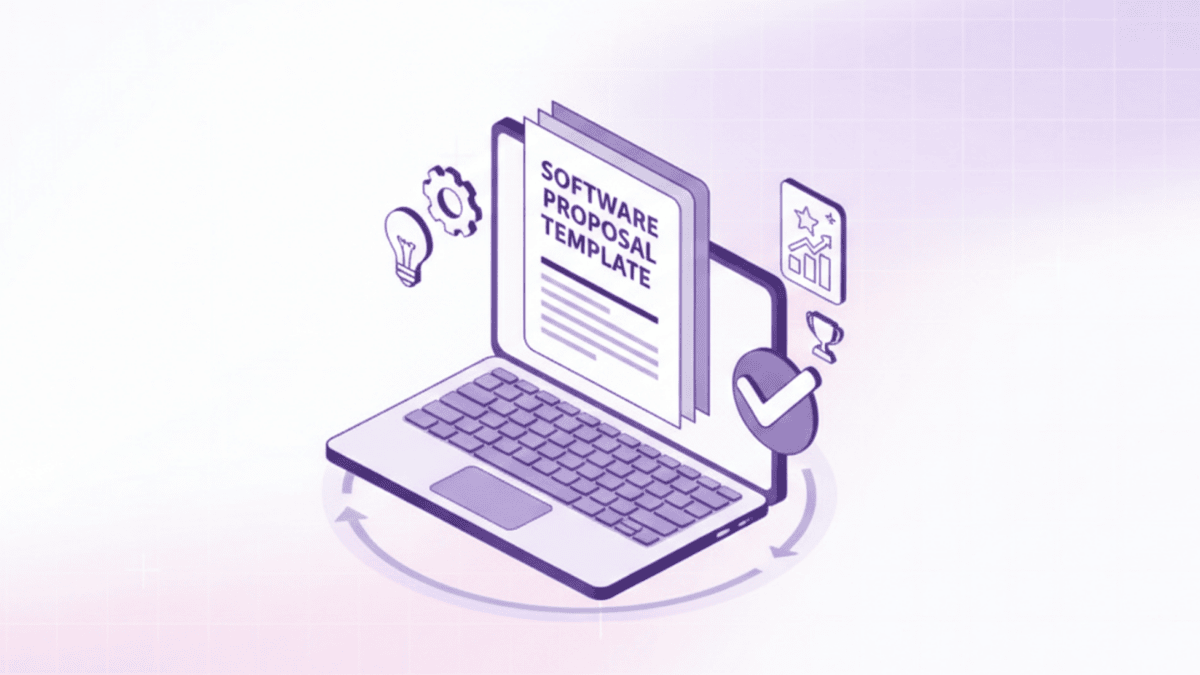
The difference between these outcomes is not random chance; it is deliberate structure, clear messaging, and thoughtful customization. This guide provides a complete software sales proposal template, breaks down how to write each section effectively, identifies common mistakes that undermine proposals, and explains how to create high-quality proposals efficiently when you are managing multiple concurrent opportunities.
What makes software sales proposals different
Software proposals face unique challenges compared to product sales or service engagements.
- Technical complexity mixed with business evaluation: Buyers must assess both technical fit, such as integrations, architecture, security, scalability, business value, and operational impact. Your proposal must address both audiences: technical evaluators who need architectural details and business stakeholders who need strategic justification.
- Implementation risk and disruption: Unlike product purchases, where value is immediate, software implementations require time, resources, and organizational change. Buyers worry about failed implementations, scope creep, hidden costs, and business disruption during deployment. Your proposal must acknowledge these concerns and demonstrate how your approach mitigates implementation risk.
- Longer sales cycles with multiple stakeholders: Software purchases often require consensus across IT, finance, operations, and executive leadership. Each stakeholder evaluates different criteria. Your proposal must address all these perspectives while maintaining coherent messaging.
- Competitive evaluation: Buyers rarely evaluate a single option. Your proposal is being compared side-by-side with competitors. Generic content that could apply to any vendor in your category fails to differentiate. Your proposal must explicitly position your advantages.
Essential components of a winning software sales proposal
A complete software proposal includes these sections, each serving a specific purpose in the buyer's evaluation.
1. Executive summary
A concise overview of the buyer's challenge, your proposed solution, key benefits, and recommended next steps. This is often the only section C-suite executives read carefully. It must stand alone while motivating readers to review the full proposal.
2. Problem statement and business context
Demonstrate that you understand the buyer's current situation: the business problems they face, the technical limitations that create those problems, and the strategic impact of not solving them. Use the buyer's own language and reference their specific context, not generic industry challenges.
3. Proposed solution
Describe how your software addresses the problems identified. Focus on capabilities that directly solve their stated needs rather than exhaustive feature lists. Connect features to outcomes: "Our automated workflow engine reduces manual approvals from 48 hours to under 4 hours, enabling same-day customer onboarding."
4. Technical specifications and architecture
Provide enough technical detail for IT evaluators to assess fit without overwhelming business readers. Cover integration requirements, infrastructure needs, security and compliance capabilities, scalability parameters, and data handling. Use diagrams to illustrate complex architectures in an accessible way.
5. Implementation plan and timeline
Outline the phases from contract signature through go-live and beyond: discovery, configuration, data migration, testing, training, rollout, and post-launch support. Specify timelines, milestones, resource requirements from the buyer's team, and risk mitigation strategies. Buyers need confidence that you have successfully implemented it before.
6. Pricing and investment structure
Present pricing clearly with all components itemized: software licenses, implementation services, training, support, and any optional modules. Explain pricing structure, per user, per transaction, flat fee, and provide multiple configuration options if relevant. Include the total cost of ownership perspective that accounts for ongoing costs.
7. Terms and conditions
Cover contract duration, renewal terms, service level agreements, termination provisions, data ownership, intellectual property rights, and any other legal or commercial terms material to the decision. While legal teams draft final contracts, proposals must address key commercial terms upfront.
8. Success metrics and expected outcomes
Quantify expected results: time savings, cost reduction, revenue impact, efficiency gains, or other metrics relevant to the buyer's goals. Provide timeframes for realizing these outcomes and reference comparable client results when credible.
9. Next steps and decision timeline
Propose a clear path forward: additional discovery sessions, technical proof-of-concept, reference calls, executive briefings, or contract negotiations. Indicate timeline expectations and what you need from the buyer to proceed.
Software sales proposal template
Below is a complete proposal structure you can adapt. Customize depths and emphases based on your software, sales cycle, and buyer profile.
[YOUR COMPANY LOGO]
Proposal for [Client company name]
Prepared for: [Client Name, Title]
Prepared by: [Your Name, Title]
Date: [Date]
Validity: [Proposal valid through date]
Executive summary
[Client Company] is facing [specific business challenge], which is currently resulting in [quantified impact]. Based on our discovery conversations with [stakeholders], we understand the core issues are [2-3 key problems].
[Your Software] addresses these challenges by [core capability in business terms]. Our proposed solution will enable [Client] to [specific measurable outcome] within [timeframe].
This proposal outlines our recommended approach, technical specifications, implementation plan, and investment structure. We propose moving forward with [specific next step] by [date] to achieve go-live by [target date].
Understanding your challenge
- Current situation: [Describe buyer's current state in their words, reference specific pain points mentioned in discovery]
- Business impact: [Quantify the cost of the problem: lost revenue, wasted time, compliance risk, competitive disadvantage]
- What needs to change: [Articulate what must be different for them to achieve their goals]
- Success criteria: [List what the buyer identified as success measures].
Proposed solution
Overview: [High-level description of your software and how it solves the problems identified above]
Core capabilities addressing your needs:
- [Capability 1]: [Description focused on buyer's specific use case, not generic feature]
- Impact: [Quantified outcome this delivers]
- [Capability 2]: [Description tied to buyer's workflow]
- Impact: [Measurable benefit]
- [Capability 3]: [Specific to buyer's requirements]
- Impact: [Expected result]
[Continue for 4-6 key capabilities most relevant to the buyer]
Why this approach: [Explain your methodology or philosophy that differentiates your solution].
Technical specifications
System requirements:
- [Hardware/infrastructure needs]
- [Browser/device compatibility]
- [Network requirements]
Integration capabilities:
- [Native integrations with systems buyer uses]
- [API specifications for custom integrations]
- [Data sync frequency and methods]
Security and compliance:
- [Security certifications: SOC 2, ISO 27001, etc.]
- [Compliance standards: GDPR, HIPAA, etc.]
- [Data encryption and access controls]
- [Backup and disaster recovery]
Architecture: [Include diagram if helpful]
Scalability: [Capacity to grow with buyer's needs]
Implementation plan
Phase 1: Discovery and configuration (weeks 1-3)
- Detailed requirements validation
- System configuration
- Integration setup
- Milestone: Configuration complete and integration tested
Phase 2: Data migration and testing (weeks 4-6)
- Data mapping and migration
- User acceptance testing
- Performance validation
- Milestone: System ready for pilot launch
Phase 3: Training and rollout (weeks 7-9)
- Admin and end-user training
- Pilot deployment with [department/team]
- Full production rollout
- Milestone: All users live on the system
Phase 4: Optimization and handoff (weeks 10-12)
- Performance tuning
- Knowledge transfer to the internal team
- Post-launch support
- Milestone: Transition to ongoing support
Your team's involvement:
[Specify time commitments needed from buyer's team: IT resources, subject matter experts, project sponsor].
Investment structure
Payment terms: [Net 30, milestone-based, etc.]
Optional add-ons: [List optional modules or services with pricing]
Terms and Conditions Summary
- Contract term: [Duration]
- Service level agreement: [Uptime guarantee, support response times]
- Data ownership: [Customer owns all data]
- Termination: [Notice period and conditions]
- [Other key commercial terms]
Full terms and conditions available in the contract agreement.
Expected outcomes
Based on implementations with similar organizations, you can expect:
- [Outcome 1]: [e.g., "50-60% reduction in approval cycle time"] within [3 months]
- [Outcome 2]: [e.g., "Annual savings of $[amount] in operational costs"] within [12 months]
- [Outcome 3]: [e.g., "Improved customer satisfaction scores from 7.2 to 8.9"] within [6 months]
Client success stories: [Reference 1-2 comparable clients and their results].
Why [your company]
- Experience: [Years in business, number of implementations, relevant industry expertise]
- Client success: [Retention rate, satisfaction scores, growth statistics]
- Commitment: [Your approach to client relationships and support]
- Differentiation: [Why you versus alternatives: specific advantages relevant to this buyer].
Next steps
We recommend the following timeline to achieve your target go-live date:
- [Date]: Executive decision and contract negotiation
- [Date]: Contract execution and project kickoff
- [Date]: Implementation complete and system live
Questions? Contact [your name] at [email] or [phone].
Writing each section effectively
1. Executive summary best practices
Write this last, after all other sections are complete. Limit to one page maximum. State the problem, solution, and outcome in business terms without technical jargon. Include a specific call to action. Treat this as a standalone document; executives may read only this section.
2. Problem framing that resonates
Use the buyer's own language from discovery conversations. Reference their specific context: "Your current manual approval workflow requires sign-off from six stakeholders across three departments, creating 48-hour delays that prevent same-day customer onboarding." Quantify the impact in business terms they care about: revenue, cost, risk, and competitive position.
3. Solution positioning without feature dumps
Connect every capability to a buyer outcome. Not "We have workflow automation" but "Automated approval routing reduces your 48-hour cycle to under 4 hours, enabling same-day onboarding." Prioritize capabilities that address their stated must-haves and differentiators that matter in their evaluation.
4. Technical specifications for mixed audiences
Structure technical sections so business readers can skim while technical evaluators find the depth they need. Use expandable details, appendices, or clearly labeled technical deep-dives. Include architecture diagrams that communicate complexity visually without requiring readers to parse dense technical prose.
5. Pricing presentation that builds rather than scares
Present pricing after establishing value. Show investment structure clearly with all components itemized. Offer configuration options if relevant, such as different tiers, phased deployment, or modular approaches. Frame total cost of ownership: compare your pricing to the cost of their current approach, including labor costs, inefficiencies, and opportunity costs.
When bid and proposal teams manage multiple proposal opportunities simultaneously, using AI RFP tools with personalization capabilities that can help tailor proposals by industry, company size, and buyer context allows teams to deliver customized proposals without rebuilding each one from scratch.
Common software proposal mistakes
- Too technical for business stakeholders: Proposals that read like technical specifications lose executives and finance teams who need to understand business value, not architecture details. Balance technical depth with accessible business framing.
- Too generic; not customized to the buyer: Proposals that feel like templates with the company name swapped out signal you do not understand the buyer's specific situation. Use their terminology, reference their context, and address their unique concerns.
- Poor formatting and visual hierarchy: Dense text blocks, inconsistent formatting, and a lack of visual breaks make proposals hard to navigate. Use headers, bullet points, tables, and whitespace to create scannability. Important information should be visually prominent.
- Missing stakeholder concerns: Software purchases involve multiple evaluators with different priorities: IT cares about integration, finance cares about ROI, operations cares about user adoption, and executives care about strategic fit. Proposals that address only one perspective fail with others.
- No clear differentiation: When buyers are evaluating multiple vendors, generic claims like "best-in-class" and "industry-leading" apply equally to everyone. Specific differentiators, "The only platform that natively integrates with [buyer's specific system]", actually distinguish your proposal.
- Inconsistent messaging across sections: When multiple contributors draft different sections without coordination, proposals contain contradictory claims, inconsistent terminology, and misaligned emphasis. Unified messaging requires central coordination and review.
Creating proposals efficiently at scale
For teams managing multiple concurrent proposals, efficiency without sacrificing quality requires structure.
Build reusable content libraries
Maintain approved content for standard sections: company overview, technical specifications, security documentation, implementation methodology, case studies, and terms. Update this library as products evolve and new proof points emerge. Starting from verified content is faster and more consistent than recreating sections for each proposal.
Maintain proposal consistency across the team
When every rep builds proposals from scratch using their own judgment, quality varies, and messaging diverges. Centralized standards ensure every proposal reflects current positioning, uses approved language, includes required legal disclaimers, and presents the company consistently. A sales collateral builder that generates proposals from verified content libraries helps teams produce customized proposals at scale while maintaining brand and message consistency.
Automate routine sections while customizing what matters
Some proposal sections require buyer-specific customization: problem statements, solution configurations, implementation plans, and competitive positioning. Other sections are largely standard: company background, technical specifications, security certifications, and general capabilities. Automating standard sections from content libraries frees time for the high-value customization that actually differentiates your proposal.
Enable team collaboration
Proposals often require input from sales, solutions engineering, legal, finance, and product. Coordinate these contributions efficiently: clear ownership of sections, defined timelines, centralized review, and version control. Collaborative tools prevent lost edits, duplicated effort, and last-minute assembly chaos.
The bottom line
Software sales proposals are not just documents that formalize pricing; they are sales tools that either build confidence in your solution or raise doubts that send buyers toward competitors. The teams that win consistently treat proposal creation as a strategic discipline requiring clear messaging, thoughtful customization, and efficient execution.
A strong template provides structure. Effective section-by-section writing provides content quality. Systematic approaches to reusability and automation provide the efficiency that lets you pursue more opportunities without compromising proposal quality. Together, these elements transform proposals from administrative necessities into competitive advantages that win deals.
Using an always-on AI sales assistant helps generate customized proposals instantly by pulling verified content, personalizing by buyer context, and maintaining consistency across every opportunity your team pursues.