


.avif)

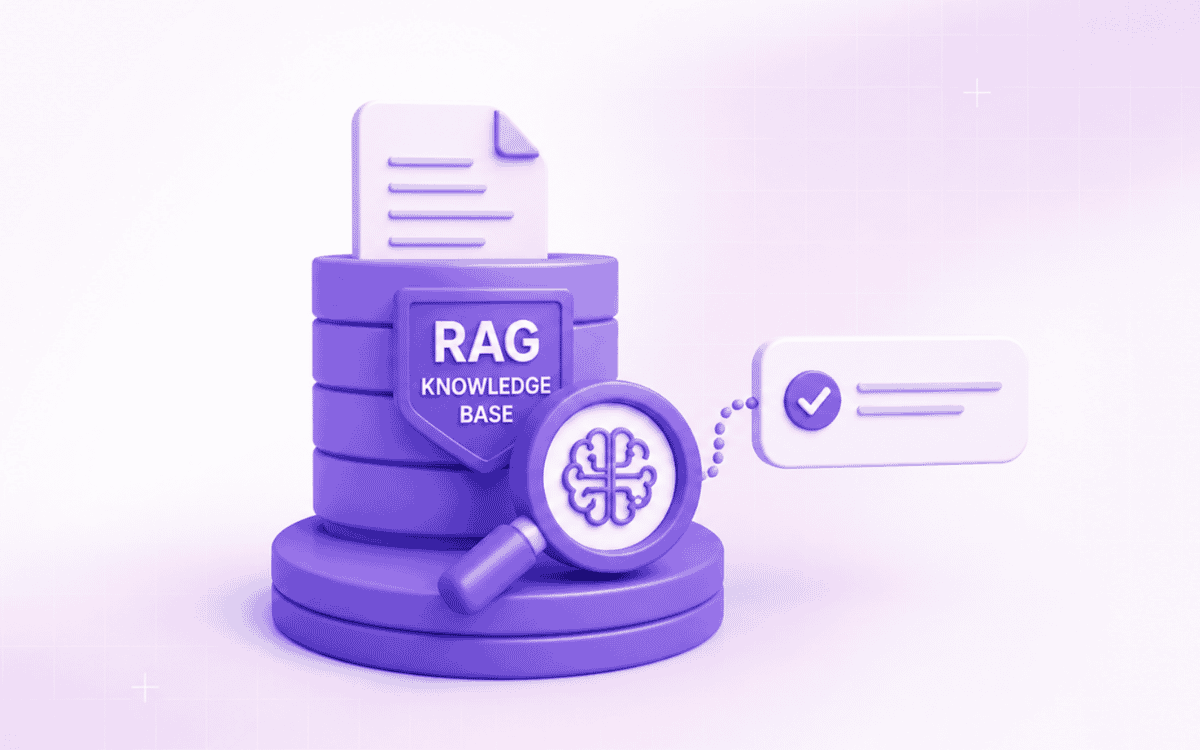
RAG knowledge bases determine whether AI tools for sales and presales teams generate answers that are accurate, current, and defensible, or merely plausible-sounding. This guide explains how retrieval-augmented generation works, why connected knowledge sources matter, and what separates production-ready AI from demo-only tools.
- RAG retrieves answers from live organizational knowledge sources instead of relying only on static AI training data.
- Poor retrieval architecture causes hallucinated product claims, stale certifications, inconsistent responses, and compliance risks.
- Effective RAG systems connect directly to Confluence, SharePoint, Google Drive, CRM, Slack, and past submissions to keep answers current automatically.
- Source attribution and governance controls make AI-generated responses traceable, auditable, and safe for compliance-sensitive workflows like RFPs and DDQs.
- Revenue teams using connected, governed RAG architectures improve response speed, consistency, and submission accuracy at scale.
RAG knowledge bases determine whether AI tools for sales and presales teams generate answers that are accurate, current, and defensible, or merely plausible-sounding. This guide explains how retrieval-augmented generation works, why connected knowledge sources matter, and what separates production-ready AI from demo-only tools.
- RAG retrieves answers from live organizational knowledge sources instead of relying only on static AI training data.
- Poor retrieval architecture causes hallucinated product claims, stale certifications, inconsistent responses, and compliance risks.
- Effective RAG systems connect directly to Confluence, SharePoint, Google Drive, CRM, Slack, and past submissions to keep answers current automatically.
- Source attribution and governance controls make AI-generated responses traceable, auditable, and safe for compliance-sensitive workflows like RFPs and DDQs.
- Revenue teams using connected, governed RAG architectures improve response speed, consistency, and submission accuracy at scale.
If you have evaluated more than one AI tool for your sales or presales team, you have almost certainly encountered the question that separates tools that work in production from tools that work in demos: where does the answer actually come from?
A general AI tool answers from its training data, a vast but static snapshot of publicly available information, frozen at a point in time and containing nothing specific to your organization. A sales AI built on a RAG knowledge base answers from your organization's actual content, your product documentation, your compliance certifications, your approved Q&A pairs, your past RFP submissions, and your customer proof points. The answer is grounded in what your team knows, not what the model was trained on.
That distinction, retrieval-augmented generation versus training-data generation, is the most important technical difference between AI tools that sales and presales teams can actually deploy in production and AI tools that look impressive until someone asks a question the model should not be guessing at.
This guide explains what a RAG knowledge base is in plain language, why it matters specifically for revenue teams using AI for proposals, RFPs, and deal intelligence, and what happens to answer quality and compliance risk when the retrieval layer is absent or poorly built.
What RAG actually means, without the engineering jargon
RAG stands for retrieval-augmented generation. It describes an AI architecture with two stages:
Retrieval: Before generating an answer, the system searches a knowledge base for relevant content, documents, Q&A pairs, past submissions, policy statements, and product specifications that are related to the question being asked.
Generation: The AI then uses that retrieved content, alongside its language capabilities, to formulate a response that is grounded in your actual organizational knowledge rather than synthesized from training data.
The practical difference is significant. Without retrieval, an AI model answers based on what it has learned, which may be outdated, general, or simply wrong for your specific product and context. With retrieval from a well-governed knowledge base, the AI answers from what your organization actually knows, what your team has verified, what your compliance team has approved, and what your subject matter experts have confirmed is accurate.
For a sales team writing a marketing email, the difference is minor; creative content benefits more from fluency than from factual precision. For a presales team responding to a security questionnaire, the difference is the entire value proposition. An incorrect claim about your encryption standard or certification scope in a due diligence questionnaire is not a creative writing problem. It is a compliance liability.
Why is the knowledge base the most important part of the architecture
RAG systems are only as good as the knowledge base they retrieve from. The language model handles fluency and structure. The knowledge base determines whether the facts are correct.
This is where most enterprise AI implementations, including many tools marketed to sales teams, fall short. The retrieval layer is either:
Absent: The tool generates responses from training data alone, producing answers that sound authoritative but reflect no knowledge of your specific product, certifications, pricing, or organizational context. The answer may be plausible. It is not verifiable. For compliance-sensitive content, RFPs, DDQs, SIG questionnaires, and security reviews, this is a deployment risk.
Static and manually maintained: The tool retrieves from a knowledge base that was built once and requires ongoing manual curation to stay current. As certifications renew, product features change, pricing is updated, and compliance policies evolve, the knowledge base drifts from organizational reality unless someone maintains it continuously. Most teams cannot sustain that maintenance burden at meaningful content volume. The knowledge base becomes a graveyard of accurate, when-written content that generates increasingly stale answers.
Connected to live sources: The tool retrieves directly from the systems where your organization's knowledge already lives, product documentation in Confluence, compliance records in SharePoint, past submissions in Google Drive, approved Q&A libraries, CRM records, and call transcripts from Gong. The knowledge base stays current automatically because it is the actual source, not a copy of it. When a certification renews, the renewed document is what surfaces in the next questionnaire response.
The third architecture is the only one that produces answers a revenue team can deploy in compliance-sensitive workflows without a separate verification step for every response.
What poor RAG implementation looks like in a sales workflow
The failure modes of inadequate RAG architecture are specific and consistent. Most sales and presales teams have experienced at least one of them, often without identifying the root cause as a retrieval problem.
The hallucinated specification. A rep uses an AI tool to draft a response to a technical capability question. The tool generates a confident, well-written answer that references a feature the product does not have, or describes an integration that is on the roadmap but not yet live. The answer sounds right. The evaluator follows up on it. The presales engineer has to walk it back. The deal slows.
The stale certification. A tool generates a security questionnaire response referencing an SOC 2 Type II report from eighteen months ago. The current report has a different scope. The buyer's vendor risk team catches the discrepancy. The response requires a correction, a follow-up, and an explanation, all of which raise questions about how carefully the submission was reviewed before it was sent.
The inconsistent answer. Two reps respond to the same security question on concurrent RFPs using the same AI tool. One answer says the recovery time objective is four hours. The other says six hours. Neither is pulled from a verified source. Both reflect what the model generated from its training data and whatever context was in the prompt. The buyer evaluating both submissions notices the inconsistency.
The context-free proof point. A rep asks an AI tool to suggest a relevant customer case study for a healthcare proposal. The tool generates a description of a customer outcome that sounds plausible but is not verified, or retrieves a case study that is not approved for external use, or produces a paraphrase of a real customer story with the metrics slightly wrong. The proposal goes out with proof that cannot be substantiated if the buyer asks for a reference call.
Each of these is a RAG problem, specifically, a knowledge base quality problem. The language model produced fluent, structurally correct output. The retrieval layer failed to ground it in accurate, current, organization-specific content.
What a well-governed RAG knowledge base looks like for revenue teams
A RAG knowledge base purpose-built for sales and presales workflows has four properties that distinguish it from generic vector search over a document library.
Source connection rather than content duplication. Rather than copying documents into a separate database that immediately begins to diverge from the original, the knowledge base connects to the live systems where content is maintained: Confluence, SharePoint, Google Drive, Slack, Salesforce, and Gong. When the original document is updated, the retrieval layer reflects the update. There is no synchronization lag and no curation overhead.
Domain-specific retrieval. A general-purpose RAG system retrieves by semantic similarity without domain awareness. A purpose-built revenue RAG system retrieves with awareness of the document type, the use case, and the organizational context, distinguishing between a security questionnaire response and a proposal narrative, pulling compliance language for a DDQ and competitive positioning for an RFP, understanding that a question about encryption standards needs to retrieve from the security policy repository rather than the product marketing folder.
Source attribution on every answer. Every response includes a traceable reference to the specific document it was retrieved from, including document name, version, owner, and last modified date. This serves two purposes: it allows reviewers to verify currency before a response goes out, and it provides a complete audit trail for compliance teams reviewing what was submitted and on what basis.
Governance without curation overhead. Content has review cycles, expiration rules, and ownership assignments, so responses pulled from a compliance certification that lapsed three months ago are flagged before they reach a submission, not after. The governance is structural rather than dependent on someone remembering to update a separate document every time a source changes.
How SiftHub's knowledge layer addresses the RAG problem for revenue teams
SiftHub is built on a connected, governed retrieval architecture, which is why it is positioned differently from general AI tools that generate responses from training data and from legacy RFP tools that retrieve from manually maintained static libraries.
Rather than maintaining a separate knowledge base that requires ongoing curation, SiftHub connects to the systems where your organization's knowledge already lives — CRM records, Gong call recordings, Slack, Google Drive, Confluence, SharePoint, past submissions, and approved Q&A libraries. The retrieval layer pulls from these sources directly, with every answer attributed to its source document, including last modified date, owner, and document name.
For compliance-sensitive workflows — RFP responses, DDQ completion, SIG questionnaire answers, this means every response is grounded in content your team has verified, not content the model has inferred. When a security question asks about your encryption standard, the answer comes from your current security policy document, not from what the model was trained to believe your encryption standard might be.
SiftHub's AI RFP software ensures every response draws from your connected, governed sources — with full source attribution on every answer, including document name, owner, and last modified date. Content approaching its review date is flagged before responses go out, not after. The accuracy is structural, not dependent on someone remembering to update a separate library.
For revenue teams asking, "Why not just use ChatGPT for our RFPs?" the answer is the knowledge layer. ChatGPT generates from training data. SiftHub's AI RFP software retrieves from your connected, governed, source-attributed organizational knowledge, and then generates responses grounded in what your team has verified and approved. The fluency is similar. The accuracy, traceability, and defensibility of compliance are categorically different.
Sirion handles 1.5x more RFPs per month after connecting their response workflow to SiftHub's knowledge layer, while cutting 48 hours off their average response SLA.
Allego reduced a process that previously took one to three days down to two hours per questionnaire, with 90% of questions completed automatically. "SiftHub's AI platform has helped us realize massive time savings on RFP and information security responses, boosting overall sales productivity, helping our GTM teams close deals faster," said Peter Kyranakis, VP of Solution Consulting and Sales Enablement at Allego.
The questions worth asking before deploying any AI knowledge tool
For revenue leaders evaluating AI tools for sales and presales workflows, the RAG architecture of the tool is the most important technical question that most evaluations skip entirely.
Where do the answers actually come from? Training data, a manually maintained library, or live connected source documents? The answer determines accuracy, currency, and compliance defensibility.
Is every answer traceable to a source? If a tool cannot show you the specific document an answer was retrieved from, you cannot verify it before it goes out. In compliance-sensitive submissions, unverifiable answers are a liability.
How does the knowledge base stay current? If the answer is "manual curation," the real question is: who is doing that curation, how often, and what happens when they miss an update? A tool connected to live sources does not have this problem by design.
Does the retrieval layer understand domain context? Can the tool distinguish between a security response and a marketing claim? Between content approved for external use and content that is internal-only? Between an active certification and one that has lapsed? A general-purpose semantic search layer does not make these distinctions automatically.
What happens when the knowledge base does not have an answer? Does the tool generate a plausible-sounding response from training data? Does it flag the gap and route to a subject matter expert? The behavior on unknown questions reveals more about production reliability than the behavior on known ones.
Conclusion
RAG knowledge base quality is the most consequential technical factor in whether an AI tool is deployable in production for revenue teams, and it is the factor that most tool evaluations examine least carefully.
A well-governed, connected, source-attributed retrieval layer is what separates AI that sales and presales teams can rely on for compliance-sensitive submissions from AI that requires a separate human verification step for every response it generates. The language model determines fluency. The knowledge base determines trust.
For revenue teams where proposals, RFPs, DDQs, and security questionnaires are part of the regular sales workflow, the question is not whether to use AI. It is whether the AI you are using retrieves from knowledge you can stand behind, or generates from knowledge you cannot verify.