


.avif)
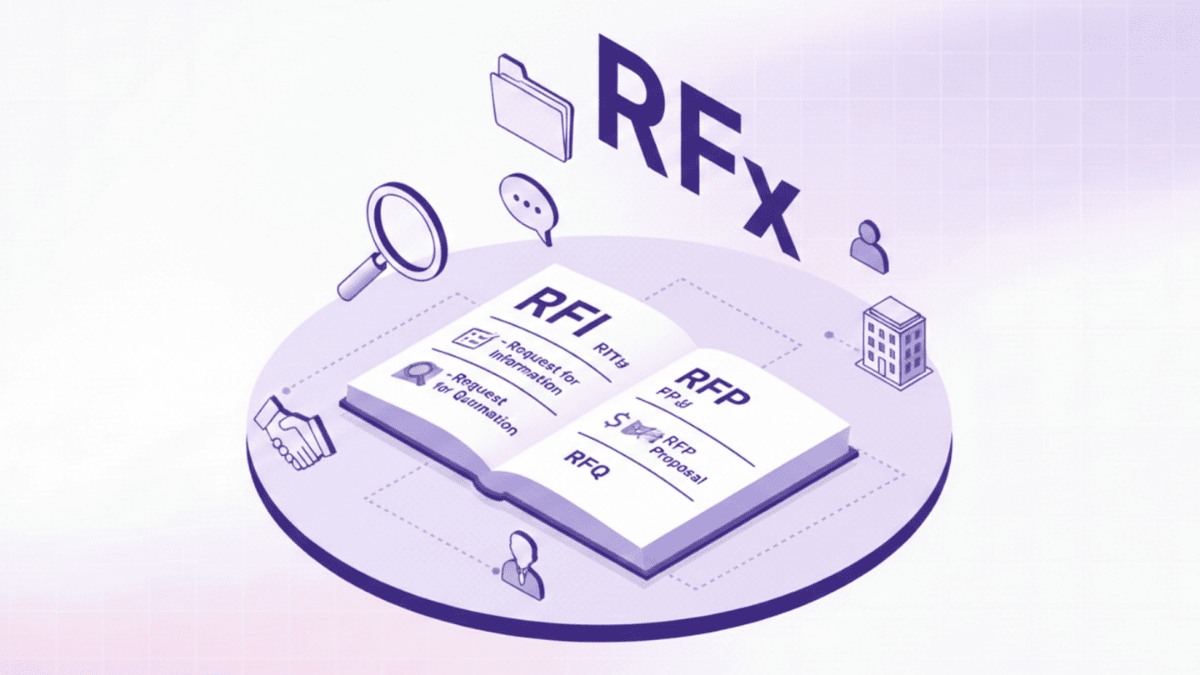
RFx is the collective term for procurement documents that buyers use to request information, proposals, or pricing from vendors. The three most common types are RFI (Request for Information), used to explore the market and gather preliminary information; RFP (Request for Proposal), used to evaluate how vendors would solve a specific business problem; and RFQ (Request for Quotation), used when requirements are already defined and the buyer primarily wants to compare pricing. Choosing the right RFx document ensures the procurement process gathers the information needed at each stage.
If you have encountered the terms RFI, RFP, or RFQ in business conversations and wondered what distinguishes them, you are navigating the world of formal procurement processes. These acronyms represent different types of solicitations that organizations use when purchasing goods, services, or solutions, and understanding the differences matters whether you are issuing them or responding to them.
Each RFx document serves a specific purpose in the procurement lifecycle: gathering preliminary information, evaluating comprehensive solutions, or comparing straightforward pricing. Using the wrong type wastes time and produces results that do not match the buyer's needs. Responding to one without understanding its purpose leads to proposals that miss the mark entirely.
One acronym in particular carries a wrinkle worth flagging up front: RFQ is used for two genuinely different documents depending on the industry. This guide covers the version most people mean by default, Request for Quotation, in full, and includes a dedicated section further down on its lesser-known counterpart, Request for Qualifications, since the two get confused constantly and are not the same thing.
This guide explains what RFx means, breaks down the three most common types—RFI, RFP, and RFQ—their purposes, structures, and appropriate use cases, and compares them side by side. It also covers other RFx variations you may encounter and walks through the typical RFx process from planning through award.
What is RFx?
RFx is a collective term for formal solicitation documents issued by organizations when they need to purchase products, services, or solutions through a structured competitive process. The "x" is a placeholder that represents different document types: RFI (Information), RFP (Proposal), RFQ (Quotation), and, in some industries, RFQ (Qualifications) — and several others.
Organizations use RFx processes rather than informal negotiations for several strategic and operational reasons. Formal solicitations create documented, defensible procurement records that demonstrate fair vendor treatment and objective selection criteria. They enable systematic comparison of multiple alternatives using consistent evaluation standards.
For public sector organizations, competitive RFx processes are often legally required above certain dollar thresholds to ensure transparency and prevent favoritism. For private companies, RFx processes are best practices that improve purchasing decisions, strengthen negotiating positions, and reduce procurement risk.
RFI: Request for Information
An RFI is a preliminary document used to gather general information about available capabilities, market options, and vendor qualifications before committing to a formal procurement.
1. Purpose and goals of an RFI
RFIs serve information-gathering purposes, not vendor selection. The buyer may be exploring a market they do not understand well, determining whether existing solutions can address their needs, identifying qualified vendors to invite to a subsequent RFP, or establishing realistic budgets and timelines based on what the market offers.
An RFI is not a commitment to buy. Vendors who respond should understand they are providing information that helps the buyer refine requirements and plan procurement strategy, not competing for an immediate contract award.
2. When organizations use RFIs
Organizations issue RFIs when they know they have a problem but do not yet know the best solution approach. A company recognizing that its legacy system is inadequate might issue an RFI to understand which modern alternatives exist, which capabilities are standard versus custom, what implementation typically requires, and which vendors specialize in their industry.
RFIs are also common when exploring emerging technology categories. If a buyer is considering artificial intelligence, blockchain, or another technology where internal expertise is limited, an RFI educates them about what is possible, what is mature versus experimental, and which vendors have relevant experience.
Public sector organizations frequently use RFIs to comply with procurement regulations requiring market research before issuing formal solicitations. The RFI documents that they investigated available options before defining requirements.
3. What an RFI typically contains
RFIs are less formal than RFPs or RFQs and focus on open-ended questions rather than detailed specifications. A typical RFI includes background on the buyer's organization and the general challenge, a high-level description of what they are trying to accomplish, questions about vendor capabilities and relevant experience, requests for information about typical implementations and timelines, and questions about pricing models or budget ranges.
RFIs do not include detailed technical requirements, precise specifications, or contractual terms. The buyer is gathering information, not defining a complete procurement.
4. What vendors provide in RFI responses
Vendors respond to RFIs with educational information rather than formal proposals. Responses typically describe the vendor's relevant solutions and capabilities, case studies or examples of similar projects, a high-level approach to addressing the buyer's stated challenge, typical implementation timelines and resource requirements, and general pricing models or ranges.
RFI responses should be substantive enough to demonstrate expertise without investing the effort required for a full proposal. Vendors are positioning themselves for potential inclusion in a future RFP rather than bidding on immediate business.
5. RFI timeline and next steps
RFI processes move relatively quickly, often two to four weeks from publication to response deadline. The buyer reviews responses to identify qualified vendors, refine requirements based on what they learned, and determine the appropriate next step.
That next step might be issuing an RFP to shortlisted vendors, proceeding directly to RFQ if requirements are now clear, conducting vendor demonstrations or capability briefings, or deciding to postpone procurement if the market is not mature enough to meet their needs.
6. RFI example scenario
A mid-sized healthcare provider knows their patient scheduling system is outdated, but is uncertain what modern systems offer. They issue an RFI asking software vendors to describe scheduling capabilities, integration with electronic health records, patient portal features, implementation approaches, and typical costs for organizations of their size. The responses educate them about current market options and help them write a detailed RFP six months later when the budget is approved.
RFP: Request for Proposal
An RFP is a formal solicitation used when the buyer has defined requirements but is open to different solution approaches and wants vendors to propose how they would address the need.
1. Purpose and goals of an RFP
RFPs solicit comprehensive proposals that describe how vendors would solve the buyer's problem, what their approach entails, why their solution is superior to alternatives, and the cost. Unlike RFQs, where the buyer specifies exactly what they want, RFPs give vendors flexibility to propose different methodologies, architectures, or approaches.
The buyer evaluates RFP responses on multiple dimensions: technical approach, vendor qualifications, implementation plan, pricing, and risk mitigation. The cheapest bid does not automatically win; the buyer weighs cost against quality, capability, and fit.
2. When organizations use RFPs
RFPs are appropriate when the buyer knows what outcomes they need but not the optimal way to achieve them. A company upgrading enterprise software might specify functional requirements and integration needs but allow vendors to propose different technical architectures, phased versus big-bang implementations, or cloud versus on-premise deployment.
RFPs are also common for professional services where methodology matters. A consulting engagement RFP would specify objectives and constraints but invite vendors to propose their approach, team composition, and delivery methodology.
Complex purchases involving significant customization, long-term partnerships, or strategic importance typically use RFPs rather than RFQs because the buyer wants vendor expertise applied to solution design, not just pricing on predefined specifications.
3. What an RFP typically contains
RFPs are comprehensive documents that may run dozens to hundreds of pages, depending on complexity. Standard components include an executive summary describing the opportunity, background on the buyer's organization and current state, detailed requirements organized by category or priority, technical specifications and integration needs, evaluation criteria and weighting, submission requirements and format, proposal deadline and selection timeline, contract terms and conditions, and appendices with supporting information.
Well-structured RFPs distinguish mandatory requirements from desirable features. They provide enough detail for vendors to propose credible solutions without prescribing the exact approach.
4. What vendors provide in RFP responses
RFP responses are substantial documents that demonstrate the vendor's understanding of requirements, proposed solution and methodology, technical architecture and specifications, implementation plan and timeline, team qualifications and relevant experience, case studies from comparable engagements, detailed pricing and cost breakdown, risk mitigation approach, and acceptance of contract terms or proposed modifications.
Vendors invest significant effort in RFP responses, often hundreds of person-hours for complex opportunities. The response must demonstrate both capability and differentiation: why this vendor's approach is superior to alternatives the buyer is evaluating.
5. RFP timeline and process
RFP processes typically span weeks to months: vendor questions period, optional site visits, proposal submission, compliance screening, detailed evaluation by scoring teams, finalist presentations, and final negotiations before award. Buyers typically evaluate 3 to 10 vendors, sometimes shortlisting to finalists based on initial scores.
RFP example scenario
A university needs a new learning management system. They issue an RFP specifying functional requirements for course management, student portals, grading, and integration with their student information system. Vendors propose different platforms, implementation approaches, and support models. The university evaluates responses on functionality, user experience, implementation risk, vendor stability, and total cost of ownership, not just purchase price.
RFQ: Request for Quotation
An RFQ is used when the buyer knows exactly what they want, and price is the primary evaluation factor.
1. Purpose and goals of an RFQ
RFQs solicit pricing for the delivery of precisely specified goods or services. The buyer has defined specifications in detail, quantities, technical requirements, delivery schedules, quality standards, and vendors provide quotes for delivering what was specified.
Evaluation focuses heavily on price because the offerings are directly comparable. The buyer is not seeking different solution approaches or methodology variations, they want the specified deliverable at the best price from a qualified vendor.
2. When organizations use RFQs
RFQs are appropriate for commodity or commodity-like purchases where specifications are clear and standardized. Purchasing 1000 units of a specified part, procuring defined professional services like staffing or maintenance, buying software licenses with known specifications, or contracting for construction based on detailed plans are all RFQ scenarios.
The key differentiator is that the buyer has already determined what they need with enough precision that vendors are quoting on identical or nearly identical deliverables. If significant solution design remains, an RFP is more appropriate.
3. What an RFQ typically contains
RFQs are more concise than RFPs because the buyer has done the specification work upfront. Standard elements include a precise description of goods or services required, quantities and delivery schedules, technical specifications and quality requirements, delivery location and logistics, payment terms and conditions, quote submission deadline, and evaluation criteria (typically price-focused).
RFQs leave little room for vendor interpretation. The specifications are prescriptive: deliver this in this quantity to this standard by this date.
4. What vendors provide in RFQ responses
RFQ responses are straightforward quotes that provide unit pricing and total cost, confirm the delivery timeline, confirm that specifications can be met, propose payment terms, and specify the validity period for the quoted price.
Unlike RFP responses, which explain methodology and approach, RFQ responses simply state the price and confirm the capability to deliver what was specified. The buyer is not evaluating different approaches; they are comparing price and delivery terms for the same deliverable.
5. RFQ timeline and process
RFQ processes move faster than RFPs because evaluation is simpler. The timeline might include 2 weeks for vendors to prepare quotes, 1 week for evaluation, and an award to the lowest responsive, responsible bidder.
"Responsive" means the vendor met all specifications and requirements. "Responsible" means they have the capability, financial stability, and track record to deliver. The lowest responsive and responsible bidder typically wins, unless the buyer has documented reasons to select a higher-priced alternative.
RFQ example scenario
A manufacturing company needs 5000 units of a specified electronic component with defined technical specifications. They issue an RFQ with exact part specifications, quality standards, delivery schedule, and packaging requirements. Vendors quote unit prices. The buyer awards the vendor offering the lowest price who can meet the delivery timing and quality requirements.
RFQ has two meanings: Quotation vs. Qualifications
Everything above describes a Request for Quotation — pricing-focused, used once specifications are already locked. But in construction, architecture, engineering, and government professional-services procurement specifically, RFQ often means something else entirely: a Request for Qualifications, and it has nothing to do with pricing.
Request for Qualifications vs RFP: what's actually different
A Request for Qualifications is a pre-screening step. Instead of asking vendors what they'd charge, the buyer asks vendors to submit their experience, credentials, past project history, team composition, and financial stability — then uses those submissions to narrow a large pool down to a shortlist of qualified firms. Only that shortlist goes on to receive the RFP.
In several U.S. states, this distinction isn't just convention, it's written into procurement law. Statutes governing architecture and engineering services in some jurisdictions explicitly prohibit price from being used as a selection factor during a Request for Qualifications, specifically to keep that stage focused on competence rather than cost.
How to tell which RFQ someone means
Context gives it away almost every time. If the conversation involves construction, architecture, engineering, or government professional services — especially if it's happening before an RFP has been issued — RFQ almost certainly means Request for Qualifications. If specifications are already locked and the conversation is about price, RFQ means Request for Quotation, the version covered throughout the rest of this guide.
Key differences: RFI vs RFP vs RFQ
Understanding when to use each type requires recognizing how they differ across multiple dimensions. The comparison below uses RFQ in its Request for Quotation sense, the most common usage outside construction and AEC procurement.
RFI vs RFP vs RFQ Comparison
Use case scenarios
Scenario 1: Unknown solution space → RFI A company recognizes they need better customer service tools but does not know whether to pursue CRM systems, help desk platforms, or unified communication tools. Issue RFI to understand market options.
Scenario 2: Requirements defined, approach uncertain → RFP A government agency needs to modernize its IT infrastructure. The requirements are clear, but the optimal migration approach for cloud, hybrid, or on-premises modernization remains uncertain. Issue RFP for vendors to propose solutions.
Scenario 3: Specifications complete → RFQ An organization needs 500 laptops meeting specific hardware specifications for new employee onboarding. Exact specs are defined. Issue RFQ for pricing from qualified suppliers.
Sequential use of multiple RFx types
Buyers sometimes use multiple RFx types sequentially: RFI to understand the market and refine requirements, RFP to solicit proposals from qualified vendors, and, in some cases, a final RFQ or Best and Final Offer (BAFO) for pricing from finalists. In construction and AEC procurement specifically, that sequence often starts one step earlier: Request for Qualifications to build the shortlist, then RFP for the actual proposal. This staged approach gathers information progressively while appropriately managing vendor effort.
Other RFx variations
Beyond RFI, RFP, and RFQ, several other formal solicitation types exist with specialized purposes.
- RFT (Request for Tender). Common in construction, engineering, and international procurement. Similar to RFQ — solicits pricing for well-defined work. The term "tender" is preferred in Commonwealth countries and the construction industries.
- ITB (Invitation to Bid). Nearly identical to RFQ. Used in public sector procurement and construction. Typically implies sealed-bid processes in which bids open publicly at a specified time.
- RFS (Request for Solution). Similar to RFP, but emphasizes that buyers seek vendors to solve a problem rather than meet specifications. Invites innovation and alternative approaches beyond what the buyer initially envisioned.
- EOI (Expression of Interest). Even less formal than RFI. Solicits brief statements from vendors interested in a future opportunity. Buyers use EOI responses to gauge market interest and create shortlists for subsequent RFI or RFP.
- RFP/Q (Request for Proposal and Quotation). Hybrid format requesting both a solution proposal and detailed pricing in one submission. Commonly, when the buyer wants a solution methodology evaluated, they also need an accurate cost comparison.
- Request for Qualifications. A pre-screening document, most common in construction, architecture, and engineering procurement, used to narrow a vendor pool down to a qualified shortlist before an RFP is issued. Covered in full detail earlier in this guide, since it shares the RFQ acronym with Request for Quotation but is a fundamentally different document.
The typical RFx process
While specific procedures vary, the fundamental process follows a consistent pattern.
- Planning phase: Identify needs, determine budget, define requirements, decide RFx type, assemble evaluation team, and draft solicitation.
- Solicitation phase: Publish through procurement portals or via direct invitation; hold pre-submission conferences to address vendor questions and clarifications.
- Response phase: Vendors evaluate fit, prepare responses per requirements, and submit by the deadline. Late submissions are typically rejected.
- Evaluation phase: Review for compliance, score against published criteria, conduct finalist presentations if applicable, check references, and identify selected vendor.
- Award phase: Notify winning vendor, negotiate final terms, execute contract, and provide debrief feedback to unsuccessful vendors.
- Post-award: Execute contract, begin performance, and conduct lessons learned to improve future processes.
Guidance for buyers and vendors
For buyers creating RFx documents: Use the right RFx type for your situation: RFI for exploration, RFP for solutions, RFQ for specifications complete (or Request for Qualifications first, if you're in construction or AEC procurement and need to narrow a large field before writing the RFP). Provide clear, complete information so vendors can respond substantively. Distinguish mandatory requirements from desirable features. Establish objective evaluation criteria before issuing the solicitation. Respect the effort vendors invest by running fair, timely processes.
For vendors evaluating RFx opportunities: Recognize what each RFx type signals about the buyer's process stage. Invest effort proportional to the likelihood of winning and strategic value. For RFIs, position for the future RFP without over-investing. For RFPs, respond comprehensively if the opportunity fits your capabilities. For RFQs, price competitively if you can deliver profitably at market rates. For a Request for Qualifications, focus on presenting your strongest, most relevant credentials — this stage isn't won on price, it's won on trust. Know when to decline; pursuing every RFx dilutes resources from winnable opportunities.
The bottom line
RFx processes exist because organizations need structured, defensible methods for significant purchasing decisions. The terminology- RFI, RFP, RFQ, and variations- reflects different stages of the buying journey and different levels of requirement certainty. Using the right type at the right time produces better outcomes for buyers and vendors alike: buyers get relevant information and competitive proposals, and vendors invest effort where it has the highest return.
Whether you are issuing RFx documents or responding to them, understanding these differences ensures you approach each opportunity with appropriate strategy, effort, and expectations. RFIs gather information for future decisions. RFPs solicit comprehensive solutions when requirements are clear, but the approach is open. RFQs request pricing when specifications are complete, or in construction and AEC procurement, first pre-screen vendors on qualifications before the RFP is even written. Each serves a purpose; recognizing which purpose an RFx serves, and which RFQ someone actually means, determines how to engage with it effectively.