


.avif)
Every sales organization operates in a specific competitive landscape with particular strengths to leverage, weaknesses to address, opportunities to pursue, and threats to defend against. Yet most sales teams navigate these dynamics reactively, responding to lost deals, scrambling when competitors release new features, or discovering market shifts only after they have already lost momentum.
A sales SWOT analysis is a structured framework for making these assessments deliberately rather than discovering them through painful experience. By systematically evaluating your sales organization's Strengths, Weaknesses, Opportunities, and Threats, you create the foundation for strategic decisions about territory design, resource allocation, competitive positioning, product roadmap priorities, and go-to-market approach.
This guide explains what sales SWOT analysis is and when to conduct one, breaks down each of the four components with sales-specific examples, provides a step-by-step methodology for running the analysis, offers a complete template you can use, walks through real examples from different sales contexts, and covers how to translate SWOT insights into actionable sales planning.
What is a sales SWOT analysis?
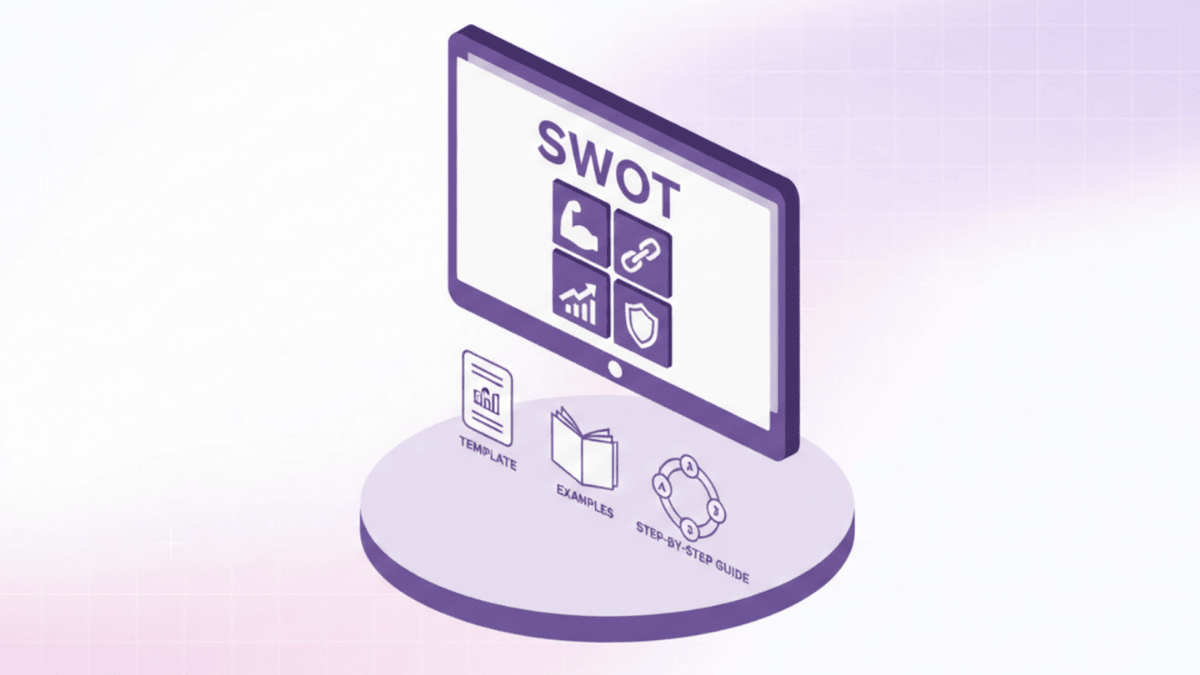
SWOT analysis is a strategic planning framework that evaluates four dimensions of an organization's position: internal Strengths and Weaknesses, and external Opportunities and Threats. In a sales context, SWOT focuses specifically on factors that affect your ability to acquire customers, win competitive deals, achieve revenue targets, and maintain market position.
- Strengths are internal positive factors: capabilities, resources, or advantages your sales organization possesses that contribute to success. A strong brand reputation, exceptional product-market fit in a specific vertical, a highly skilled solutions engineering team, or proprietary technology that competitors cannot match are all potential strengths.
- Weaknesses are internal negative factors: gaps, limitations, or disadvantages that hinder sales performance. Long sales cycles that make quota attainment difficult, insufficient presales capacity that limits deal coverage, weak competitive positioning in certain segments, or product gaps that consistently lose deals to specific competitors are weaknesses.
- Opportunities are external positive factors: market conditions, trends, or circumstances your organization could exploit for advantage. An underserved market segment where your solution fits well, a regulatory change that makes your compliance capabilities valuable, a competitor's product quality issues, or emerging buyer priorities that align with your differentiators are opportunities.
- Threats are external negative factors, such as market conditions, competitive moves, or trends that could undermine your position. New well-funded competitors entering your core market, pricing pressure from offshore alternatives, customer budget constraints from economic downturns, or technological shifts that make your approach obsolete are threats.
Why do sales teams conduct SWOT analysis?
SWOT provides a structured way to surface insights that might otherwise stay fragmented across different people's heads. Your top rep knows which competitor consistently beats you in mid-market manufacturing deals. Your product team knows which feature gaps cost deals. Your newest hire sees competitive weaknesses your veterans stopped noticing. SWOT consolidates these distributed insights into a single view.
The analysis also forces an honest assessment. Sales organizations naturally develop narratives about why they win and lose. SWOT requires validating those narratives with evidence and identifying blind spots, the weaknesses leadership does not want to acknowledge, or the opportunities everyone assumes someone else is pursuing.
Finally, SWOT creates alignment on priorities. When the sales team, product, marketing, and executive leadership all see the same consolidated SWOT analysis, strategic conversations shift from "what should we prioritize?" arguments based on different assumptions to "given these agreed-upon strengths, weaknesses, opportunities, and threats, what is our best path forward?"
When to conduct a sales SWOT analysis
- Annual strategic planning: Most organizations conduct a comprehensive SWOT analysis during annual planning cycles to inform quota setting, territory design, product roadmap priorities, and go-to-market strategy for the coming year.
- Entering new markets: Before expanding into new geographies, verticals, or customer segments, SWOT analysis identifies whether you have relevant strengths to leverage, what new threats you will face, and what opportunities justify the investment.
- Major competitive shifts: When a significant competitor launches a disruptive product, gets acquired, exits the market, or changes pricing strategy, SWOT analysis helps you reassess your position and adjust your approach.
- After consistent underperformance: When a sales team chronically misses targets despite adequate territory and reasonable quotas, a SWOT analysis can identify whether the problem lies in addressable weaknesses, unaddressed threats, or fundamental market dynamics.
- Before significant organizational changes: Restructuring territories, launching new products, changing pricing models, or overhauling sales methodology should be informed by a current SWOT assessment rather than assumptions about your position.
How to conduct a sales SWOT analysis: step by step
Step 1: Assemble the right team
SWOT analysis requires diverse perspectives. Include sales leadership, top-performing reps who understand competitive dynamics on the ground, sales operations with pipeline and win-loss analytics, product management aware of roadmap and competitive positioning, marketing familiar with market trends, and optionally a facilitator who can keep the discussion productive.
Aim for 6 to 12 participants. Smaller groups miss important perspectives. Larger groups become unwieldy and discourage candid input.
Step 2: Gather data before the session
Effective SWOT is evidence-based, not just opinions. Prepare relevant data: win-loss analysis showing why deals were won or lost; competitive intelligence reports; customer feedback and NPS scores; market research on industry trends; pipeline coverage and conversion metrics; product gap analysis from lost deals; and sales cycle length trends.
Distribute this data beforehand so participants arrive informed rather than discovering patterns during the session.
Step 3: Identify strengths
Start with internal positive factors. Ask: What do we do better than competitors? What unique capabilities do we have? What do customers consistently cite as reasons they chose us? What advantages do our sales reps have in deals?
Examples of sales strengths:
- Exceptional product-market fit in a specific vertical
- Strong executive relationships at key accounts
- Solutions engineering team with deep domain expertise
- Proprietary technology competitors cannot replicate.
- Superior implementation track record
- Brand recognition that opens doors
Be specific. "Strong product" is too vague. "Market-leading uptime SLA that wins against competitors in reliability-focused evaluations" is a strength you can leverage strategically.
Step 4: Identify weaknesses
Next, assess internal negative factors honestly. Ask: Where do we consistently lose to competitors? What gaps in our offering cost us deals? What operational limitations constrain our sales effectiveness? What do customers complain about?
Examples of sales weaknesses:
- Long sales cycles make quarterly quota attainment difficult
- Insufficient presales capacity to support all qualified opportunities
- Product gaps in the capabilities that competitors have
- Weak positioning in certain market segments
- Limited case studies or references in key verticals
- CRM data quality issues that undermine forecasting
The key is honesty. If your team cannot acknowledge real weaknesses, SWOT becomes a waste of time. Document them so you can address them.
Step 5: Identify opportunities
Shift to external positive factors. Ask: What market trends could we capitalize on? Which underserved segments fit our solution? What competitor weaknesses could we exploit? What regulatory or technological changes favor our approach?
Examples of sales opportunities:
- Emerging regulatory requirements that make our compliance capabilities valuable
- Competitor losing key personnel or experiencing product quality issues
- A growing market segment where we have early wins and no dominant competitor
- Customer dissatisfaction with incumbent solutions creates a switching appetite
- A technology trend that makes our architecture approach superior
- Economic conditions are making our ROI story compelling
Opportunities are potential advantages you have not yet fully exploited. Identifying them focuses strategic investment where the payoff is likely.
Step 6: Identify threats
Finally, assess external negative factors. Ask: What competitive moves threaten our position? What market trends work against us? What could make our solution less relevant? What external risks could undermine our sales performance?
Examples of sales threats:
- A well-funded new competitor is entering our core market with aggressive pricing
- Economic downturn is reducing customer budgets for our category
- Technological shift toward approaches different from our architecture
- Regulatory changes that favor competitors' compliance capabilities
- Consolidation among competitors is creating larger, better-resourced rivals
- Customer preference shifts toward capabilities we lack
Threats are not reasons for pessimism; they are realities that require a proactive response rather than reactive scrambling when they materialize.
Step 7: Analyze and prioritize
Once all four quadrants are populated, analyze relationships. Which strengths can you leverage to pursue which opportunities? Which weaknesses make you vulnerable to which threats? What quick wins exist, high-impact actions with low implementation cost? What fundamental issues require long-term strategic response?
Prioritize based on impact and urgency. Not every weakness needs immediate attention. Not every opportunity warrants investment. Focus on the factors most material to sales performance.
Step 8: Translate to action plans
A SWOT analysis that does not drive action is an academic exercise. For each prioritized item, define specific actions, assign ownership, set timelines, and establish success metrics.
If a strength is "superior implementation track record," the action might be "create case study library showcasing implementation success across top three verticals by Q2." If a threat is "a new well-funded competitor with aggressive pricing," the action might be "develop value-based selling training to position on ROI rather than price by the end of the quarter."
Sales SWOT analysis template
Use this template to structure your analysis. Fill each quadrant with specific, evidence-based factors.
STRENGTHS (Internal Positive Factors)
What we do better than competitors:
- [Example: Market-leading integration capabilities with major ERP systems]
Unique capabilities or resources:
- [Example: Solutions engineering team with Fortune 500 implementation experience]
What customers cite as reasons they chose us:
- [Example: Superior customer support with sub-4-hour response time]
Competitive advantages:
- [Example: Proprietary algorithm that delivers 40% better accuracy than alternatives]
WEAKNESSES (Internal Negative Factors)
Where we consistently lose to competitors:
- [Example: Lose to Competitor X in mid-market manufacturing segment 70% of the time]
Product or service gaps:
- [Example: Lack mobile app functionality that enterprise buyers increasingly require]
Operational limitations:
- [Example: Presales capacity covers only 60% of the qualified pipeline]
Resource constraints:
- [Example: No vertical-specific case studies in healthcare despite 15% of the pipeline].
OPPORTUNITIES (External Positive Factors)
Market trends we can capitalize on:
- [Example: Regulatory change requiring capabilities we already have]
Underserved segments that fit our solution:
- [Example: Mid-market financial services firms underserved by enterprise-focused competitors]
Competitor weaknesses we can exploit:
- [Example: Competitor's recent quality issues creating switching appetite]
Technological or economic shifts in our favor:
- [Example: Cloud migration trend favors our SaaS architecture]
THREATS (External Negative Factors)
Competitive moves threatening our position:
- [Example: New well-funded competitor with $50M Series B targeting our core market]
Market trends working against us:
- [Example: Buyer preference shifting toward open-source alternatives]
Economic or regulatory headwinds:
- [Example: Budget freezes in the public sector, reducing 20% ofthe addressable market]
Technology shifts that could make us less relevant:
- [Example: AI-native competitors potentially disrupting traditional approach].
SWOT analysis examples
Example 1: SaaS sales team SWOT
Strengths:
- Product has best-in-class integration with Salesforce and HubSpot
- 95% customer retention rate provides a strong reference base
- The sales team has deep expertise in the fintech vertical
- Implementation typically completes in 30 days versus the 90-day industry average.
Weaknesses:
- No mobile app, while competitors have released native iOS/Android apps
- Sales cycle averages 120 days, making quarterly quota attainment challenging
- Weak presence in the West Coast market, despite 40% of the target accounts located there
- Only two enterprise-tier references, limiting credibility in enterprise deals.
Opportunities:
- Recent competitor quality issues have created dissatisfaction among their customer base
- New data privacy regulation makes our compliance capabilities a differentiator
- Enterprise-focused competitors underserve the mid-market segment
- The remote work trend increases demand for our collaboration features.
Threats:
- Well-funded startup with an aggressive freemium model entering our core mid-market segment
- Economic uncertainty is causing buyers to delay software purchases
- Two major competitors announced mobile apps in Q3
- Customer preference is shifting toward all-in-one platforms versus best-of-breed.
Example 2: Enterprise software sales team SWOT
Strengths:
- Established relationships with IT leaders at 60% of Fortune 500
- Implementation success rate of 98% versus 75-80% industry average
- The solutions engineering team has unmatched technical depth
- Ten years of financial data proving ROI to CFO stakeholders.
Weaknesses:
- 18-month average sales cycle limits new rep productivity
- Product perceived as complex, requiring extensive training
- Pricing 30% higher than the primary competitor
- Weak digital marketing presence compared to cloud-native competitors.
Opportunities:
- Large installed base of legacy competitor nearing end-of-life, creating replacement cycle
- The hybrid cloud trend favors our flexible deployment options
- Strategic partnership with a major consulting firm, opening new channels
- CIO priorities are shifting toward security and compliance, where we excel.
Threats:
- Cloud-native competitorsare gaining credibility in enterprise accounts we considered safe
- Buyer preference for consumption-based pricing versus our upfront license model
- The top two competitors have both been acquired by larger companies with deeper resources
- Open-source alternatives are gaining traction in cost-sensitive segments.
Common SWOT mistakes to avoid
- Too vague and generic: "Good product" and "strong team" are not useful SWOT entries. Specific, evidence-based factors, such as "integration with Salesforce cited in 65% of wins" or "solutions engineering team capacity covers only 55% of qualified opportunities," provide actionable insight.
- Confusing internal and external factors: Strengths and weaknesses are internal, things your organization controls. Opportunities and threats are external, market conditions you must respond to. "Competitor pricing" is a threat (external), not a weakness (internal). "Our long sales cycle" is a weakness (internal), not a threat (external).
- Analysis without action planning: SWOT that ends with four populated quadrants but no follow-through is wasted effort. The value is in the strategic decisions and tactical actions that the analysis informs.
- One-time exercise versus ongoing practice: Markets evolve, competitors move, products change, and team capabilities develop. SWOT analysis conducted once and filed away quickly becomes outdated. Quarterly or biannual SWOT reviews keep the assessment current.
- Avoiding hard truths: If the team cannot honestly acknowledge weaknesses or threats, the analysis will not surface the issues most needing attention. Create psychological safety for candid input.
Translating SWOT insights to sales strategy
The ultimate purpose of SWOT analysis is to make better strategic decisions.
- Leverage strengths to pursue opportunities: If your strength is deep healthcare expertise and the opportunity is a regulatory change that makes your compliance capabilities valuable, double down on healthcare sales with messaging that emphasizes that compliance advantage.
- Address weaknesses that make you vulnerable to threats: If your weakness is a lack of mobile capabilities and the threat is competitors launching mobile apps, prioritize mobile development to avoid losing deals on that gap.
- Convert threats into opportunities through strategic response: If the threat is a well-funded new competitor, the opportunity might be to accelerate customer renewals before they are exposed to competitive offers, or to sharpen differentiation to compete on value rather than price.
- Shore up weaknesses before pursuing opportunities: If your presales capacity is stretched thin (weakness). Still, if you identify an attractive new market segment (opportunity), expanding presales capacity might be a prerequisite for successfully entering it.
Conclusion
The strategic questions SWOT helps answer include: Which market segments should we prioritize? What competitive positioning wins most effectively? Where should we invest in product development? How should we allocate sales resources across territories? What messaging and positioning will resonate most?
SWOT analysis is not a one-time planning ritual; it is a discipline for maintaining a realistic assessment of your competitive position as markets evolve. The sales organizations that use SWOT effectively make it a regular practice: quarterly reviews that update the analysis based on recent wins and losses, competitive moves, market shifts, and internal capability changes.
This ongoing assessment prevents strategic drift, where you continue executing last year's strategy despite changed conditions, and it surfaces opportunities and threats early enough to respond proactively rather than reactively. The template, examples, and methodology in this guide provide the structure. The value comes from honest assessment, broad participation, evidence-based input, and most importantly, translating insights into strategic actions that improve sales performance.