



What are AI sales tools?
AI sales tools are software platforms that automate or accelerate the workflows revenue teams use to generate pipeline, execute deals, and close revenue. The best AI sales tools in 2026 improve team-wide performance, not just individual rep productivity, by converting deal signals and scattered knowledge into consistent, repeatable outputs across the full sales cycle.
How should sales leaders evaluate AI sales tools?
Here are three questions that sales leaders should ask when evaluating an AI sales tool.
Does it address your team's highest-friction workflow?
Every sales team has one bottleneck where the most time is lost, and the most deals stall. For some teams, it's RFP turnaround. For others, it's meeting prep, follow-up consistency, or pipeline visibility. A tool that doesn't address your highest-friction workflow gets adopted briefly and then ignored. Name the workflow costing your team the most before you evaluate anything.
Does it work where your team already lives?
Adoption is the silent killer of sales tech investments. Tools that require reps to leave their existing workflow get used by champions and skipped by everyone else. The best AI sales tools in 2026 work inside the tools your team already uses: Salesforce, Slack, Google Workspace, Microsoft 365, and email.
Can you measure ROI within 90 days?
If a vendor can't tell you what week one looks like, that's a red flag. The best tools deliver measurable results within 30 to 90 days. Define your success metrics up front: time saved per RFP, meetings booked per rep, and forecast accuracy. If the tool can't connect to one of those metrics, justifying renewal will be hard.
The top 10 AI sales tools in 2026
1. SiftHub: Best AI sales tool for deal execution and mid-funnel acceleration
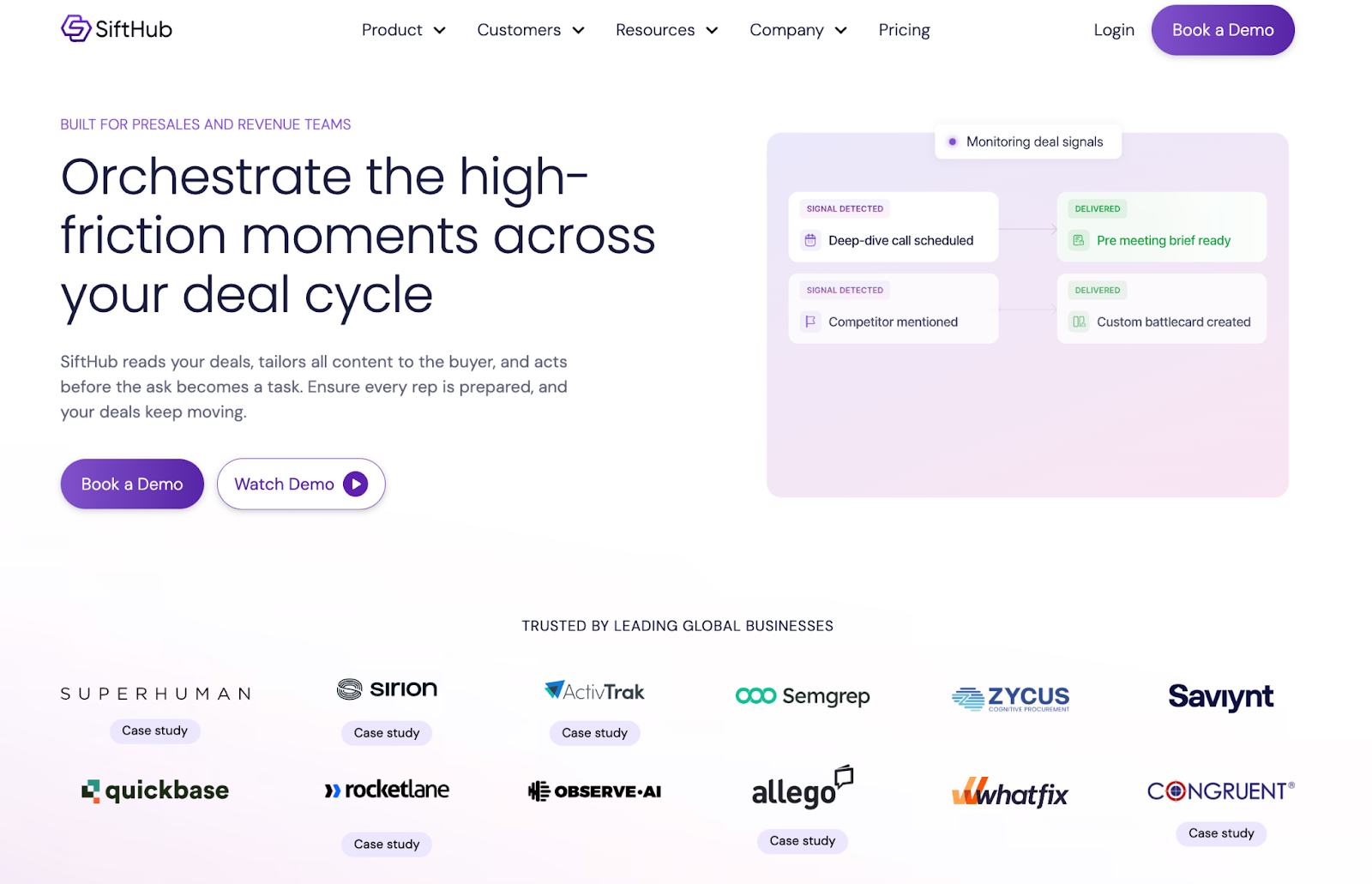
SiftHub is the best AI sales tool for revenue teams because it solves the problem every other tool on this list leaves unaddressed: what happens after a qualified opportunity exists. Most AI sales tools help teams generate a pipeline or understand what's happening in deals. SiftHub helps teams do something about it.
It's an agentic deal orchestration platform that connects to your entire GTM stack, Gong, Salesforce, Google Drive, SharePoint, Confluence, Slack, Seismic, and converts that context into 3 types of output that directly accelerate mid-funnel deal velocity.
How does SiftHub accelerate deals specifically?
SiftHub accelerates deals specifically by eliminating the content bottleneck that stalls most mid-funnel opportunities. When an RFP lands on a Friday, the default is manual work and slow turnarounds. When a buyer asks for a competitive comparison, it depends on which rep you ask. When an SE needs a handover brief before a POC, someone has to write it from scratch. SiftHub removes all 3 bottlenecks, automatically, grounded in your actual deal context.
RFP and questionnaire responses
SiftHub's RFP agent handles the full cycle, from bid/no-bid analysis through autofill, compliance checks, and final submission. It completes 70–90% of responses automatically. Across SiftHub customers, that automation handled 240,000+ questions in just six months. Every answer includes source attribution, traceable back to the exact call, doc, or CRM record it came from. It works natively inside Google Sheets, Google Docs, Microsoft Excel, and Word. No import/export required.
Allego achieved 90% autofill rates and 8x faster RFP turnaround. Sirion handled 1.5x more RFPs with a 48-hour SLA reduction.
Deal briefs and pre-call prep
SiftHub auto-generates internal briefs for every opportunity. It pulls from call transcripts, CRM notes, emails, and enablement content. Pre-call prep is ready before every meeting. Handover documents are 80% complete when a deal closes, with no one writing them by hand.
Superhuman saved 8+ hours per week and diverted 50% of repetitive queries away from their presales team.
Technical sales collateral
SiftHub generates tailored proposals, battlecards, POV decks, and executive summaries from live call insights and CRM context. Competitive intel is pulled automatically from call mentions. Content adapts to each buyer's industry, use case, and deal stage.
What sales leaders see
SiftHub gives RevOps and sales leaders adoption metrics, content performance analytics, and governance controls. You can track ROI and report on impact, not just usage.
Enterprise credentials: SOC 2 Type II, ISO 27001, VAPT certified. Source-backed answers with full audit trails. Granular RBAC and SSO.
Best for: B2B software companies with active presales or solutions engineering teams where deals stall due to slow content turnaround, RFP volume, or inconsistent messaging across reps.
2. Apollo.io: Best all-in-one platform for prospecting and outbound
Apollo.io consolidates contact data, AI-powered sequencing, a built-in dialer, and basic conversation intelligence into one platform, making it the most cost-effective starting point for outbound-led teams.
What it does:
- 265M+ verified contacts with advanced persona filtering (source: Apollo.io)
- AI Outbound Copilot finds ideal prospects and adds them to personalized sequences automatically
- Email warmup (launched Q3 2025) builds sender domain reputation before campaigns go live
- Named top AI-native sales intelligence platform in G2's 2026 Best Software Awards, backed by nearly 10,000 reviews (source: G2, February 2026)
Limitation:
- Phone number accuracy is inconsistent for heavy cold calling
- Data decay is a real issue at scale; enterprise governance controls may not meet strict compliance requirements
Best for: Startups and mid-market sales teams that want to consolidate prospecting, sequencing, and outbound in one affordable platform.
3. Clay: Best for GTM data enrichment and outbound workflow automation
Clay functions as a GTM development environment, combining enrichment from 150+ data sources, AI-powered research, and workflow automation in a spreadsheet-like interface used by 300,000+ GTM professionals.
What it does:
- Waterfall enrichment checks multiple data providers in sequence; you only pay for successful lookups (source: Clay)
- Claygent AI agent extracts data from websites, PDFs, and search results automatically
- Sculptor generates full GTM workflows from natural language prompts
- March 2026: Clay cut data costs by 50–90% across all plans (source: Clay pricing announcement, March 11, 2026)
- Anthropic tripled its enrichment rate after switching to Clay (source: Clay customer case study)
Limitation:
- 2–4 week learning curve, works best with a dedicated RevOps or GTM engineer on the team
Best for: RevOps and GTM engineering teams running high-volume outbound or managing complex CRM enrichment across large total addressable markets.
4. ZoomInfo Copilot: Best for intent-driven prospecting and account intelligence
ZoomInfo Copilot layers AI-powered deal signals and outreach automation onto the world's largest B2B contact database, making it the strongest choice for enterprise teams where data accuracy and buying intent matter throughout the full sales cycle.
What it does:
- Alerts reps when an active deal's decision-maker hasn't engaged in 30 days
- AI Emailer generates personalized follow-ups from CRM history, engagement data, and account signals throughout the active deal cycle, not just top of funnel
- Breaking Alerts via Slack for time-sensitive signals: leadership changes, funding events, surge intent
- Customers report 60% more demos booked and 10+ hours saved per rep per week (source: ZoomInfo 2025 Customer Impact Report)
Limitation:
- Strength is data and intelligence, but it doesn't generate deal briefs, RFP responses, or tailored proposals
Best for: Enterprise revenue teams that need high-quality, real-time B2B intelligence from first touch through active deal management.
5. Gong: Best for conversation intelligence and risk detection
Gong automatically captures and analyzes every customer interaction, calls, emails, and meetings, converting those interactions into deal intelligence that sales leaders can act on, not just review.
What it does:
- Captures 100% of customer interactions and flags deal risks, competitor mentions, and disengagement signals automatically
- Gong Orchestrate (October 2025): agentic AI that acts on deal signals, not just surfaces them
- AI Data Extractor auto-populates CRM fields from call content, no manual entry
- Gong Enable (February 2026): unifies coaching and conversation intelligence in one platform
- Named a Leader in Gartner's inaugural Magic Quadrant for Revenue Action Orchestration, ranking #1 across 4 use cases (source: Gartner, December 2025)
- Paycor reported a 141% increase in deal wins after adopting Gong (source: Gong customer case study)
Limitation:
- Strong on insight, increasingly agentic, but doesn't generate RFP responses, deal briefs, or tailored proposals
Best for: Revenue leaders who need complete visibility into conversation patterns, deal health, and rep performance, with AI that now acts on signals, not just reports them.
6. Lavender: Best for AI email coaching and reply rate optimization
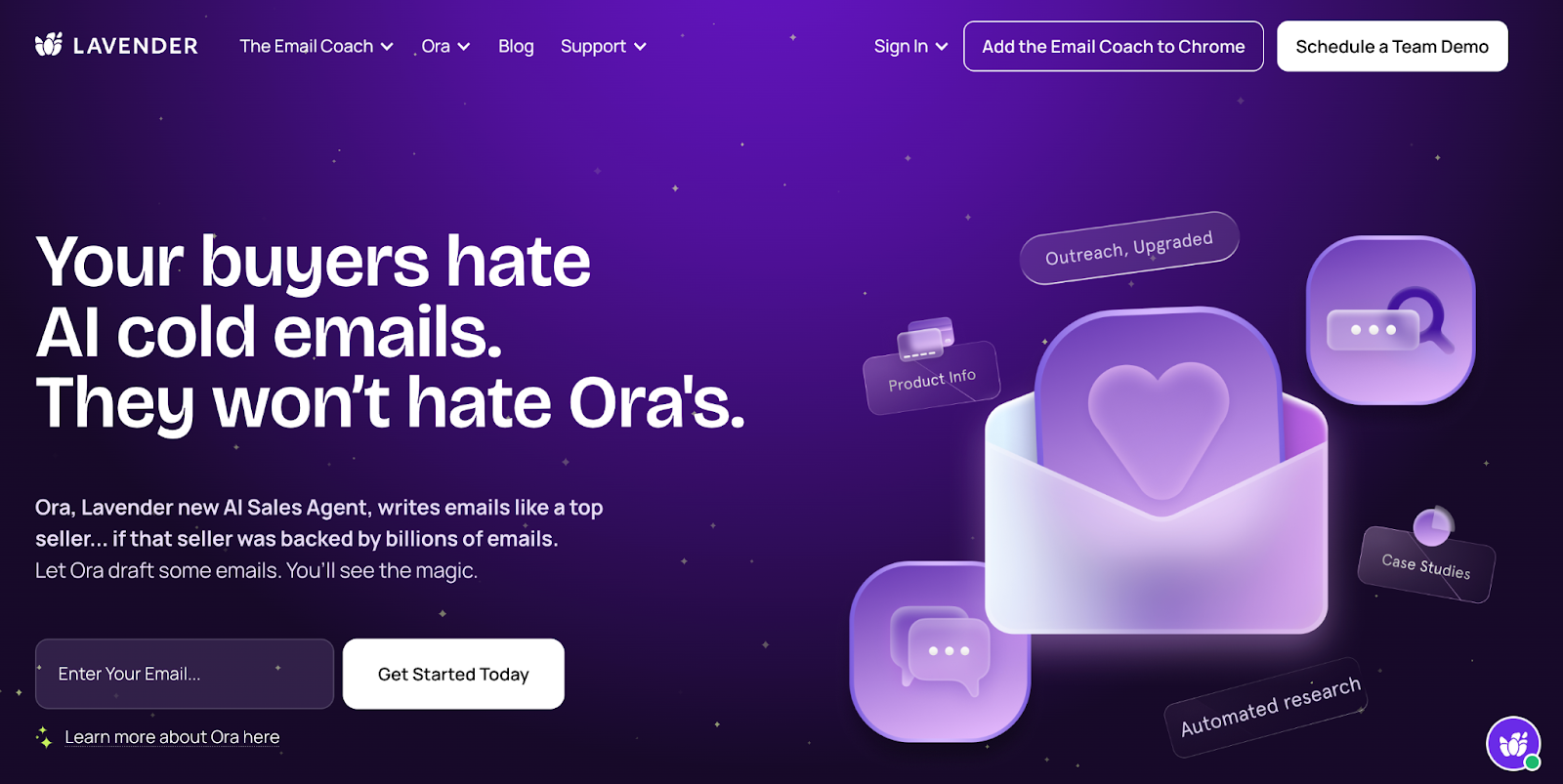
Lavender is an AI email coach that lives inside your inbox as a browser extension, scoring outbound emails in real time before they're sent in Gmail, Outlook, Salesloft, Outreach, and HubSpot.
What it does:
- Scores emails on length, reading level, personalization, and mobile formatting in real time
- Personalize AI pulls prospect data from LinkedIn and the web to suggest relevant icebreakers automatically
- Analyzes millions of emails to benchmark copy against what statistically gets replies
- Reps using Lavender report 20–40% reply rate improvements within the first 2 weeks (source: Lavender)
Limitation:
- A coaching layer on top of your existing outbound motion, not a standalone sequencing platform or contact database
Best for: SDR and AE teams with underperforming outbound reply rates who want to improve email quality without slowing output.
7. Fireflies.ai: Best for AI meeting notes and conversation capture
Fireflies.ai automatically joins calls, transcribes conversations, and generates summaries, action items, and follow-up notes across Zoom, Google Meet, Microsoft Teams, and 40+ other platforms.
What it does:
- Pushes meeting summaries and action items directly into Salesforce, HubSpot, Slack, and Notion
- Smart Search lets reps query any meeting transcript in seconds using natural language
- Used by 300,000+ organizations globally (source: Fireflies.ai)
- Integrates with 40+ meeting and CRM platforms
Limitation:
- Captures and organizes meeting intelligence, doesn't convert notes into deal briefs, RFP responses, or sales collateral
Best for: Sales and presales teams that lose time to manual note-taking, inconsistent follow-ups, or poor information transfer between calls and CRM records.
8. 6sense: Best for buyer intent data and account-based pipeline
6sense identifies in-market accounts before they raise their hands, capturing 1 trillion buyer signals daily to predict which accounts are actively evaluating solutions in your category right now.
What it does:
- Illuminates the dark funnel, the 95% of B2B buyers who research anonymously before contacting a vendor (source: 6sense)
- Predictive buying-stage modeling assigns accounts to the Awareness, Consideration, Decision, or Purchase stage
- AI Email Agents target in-market accounts, personalize outreach, and book meetings automatically
- Named a Gartner Leader in ABM Platforms for 5 consecutive years (source: Gartner, 2025)
- Socure generated $52M in pipeline in year 1 using 6sense (source: 6sense customer case study)
Limitation:
- The pipeline generation tool's role decreases significantly once an opportunity is in your CRM
Best for: Marketing and sales leaders running account-based motions who need to identify and prioritize in-market accounts before competitors do.
9. Dialpad: Best for real-time AI coaching on live sales calls
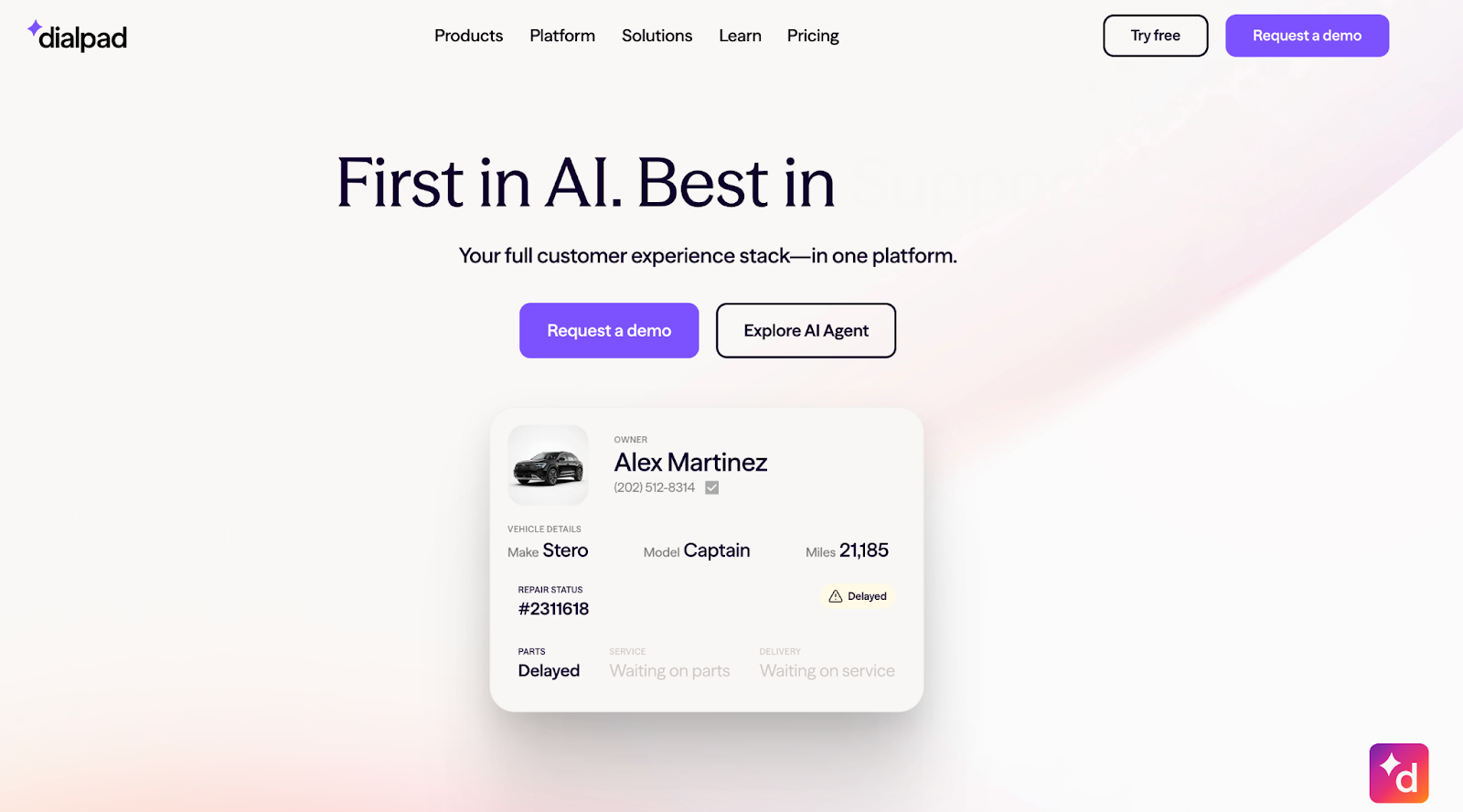
Dialpad is an AI-powered communications platform with a purpose-built sales intelligence layer that delivers real-time coaching, objection responses, and battlecard content during a live call, not after it ends.
What it does:
- Surfaces talk tracks, objection responses, and competitive intel in real time during calls
- Detects sentiment and flags competitor mentions automatically
- Post-call summaries and action items are generated and pushed to Salesforce or HubSpot automatically
- Customers report a 21% increase in sales team productivity after adopting Dialpad's AI features (source: Dialpad)
Limitation:
- Conversation intelligence features don't match Gong's depth on deal analytics and pipeline forecasting. For teams whose primary need is deep deal-level insight, Gong is the stronger choice
Best for: Sales teams that live on the phone and want AI coaching in the moment, not just post-call analysis, to improve rep performance during live conversations.
10. Mindtickle: Best for rep coaching and sales readiness at scale
Mindtickle combines training, AI coaching, role-play simulations, and conversation intelligence to ensure every rep is prepared for every selling situation and to give sales leaders data to connect readiness to revenue outcomes.
What it does:
- The Ideal Rep Profile framework defines what good looks like, then tracks every rep against it
- AI Copilot reviews role-play submissions in 60 seconds vs. 17 minutes for a human reviewer (source: Mindtickle)
- Processed 7,000 role-play submissions in 2025, saving the equivalent of 50 work weeks of manager review time (source: Mindtickle)
- Cisco increased average deal sizes by 31% using Mindtickle's AI role-play platform (source: Mindtickle customer case study)
- Bi-directional Salesforce integration: rep skill data flows back to CRM, enriching pipeline reporting
Limitation:
- Readiness platform, not a deal execution tool, prepares reps for better conversations but doesn't generate follow-ups, proposals, or RFP responses
Best for: Sales leaders who need to reduce ramp time, replicate top-performer behaviors across the whole team, and connect coaching investment to measurable revenue outcomes.
How to build an AI sales stack that actually works
A sales stack that works covers 3 layers: pipeline generation, deal execution, and forecast and close. Most teams have layers 1 and 3 covered. Layer 2, where deals actually stall, is the gap.
Layer 1: Pipeline generation
Apollo and ZoomInfo identify the right accounts and contacts. Clay automates enrichment so outreach is relevant before it's sent. 6sense ensures your team focuses only on accounts that are actively in-market. Lavender improves email quality, turning sends into replies.
These tools fill the top of the funnel. They don't close it.
Layer 2: Deal execution
This is where SiftHub operates, and where most stacks have nothing. Once an opportunity exists, the real work begins: RFP responses, pre-call briefs, tailored proposals, competitive battlecards, and handover documents. These workflows determine whether a deal moves forward or stalls.
SiftHub connects to your entire stack, Gong, Salesforce, Google Drive, Seismic, and Confluence, and generates the content your team needs in minutes, not days. Every output is source-attributed and verifiable. It works inside your existing drafting tools. No new workflow to adopt.
Gong feeds SiftHub with context: what was said on calls, what risks exist, and what the buyer cares about. Fireflies captures meeting intelligence from calls outside Gong's coverage.
Layer 3: Forecast and close
Dialpad coaches reps through objections in real time on live calls. Mindtickle ensures reps are prepared for late-stage pressure before they're in the room. Gong's pipeline analytics give leaders ground-level deal visibility that CRM stage data alone can't provide.
The principle that separates good stacks from great ones:
Evaluate tools as a connected system, not in isolation. Clay enriches the accounts 6sense identifies. Apollo sequences the contacts ZoomInfo surfaces. Lavender improves the emails that those sequences send. Fireflies capture the calls Gong analyzes. Gong feeds the context SiftHub converts into collateral.
The teams winning in 2026 aren't using more AI. They're using connected AI.
If you're unsure where to start, name your highest-friction workflow first. If deals are stalling after the first call, RFPs are taking too long, follow-ups are inconsistent, and content assembly is slowing down your SEs, that's your Layer 2 problem. Solve that first.
Book a 20-minute demo with SiftHub to see how the deal execution layer works, and what your team's first week looks like.