



The best RFP database for your team depends entirely on budget and which government layer you sell into — a free SAM.gov account covers federal basics, while analyst-curated platforms like GovWin IQ can run $12,000–$42,000 a year for pre-RFP intelligence years ahead of a public posting. This guide compares eight platforms on coverage, pricing, and how early they surface opportunities, so you can match the tool to your actual pipeline gap instead of your budget to whichever one shows up first in search.
- Free and paid options serve different problems: SAM.gov and The RFP Database cost nothing but only show what's already public; paid platforms like GovWin IQ and Civic IQ earn their price by surfacing opportunities months before a formal RFP exists.
- Coverage varies more than most buyers expect — BidPrime tracks 120,000+ agency sources, including ones that post less than once a month, while narrower aggregators miss that long tail entirely.
- Pricing is opaque across the analyst-driven tier: GovWin IQ, GovSpend, and similar platforms don't publish rates, and real quotes range 5–20x apart depending on seats and modules.
- Finding the RFP is only step one — once it lands, SiftHub's AI RFP software and bid/no-bid analysis take over, qualifying the opportunity and drafting the first response in minutes instead of days.
- No single database covers the whole market; teams pursuing government revenue seriously typically run a free baseline tool alongside one paid platform suited to their specific tier (federal, SLED, or education).
The best RFP database for your team depends entirely on budget and which government layer you sell into — a free SAM.gov account covers federal basics, while analyst-curated platforms like GovWin IQ can run $12,000–$42,000 a year for pre-RFP intelligence years ahead of a public posting. This guide compares eight platforms on coverage, pricing, and how early they surface opportunities, so you can match the tool to your actual pipeline gap instead of your budget to whichever one shows up first in search.
- Free and paid options serve different problems: SAM.gov and The RFP Database cost nothing but only show what's already public; paid platforms like GovWin IQ and Civic IQ earn their price by surfacing opportunities months before a formal RFP exists.
- Coverage varies more than most buyers expect — BidPrime tracks 120,000+ agency sources, including ones that post less than once a month, while narrower aggregators miss that long tail entirely.
- Pricing is opaque across the analyst-driven tier: GovWin IQ, GovSpend, and similar platforms don't publish rates, and real quotes range 5–20x apart depending on seats and modules.
- Finding the RFP is only step one — once it lands, SiftHub's AI RFP software and bid/no-bid analysis take over, qualifying the opportunity and drafting the first response in minutes instead of days.
- No single database covers the whole market; teams pursuing government revenue seriously typically run a free baseline tool alongside one paid platform suited to their specific tier (federal, SLED, or education).
Every RFP database claims the most comprehensive coverage. None of them is lying, exactly — they're just measuring different things. SAM.gov is genuinely comprehensive for federal solicitations above the posting threshold. BidPrime is genuinely comprehensive across 120,000+ agency sources that most teams have never heard of. GovWin IQ is genuinely comprehensive on pre-RFP intelligence that doesn't exist anywhere else. The question isn't which database has the most RFPs. It's the gap in your pipeline you're actually trying to close.
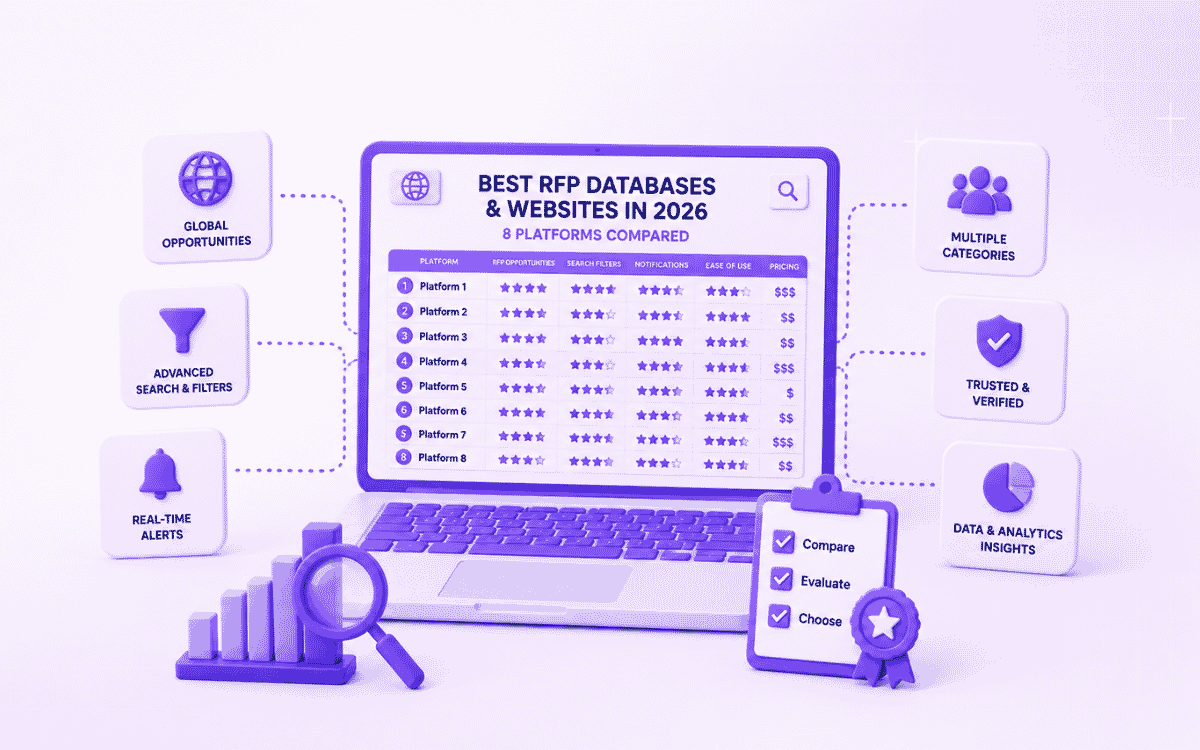
This guide compares eight platforms — free and paid, federal and state/local, real-time aggregators and analyst-curated intelligence, on the dimensions that actually predict whether a subscription is worth it: coverage depth, pricing, and how early they get you in front of an opportunity.
What to look for in an RFP database
Before comparing platforms, it's worth being clear on what separates a genuinely useful database from an expensive list of links.
Coverage breadth. How many agency sources does the platform actually monitor? The largest platforms track well over 100,000 sources, including small agencies that post infrequently and get skipped by narrower tools.
Pre-RFP signal, not just posted RFPs. The opportunities worth the most are the ones you see before your competitors do. Some platforms only index what's already publicly posted; others employ research analysts who identify opportunities from budget documents, board meetings, and agency contacts months or years ahead of a formal solicitation.
Filtering precision. NAICS/PSC code filtering, set-aside status, and place-of-performance filters matter more than keyword search — procurement officers classify by code, not by the words a vendor happens to search for.
Document access. Can you download the actual specification documents in one click, or does the platform just link out to a portal that may require separate registration?
Pricing transparency. Some platforms publish rates. Others require a sales call and quote based on seats, modules, and negotiating leverage — worth knowing going in, since real-world quotes for the same platform can vary 5–20x.
Quick comparison: Best RFP databases in 2026
1. SAM.gov: The free federal baseline
SAM.gov (System for Award Management) is the U.S. federal government's official platform, and every federal agency is generally required to post solicitations above a set dollar threshold here. You can search by NAICS code, agency, opportunity type, and deadline, and set up saved searches with email alerts. It also handles vendor registration, which is required before your business can receive most federal contract awards.
The tradeoff is exactly what you'd expect from a free, comprehensive government tool: no pre-RFP intelligence, no curated analysis, and a search interface that rewards precise NAICS/PSC filtering far more than casual keyword search.
Best for: every federal contractor, as a baseline — not a replacement for a paid tool if federal revenue is a serious priority, but the starting point regardless.
2. GovWin IQ (Deltek): The most comprehensive and the most expensive
GovWin IQ pairs a database of federal prime contracts dating to 1999 with a team of 150+ market analysts who contact government sources directly. The result is real pre-RFP intelligence: roughly 75% of GovWin's federal opportunities are reportedly identified before they're publicly available, and its SLED database covers an estimated 95% of state, local, and education spending, with lead alerts pulled from capital improvement plans and budgets well before a bid is posted.
The cost reflects that depth. Deltek doesn't publish pricing, and real-world 2026 quotes range from roughly $12,000/year for a single-seat starter package up to $42,000+/year for a full enterprise build with Federal Industry Analysis and multiple seats — reporting puts the average deal around $29,000/year. It's also not a fit for every team: SLED-focused vendors and smaller BD teams often find the federal-first data model delivers weaker signal relative to the price than a platform built specifically for their tier.
Best for: large primes pursuing $50M+ recompetes, where analyst-curated intelligence years ahead of a posting justifies the spend.
3. BidPrime: Broadest raw coverage, including sources others miss
BidPrime tracks solicitations across more than 120,000 federal, state, local, and education agency sources in the U.S. and Canada, including the roughly 30% of solicitations that come from agencies posting once a month or less, which narrower aggregators routinely miss. Its Opportunity Tracer technology digs into e-procurement portals and low-visibility sources rather than only scraping high-traffic sites, and its Future Opps module forecasts upcoming contracts using historical bid data.
Pricing isn't published and requires a sales conversation, but the platform offers a genuine full-access free trial rather than a restricted demo, which makes it easier to evaluate coverage against your specific target agencies before committing.
Best for: teams whose target agencies are small, infrequent posters that bigger-name aggregators tend to miss.
4. BidNet Direct: Established state & local aggregation
BidNet Direct aggregates bids directly from local government purchasing groups and statewide agencies, and is one of the more widely recognized names for state and local government contract discovery. It functions as a straightforward aggregator: strong breadth across state/local sources, without the analyst-driven pre-RFP layer that GovWin IQ or Civic IQ offer.
Best for: teams that need solid state/local aggregation without paying for predictive intelligence they won't use.
5. GovSpend: Spend data and RFPs in one platform
GovSpend combines historical government spending data with RFP and bid tracking across federal, state, and local procurement. The spend-history angle is the differentiator: seeing what an agency has previously paid for similar work helps with both bid/no-bid decisions and pricing strategy, not just opportunity discovery.
Pricing starts at roughly $15,000/year with no public rate card, and its federal-specific depth is generally considered lighter than GovWin's — the platform is built to be broad across government levels rather than deepest on any single one.
Best for: teams selling into state and local government who want to spend history alongside opportunity alerts.
6. Civic IQ: Early SLED signal at a lower price point
Civic IQ focuses specifically on pre-RFP intelligence for state, local, and education (SLED) agencies, monitoring board meeting agendas and public records across 79,000+ agencies to surface buying signals 6–18 months before a formal solicitation — often before anything appears on SAM.gov or a procurement portal. Starting around $299/month, it's positioned as a lower-cost alternative to GovWin IQ specifically for teams whose territory is SLED rather than federal.
Best for: SLED-focused teams that want GovWin-style early signal without GovWin-scale pricing.
7. The RFP Database (RFPDB): Free and community-submitted
The RFP Database is a free, user-contributed listing site covering government, for-profit, and non-profit RFPs, with no subscription or membership fee. As a community-submitted source, coverage is naturally less systematic than a platform built around dedicated data collection — but as a no-cost supplementary source alongside a primary tool, it costs nothing to add to the rotation.
Best for: budget-constrained teams, or as a free supplementary layer alongside a paid primary platform.
8. FindRFP: A lower-cost subscription option
FindRFP tracks government contracts, bids, and RFPs across federal, state, and local levels through a subscription model, positioned as a more accessible price point than enterprise analyst platforms. It won't match GovWin's pre-RFP depth or BidPrime's raw source count, but for teams that need a straightforward paid aggregator without a five-figure annual commitment, it fills that gap.
Best for: smaller government contracting teams who want a paid tool without enterprise-tier pricing.
How to choose the right RFP database
If you're federal-only and just starting out: SAM.gov is free and mandatory to register on, regardless of what else you use — start there before paying for anything.
If you're chasing large federal recompetes: GovWin IQ's analyst-sourced pre-RFP intelligence is the deepest in the category, and for $50M+ pursuits, the subscription typically pays for itself on a single repositioned deal.
If your target agencies are smaller or infrequent posters: BidPrime's 120,000+ source coverage is built specifically to catch what bigger-name tools miss.
If you're SLED-focused and price-sensitive, Civic IQ delivers GovWin-style early signal at a fraction of the cost, specifically because it doesn't try to also cover federal.
If you want to spend history alongside opportunities: GovSpend's combined dataset supports both discovery and pricing strategy in one platform.
If budget is the primary constraint: SAM.gov, The RFP Database, and FindRFP together cover a meaningful share of the public market without an enterprise price tag, just accept you'll be working with less lead time than an analyst-driven platform provides.
Once you've found it, the real work starts
A database tells you an opportunity exists. It doesn't tell you whether you should pursue it, and it definitely doesn't write the response. That's a separate problem; treating it as the same one is how teams end up chasing bids they were never going to win.
SiftHub's AI RFP software picks up exactly where these databases leave off — running a one-click bid/no-bid analysis against your solution fit, risk profile, and competitive landscape, then auto-filling 70–90% of the response from your verified content once you commit. Sirion used this combination to handle 1.5x more RFPs per month with the same headcount, and Congruent Solutions cut response time by 10x while freeing up 50% more presales bandwidth. For a full breakdown of where to actually search, including channels most of these databases don't cover, see our guide on how to find RFPs in 2026.